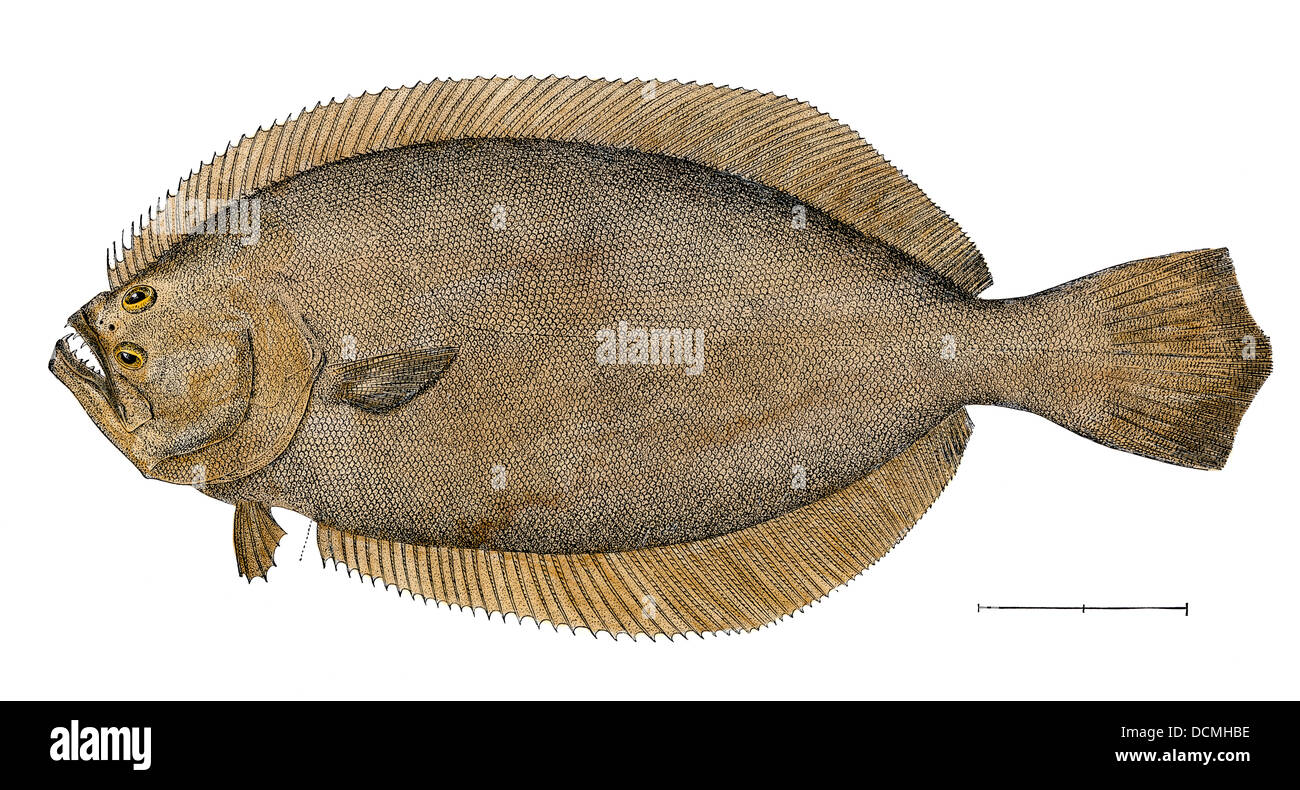
The American plaice (Hippoglossoides platessoides) is a cold-water flatfish belonging to the family Pleuronectidae, widely distributed across the North Atlantic Ocean. Primarily found on sandy or muddy bottoms at depths ranging from 40 to 180 meters, it serves as a vital component of the marine food web and a historically significant commercial resource for North American and European fisheries. In 2026, management efforts continue to focus on stock rebuilding and monitoring the impacts of rising ocean temperatures on its sub-arctic habitats.
Biological Profile of Hippoglossoides platessoides
The American plaice is a "right-eyed" flatfish, meaning that as it matures from a larva into an adult, its left eye migrates to the right side of its head, and it spends its life swimming along the seafloor on its blind left side. This physiological transformation is a hallmark of the Pleuronectidae family, allowing the fish to remain camouflaged against the benthos while keeping both eyes positioned to scout for predators and prey.
Morphology and Identification
Distinctive physical characteristics set the American plaice apart from other regional flatfish like the winter flounder or the Atlantic halibut. One of the most reliable identification marks is its lateral line, which is nearly straight but possesses a very slight curve above the pectoral fin. The mouth is relatively large compared to other "dabs," with the upper jaw extending back to the middle of the lower eye.
The body is typically reddish-brown to grayish-brown on the ocular side, often exhibiting vague darker spots, while the blind side is a stark, translucent white. In terms of size, American plaice can grow up to 70 centimeters (about 28 inches) in length and weigh as much as 3.5 kilograms, though the average specimen caught in commercial gear in 2026 typically measures between 30 and 40 centimeters.
Life Cycle and Reproduction
The life cycle of the American plaice is deeply influenced by water temperature. Spawning typically occurs in the spring, though the exact timing varies by latitude. In the warmer southern reaches of its range, such as the Gulf of Maine, spawning may begin as early as March. In the colder waters of the Grand Banks or the Barents Sea, it may extend into June or July.
A single female can produce between 250,000 and 1,500,000 eggs depending on her size and health. These eggs are buoyant and drift in the upper water column for several weeks. Once the larvae hatch, they remain planktonic until they reach a length of approximately 20 to 30 millimeters. At this stage, the dramatic metamorphosis begins: the eye migrates, the body flattens, and the juvenile fish descends to the ocean floor to begin its life as a benthic dweller.
Distribution and Habitat in the Atlantic
The American plaice boasts one of the widest distributions of any Atlantic flatfish, spanning both the Northwest and Northeast Atlantic. However, despite its name, the species is not exclusive to American waters.
Northwest Atlantic Populations
In the Northwest Atlantic, the species ranges from the icy waters off southern Labrador and the Grand Banks of Newfoundland down to the shores of Rhode Island. Historically, the Grand Banks have supported the largest biomass of American plaice in the world. This region provides the ideal combination of depth, soft sediment, and the cold temperatures (ranging from -1°C to 4°C) that the species requires for optimal metabolic function.
Northeast Atlantic Populations
In the Northeast Atlantic, the species is frequently referred to as the Long Rough Dab. Its range extends from the Barents Sea and the waters surrounding Spitsbergen and Iceland down to the North Sea and the western Baltic. While it is biologically the same species (Hippoglossoides platessoides), the eastern populations tend to be slightly smaller on average than their western counterparts, likely due to differences in fishing pressure and prey availability.
Habitat Preferences
The American plaice is a stenothermal species, meaning it can only tolerate a narrow range of cold temperatures. It is rarely found in waters that exceed 10°C for extended periods. This preference dictates its bathymetric distribution; while it can be found in shallow coastal waters in the northern parts of its range, it must retreat to deeper, cooler offshore basins in the southern regions to avoid seasonal warming.
The Role of American Plaice in the Marine Ecosystem
As both a predator and a prey species, the American plaice is a keystone of the benthic ecosystem. Its presence is often used by marine biologists as an indicator of the health of the sea floor.
Dietary Habits
The American plaice is an opportunistic feeder. Its diet changes significantly as it grows. Juveniles primarily consume small crustaceans such as amphipods and copepods. As they mature, their larger mouths allow them to transition to a more diverse diet including:
- Echinoderms: Brittle stars and sea urchins.
- Polychaetes: Segmented marine worms found in the sediment.
- Mollusks: Small clams and bivalves.
- Small Fish: Including capelin, sand lance, and even smaller flatfish.
Predation and Competition
The American plaice is a primary prey item for many larger marine inhabitants. Cod, Atlantic halibut, and various species of skates are known to feed heavily on juvenile and adult plaice. Additionally, seals—particularly grey seals in the Northwest Atlantic—are significant predators. The species also competes for food and space with other flatfish, such as the yellowtail flounder and the witch flounder, which occupy similar ecological niches.
Commercial Importance and Harvesting
For much of the 20th century, the American plaice was one of the most heavily harvested groundfish in the North Atlantic. It is prized for its white, flaky flesh and mild flavor, often marketed simply as "flounder" or "sole" in North American retail markets.
Fishing Methods
The vast majority of American plaice are harvested using bottom otter trawls. These large nets are towed along the seafloor, equipped with "doors" that keep the mouth of the net open. In recent years, there has been a significant push toward "low-impact" trawling gear designed to minimize habitat disruption and reduce the bycatch of non-target species. Some smaller-scale fisheries also use gillnets or longlines, though these account for a much smaller percentage of the total catch.
Economic Value
While it does not command the high per-pound price of Atlantic halibut or sea scallops, the sheer volume of American plaice historically landed made it an economic pillar for coastal communities in Newfoundland, Nova Scotia, and Maine. In 2026, the market value remains stable, though the industry is highly regulated to prevent the boom-and-bust cycles seen in previous decades.
Comparison of Atlantic Flatfish Species
Understanding the differences between American plaice and its relatives is essential for both fishers and researchers. The following table highlights the key distinctions among common Pleuronectidae found in the Atlantic.
| Feature | American Plaice | Atlantic Halibut | Winter Flounder | Yellowtail Flounder |
|---|---|---|---|---|
| Scientific Name | H. platessoides | Hippoglossus hippoglossus | Pseudopleuronectes americanus | Limanda ferruginea |
| Max Size | ~70 cm | ~250 cm | ~60 cm | ~60 cm |
| Lateral Line | Nearly straight | Strongly arched | Nearly straight | Arched over pectoral |
| Mouth Size | Large | Very Large | Small | Small |
| Preferred Bottom | Sand/Mud | Rock/Gravel/Sand | Mud/Silt | Sand/Gravel |
| Temperature | -1°C to 4°C | 3°C to 9°C | 0°C to 15°C | 2°C to 12°C |
Management and Conservation Status (2026)
The history of American plaice management is a cautionary tale of overexploitation followed by rigorous, science-based recovery efforts. In the 1970s and 1980s, stocks on the Grand Banks and in the Gulf of Maine were severely depleted due to a lack of international coordination and the use of small-mesh nets that captured immature fish.
Current Regulatory Frameworks
In 2026, the management of American plaice is governed by several major bodies:
- NOAA Fisheries (USA): Manages stocks in the Gulf of Maine and Georges Bank under the Northeast Multispecies Fishery Management Plan.
- Fisheries and Oceans Canada (DFO): Oversees the vast stocks in the Maritimes and Newfoundland and Labrador regions.
- NAFO (Northwest Atlantic Fisheries Organization): Coordinates management for stocks that straddle international boundaries, particularly on the "Nose" and "Tail" of the Grand Banks.
Stock Rebuilding and Status
As of the 2026 assessments, many American plaice stocks are classified as "rebuilding." While biomass levels are significantly higher than the lows seen in the early 1990s, they have not yet reached the "maximum sustainable yield" (MSY) targets in all regions. Strict quotas (Total Allowable Catches or TACs), mandatory observer programs, and seasonal closures of spawning grounds remain the primary tools for ensuring the long-term viability of the species.
Challenges Facing American Plaice: Climate Change
The greatest threat to American plaice in 2026 is no longer overfishing, but the rapid warming of the North Atlantic. Because this species is uniquely adapted to cold, sub-arctic waters, even a slight increase in bottom temperatures can have profound effects.
Range Contraction
As southern waters warm, the "thermal envelope" suitable for American plaice is shifting northward and into deeper water. In the Gulf of Maine, researchers have documented a steady retreat of the species into deeper basins. This shift can decouple the fish from their traditional prey sources and force them into competition with more temperate species moving up from the south.
Metabolic Stress
Higher temperatures increase the metabolic rate of the fish, meaning they require more food just to maintain their body weight. In areas where prey density is low, this can lead to reduced growth rates, lower reproductive success, and increased mortality. Monitoring these "sub-lethal" effects is a major focus of marine research in the current decade.
Frequently Asked Questions
Is American plaice the same as the "dab" found in Europe?
Technically, no. While American plaice is often called the "Long Rough Dab" in the UK and Europe, it is a different species from the "Common Dab" (Limanda limanda). The American plaice is generally larger and prefers deeper, colder water than the common dab.
Can American plaice be farmed through aquaculture?
While there have been experimental attempts to farm various flatfish, American plaice is not currently a major candidate for commercial aquaculture. Its slow growth rate compared to species like Atlantic salmon or even Atlantic halibut makes it less economically viable for land-based or cage-culture systems as of 2026.
How can I tell if the "flounder" I'm buying is American plaice?
In many markets, labeling is generic. However, if the fish is sourced from the North Atlantic and is sold as "sand dab" or "Canadian plaice," it is likely Hippoglossoides platessoides. Look for fillets that are thin, white, and have a fine-grained texture.
Why is the American plaice called a "right-eyed" fish?
This refers to the position of the eyes on the adult fish. In American plaice, both eyes are located on the right side of the body. If you hold the fish with the dorsal fin up and the tail toward you, the eyes will be on the right side. This distinguishes them from "left-eyed" flatfish like summer flounder (fluke).
What is the best way to cook American plaice?
Because the fillets are relatively thin and delicate, they are best suited for quick cooking methods. Pan-searing with butter and lemon, poaching in a light broth, or breading and lightly frying are the most popular preparations. Overcooking should be avoided, as the lean flesh can dry out quickly.
Recommended Next Actions for Stakeholders
For those involved in the fishing industry or marine conservation, staying informed on the latest stock assessments is critical. The following steps are recommended:
- Consult NAFO and NOAA Reports: Review the 2026 stock status updates to understand current TACs and regional health.
- Adopt Gear Modifications: Fishers should prioritize the use of separator grates and large-mesh codends to reduce the bycatch of juvenile plaice.
- Support Climate Research: Industry groups should collaborate with academic institutions to track shifting distributions, as this will directly impact future fishing grounds and port infrastructure needs.