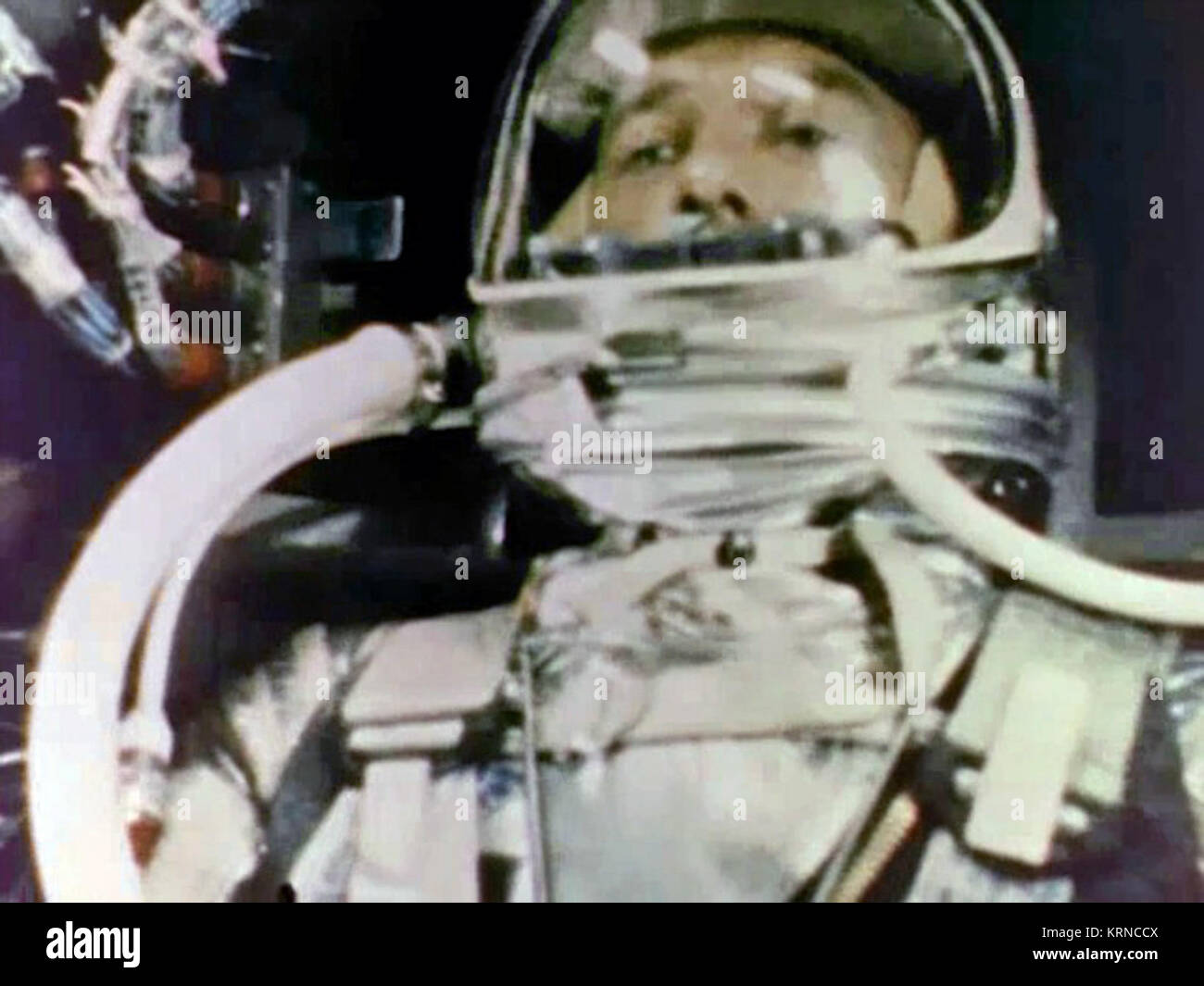
Alan Shepard was the first American to travel into space, launching aboard the Freedom 7 capsule on May 5, 1961. His suborbital flight proved the United States could compete in the Space Race, eventually leading to his lunar command during Apollo 14. Shepard's legacy continues to shape modern aerospace through his leadership at NASA and the commercial spaceflight missions named in his honor.
The Path to the Mercury Seven: Selection and Rigor
Before Alan Shepard became a household name, he was a highly accomplished naval aviator and test pilot. Born in 1923, Shepard’s career trajectory was defined by the transition from propeller-driven aircraft to high-performance jets. By the late 1950s, the Cold War tensions between the United States and the Soviet Union shifted toward the "High Frontier." In 1958, the newly formed National Aeronautics and Space Administration (NASA) began the search for its first group of astronauts.
The selection process for what would become the Mercury Seven was grueling and unprecedented. Candidates were required to be under 40 years of age, shorter than 5 feet 11 inches (to fit in the cramped Mercury capsule), and possess extensive experience in test piloting. Shepard, alongside peers like John Glenn and Gus Grissom, underwent psychological evaluations, extreme temperature tests, and high-G centrifuge simulations.
Shepard’s selection was not just a matter of physical endurance; it was a testament to his "ice-cold" demeanor under pressure. His technical proficiency in the cockpit and his ability to communicate complex engineering data to ground control set him apart. When NASA leadership, led by Robert Gilruth, finally chose Shepard to be the first American in space, it was a decision based on his peer-evaluated leadership and technical mastery of the Mercury systems.
Freedom 7: 15 Minutes That Changed American History
On May 5, 1961, Alan Shepard sat atop a Redstone rocket at Cape Canaveral. The mission, designated Mercury-Redstone 3 (MR-3) and christened Freedom 7 by Shepard, carried the weight of a nation’s anxiety. Less than a month earlier, the Soviet Union had successfully put Yuri Gagarin into orbit, dealing a significant blow to American prestige.
The mission was suborbital, meaning Shepard would go up and come back down without completing a full orbit of the Earth. While Gagarin’s flight was more technically advanced in terms of orbital mechanics, Shepard’s flight offered a critical distinction: manual control. Unlike Gagarin, who was largely a passenger in an automated craft, Shepard successfully tested the manual attitude control systems, proving that a human could "fly" a spacecraft in zero gravity.
Technical Specifications of the Freedom 7 Mission
The Freedom 7 mission lasted only 15 minutes and 22 seconds, but the technical data gathered was foundational for every subsequent NASA mission.
| Feature | Specification / Detail |
|---|---|
| Launch Vehicle | Mercury-Redstone Rocket |
| Maximum Altitude | 116.5 miles (187.5 km) |
| Top Speed | 5,134 mph (8,262 km/h) |
| Spacecraft Name | Freedom 7 (Capsule #7) |
| Landing Site | Atlantic Ocean (near the Bahamas) |
| G-Force Experienced | 6 Gs (Launch) / 11 Gs (Re-entry) |
| Flight Type | Suborbital Ballistic Trajectory |
The success of Freedom 7 provided the political capital necessary for President John F. Kennedy to address Congress just weeks later, setting the ambitious goal of landing a man on the moon before the end of the decade. Shepard’s 15-minute flight was the literal and figurative launchpad for the Apollo program.
The Medical Crisis: Meniere’s Disease and the Lost Years
Following his historic flight, Shepard was slated to command the final Mercury mission (Mercury-Atlas 10), but the mission was canceled. More devastatingly, Shepard began experiencing episodes of extreme dizziness, nausea, and a ringing in his left ear. He was diagnosed with Meniere’s disease, a disorder of the inner ear that affects balance and hearing.
For a pilot, this diagnosis was a career death sentence. Shepard was grounded and removed from flight rotation. During this period, which lasted from 1963 to 1969, he served as the Chief of the Astronaut Office. While he could not fly, he held immense power over the selection of crews for the Gemini and Apollo missions. His "steely" personality earned him the nickname "The Old Man," as he demanded perfection from the younger astronauts who would eventually walk on the moon before him.
In 1968, Shepard underwent a then-experimental surgical procedure to insert a small shunt in his inner ear to drain excess fluid. The surgery was a success. By 1969, he was restored to full flight status, and at the age of 47—the oldest in the program at the time—he was assigned to command Apollo 14.
Apollo 14: Return to the Moon and Scientific Mastery
Shepard’s return to space in January 1971 was a narrative of redemption. Apollo 13 had famously failed to land on the moon following an oxygen tank explosion, placing immense pressure on Shepard and his crew (Edgar Mitchell and Stuart Roosa) to restore confidence in the Apollo program.
The mission targeted the Fra Mauro highlands, the same site intended for Apollo 13. Shepard and Mitchell successfully landed the Lunar Module Antares on February 5, 1971. Over the course of two Extravehicular Activities (EVAs), they collected over 90 pounds of lunar samples and deployed a suite of scientific instruments.
Shepard is perhaps most famously remembered for his "lunar golf" stunt. Using a makeshift six-iron attached to a sample collection tool, he struck two golf balls. In the moon’s one-sixth gravity, he famously claimed the second ball went "miles and miles and miles." While a lighthearted moment, it humanized the space program and remains one of the most iconic images of the Apollo era.
The Scientific Impact of Fra Mauro
Beyond the golf, the Apollo 14 mission was a scientific triumph. The mission utilized the Modular Equipment Transporter (MET), a two-wheeled cart that allowed the astronauts to carry more tools and samples further from the Lunar Module. The samples brought back by Shepard and Mitchell provided crucial data on the Moon's early volcanic activity and the formation of the Imbrium Basin, significantly advancing our understanding of lunar geology.
The Lasting Impact on Modern Spaceflight
Alan Shepard’s influence extends far beyond the 20th century. As we look at the aerospace landscape in 2026, his fingerprints are visible in both government and commercial sectors.
1. The Chief Astronaut Archetype
Shepard defined the role of the Chief Astronaut. His emphasis on technical excellence, rigorous training, and pilot-driven mission architecture remains the standard at NASA’s Johnson Space Center. Modern Artemis astronauts still follow the "Shepard model" of cross-disciplinary training, where pilots must also be geologists and engineers.
2. Commercial Legacy: Blue Origin and New Shepard
The most direct modern tribute to Shepard is Jeff Bezos’s spaceflight company, Blue Origin. Their flagship suborbital rocket is named New Shepard. Much like Shepard’s original 1961 flight, the New Shepard rocket focuses on suborbital hops that cross the Kármán line (the boundary of space). By naming their vehicle after him, Blue Origin acknowledges that the commercial space tourism industry is built on the suborbital foundation Shepard laid decades ago.
3. The Artemis Program and Lunar Continuity
As NASA continues the Artemis missions in 2026, the focus has returned to the lunar highlands and the establishment of a sustainable human presence. Shepard’s work on Apollo 14 proved that humans could navigate rugged lunar terrain and conduct sophisticated science in a hostile environment. The data from his mission continues to inform landing site selection for current robotic and crewed missions to the Moon’s south pole.
Technical Depth: Managing Risks in Early Rocketry
To understand Shepard's impact, one must appreciate the sheer technical risk of his first flight. The Redstone rocket was an adaptation of a ballistic missile. In 1961, rockets had a high failure rate. Unlike modern reusable rockets with hundreds of sensors and autonomous abort systems, the Mercury-Redstone had limited redundancy.
Shepard’s "impact" was essentially psychological and structural. He proved that the human body could withstand the rapid acceleration of launch and the disorientation of weightlessness without losing cognitive function. His feedback led to improvements in the "couch" design (the astronaut's seat), the layout of the instrument panel, and the communication protocols between the spacecraft and the Capsule Communicator (CAPCOM).
Frequently Asked Questions
Was Alan Shepard the first person in space?
No, Alan Shepard was the second person in space but the first American. Soviet cosmonaut Yuri Gagarin became the first human in space and the first to orbit the Earth on April 12, 1961, roughly three weeks before Shepard’s flight. However, Shepard’s mission was the first where the pilot had direct control over the spacecraft's orientation.
Why was Alan Shepard's first flight so short?
The Freedom 7 mission was a suborbital flight designed as a "man-in-space" test. Because the Redstone rocket did not have enough thrust to push the capsule into a full orbit, the flight followed a parabolic arc. This allowed NASA to test the life support systems and the effects of weightlessness without the complexity of an orbital re-entry.
Did Alan Shepard actually hit a golf ball on the Moon?
Yes, during the Apollo 14 mission in 1971, Shepard brought two golf balls and a modified six-iron head. Because of his bulky spacesuit, he had to swing with one hand. Recent photographic analysis from the Lunar Reconnaissance Orbiter has since located the balls, confirming they did not actually travel "miles," but roughly 24 and 40 yards respectively—still an impressive feat given the suit's constraints.
How did Shepard contribute to the Space Program after retiring?
After retiring from NASA and the Navy in 1974, Shepard served on the boards of several corporations and became a successful businessman. He also co-founded the Astronaut Scholarship Foundation, which provides financial support to college students pursuing degrees in science and engineering, ensuring his impact on the next generation of explorers.
Is the Freedom 7 capsule still around?
Yes, the Freedom 7 capsule is a centerpiece of American history. For many years, it was housed at the Smithsonian's National Air and Space Museum. As of 2026, it remains one of the most visited artifacts in aerospace history, serving as a physical reminder of the beginning of the U.S. human spaceflight program.
Strategic Recommendation for Enthusiasts and Researchers
For those looking to understand the technical and personal nuances of Shepard's career, the primary recommendation is to study the Apollo 14 Mission Reports and the Mercury-Redstone 3 Post-Launch Memorandum available through the NASA History Office. These documents provide a granular look at the telemetry and pilot debriefings that shaped subsequent missions.
Furthermore, visiting the Kennedy Space Center Visitor Complex provides an immersive look at the "Heroes & Legends" exhibit, which contextualizes Shepard's contribution within the broader framework of the Mercury Seven. To see the continuation of his legacy, monitor the progress of the Blue Origin New Shepard launches, which represent the evolution of the suborbital flight path Shepard first blazed in 1961.