Navigating the Alabama workers' compensation system requires employers, employees, and medical providers to complete and submit specific administrative documents in compliance with state regulations overseen by the Alabama Department of Labor. Missing documentation, delayed filings, or using outdated templates can lead to disputed claims, delayed benefit disbursements, or statutory penalties, making a structured approach to these forms essential for all stakeholders.
Introduction to Alabama Workers' Compensation Administration
The Alabama workers' compensation system operates under the statutory framework established in the Code of Alabama 1975, Title 25. When an occupational injury or illness occurs, a paper trail must be initiated immediately to protect the rights of the injured worker while ensuring the employer maintains compliance with state labor laws. The system relies heavily on standardized reporting forms to track injuries, record wage histories, authorize medical treatments, and document settlements.
Unlike jurisdictions that utilize fully digital, real-time court portals for every administrative filing, Alabama's process blends traditional paper submissions with specific reporting mandates directed to the Alabama Department of Labor (ADOL) Workers' Compensation Division. Understanding which form to use, who bears the responsibility for filing it, and when the statutory clock starts ticking is critical for avoiding administrative friction. Whether you are an employer establishing a safety protocol, an injured employee seeking lost wage replacement, or a claims adjuster managing medical disbursements, mastering these forms ensures the claim moves efficiently through the lifecycle of temporary total disability, maximum medical improvement, and eventual resolution.
Employer and Insurer Responsibilities: Initiating a Claim
Employers carry the primary legal obligation to report workplace injuries to their insurance carriers and, when required by statutory thresholds, to the state. Compliance begins the moment an employer is notified of an occupational injury that results in more than three days of lost time, or a fatality.
First Report of Injury (FROI)
The foundation of any workers' compensation claim in Alabama is the First Report of Injury. While many insurers utilize standard national formats such as the Workers' Compensation Insurance Organization (WCIO) FROI layout or state-specific equivalents, the fundamental data required includes:
- Employer name, federal employer identification number (FEIN), and insurance carrier details.
- Employee personal data, job classification, and wage information.
- Date, time, and precise location of the accident or exposure.
- A detailed description of how the incident occurred and the specific body parts affected.
Under Alabama law, employers must report injuries to their insurance carrier promptly so the carrier can file necessary electronic or physical reports with the state Department of Labor. Failing to report an injury can jeopardize the employer's insurance standing and expose them to regulatory scrutiny.
Wage Statement Documentation
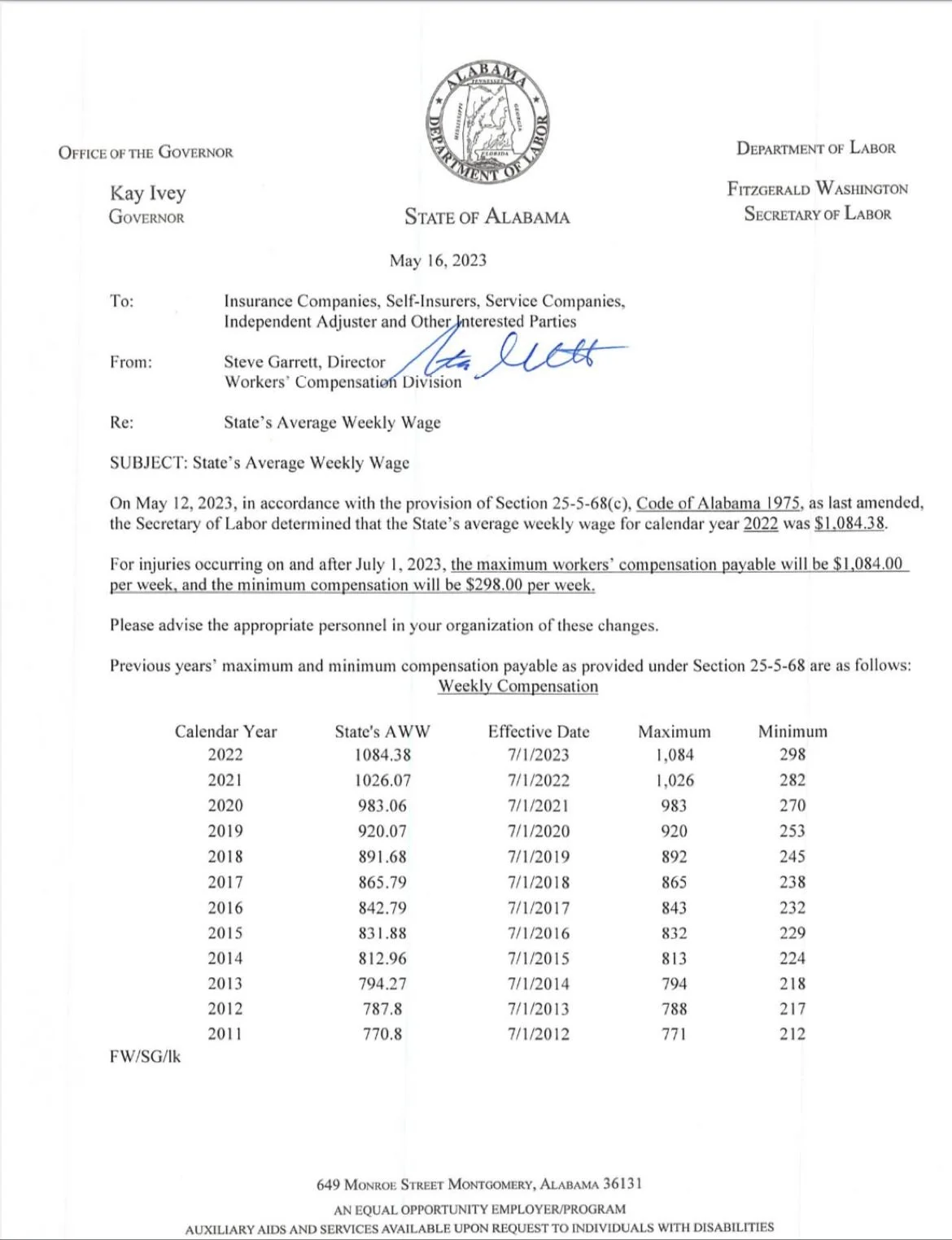
Calculating average weekly wages (AWW) is one of the most critical steps in determining compensation rates for temporary total disability (TTD) or permanent partial disability (PPD). The employer must complete a detailed wage statement—often corresponding to historical earnings templates or insurer-specific forms—reflecting the employee's gross earnings for the 52 weeks preceding the injury. If the employee worked less than 52 weeks, standard statutory formulas apply, utilizing the earnings of similar workers in the same employment category.
Employee Responsibilities and Notice Requirements
An injured worker has specific obligations under Alabama law to preserve their right to benefits. Failure to meet these notification deadlines can bar an employee from receiving compensation entirely.
Written Notice of Injury
Under Section 25-5-78 of the Code of Alabama, an employee must provide written notice of the accident to their employer within five days of the occurrence. While oral notice to a supervisor is common practice, written notice protects the worker's legal standing. The notice should include:
- The date and time of the injury.
- The location and circumstances surrounding the incident.
- The nature of the injury sustained.
If the employer has actual knowledge of the injury, or if the employee can prove lack of prejudice or reasonable excuse for failing to provide timely written notice, exceptions may apply, but relying on exceptions introduces legal risk.
Claim for Compensation (Statute of Limitations)
If an employer or insurer denies liability or fails to pay benefits voluntarily, the employee must file a formal claim for compensation within two years of the date of the injury. If compensation has been paid voluntarily, the two-year limitation period generally runs from the date of the last payment of compensation. This formal action is typically initiated through the filing of a verified complaint in the appropriate Alabama Circuit Court, accompanied by supporting medical documentation and historical claim forms.
Medical Management and Treatment Forms
Medical treatment under the Alabama workers' compensation framework is strictly regulated. Employers maintain the statutory right to choose the initial treating physician from a panel approved by the employer or insurer, provided certain statutory requirements are met.
Choice of Physician and Medical Authorization
When an employee requests medical treatment, insurers and employers utilize specific internal or standardized forms to authorize visits and diagnostic procedures. Key medical forms include:
- Medical Treatment Request Forms: Submitted by healthcare providers to secure pre-authorization for specialized treatments, physical therapy, or surgical interventions.
- HCFA-1500 and UB-04 Forms: Standardized billing forms utilized by medical providers and hospitals to submit itemized charges for professional services and inpatient/outpatient care to the workers' compensation insurance carrier.
- Form WC-9 (or carrier-equivalent Work Status Reports): Completed by the treating physician after every visit to outline restrictions, light-duty capacities, and anticipated return-to-work dates.
| Form Category | Primary Purpose | Responsible Party | Key Statutory Deadline |
|---|---|---|---|
| First Report of Injury (FROI) | Notifies insurer/state of workplace accident | Employer / Insurer | Promptly upon exceeding 3 lost days |
| Written Notice of Injury | Informs employer of occupational incident | Employee | Within 5 days of accident |
| Wage Statement | Establishes average weekly wage for benefits | Employer | Compiled during initial claim setup |
| Work Status Report | Defines medical restrictions and disability status | Treating Physician | Issued after each medical evaluation |
| Settlement Petition (Settlement Papers) | Concludes claim via lump-sum or structured agreement | Jointly (Employer & Employee) | Filed upon reaching maximum medical improvement |
Resolving Disputes and Settlement Documentation
When disputes arise regarding compensability, the extent of disability, or the necessity of medical treatment, the Alabama Department of Labor provides mediation services, though many disputes ultimately resolve through judicial settlement or administrative review.
Settlement Papers and Joint Petitions
When an injured worker reaches Maximum Medical Improvement (MMI) and a permanent impairment rating has been assigned, the parties often pursue a final settlement. In Alabama, lump-sum settlements or structured agreements must be approved by a circuit court judge to be binding under Section 25-5-56 or Section 25-5-68 of the Code of Alabama. The settlement paperwork typically includes:
- Petition for Approval of Settlement: A joint legal document detailing the terms of the settlement, medical history, impairment ratings, and allocation of future medical benefits.
- Release of Liability: A binding legal waiver releasing the employer and insurer from further financial obligation regarding the specific injury, subject to statutory exceptions for future medical care if left open by agreement.
- Child Support and Medical Lien Verifications: Documentation ensuring that any outstanding child support obligations or Medicare set-aside (MSA) requirements are properly addressed prior to fund disbursement.
Frequently Asked Questions
What happens if an employer refuses to accept the First Report of Injury?
If an employer refuses to complete or submit the First Report of Injury, the injured worker should contact the Alabama Department of Labor Workers' Compensation Division directly to file a complaint and seek administrative intervention. Keeping personal records of all injury reports, medical visits, and communications with management is vital in these scenarios.
Are Alabama workers' compensation forms submitted online or via paper?
The method of submission depends on the specific entity. Insurance carriers and self-insured employers typically submit injury data electronically via Electronic Data Interchange (EDI) formats mandated by the state. Individual employees and claimants, however, often rely on physical paperwork, court filings, and direct correspondence with claims adjusters.
Can an injured worker change their treating physician in Alabama?
Under Alabama law, the employer has the initial right to select the treating physician. If an employee is dissatisfied with the chosen physician, they may request a change in writing. If the employer or insurer refuses, the employee can petition the court for authorization to change physicians, provided they demonstrate good cause.
What is the purpose of the Work Status Report form?
The Work Status Report form bridges the gap between medical providers, employers, and insurers. It communicates whether the employee is totally disabled, capable of performing light-duty work, or fully released to regular duties, directly dictating whether temporary total disability benefits must continue or cease.
How are partial disability benefits calculated using wage forms?
Partial disability benefits are calculated using wage documentation to determine the difference between the employee's pre-injury average weekly wage and their post-injury earning capacity in a light-duty or alternative position, subject to statutory maximums established by the state legislature.
Conclusion and Next Actions
Successfully managing paperwork within the Alabama workers' compensation ecosystem requires strict adherence to statutory deadlines and precise data collection. Whether initiating a claim via the First Report of Injury, tracking recovery through medical status reports, or finalizing a claim with court-approved settlement papers, diligence prevents costly delays. Stakeholders should verify all form requirements directly with the Alabama Department of Labor or qualified legal counsel to ensure complete regulatory compliance.