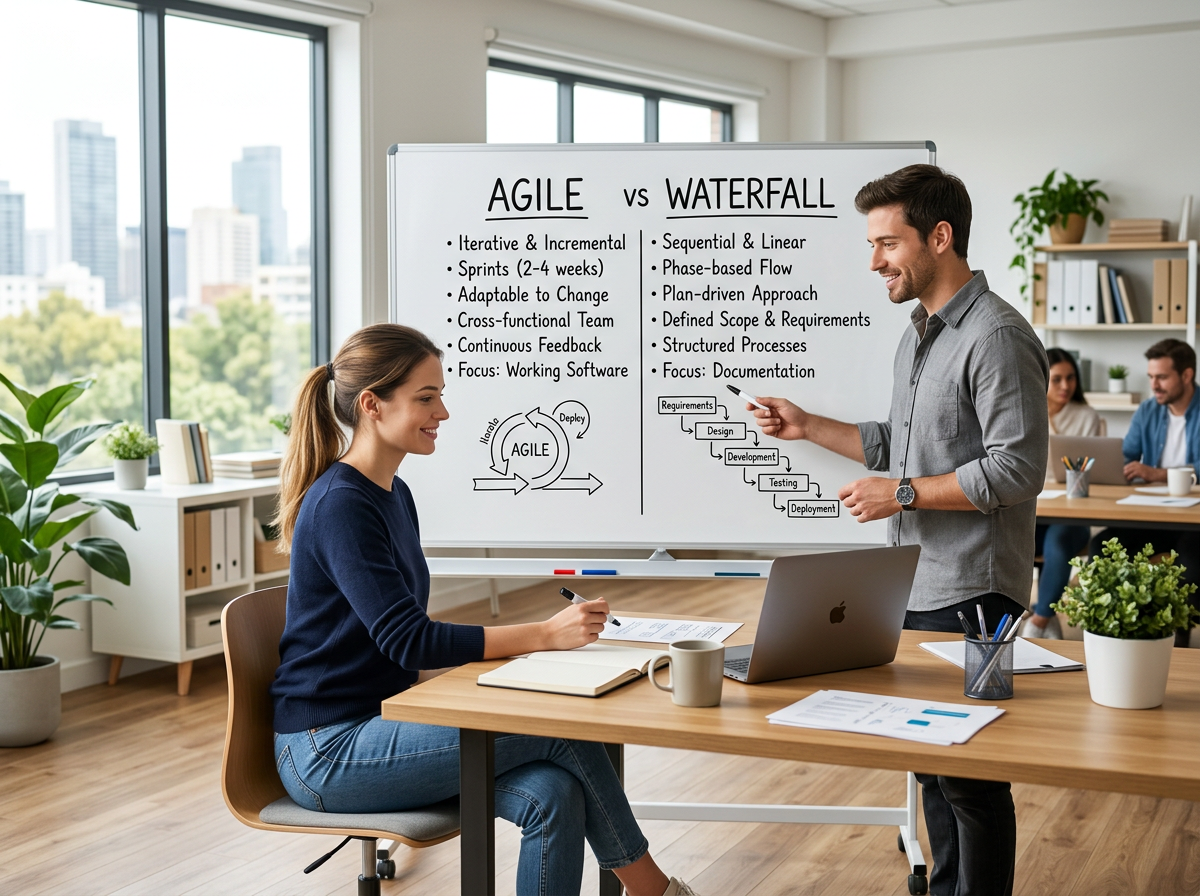
Agile methodology outperforms Waterfall for most software teams by prioritizing iterative delivery, continuous feedback, and adaptability. Unlike the rigid, sequential nature of Waterfall, Agile allows teams to respond to shifting market demands and technical discoveries in real-time. This flexibility reduces project risk, improves product-market fit, and ensures faster delivery of functional software.
The Foundational Split: Understanding Waterfall and Agile
To understand why Agile has become the industry standard by 2026, one must first recognize the fundamental differences in how these two frameworks approach the lifecycle of software development. While both aim to deliver high-quality products, their philosophies regarding planning, execution, and change are diametrically opposed.
The Waterfall Legacy
The Waterfall model, rooted in the traditional manufacturing and construction industries of the mid-20th century, operates on a linear, sequential path. A project moves through distinct phases: requirements gathering, analysis, design, implementation, testing, and maintenance. In this model, one phase must be 100% complete before the next begins.
The primary assumption of Waterfall is that project requirements can be fully understood and documented at the outset. While this worked for building bridges or assembly lines where physical constraints make mid-project changes prohibitively expensive, it often fails in the abstract world of software. In Waterfall, testing only occurs at the very end of the cycle. If a fundamental flaw is discovered during the final stages, the cost of rectification is catastrophic, often requiring the team to restart the entire process.
The Agile Revolution
Agile methodology, formalized by the Agile Manifesto in 2001 and refined over the subsequent decades, treats software development as an empirical process. Rather than planning the entire project upfront, Agile breaks the work into small, manageable increments known as iterations or Sprints.
Agile assumes that requirements will evolve as stakeholders see the product take shape. By delivering a "Minimum Viable Product" (MVP) early and then iterating based on actual user data, Agile teams ensure they are building what the market actually needs, rather than what they thought the market needed six months prior. By 2026, this responsiveness is no longer a luxury; it is a prerequisite for survival in a global economy driven by rapid technological shifts and AI-integrated workflows.
Why Agile Dominates the 2026 Development Landscape
The superiority of Agile for modern software teams is not merely a matter of preference but a response to the technical and economic realities of the current era. In 2026, software is rarely a "finished" product; it is a living service that requires constant evolution.
Accelerated Time-to-Market
One of the most significant advantages of Agile is the speed at which value is delivered to the end-user. In a Waterfall environment, the customer may wait months or years before seeing a functional version of the software. In Agile, functional increments are delivered every two to four weeks.
This rapid delivery cycle allows businesses to capture market share early and begin generating revenue or collecting data long before the "full" vision of the product is realized. In a competitive landscape where first-mover advantage is fleeting, the ability to ship a core feature set while competitors are still stuck in the "Requirements Documentation" phase of Waterfall is a decisive strategic edge.
Managing the "Cost of Change"
In traditional project management, the cost of changing a requirement increases exponentially as the project progresses. A change requested during the design phase is cheap; a change requested during the testing phase involves rewriting thousands of lines of code and re-architecting databases.
Agile flattens this cost curve. Because the team only plans for the immediate future (the next Sprint), they are always prepared to pivot. If a new competitor launches a disruptive feature or a security vulnerability is discovered in a third-party library, an Agile team can adjust their backlog and address the issue within days. This adaptability makes Agile inherently more stable than Waterfall in volatile environments.
Enhanced Quality through Continuous Testing
In the Waterfall model, testing is a discrete phase that occurs after development. This often leads to a "crunch" period where developers and QA engineers are under immense pressure to fix months' worth of accumulated bugs in a matter of weeks. Quality often suffers as deadlines loom.
Agile integrates testing into every iteration. Automated testing, Continuous Integration (CI), and Continuous Deployment (CD) are hallmarks of mature Agile teams in 2026. Because code is tested as soon as it is written, defects are identified and remediated immediately. This "shift-left" approach to quality ensures that the codebase remains healthy and maintainable, preventing the buildup of technical debt that frequently sinks Waterfall projects.
Technical Depth: The Mechanics of Agile Success
The success of Agile is driven by specific frameworks and practices that provide structure to its flexible philosophy. While "Agile" is the umbrella term, most successful 2026 software teams employ specific implementations like Scrum, Kanban, or a hybrid approach.
Scrum: Structure and Accountability
Scrum is the most widely adopted Agile framework. It organizes work into fixed-length Sprints and defines specific roles:
- The Product Owner: Represents the business and customer, prioritizing the Product Backlog.
- The Scrum Master: Acts as a coach, removing "impediments" and ensuring the team follows Scrum principles.
- The Development Team: A cross-functional group (including developers, designers, and testers) that does the work.
Scrum’s power lies in its ceremonies. The Daily Stand-up ensures transparency and quick problem-solving. The Sprint Review provides a platform for stakeholder feedback, and the Sprint Retrospective allows the team to reflect and improve their own processes. This "inspect and adapt" cycle is what allows Agile teams to continuously increase their velocity and quality.
Kanban: Visualizing Flow
For teams focused on continuous delivery rather than fixed sprints (such as DevOps or maintenance teams), Kanban is often the preferred choice. Kanban focuses on visualizing the workflow on a board and limiting Work in Progress (WIP). By restricting how many tasks can be in the "In Progress" column at once, Kanban identifies bottlenecks and ensures a steady flow of value. In 2026, Kanban boards are frequently integrated with AI analytics that predict delivery dates based on historical lead times and cycle times.
Comparative Analysis: Agile vs. Waterfall
The following table highlights the critical distinctions between the two methodologies across several key performance indicators relevant to 2026 software standards.
| Feature | Agile Methodology | Waterfall Model |
|---|---|---|
| Requirements | Evolving; documented in a dynamic backlog. | Fixed; documented in a static PRD at start. |
| Delivery Model | Iterative and incremental (Sprints). | Single, monolithic release at project end. |
| Customer Involvement | High; continuous feedback and reviews. | Low; primarily at the start and end. |
| Risk Management | Low; risks identified and mitigated early. | High; risks often hidden until testing phase. |
| Change Flexibility | Very High; pivots are expected and planned. | Low; changes require formal "change orders." |
| Testing | Continuous; integrated with development. | Discrete phase; occurs after development. |
| Team Structure | Self-organizing, cross-functional. | Hierarchical, siloed by specialty. |
| Predictability | High for value; low for specific long-term dates. | High for dates; low for final product utility. |
The Role of AI in Agile 2026
By 2026, Artificial Intelligence has fundamentally altered the software development lifecycle, further cementing Agile’s dominance. Traditional Waterfall planning cannot keep pace with the speed of AI-assisted coding.
Modern development environments now use AI to assist in backlog grooming, predicting Sprint velocity, and even generating unit tests. Because Agile is based on frequent, small batches of work, it provides the perfect data loop for these AI tools. An AI can analyze the results of a two-week Sprint and provide actionable insights for the next one. In contrast, a Waterfall project generates data too slowly for AI to provide meaningful optimization during the development cycle.
Furthermore, as AI agents become capable of autonomous coding for specific tasks, the "Requirements" phase becomes even more fluid. Developers can prototype ideas in hours rather than weeks, making the long-term documentation of Waterfall redundant.
When Waterfall Still Makes Sense: The Exceptions
While Agile "beats" Waterfall for the vast majority of software teams, it is not a universal solution. There are specific contexts where the structure of Waterfall remains appropriate, though these are increasingly rare in 2026.
- Regulated Medical or Aerospace Systems: In environments where human lives are at stake and strict regulatory compliance (such as FDA or FAA certification) requires exhaustive documentation of every design decision before a single line of code is written, a more structured, sequential approach may be necessary.
- Fixed-Price, Fixed-Scope Government Contracts: Some legacy procurement models still demand a complete breakdown of every feature and cost before a contract is awarded. While many government agencies have moved to "Agile Procurement," Waterfall still exists in these bureaucratic niches.
- Low-Uncertainty Projects: If a team is performing a routine task they have done a hundred times before—such as a basic database migration with no new features—the overhead of Agile ceremonies might outweigh the benefits.
Overcoming the Challenges of Agile Adoption
Transitioning from Waterfall to Agile is not without friction. Many teams fall into the trap of "Fragile" or "Agile in Name Only," where they adopt the terminology (Sprints, Stand-ups) but maintain a rigid, top-down mindset.
Cultural Shift
The hardest part of moving to Agile is the cultural change. Management must relinquish control over exact long-term delivery dates and trust the team to prioritize value. Developers must embrace transparency and be willing to show "unfinished" work to stakeholders. Without this trust, Agile becomes a micro-management tool rather than a productivity framework.
The Problem of "Scope Creep"
Because Agile welcomes change, projects can sometimes drift away from their original goals. This is managed through a disciplined Product Owner who ensures that every new item added to the backlog is more valuable than the items it replaces. In 2026, successful teams use Value Stream Mapping to ensure that their iterations are actually contributing to the bottom line and not just "feature bloating."
Practical Guidance for Choosing a Framework
When determining the right path for a software team in 2026, consider the following checklist. If you answer "Yes" to more than two of these, Agile is the mandatory choice:
- Is the market for this product changing rapidly?
- Do we need to validate our assumptions with real users early?
- Is the technology stack new or unproven for our team?
- Is the project expected to last longer than three months?
- Are we utilizing AI-assisted development tools?
For most modern teams, the answer to all of these is a resounding yes. The rigidity of Waterfall acts as an anchor in a world that requires sails.
Frequently Asked Questions
Does Agile mean there is no documentation?
No. Agile prioritizes "working software over comprehensive documentation," but it does not eliminate it. Modern Agile teams in 2026 use living documentation, such as automated API docs (Swagger/OpenAPI) and well-maintained ReadMe files, rather than 300-page specifications that become obsolete the moment they are printed.
Is Scrum the only way to do Agile?
Certainly not. While Scrum is popular, many teams use Kanban, Extreme Programming (XP), or Feature-Driven Development (FDD). The choice depends on the nature of the work. Scrum is excellent for product development, while Kanban is often superior for operations and support.
How do you estimate costs in an Agile project?
Estimation in Agile focuses on "Points" or "T-shirt sizes" rather than hours. Over time, a team’s "Velocity" (how many points they complete per Sprint) becomes stable, allowing for highly accurate forecasting of when specific features will be completed. This empirical data is often more reliable than the "best-guess" estimates used in Waterfall.
Can Agile work for large, enterprise-level organizations?
Yes. Frameworks like the Scaled Agile Framework (SAFe) or Large-Scale Scrum (LeSS) were designed specifically to coordinate hundreds of developers across dozens of teams while maintaining Agile principles. While more complex than team-level Agile, these frameworks are standard in 2026 for large-scale enterprise software.
Why does Waterfall often result in "Death Marches"?
A "Death March" occurs in Waterfall when a project is significantly behind schedule as the final deadline approaches. Because no functional software exists until the end, there is a desperate push to finish everything at once. In Agile, because functional software is delivered every Sprint, the project can be "shipped" at almost any time, even if the full scope isn't complete, preventing the psychological burnout of the Waterfall end-game.
Final Recommendation
For software teams operating in 2026, the transition to an Agile methodology is no longer an option but a survival imperative. The speed of innovation, driven by AI and global market shifts, makes the linear predictability of Waterfall an illusion. To maximize success, teams should start by adopting a recognized framework like Scrum, focus heavily on automated testing to maintain quality, and empower a Product Owner to make ruthless decisions about value. By delivering small increments of high-quality software frequently, teams reduce risk and ensure they are building products that users actually want.