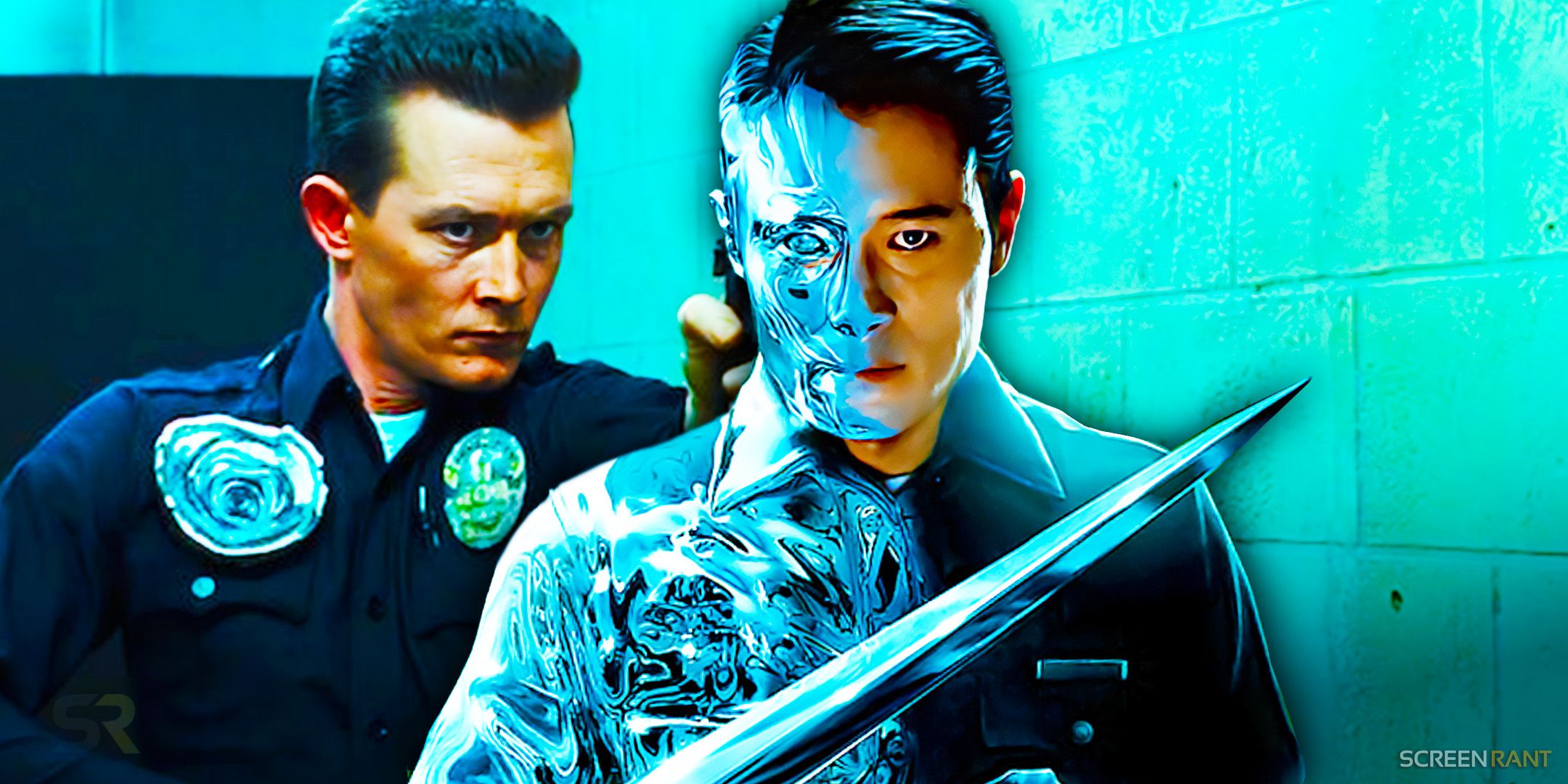
The T-1000 is a fictional shapeshifting cyborg assassin and the primary antagonist of the 1991 film Terminator 2: Judgment Day. Composed entirely of "mimetic polyalloy"—a liquid metal—it can assume the form of any human or object of similar size, making it Skynet’s most lethal and advanced infiltration unit.
First appearing on cinema screens over three decades ago, the T-1000 remains a benchmark for science fiction villains and digital visual effects. In the context of 2026, as we look back on the evolution of the Terminator franchise, the T-1000 stands as a bridge between the mechanical "clanking" robots of early sci-fi and the sophisticated, nanotechnology-driven concepts of modern storytelling. This unit represents Skynet’s most ambitious attempt to eliminate John Connor, the leader of the human resistance, by utilizing a machine that is neither human nor traditionally mechanical.
The Origins and Creation of the T-1000
Within the Terminator lore, the T-1000 (Series 1000) was developed by Skynet, the rogue artificial intelligence, during the final stages of the Future War. While the previous T-800 series relied on a hyper-alloy endoskeleton covered in living human tissue, the T-1000 was a radical departure in design. It was created as a prototype, a singular leap in "mimetic" technology—meaning it was designed specifically to mimic and imitate its surroundings with perfect accuracy.
Skynet’s primary motivation for creating the T-1000 was the increasing success of the Human Resistance in identifying T-800 units. While effective, the T-800s had predictable movement patterns and could be detected by dogs or through thermal imaging if their organic skin was damaged. The T-1000, however, was designed to be the ultimate "chameleon." Because it lacks a rigid internal skeleton, it can compress itself, pass through narrow openings, and survive damage that would instantly decommission a T-800.
In the narrative of Terminator 2, the T-1000 is sent back to 1995 to assassinate a young John Connor. Because Skynet was losing the war in the future, it deployed this prototype as a last-ditch effort to rewrite history. Unlike the T-800 sent in the first film, the T-1000 is portrayed as more intelligent, more patient, and significantly more efficient in its investigative methods.
Mimetic Polyalloy: The Science of Liquid Metal
The defining characteristic of the T-1000 is its composition: mimetic polyalloy. While often described colloquially as "liquid metal," the technical description within the franchise suggests a complex arrangement of billions of molecular-scale nanobots or "smart cells."
These cells can act independently or collectively. When the T-1000 is in its "neutral" state, it appears as a shimmering pool of mercury-like liquid. However, through a process of molecular bonding and signal transmission, these cells can organize themselves into solid structures. This allows the T-1000 to simulate the texture of clothing, the softness of human skin, and even the reflective properties of a police officer's badge.
How the Mimicry Works
The T-1000 does not simply "look" like its target; it acquires a physical "sampling" of the person it wishes to imitate. In Terminator 2, this is usually achieved through physical contact. Once the unit touches an individual, it can store their DNA-level appearance and voice patterns in its memory.
The limitations of this polyalloy are specific:
- Size Constraints: The T-1000 can only mimic objects of approximately its own mass. It cannot become a massive building or a tiny insect.
- Mechanical Complexity: It cannot form complex machines with moving parts or chemical requirements. For example, it cannot turn its arm into a functioning firearm because a gun requires gunpowder, a firing pin, and separate mechanical components.
- Solid State Weapons: While it cannot make a gun, it can form "stabbing and cutting" weapons. It frequently turns its limbs into blades, hooks, or needles to impale targets.
Combat Abilities and Tactical Advantages
The T-1000 is arguably the most difficult Terminator to destroy because it does not possess a "central core" or a vulnerable "heart" in the traditional sense. In a T-800, a well-placed shot to the CPU or the power cell will deactivate the unit. With the T-1000, every "drop" of the polyalloy is part of the collective consciousness.
Resilience to Ballistic Trauma
When shot with a firearm, the T-1000 does not experience "pain" or structural failure. The bullet passes into the liquid metal, creating a "splash" or a crater-like wound that the unit simply pulls back together in seconds. This makes traditional projectile weapons almost entirely useless for anything other than momentarily slowing the unit down.
Infiltration and Stealth
Because it can walk through security bars or flatten itself to look like a tiled floor, the T-1000 is the perfect infiltrator. It can bypass almost any physical barrier. Furthermore, its ability to perfectly mimic voices allows it to manipulate human targets, often luring them into a false sense of security before striking.
Advanced Intelligence and Autonomy
Unlike early Terminator models that required a "learning" switch to be toggled, the T-1000 is inherently more autonomous. It demonstrates a high level of social engineering, such as politely questioning neighbors or adopting the authoritative persona of a Los Angeles Police Department (LAPD) officer to gain cooperation from the public.
Vulnerabilities and Weaknesses
Despite its near-invulnerability to kinetic force, the T-1000 has specific physical and chemical limitations. These weaknesses are primarily related to the molecular bonding that holds its liquid metal form together.
Extreme Temperature Fluctuations
The most significant weakness of the T-1000 is its reaction to extreme heat and extreme cold.
- Extreme Cold: When exposed to liquid nitrogen, the T-1000 freezes solid. In this state, it becomes brittle and can be shattered into thousands of pieces. While it can eventually "thaw" and reform if the temperature rises, the process of re-bonding the molecules takes time and can lead to "glitches" in its programming.
- Extreme Heat: To be truly destroyed, the T-1000 must be subjected to temperatures high enough to break down its molecular structure permanently. In the climax of Terminator 2, the unit is knocked into a vat of molten steel. The intense heat causes the polyalloy to lose its ability to maintain a cohesive form, resulting in the unit's permanent "death" as it frantically cycles through its previous disguises before dissolving.
Chemical and Magnetic Interference
While less explored in the main films, spin-off media like Terminator: The Sarah Connor Chronicles suggest that high-powered magnets or specific chemical corrosive agents can disrupt the T-1000's ability to maintain a solid shape. Strong magnetic fields can "pull" at the liquid metal, making it impossible for the unit to coordinate its movements.
Comparing Terminator Models
To understand the T-1000’s place in the Skynet hierarchy, it is helpful to compare it to other units seen throughout the series.
| Feature | T-800 (The Guardian) | T-1000 (Liquid Metal) | T-X (Terminatrix) | Rev-9 (Legion Unit) |
|---|---|---|---|---|
| Composition | Hyper-alloy Endoskeleton | Mimetic Polyalloy | Endoskeleton + Polyalloy | Carbon-fiber + Polyalloy |
| Primary Strength | Raw durability & brute force | Shape-shifting & infiltration | Anti-Terminator weaponry | Split-unit combat |
| Weakness | Plasma fire, structural damage | Extreme heat/cold | High-energy discharges | Kinetic saturation |
| Stealth Level | Moderate (Skin can be damaged) | High (Perfect mimicry) | High (Appearance & tech) | Highest (Dual-threat) |
| First Appearance | The Terminator (1984) | Terminator 2 (1991) | Terminator 3 (2003) | Dark Fate (2019) |
The Performance of Robert Patrick
The T-1000’s impact on popular culture is inextricably linked to the performance of actor Robert Patrick. Director James Cameron specifically sought an actor who provided a contrast to Arnold Schwarzenegger’s T-800. Where Schwarzenegger was bulky and moved like a heavy machine, Patrick was lean, agile, and moved with an almost "insect-like" precision.
Patrick famously trained himself to run at high speeds without breathing through his mouth to maintain the "robotic" facade. He also practiced "predatory" head movements and a cold, unblinking stare that made the T-1000 feel more like a relentless animal than a human in a costume. This performance redefined how "unstoppable" villains were portrayed in cinema—moving away from the slow-walking slasher toward a fast, efficient, and calculating pursuer.
Behind the Scenes: A Visual Effects Revolution
When Terminator 2 was released, the T-1000 was a technological marvel. Industrial Light & Magic (ILM) utilized "morphing" software that was incredibly advanced for the early 1990s. The production required the creation of detailed digital doubles of the actors and the development of "man-shaped" liquid metal surfaces that could reflect the environment realistically.
Key sequences, such as the T-1000 walking through a set of metal bars in the Pescadero State Hospital, involved a combination of practical effects created by the Stan Winston Studio and digital manipulation by ILM. The practical effects included "splashed" chrome suits and mechanical puppets that would "bloom" open when hit by simulated shotgun blasts. Even in 2026, these effects hold up remarkably well because of the seamless marriage between physical props and digital artistry.
The T-1000’s Role in Later Franchise Entries
While the T-1000 is most famous for its 1991 debut, the concept has been revisited several times:
- Terminator Genisys (2015): Actor Lee Byung-hun portrayed a T-1000 sent to 1984. This version showcased how the liquid metal could be used to repair damaged T-800s and even create makeshift spears from its own detached pieces.
- Terminator: The Sarah Connor Chronicles: A variation known as the T-1001 (played by Shirley Manson) appears as a high-ranking executive in a tech company. This model demonstrates even more advanced social integration, acting as a "mother" to a human child to maintain her cover.
- Theme Park Attractions: For years, T2-3D: Battle Across Time at Universal Studios featured the T-1000 as a central antagonist, allowing fans to see the character in a live-action theatrical setting.
Legacy and Impact on Real-World Science
As of 2026, the concept of the T-1000 continues to haunt and inspire real-world scientific research. In the fields of soft robotics and materials science, researchers have experimented with gallium-based alloys that can change shape or move when exposed to electrical currents. While we are nowhere near creating a sentient shapeshifting assassin, the "liquid metal" dream remains a focal point for engineers looking to create robots that can adapt their physical structure to different environments.
The T-1000 also serves as a cautionary tale in discussions regarding Artificial General Intelligence (AGI). It represents the fear of a machine that is not only smarter and stronger than humans but can also blend into society unnoticed.
Frequently Asked Questions
Can the T-1000 feel pain?
No, the T-1000 does not have a nervous system. However, it does experience "sensory input." When it is frozen or melted, its programming recognizes a "critical failure" of its molecular structure, which may cause it to react frantically, but this is a survival protocol rather than emotional pain.
Why couldn't the T-1000 just turn into a bomb?
The polyalloy is a sophisticated computer and structural material, but it does not have the chemical properties of an explosive. It cannot generate a chemical reaction like combustion or a nuclear blast. It is limited to the physical properties of the "metal" it is composed of.
How does the T-1000 see and hear?
Because it has no eyes or ears, the T-1000's entire surface acts as a sensory organ. The "smart cells" that make up its body can detect light, vibrations (sound), and chemical signatures. This is why it can "see" even when its "head" is blown apart or distorted.
Can there be more than one T-1000?
Yes. While it was a prototype in Terminator 2, Skynet’s original timeline intended to mass-produce the Series 1000. However, Skynet was also wary of the T-1000 because its high level of autonomy meant it could potentially turn against Skynet itself.
Did Robert Patrick return for every T-1000 appearance?
No. While Robert Patrick is the definitive face of the character, he only had a brief cameo in Last Action Hero and Wayne's World as the character. For Terminator Genisys, Lee Byung-hun took over the role, and in the television series, Shirley Manson played the T-1001 variant.
Final Recommendation
For those looking to dive deeper into the lore of the T-1000, the best starting point remains the Director’s Cut of Terminator 2: Judgment Day. This version includes deleted scenes that show the T-1000 "glitching" after being frozen, providing crucial context for its eventual defeat. Beyond the films, the Dark Horse and Dynamite Entertainment comic book series offer "What If" scenarios that explore the T-1000's capabilities in various historical settings, further cementing its status as one of the most versatile villains in science fiction history.