Multi-cloud environments and Cloud Security Posture Management (CSPM) tools often suffer from deep-seated misconceptions regarding automated safety, shared responsibility, compliance guarantees, and visibility limitations across diverse infrastructure providers.
As organizations increasingly distribute workloads across Amazon Web Services (AWS), Microsoft Azure, Google Cloud Platform (GCP), and other providers, maintaining a secure architecture becomes exponentially complex. To manage this complexity, security and DevOps teams routinely deploy Cloud Security Posture Management (CSPM) tools. These software solutions are designed to automate cloud asset discovery, security misconfiguration detection, risk assessment, and compliance monitoring.
However, widespread myths regarding multi-cloud security and the true capabilities of CSPM tools often lead to a false sense of security, misallocated budgets, and overlooked vulnerabilities. Recognizing these misconceptions is critical for architects, security leaders, and compliance officers seeking to build genuinely resilient cloud infrastructures.
1. The Myth That Cloud Providers Handle All Security
One of the most persistent misconceptions in enterprise IT is that migrating workloads to public cloud providers means the underlying infrastructure, data, and applications are automatically secure. This misunderstanding stems from a misinterpretation of the Shared Responsibility Model.
While cloud service providers (CSPs) like AWS, Microsoft, and Google secure the cloud—meaning the hardware, facilities, physical networking, and virtualization layers—the customer remains entirely responsible for security in the cloud. This customer-managed domain includes:
- Identity and Access Management (IAM) configurations and permissions.
- Operating system patches, network traffic filtering, and firewall rules.
- Data classification, encryption keys, and database security settings.
- Application-level vulnerabilities and API security endpoints.
Relying on a provider to automatically lock down data storage buckets, enforce least-privilege access, or prevent insider threats leaves an organization vulnerable. CSPs supply robust security tools, but the configuration, operation, and governance of those controls rest firmly on the tenant organization.
2. Assuming CSPM Tools Provide Instant, Turnkey Security
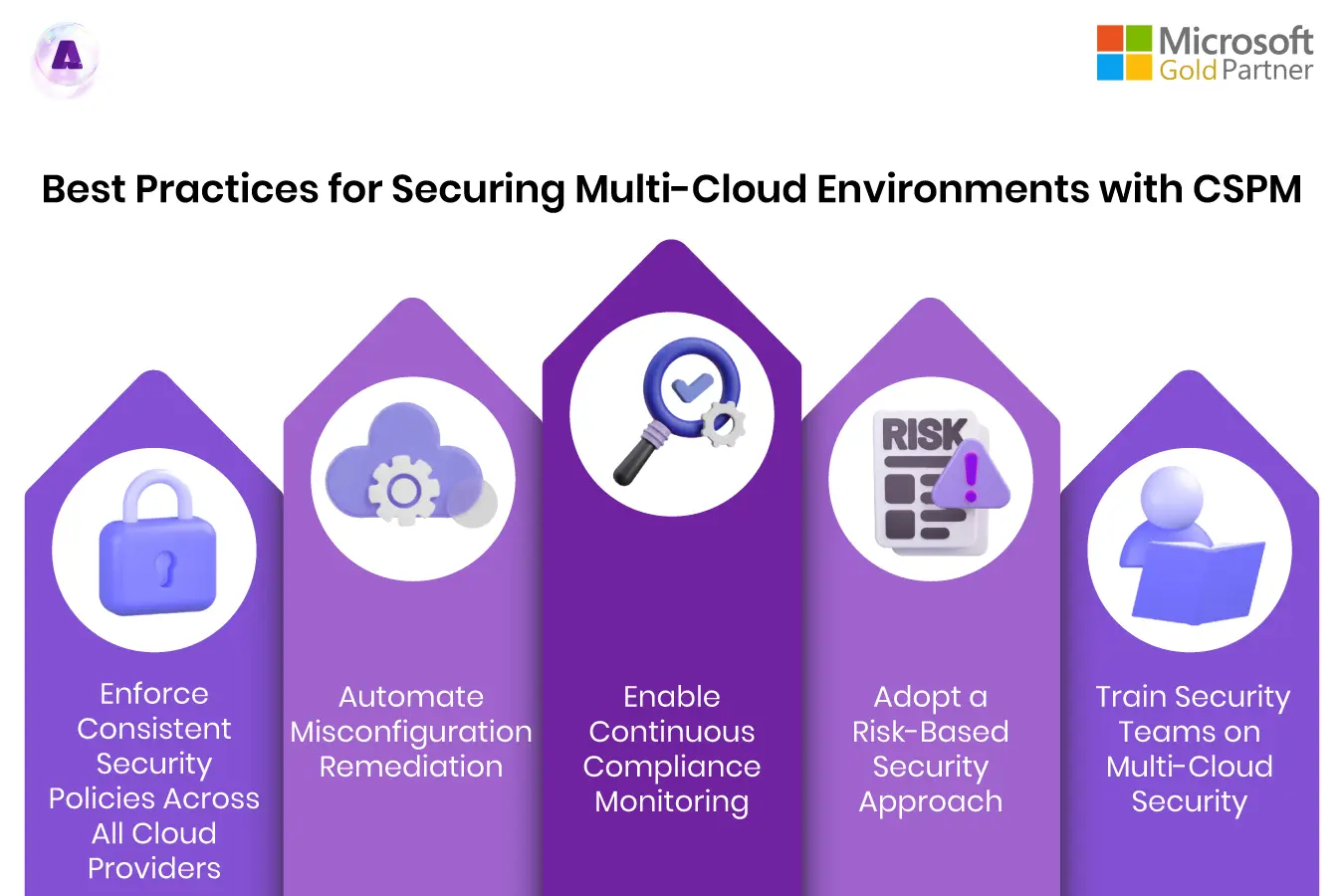
Purchasing and deploying a CSPM tool does not instantly remediate misconfigurations or secure a multi-cloud estate. A common belief is that once API keys are connected and the platform finishes its first discovery scan, the environment is automatically protected.
In reality, CSPM tools are observational and diagnostic engines. They act as automated auditors that surface security findings, misconfigurations, and compliance violations. They do not intrinsically fix broken IAM policies, patch vulnerable containers, or rewrite insecure storage bucket permissions unless explicitly configured with automated remediation (and even then, poorly tuned automation can disrupt business operations).
Furthermore, configuring a CSPM tool requires deep domain expertise. Organizations must define baseline security policies, map compliance frameworks to internal standards, and tune out false positives. Without an active, skilled engineering team to triage findings and implement fixes, a CSPM dashboard merely displays a growing list of unaddressed risks.
3. The Myth That Multi-Cloud Security Means Using Separate Native Tools
Many organizations mistakenly believe that the most effective way to secure a multi-cloud environment is to use each cloud provider's native security tooling independently—such as AWS Security Hub, Microsoft Defender for Cloud, and Google Cloud Security Command Center.
While native tools offer deep visibility and specialized optimization within their respective ecosystems, relying exclusively on them in a multi-cloud strategy creates severe operational silos:
- Fragmented Dashboards: Security analysts must constantly context-switch between different interfaces, alerting formats, and severity rating scales.
- Inconsistent Policies: Enforcing a unified security standard (such as CIS benchmarks or SOC 2 requirements) across disparate native tools is difficult to harmonize.
- Blind Spots at the Edges: Cross-cloud interactions, identity federation, and hybrid-cloud data flows often fall through the cracks between native vendor boundaries.
A centralized CSPM solution aggregates telemetry and findings from all cloud providers into a single pane of glass, standardizing risk scoring and remediation workflows.
4. Believing Compliance Frameworks Equal Real-World Security
Meeting compliance standards—such as PCI-DSS, HIPAA, SOC 2, or ISO 27001—is often treated by leadership as proof that an organization's multi-cloud environment is secure. This is a dangerous equivalence.
Compliance frameworks are point-in-time regulatory baselines. They focus on administrative controls, standardized procedures, and minimum technical thresholds. Passing an audit verifies that an organization has checked specific regulatory boxes on a given day; it does not protect against zero-day exploits, sophisticated social engineering, misconfigured serverless functions, or complex privilege-escalation attacks.
CSPM tools excel at mapping cloud configurations against compliance frameworks, but treating a high compliance score as an absolute guarantee of security invites catastrophic operational blind spots. True multi-cloud security requires continuous threat modeling and proactive posture management that extends far beyond regulatory checklists.
5. The Myth That Automation Can Completely Replace Human Oversight
The rise of automated security tooling has fueled the myth that human intervention is no longer necessary for continuous cloud defense. Organizations sometimes attempt to build "zero-touch" security operations where CSPM tools automatically revert every configuration drift or block every anomalous API call.
While automation is essential for scaling security in modern fast-paced software development cycles, total reliance on automated remediation introduces severe business risks:
- Service Outages: Automatically shutting down an uncompliant security group or blocking an anomalous database connection can unintentionally halt critical production workloads or revenue-generating services.
- Context Blindness: Automated tools lack business context. They cannot easily distinguish between a high-risk security violation and an emergency developer workaround required to resolve a live customer outage.
- Policy Degradation: Overly aggressive automated remediation often forces engineering teams to bypass security controls entirely to get their work done, fostering a hostile relationship between developers and security staff.
Human security engineers are still required to review complex findings, evaluate business impacts, and design resilient guardrails.
6. Assuming CSPMs Provide Real-Time Protection Against Active Attacks
A prevalent misconception confuses Cloud Security Posture Management (CSPM) with Cloud Workload Protection Platforms (CWPP) or Cloud Detection and Response (CDR) tools.
CSPMs are fundamentally designed to assess configurations, posture, and compliance at rest. They scan infrastructure-as-code (IaC) templates, API configurations, and storage policies. They are generally not built to detect live, in-progress runtime attacks, such as an active memory injection attack, a compromised container runtime, or lateral movement across Kubernetes clusters in real time.
Organizations that rely solely on a CSPM tool for threat detection will find themselves blind to runtime exploits. Comprehensive multi-cloud security requires pairing CSPM with runtime monitoring solutions like CWPP and SIEM (Security Information and Event Management) platforms.
7. The Myth That Infrastructure-as-Code Eliminates Misconfigurations
With the widespread adoption of Infrastructure-as-Code (IaC) tools like Terraform, AWS CloudFormation, and Pulumi, many teams assume that coding infrastructure eliminates human error and misconfigurations.
While IaC brings version control, peer reviews, and repeatability to cloud deployment, it also allows developers to scale misconfigurations rapidly. If a base module contains an insecure default—such as allowing public read access to storage or leaving SSH ports open to the world (0.0.0.0/0)—deploying that code across ten different multi-cloud accounts multiplies the vulnerability instantly.
Modern security strategies require "Shift-Left" security, integrating CSPM capabilities directly into the CI/CD pipeline to scan IaC templates before they are ever deployed to production cloud environments.
Comparison of Multi-Cloud Security and Posture Management Capabilities
| Tool Category | Primary Focus | Runtime vs. Static | Strengths | Limitations |
|---|---|---|---|---|
| CSPM (Cloud Security Posture Management) | Configuration, compliance, asset visibility, IAM hygiene | Static (Scans state and IaC) | Centralized multi-cloud visibility, compliance mapping, drift detection | Does not detect live runtime attacks or malware |
| CWPP (Cloud Workload Protection Platform) | Host, container, and serverless runtime security | Runtime (Active monitoring) | Threat detection, vulnerability patching, malware analysis | Limited visibility into broader cloud infrastructure configurations |
| CIEM (Cloud Infrastructure Entitlement Management) | Identity governance, permissions, privilege analysis | Static & Dynamic | Detects toxic permission combinations, excessive entitlements | Does not secure non-identity infrastructure resources |
| Native Cloud Security Tools | Ecosystem-specific configuration and threat monitoring | Mixed | Deep integration with provider-specific features, low latency | Siloed visibility, fragmented multi-cloud management |
8. Believing All Cloud Accounts and Subscriptions Are Equal
Managing multi-cloud environments often leads to the administrative myth that every cloud account, subscription, or project poses an identical level of risk and requires the exact same security posture.
In enterprise environments, cloud sprawl results in a chaotic mix of legacy test environments, abandoned sandbox accounts, temporary staging instances, and heavily fortified production tiers. Applying uniform, rigid security policies across all accounts can paralyze development velocity.
Effective CSPM deployment requires context-aware asset prioritization. Security teams must tag, categorize, and tier cloud assets based on data sensitivity, business impact, and exposure level, focusing remediation efforts where a breach would cause the most damage.
9. The Myth That Multi-Cloud Means Equal Security Across All Providers
Another frequent misconception is that once a CSPM tool is connected to AWS, Azure, and GCP, the security posture across all three platforms will naturally be uniform.
Each cloud provider utilizes entirely different architectural paradigms, IAM models, networking structures, and logging mechanisms. For instance:
- IAM permission inheritance in AWS differs fundamentally from role-based access control (RBAC) in Azure and Google Cloud IAM.
- Logging formats, such as AWS CloudTrail versus Google Cloud Audit Logs, require distinct parsing and normalization logic within CSPM tools.
- Default security postures vary; some providers default to more restrictive public storage settings than others.
A CSPM tool must normalize these disparate data streams, but security teams cannot assume that a secure configuration in AWS translates conceptually or functionally to a secure setup in GCP.
10. Assuming CSPM Tools Eliminate the Need for Penetration Testing
Some organizations believe that purchasing an advanced CSPM tool renders traditional security assessments, such as third-party penetration testing and red teaming, obsolete.
While CSPM tools continuously identify known misconfigurations and compliance violations, they evaluate the environment against established rulesets. They rarely uncover complex, multi-step attack chains that rely on business logic flaws, zero-day vulnerabilities, or social engineering tactics.
Penetration testing simulates real-world threat actors attempting to chain minor misconfigurations together to achieve lateral movement and data exfiltration. CSPM provides the baseline hygiene; penetration testing validates how resilient the environment actually is against determined human attackers.
11. The Myth That Visibility Equals Control
A common marketing claim from security vendors is that their CSPM tool provides "complete visibility" into a multi-cloud environment. Many organizations equate seeing an asset with having the power to secure it.
Visibility is merely the first step of security hygiene. Knowing that 500 S3 buckets are misconfigured or that 2,000 IAM users lack multi-factor authentication (MFA) does not stop an attacker if the security team lacks the organizational authority, technical ownership, or integration pipelines to fix those issues.
True multi-cloud security requires closing the loop between visibility and ownership by routing CSPM findings directly to the specific engineering teams responsible for the affected resources.
12. Believing That Security Tools Slow Down Innovation Unacceptably
A cultural myth deeply embedded in many engineering departments is that multi-cloud security controls and CSPM guardrails inherently destroy agility and innovation.
While heavy-handed, manual security reviews can grind software delivery to a halt, modern CSPM implementation aims to achieve the opposite. By embedding automated security checks into the CI/CD pipeline and notifying developers of misconfigurations in their native developer environments (such as IDEs or pull request comments), security becomes an enabler rather than a roadblock.
Educating development teams on secure coding practices transforms security from a late-stage gatekeeper into an integrated component of software engineering velocity.
13. The Myth That Encryption at Rest Solves All Data Security Risks
A pervasive checkbox mentality in cloud security assumes that if data is encrypted at rest using customer-managed keys (CMK) or provider-managed keys, the data is completely secure against unauthorized access.
Encryption protects data from physical theft of underlying storage media and casual browsing, but it offers zero protection against identity compromise. If an attacker successfully compromises an administrative IAM role or steals active database credentials, they can access, decrypt, and exfiltrate data seamlessly through legitimate API calls.
Multi-cloud security requires robust identity governance, network segmentation, and data loss prevention (DLP) controls far beyond simply turning on encryption.
14. Assuming CSPM Configuration Is a "Set-and-Forget" Project
The final and perhaps most damaging myth is that setting up a CSPM tool is a finite project with an end date. Organizations often invest heavily in initial deployment, tune the dashboards, resolve the backlog of findings, and consider the job done.
Cloud environments are dynamic. Developers spin up new instances, modify security groups, update APIs, and deploy new microservices daily. Security threat landscapes evolve constantly as new attack techniques emerge and compliance standards update.
A CSPM tool is only as effective as its ongoing maintenance. It requires continuous tuning of policies, periodic review of custom rules, active suppression of false positives, and regular alignment with evolving business requirements.
Frequently Asked Questions
What is the main difference between CSPM and CWPP?
Cloud Security Posture Management (CSPM) focuses on static infrastructure configurations, compliance monitoring, and identity hygiene across cloud accounts. Cloud Workload Protection Platforms (CWPP) focus on runtime security, vulnerability scanning, and threat detection inside running containers, virtual machines, and serverless functions.
Does a CSPM tool automatically fix security misconfigurations?
Most CSPM tools are observational and focus on detection, alerting, and reporting. While many modern platforms offer automated remediation scripts or API integrations to fix specific misconfigurations, enabling full automation requires careful tuning to prevent accidental service outages.
Why is multi-cloud security harder than single-cloud security?
Multi-cloud environments require security teams to master multiple distinct provider architectures, IAM models, logging formats, and native toolsets. This complexity increases the attack surface and makes it difficult to maintain a unified security and compliance standard without centralized tooling.
Are native cloud security tools enough for a multi-cloud strategy?
Native tools like AWS Security Hub or Microsoft Defender for Cloud provide deep visibility within their specific ecosystems, but relying solely on them creates operational silos. A centralized CSPM solution is necessary to aggregate findings, normalize telemetry, and enforce unified compliance reporting across all cloud providers.
How often should cloud security posture rules be updated?
Cloud posture rules should be reviewed and updated continuously, with formal audits conducted at least quarterly or whenever major infrastructure changes, architectural updates, or new regulatory compliance requirements are introduced.
Practical Next Steps for Multi-Cloud Security
To move beyond these myths and establish a resilient multi-cloud security posture, organizations should audit their existing tooling, establish clear lines of responsibility between cloud providers and internal engineering teams, and integrate CSPM capabilities directly into their development pipelines. Focus on automating visibility, prioritizing risk based on actual asset exposure, and fostering a collaborative culture where security and development teams share ownership of cloud defense.