Anil Ambani and his family represent one of the most dynamic and complex narratives in global corporate history. Once ranked among the world’s wealthiest individuals, Anil Ambani experienced a dramatic shift in net worth following intense market competition, heavy debt accumulation, and corporate insolvency proceedings. Today, the family’s focus centers on debt resolution, corporate restructuring, and strategic pivots in power, infrastructure, and emerging sectors.
Disclaimer: This article is for informational purposes only and does not constitute financial, investment, or legal advice. Net worth estimates, corporate debt figures, and asset valuations are based on historical public disclosures, court filings, and official corporate reports.
Historical Context: The 2005 Reliance Split
To understand the financial trajectory of Anil Ambani and his immediate family, one must examine the division of the original Reliance empire. Founded by Dhirubhai Ambani, Reliance Industries grew into India’s largest private enterprise. Following Dhirubhai’s passing in 2002 without a formal will, a ownership dispute arose between his two sons, Mukesh Ambani and Anil Ambani.
In 2005, their mother, Kokilaben Ambani, brokered a demerger agreement that split the conglomerate into two distinct corporate entities:
- Mukesh Ambani retained control over the core industrial operations: oil refining, petrochemicals, oil exploration, and heavy manufacturing under Reliance Industries Limited (RIL).
- Anil Ambani assumed control of the high-growth service and consumer-facing sectors: telecommunications, financial services, power generation, infrastructure, media, and entertainment.
This demerger formed the foundation of the Reliance Anil Dhirubhai Ambani Group (Reliance ADA Group). Armed with high-growth sectors, Anil Ambani embarked on an aggressive expansion plan funded largely through corporate debt and international capital markets.
- Dhirubhai Ambani (Founder, Reliance Empire)
- 2005 Demerger (Kokilaben Ambani)
- Mukesh Ambani (Reliance Industries Ltd)
- Refining & Oil
- Petrochemicals
- Gas Exploration
- Anil Ambani (Reliance ADA Group)
- Telecommunications
- Power Generation
- Financial Services
- Infrastructure
- Entertainment
- Mukesh Ambani (Reliance Industries Ltd)
- 2005 Demerger (Kokilaben Ambani)
Financial Trajectory: From Global Peak to Insolvency Proceedings
The Peak Years (2007–2008)
Following the 2005 demerger, the valuation of Reliance ADA Group companies expanded rapidly. The initial public offering (IPO) of Reliance Power in early 2008 generated unprecedented investor demand, subscribing fully within minutes of opening.
During this period, Anil Ambani’s net worth was estimated by Forbes at approximately $42 billion, making him the sixth richest person in the world. The group held major market share in telecommunications through Reliance Communications (RCom), operated key energy plants, and expanded into film production via partnerships with Hollywood studios like DreamWorks Studios.
Key Drivers of Financial Decline
The rapid decline of the Reliance ADA Group’s wealth stemmed from a combination of structural market changes, high leverage, and regulatory shifts:
- Telecom Tech Strategy and Market Wars: Reliance Communications relied heavily on CDMA technology for its mobile networks at a time when the global market moved toward GSM standards. Transitioning to GSM required massive additional capital expenditure. The subsequent entry of Reliance Jio (operated by Mukesh Ambani's RIL) into the Indian telecom market in 2016 triggered severe price competition, severely eroding RCom's operating margins.
- High Debt-to-Equity Ratios: Many of the group's flagship projects—particularly in power generation, roads, metros, and defense—were funded through heavy bank borrowing. Delays in land acquisition, regulatory approvals, and tariff disputes created long revenue gestation periods that failed to service debt obligations.
- Regulatory Interventions and Asset Quality: Environmental delays and policy adjustments impacted key power assets (such as ultra-mega power projects), while bad loan classification by Indian public and private sector banks limited access to fresh credit lines.
Insolvency and Court Disclosures
By 2019, Reliance Communications was forced to enter corporate insolvency proceedings under India’s Insolvency and Bankruptcy Code (IBC). In 2020, during legal proceedings in a UK court involving claims by a consortium of Chinese banks regarding loan guarantees, Anil Ambani stated that his net worth was effectively zero after accounting for liabilities and personal guarantees.
While the valuation of his equity holdings experienced severe contraction, subsequent corporate efforts have focused on debt settlement, selling non-core assets, and stabilizing surviving businesses.
Analysis of Core Group Entities
The corporate framework of the Reliance ADA Group spans multiple flagship entities, each undergoing distinct restructuring trajectories over recent years.
1. Reliance Communications (RCom)
Once the flagship telecommunications asset, RCom faced severe liquidity constraints due to falling average revenue per user (ARPU) and debt burdens exceeding ₹40,000 crore ($4.8 billion USD). The company ceased wireless operational services and moved into resolution under the IBC framework, attempting to monetize its fiber assets, tower infrastructure, and real estate portfolio.
2. Reliance Capital
Reliance Capital operated as a diversified financial services holding company with equity stakes in general insurance, life insurance, asset management, and commercial finance. Following regulatory intervention by the Reserve Bank of India (RBI) due to governance concerns and payment defaults, the RBI superseded its board in 2021. The resolution process led to a court-approved takeover bid by IIHL (Hinduja Group), shifting control away from the Ambani family.
3. Reliance Power
Reliance Power maintains operational thermal and hydroelectric power projects, along with renewable energy assets. The company has aggressively worked to clear bank debts through debt-for-equity conversions, settlement agreements with lenders, and cash capital injections. It continues to operate key assets such as the Sasan Ultra Mega Power Project in Madhya Pradesh while expanding its solar and battery storage initiatives.
4. Reliance Infrastructure
Reliance Infrastructure oversees construction, engineering, power distribution (such as BSES in Delhi), and municipal infrastructure concessions (including metro rail lines and road toll projects). The company has prioritized clearing bank liabilities, winning arbitral awards, and redirecting resources toward specialized engineering, procurement, and construction (EPC) contracts.
5. Reliance Defence and Entertainment
The group entered defense manufacturing through joint ventures (notably with Dassault Aviation in France) aimed at fulfilling offset obligations for aerospace components. Reliance Entertainment, which funded major global and domestic film projects, reduced its risk exposure by shifting to co-production models and digital content distribution.
Asset and Financial Status Overview
The following table summarizes the operational status, major sector focus, and historical restructuring pathways of key entities tied to the Anil Ambani family group:
| Enterprise / Entity | Core Sector | Historical Peak Status | Restructuring & Insolvency Pathway | Current Focus / Status |
|---|---|---|---|---|
| Reliance Communications (RCom) | Telecommunications | Top 2 Mobile Operator in India | Entered IBC Bankruptcy Framework (2019); Asset Monetization | Ceased wireless services; Liquidation/IBC resolution process |
| Reliance Capital | Financial Services | Major Non-Banking Financial Company (NBFC) | RBI Board Supersession (2021); IBC Resolution via Resolution Plan | Acquisition approved for Hinduja Group (IIHL); Ambani stake exited |
| Reliance Power | Energy Generation | Successful 2008 Mega IPO; Major Utility Player | Debt Settlements, One-Time Settlements (OTS), Debt-to-Equity Swaps | Thermal Operations (Sasan UMPP) & Renewable/Solar Pivot |
| Reliance Infrastructure | Engineering & EPC | Lead Developer for Metros, Toll Roads & Utilities | Arbitral Award Settlements, Debt Reduction Campaigns | Power Distribution (BSES), Civil EPC, and Defense Manufacturing JV |
| Reliance Defence | Aerospace & Defense | Key Offsets Partner for Global OEMs | Operational Downsizing & Focused JV Restructuring | Joint Ventures (e.g., Dassault Reliance Aerospace Limited) |
| Reliance Entertainment | Film & Media | Major Domestic & Hollywood Co-Producer | Scale-back of Direct Capital Exposure | Rights Licensing, Select Co-Productions, Digital Distribution |
Family Dynamics, Leadership, and Ongoing Influence
Tina Ambani
Tina Ambani (née Munim), a former Indian film actress, plays a central role in managing family philanthropic assets and social initiatives. She serves as the Chairperson of the Kokilaben Dhirubhai Ambani Hospital in Mumbai, a major medical institution. In addition, she oversees the Harmony Art Foundation, which supports contemporary Indian artists and cultural preservation.
Jai Anmol Ambani and Jai Anshul Ambani
The next generation of the family has taken an increasingly direct role in corporate management:
- Jai Anmol Ambani: Educated in the UK, Anmol joined the board of Reliance Capital in 2016 and subsequently took on executive responsibilities across group entities. He played a prominent role in negotiating asset sales, driving capital raising efforts, and restructuring operational liabilities at Reliance Power and Reliance Infrastructure.
- Jai Anshul Ambani: Has served in operational and managerial roles across group businesses, focusing on internal operations and organizational alignment.
Relations Within the Wider Ambani Family
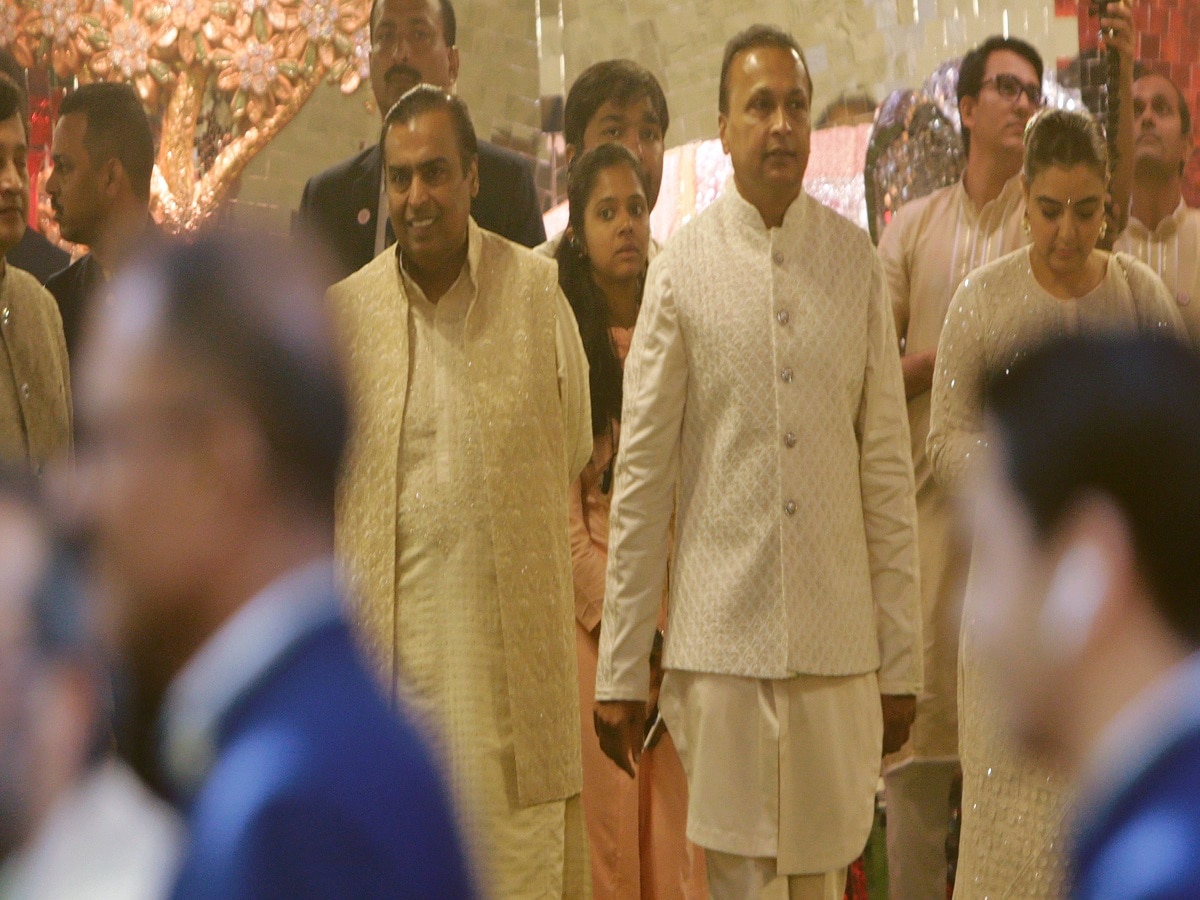
Despite the corporate demerger and subsequent financial divergence between the brothers, family ties have remained visible during periods of personal and financial crisis. In 2019, Mukesh Ambani stepped in to assist Anil Ambani in settling a critical payment default owed to Ericsson, preventing a potential contempt-of-court detention order for Anil. Furthermore, family members regularly appear together at major family milestones, signaling shared personal heritage despite distinct business paths.
- Kokilaben Ambani
- Mukesh Ambani (Chairperson, RIL)
- Akash Ambani
- Ila Ambani
- Anant Ambani
- Anil Ambani (Chairperson, ADA Group) m. Tina Ambani
- Jai Anmol Ambani
- Jai Anshul Ambani
- Mukesh Ambani (Chairperson, RIL)
Regulatory and Legal Context
Navigating debt workouts in India involves navigating complex statutory frameworks. Anil Ambani's business recovery efforts occur under strict regulatory oversight:
- Insolvency and Bankruptcy Code (IBC), 2016: The primary legal framework governing distressed assets in India. Under the IBC, once a company enters corporate insolvency, control shifts from promoters to an Insolvency Resolution Professional (IRP) and a Committee of Creditors (CoC).
- Personal Guarantees and Liability Enforcement: Lenders have increasingly invoked personal guarantee provisions under the IBC against business promoters who guaranteed corporate loans. Legal proceedings regarding promoter guarantees remain active across Indian debt recovery tribunals and higher courts.
- SEBI Capital Market Regulations: The Securities and Exchange Board of India (SEBI) imposes stringent governance rules regarding market disclosures, debt settlement disclosures, and promoter share pledges. Enforcement actions by SEBI have historically impacted promoter board eligibility in listed subsidiaries.
For comprehensive information regarding Indian corporate governance standards, official guidelines can be reviewed via the Securities and Exchange Board of India (SEBI) and insolvency procedures through the Insolvency and Bankruptcy Board of India (IBBI).
Key Challenges and Strategic Recovery Actions
To stabilize their business operations, Anil Ambani and his leadership team have pursued several explicit strategic steps:
- Aggressive Debt Reductions: Utilizing proceeds from legal awards and internal accruals to settle outstanding liabilities with domestic banking syndicates.
- Refocusing on Core Strengths: Shifting Reliance Infrastructure away from capital-intensive concession projects toward asset-light EPC and utility operations.
- Renewable Energy Expansion: Aligning Reliance Power’s strategic generation goals with national goals for solar capacity and clean power integration.
- Governance Adjustments: Reorganizing executive board structures to include next-generation leadership and independent advisory oversight.
Frequently Asked Questions
What caused the decline in Anil Ambani's net worth?
The decline was primarily caused by high leverage across capital-intensive infrastructure and power projects, operational challenges, intense tariff competition in the telecommunications sector following the launch of Reliance Jio, and choices regarding CDMA technology over GSM at RCom.
What is Anil Ambani's current net worth status?
In legal court proceedings in 2020, Anil Ambani stated his net worth was effectively zero after accounting for overall debt liabilities and guarantees. While listed equity holdings in surviving entities retain value, current wealth figures are tied up in corporate debt settlements and recovery processes rather than liquid capital.
Who controls Reliance Capital now?
Control of Reliance Capital transferred out of the Reliance ADA Group. Following insolvency proceedings initiated by the Reserve Bank of India, IndusInd International Holdings Ltd (IIHL), part of the Hinduja Group, emerged as the successful resolution applicant to acquire the company.
What businesses do Anil Ambani's sons manage?
Jai Anmol Ambani has been actively involved in executive leadership, strategy, and debt restructuring across Reliance Infrastructure and Reliance Power. Jai Anshul Ambani has similarly assisted in business operations and strategy within group entities.
Is Anil Ambani still involved in defense manufacturing?
Yes, through companies like Reliance Infrastructure and specialized joint ventures such as Dassault Reliance Aerospace Limited (DRAL), the group maintains strategic investments in defense manufacturing and aerospace offset projects.
What is Tina Ambani's role in the family enterprise?
Tina Ambani serves as the Chairperson of the Kokilaben Dhirubhai Ambani Hospital & Medical Research Institute in Mumbai and leads the Harmony Art Foundation. Her primary focus centers on healthcare management, social service, and cultural endeavors.
Summary and Key Takeaways
Understanding the modern scope of Anil Ambani and his family's corporate footprint requires distinguishing between past peak valuations and current operational realities:
- Shift from Conglomerate to Restructured Niche: The broad multi-sector enterprise assembled in 2005 has been streamlined. Telecom and financial service arms have largely been resolved through insolvency processes.
- Focus on Power & Infrastructure: The family’s primary corporate influence resides in surviving entities—specifically Reliance Power and Reliance Infrastructure—which continue to execute debt reduction plans and operational pivots.
- Generational Succession: The active involvement of Jai Anmol Ambani marks an operational shift toward next-generation leadership, focusing on debt clearance, green energy initiatives, and modern corporate practices.
Stakeholders, financial analysts, and corporate observers tracking the group should monitor official filings on Indian stock exchanges (BSE and NSE) and regulatory disclosures from the IBBI for verified updates on debt settlements and corporate governance decisions.