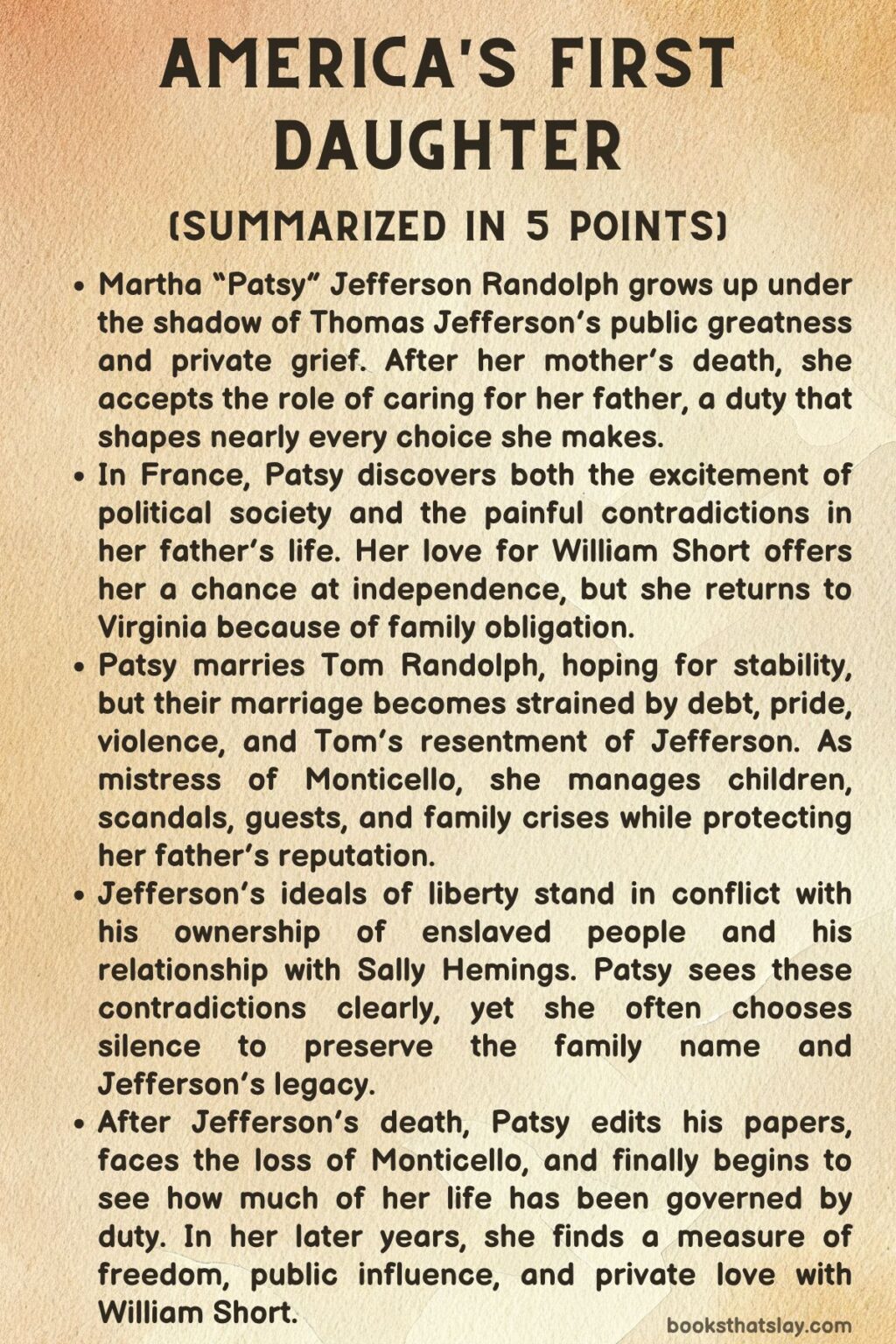
America's First Daughter, co-authored by Stephanie Dray and Laura Kamoie, is a meticulously researched historical fiction novel that chronicles the life of Martha "Patsy" Jefferson Randolph, the eldest daughter of Thomas Jefferson. The book explores her pivotal role in protecting her father's legacy, her struggles with societal expectations, and her endurance through personal and political turmoil.
The Legacy of Martha "Patsy" Jefferson Randolph
To understand the depth of America's First Daughter: A Tale of Courage and Loss, one must first understand the woman at its center. Martha Jefferson Randolph, known affectionately as Patsy, was perhaps the most influential woman in Thomas Jefferson’s life following the early death of his wife. As we look back from 2026, her story remains a vital touchstone for understanding the complexities of the American founding era, viewed not through the lens of Great Men, but through the women who sustained them.
Patsy was more than just a spectator to history; she was an active participant in the molding of the American presidency and the preservation of the Jeffersonian image. The novel captures her evolution from a young girl traveling to the glittering, pre-revolutionary courts of Paris to the weathered matriarch of a crumbling Monticello. Her life was defined by a singular, often crushing devotion to her father—a devotion that required her to navigate the treacherous waters of his political enemies, his financial instability, and the moral contradictions of a man who wrote the Declaration of Independence while enslaving hundreds of human beings.
The Narrative Arc: From Paris to Monticello
The story begins with a young Patsy accompanying her father to France after the death of her mother. This period is crucial for setting the stage for her "courage and loss." In Paris, Patsy is exposed to Enlightenment ideals and the sophisticated maneuvers of international diplomacy. It is also here that she experiences her first major conflict between personal desire and family duty.
In the narrative, the authors highlight her education at the Abbaye Royale de Panthemont, where she briefly considered converting to Catholicism and becoming a nun—a move that would have fundamentally altered American history. Jefferson's reaction to this, and Patsy's subsequent submission to his will, establishes the lifelong pattern of her sacrificing her own path to remain his "right hand."
Upon returning to Virginia, the story shifts to the reality of life at Monticello. The transition from the salons of Paris to the grueling management of a Southern plantation illustrates the "loss" of the freedom she briefly glimpsed in Europe. Her marriage to Thomas Mann Randolph Jr. was intended to solidify the family’s future but instead brought decades of financial anxiety and emotional hardship, as her husband struggled with mental instability and a volatile temper.
Themes of Sacrifice and Silence
The subtitle "A Tale of Courage and Loss" is most poignantly reflected in Patsy’s handling of the Sally Hemings controversy. Dray and Kamoie do not shy away from the deeply uncomfortable reality of Jefferson’s relationship with Hemings. Through Patsy’s eyes, readers witness the cognitive dissonance required to maintain a "noble" family front while living amidst the evidence of her father’s shadow family.
Patsy’s courage was often silent. It was the courage to endure social scandal, to manage the complex logistics of a household that was constantly under the microscope, and to protect her children from the fallout of their grandfather’s complicated life. The "loss" she suffered was multifaceted:
- Loss of Identity: Much of her life was subsumed by her father’s needs.
- Loss of Financial Security: Despite Jefferson’s status, he died in massive debt, leaving Patsy to deal with the literal sale of her home and the people she grew up with.
- Loss of Moral Certainty: Navigating the ethics of slavery while being the daughter of a man who championed liberty.
The Paradox of Thomas Jefferson
A significant portion of the book’s technical depth lies in its portrayal of Thomas Jefferson. Instead of a one-dimensional founding father, we see a man through the eyes of the person who knew his flaws best. The novel explores the "Jeffersonian Paradox"—the gap between his public ideals and his private actions.
For Patsy, this paradox was her daily reality. The authors use thousands of original letters to reconstruct conversations and events, lending the book a high degree of historical authenticity. This research reveals a Jefferson who was emotionally dependent on his daughter, often at the expense of her own happiness. The book forces readers to confront the idea that the "courage" of the founding era was not just found on battlefields, but in the domestic spheres where women like Patsy managed the consequences of their fathers' and husbands' political ambitions.
Historical Accuracy and Research Methodology
One of the reasons America's First Daughter remains a staple in historical fiction curricula in 2026 is the authors' commitment to primary sources. Stephanie Dray and Laura Kamoie utilized the extensive archives of the Jefferson Papers and the records at Monticello.
The technical challenge for the authors was filling the gaps where history remained silent. While Jefferson’s public life is well-documented, the inner lives of the women in his circle were often relegated to the margins. The authors used a technique called "informed imagination," where they took known facts—such as the timing of letters or documented visitors to Monticello—and built plausible emotional arcs around them. This method ensures that while the dialogue is fictional, the historical scaffolding is sturdy.
| Aspect of Patsy's Life | Historical Record | Novel's Interpretation |
|---|---|---|
| Education | Studied at a convent in Paris. | A period of religious awakening and conflict with her father. |
| Marriage | Married her cousin, Thomas Mann Randolph Jr. | A turbulent union marked by financial ruin and abuse. |
| Role at Monticello | Managed the household and acted as hostess. | A grueling job involving the management of hundreds of people. |
| Sally Hemings | Presence of Hemings' children at Monticello is documented. | Patsy’s internal struggle and tactical silence to protect legacy. |
| Financial Status | Inherited nearly $100,000 in debt upon Jefferson's death. | The heartbreaking process of losing her ancestral home. |
Why the Book Resonates in 2026
Ten years after its initial publication, America's First Daughter continues to be relevant because it addresses the modern interest in "hidden figures" of history. In 2026, the study of the American Revolution has moved beyond dates and battles to include the social and familial structures that allowed the nation to survive its infancy.
Patsy Jefferson represents the "invisible labor" that built the United States. Her story is a reminder that the price of political greatness is often paid by those in the leader's immediate circle. The book serves as a bridge between traditional biography and contemporary storytelling, making the 18th century feel immediate and personal.
Analyzing the "Courage and Loss" in Literary Structure
The authors structure the novel to mirror the rising and falling fortunes of the Jefferson family. The "courage" sections are often characterized by fast-paced prose and high-stakes political drama, such as Jefferson’s election in 1800. Conversely, the "loss" sections are more introspective, focusing on the quiet decay of Monticello and the mounting deaths of Patsy’s children and siblings.
The use of first-person perspective allows the reader to feel the weight of Patsy’s responsibilities. When she has to choose between her husband’s stability and her father’s reputation, the reader is positioned to understand why she made the choices she did—choices that might seem baffling to a modern observer but were survival mechanisms in the 1800s.
The Intersection of Public Policy and Private Life
The novel also highlights how public policy of the era directly impacted the lives of women. Patsy’s inability to own property in her own name for much of her life, the lack of legal recourse against a volatile husband, and the societal requirement to remain a "silent" partner to her father all underscore the limitations placed on even the most elite women of the time.
Her courage, therefore, was a form of subversion. By becoming indispensable to Thomas Jefferson, she exerted a level of political influence that was rare for women. She vetted his correspondence, managed his public image during the Callender scandal, and ensured that his papers were preserved for posterity. Without Patsy's "courageous" intervention, our modern understanding of Thomas Jefferson would be significantly more fragmented.
Common Mistakes in Interpreting the Novel
When discussing or reviewing America's First Daughter, readers often fall into a few common traps:
- Viewing Patsy as a Passive Victim: It is easy to see her only as a victim of her father’s ego. However, the book portrays her as a woman who made conscious, if difficult, choices to preserve what she valued most: her family's name and her children's future.
- Expecting a Romance Novel: While there are romantic elements (specifically her early relationship with William Short), this is primarily a political and family drama. The "loss" often outweighs the romance.
- Ignoring the Historical Context of Slavery: Some readers may find Patsy’s complicity in the slave system at Monticello unforgivable. The authors' goal is not to excuse her, but to accurately portray the mindset of a woman of her class and era, showing how she reconciled her father's ideals with the reality she lived.
FAQs
Is "America's First Daughter" based on a true story?
Yes, it is a work of historical fiction based on the life of Martha Jefferson Randolph. The authors used thousands of letters and historical documents to ensure that the major events, dates, and figures in the book align with the historical record. While conversations and internal thoughts are imagined, the framework of the story is factually grounded.
Who was the "First Daughter" in the title?
The title refers to Martha "Patsy" Jefferson Randolph, the eldest daughter of Thomas Jefferson. Although the term "First Lady" was not in common use at the time, Patsy often fulfilled the social and ceremonial duties of the position during her father's presidency because her mother had passed away years earlier.
How does the book handle the Sally Hemings controversy?
The book addresses the relationship between Thomas Jefferson and Sally Hemings directly. It portrays it through Patsy’s perspective, highlighting her awareness of the situation and the emotional toll it took on her as she attempted to maintain her father’s public reputation while living with the reality of his actions.
What happened to Patsy Jefferson after her father died?
After Thomas Jefferson's death in 1826, Patsy faced severe financial hardship. Monticello was eventually sold to pay off her father's debts. She lived with various family members and was eventually granted a small pension by the states of Virginia and South Carolina in recognition of her father's service, which allowed her some stability in her final years.
Is the book suitable for students of American history?
Absolutely. While it is fiction, the depth of research makes it an excellent supplemental read for those studying the Jeffersonian era. It provides a unique perspective on the domestic and social realities of the time that are often missing from standard textbooks.
Practical Recommendations for Readers
For those looking to dive into America's First Daughter, it is recommended to read it alongside a non-fiction biography of Thomas Jefferson or a history of Monticello to fully appreciate the "informed imagination" the authors used.
If you are a book club coordinator, focusing on the themes of "loyalty vs. morality" provides rich ground for discussion. The book invites readers to ask: At what point does loyalty to a parent become a betrayal of one's own values? This question remains as relevant in 2026 as it was in the 1820s. After finishing the book, visiting the digital archives of the Thomas Jefferson Foundation can provide a visual context to the "courage and loss" depicted in the narrative, allowing you to see the actual letters and artifacts that inspired the story.