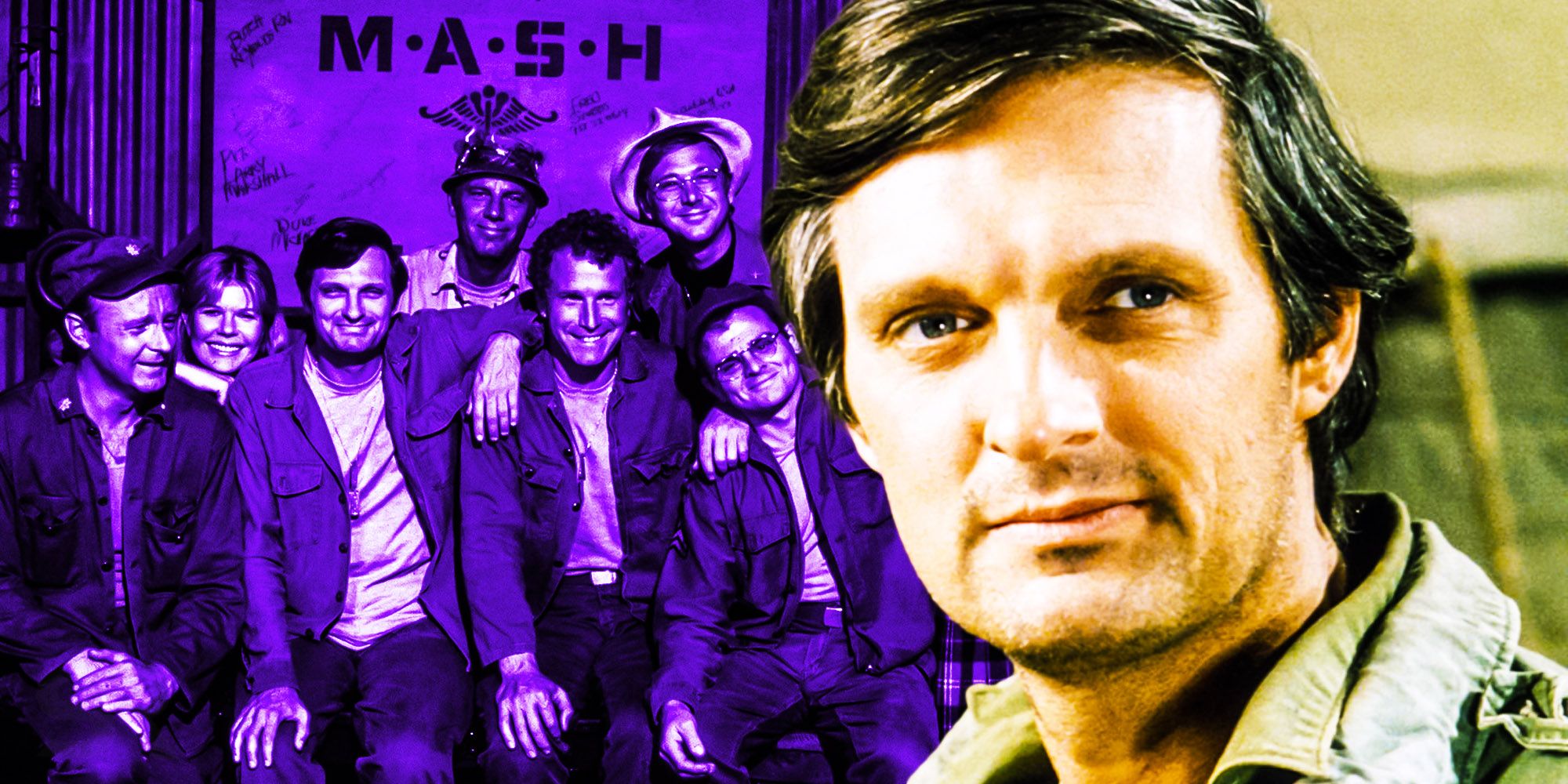
Alan Alda’s consistent presence on MASH* is defined by his record-breaking achievement as the only actor to appear in all 251 episodes of the series. Beyond acting, Alda served as a writer, director, and creative consultant, winning Emmys in all three categories and fundamentally shaping the show’s transition from a sitcom to a profound dramedy.
For eleven seasons, from 1972 to 1983, Alan Alda was the undeniable heartbeat of the 4077th Mobile Army Surgical Hospital. While the show saw significant cast turnover—replacing beloved characters like Trapper John McIntyre, Henry Blake, and Frank Burns—Alda’s portrayal of Captain Benjamin Franklin "Hawkeye" Pierce remained the show's singular constant. This consistency was not merely a matter of contractual obligation; it was a professional marathon that saw Alda evolve from a leading man into one of the most influential creative forces in television history. As of 2026, his work on MASH* continues to be studied by television historians and enjoyed by new generations via high-definition streaming platforms.
The Significance of the "251 Club"
In the landscape of ensemble television, it is exceedingly rare for a lead actor to never miss a single installment over an eleven-year run. Production schedules, health issues, or creative disputes often lead to "light" episodes where a lead character is absent or only appears in a cameo. Alan Alda, however, appeared in every single episode of MASH*.
This perfect attendance record was central to the show’s narrative stability. As the 4077th dealt with the chaotic "rotation" system of the Korean War, Hawkeye Pierce became the audience's surrogate. The viewers felt the weight of the war through Hawkeye’s growing fatigue because they, like him, never left the camp. Alda’s presence provided the structural integrity that allowed the show to survive the departure of other core cast members. When McLean Stevenson (Henry Blake) and Wayne Rogers (Trapper John) left at the end of Season 3, many critics predicted the show’s demise. Alda’s willingness to remain—and to deepen his character’s emotional stakes—anchored the series through its most turbulent transitions.
Creative Evolution: From Actor to Auteur
Alan Alda’s consistency was not limited to his time in front of the camera. He is famously the first person to win Primetime Emmy Awards for acting, writing, and directing on the same series. This "triple threat" status allowed him to guide the show’s tonal shift from the irreverent, "frat-house" humor of the early seasons toward the "socially conscious" dramedy of the later years.
Writing and Directing Milestones
Alda’s influence grew exponentially as the series progressed. He wrote 19 episodes and directed 32, including the record-breaking series finale. His writing often explored the psychological toll of war, moving away from the slapstick origins of the 1970 film and the early television seasons.
One of the most significant examples of Alda’s creative consistency is the Season 4 episode "The Interview." Filmed in black and white and presented as a documentary, this episode relied heavily on character improvisation and deep psychological insight. Alda’s fingerprint on such experimental episodes helped MASH* break the "sitcom" mold, paving the way for the sophisticated "prestige TV" seen in the 21st century.
The Impact of Creative Consultancy
By the later seasons, Alda served as a creative consultant, ensuring that the show’s themes remained consistent with its anti-war underpinnings. He famously insisted that every episode feature at least one scene in the Operating Room (OR) to remind the audience that, despite the jokes, the characters were in a zone of death and trauma. This "OR requirement" became a hallmark of the show’s realism and a testament to Alda’s commitment to the subject matter.
The Physical and Personal Toll of Consistency
Maintaining a consistent presence on a top-tier network show for over a decade requires immense personal sacrifice. For much of the show’s run, Alan Alda maintained a grueling schedule that involved commuting between the filming location in Los Angeles and his family home in New Jersey.
Alda chose not to move his family to California, wanting to provide his daughters with a stable upbringing away from the Hollywood spotlight. This meant that for several months out of the year, he was a "weekend father," flying across the country during production breaks. This level of commitment to both his profession and his personal values mirrored the dualities of Hawkeye Pierce—a man dedicated to his craft (surgery) while desperately longing for the "Swamp" of his home in Crabapple Cove, Maine.
Cast Dynamics and the Role of the Anchor
While Alda was the lead, MASH* was an ensemble show. However, the "consistency" of the ensemble changed significantly over time. Alda acted as the bridge between the "old guard" and the "new guard."
| Actor | Character | Seasons | Episodes | Role in the Series |
|---|---|---|---|---|
| Alan Alda | Hawkeye Pierce | 1–11 | 251 | The Central Anchor |
| Loretta Swit | Margaret Houlihan | 1–11 | 239 | The Evolving Antagonist-to-Ally |
| Jamie Farr | Maxwell Klinger | 1–11 | 215 | From Bit Player to Main Cast |
| William Christopher | Father Mulcahy | 1–11 | 213 | The Moral Compass |
| Harry Morgan | Sherman Potter | 4–11 | 180 | The Father Figure |
| Mike Farrell | B.J. Hunnicutt | 4–11 | 179 | The Loyal Partner |
| David Ogden Stiers | Charles Emerson Winchester III | 6–11 | 131 | The Intellectual Foil |
As seen in the data, while Loretta Swit, Jamie Farr, and William Christopher were present for all eleven seasons, only Alda appeared in every single produced episode. His presence ensured that when new characters like B.J. Hunnicutt or Colonel Potter arrived, there was a seamless transition. Hawkeye’s relationships with these new arrivals defined the "second era" of MASH*, which many fans consider to be the show’s creative peak.
The "Goodbye, Farewell and Amen" Legacy
The ultimate proof of Alan Alda’s consistent presence and influence was the series finale, "Goodbye, Farewell and Amen." Aired on February 28, 1983, the 2.5-hour movie was co-written and directed by Alda. In 2026, it remains a landmark in broadcasting history, having drawn over 105 million viewers—a record for a scripted episode that stood unchallenged for decades.
The finale focused heavily on Hawkeye’s mental health, specifically his nervous breakdown and subsequent recovery in a psychiatric ward. This bold choice was the culmination of Alda’s decade-long effort to treat the characters as real people suffering from PTSD, rather than cardboard cutouts in a comedy. By directing the final frames himself, Alda ensured that the "consistent presence" he maintained for 251 episodes ended on his own creative terms.
Technical Specifications of the MAS*H Production
To understand why Alda’s presence was so vital, one must look at the technical rigors of the show’s production. Unlike modern 8-to-13 episode seasons, MASH* produced 24 episodes per year on average.
- Film Format: Shot on 35mm film, which required long hours of lighting and setup compared to multi-camera sitcoms shot on tape.
- Locations: The show utilized the Malibu Creek State Park (the "Fox Ranch") for exterior shots. The heat and dust of the California mountains were often grueling, yet Alda was present for every exterior shoot.
- The Laugh Track: Alda was a vocal critic of the laugh track. While CBS insisted on it, Alda and the producers successfully fought to have it removed during all Operating Room scenes, a major step in the evolution of the "dramedy" genre.
Alan Alda’s Impact in 2026
In the current year of 2026, the legacy of Alan Alda’s consistency is more relevant than ever. With the proliferation of short-run streaming series, the "marathon" acting of the 1970s and 80s has become a lost art. Alda’s work on MASH* serves as a masterclass in character development over time.
Furthermore, Alda’s post-MASH* career—including his advocacy for science communication through the Alan Alda Center for Communicating Science and his transparency regarding his diagnosis of Parkinson’s disease—reflects the same intellectual curiosity and humanitarian spirit he brought to Hawkeye Pierce. Fans revisit the series today not just for the nostalgia of the Korean War setting, but to witness the artistic growth of a man who refused to phone in a single performance over eleven years.
Common Misconceptions About Alda’s Role
Despite his dominance on the show, several myths persist regarding Alda’s "consistent presence."
- The "Dictator" Myth: Some critics suggested that Alda became too dominant in the later years, turning the show into a "moralizing" platform. However, interviews with cast members like Mike Farrell and Loretta Swit consistently refute this, noting that Alda’s leadership was collaborative and that he often championed storylines for other characters.
- The Trapper John Rivalry: It is often rumored that Wayne Rogers left because of Alda’s ego. In reality, Rogers left because his contract did not specify he was a "co-lead," and he felt the writers were focusing too much on Hawkeye—a structural decision made by the studio, not necessarily an individual mandate by Alda.
- The Finale’s Script: While Alda directed the finale, he was one of eight credited writers. His consistency was as a collaborator, not a solo act.
Practical Guidance for Revisiting the Series
For those looking to experience Alda’s consistent presence on MASH* in 2026, several resources are available:
- Streaming Platforms: The series is available in 1080p and 4K remasters on major platforms like Hulu and Disney+. These versions allow viewers to see the nuances of Alda’s facial acting that were often lost on 1970s-era television sets.
- The Alan Alda Center: For those interested in the communication techniques Alda honed during the "Interview" style episodes, his university center offers workshops based on his experiences.
- The Smithsonian: The original "Swamp" set and Hawkeye’s iconic robe and combat boots are preserved at the National Museum of American History, serving as a physical testament to his decade-long residency in the role.
FAQ
Did Alan Alda really appear in every single episode of MAS*H?
Yes. Out of the 251 episodes produced over 11 seasons, Alan Alda is the only cast member credited with an appearance in every one. Other long-term cast members like Loretta Swit missed several episodes due to other commitments or creative breaks.
How many episodes of MAS*H did Alan Alda direct?
Alan Alda directed a total of 32 episodes. His most notable directorial effort was the series finale, "Goodbye, Farewell and Amen," which he also co-wrote. His direction was known for being actor-centric and visually inventive for a sitcom of that era.
Why did Alan Alda decide to stay for the entire 11-year run?
Alda stayed because of his deep connection to the character’s humanitarian message and his increasing creative control. As he moved into writing and directing, the show became a primary vehicle for his artistic expression. He also felt a strong sense of loyalty to the "MASH family" as they navigated the show's massive success.
Did Alan Alda win an Emmy for every role he played on the show?
Yes, he achieved a historic "triple crown" for MASH*. He won Emmys for Outstanding Lead Actor in a Comedy Series, Outstanding Writing for a Comedy Series, and Outstanding Directing for a Comedy Series. This remains one of the most significant individual achievements in television history.
Is MAS*H still popular in 2026?
Absolutely. Due to its themes of war, bureaucratic absurdity, and medical heroism, MASH* remains timeless. In 2026, it continues to rank highly on streaming charts and is frequently cited by modern showrunners as a foundational influence on the "dramedy" genre.
Final Recommendation
To truly appreciate the depth of Alan Alda’s consistent presence, viewers should watch the series chronologically rather than in syndication. Observing the subtle shift in Hawkeye’s demeanor from the pilot episode to the finale reveals a masterclass in long-form acting. For students of television and fans of humanitarian storytelling, Alda’s eleven-year journey remains the gold standard for lead-actor commitment and creative integrity.