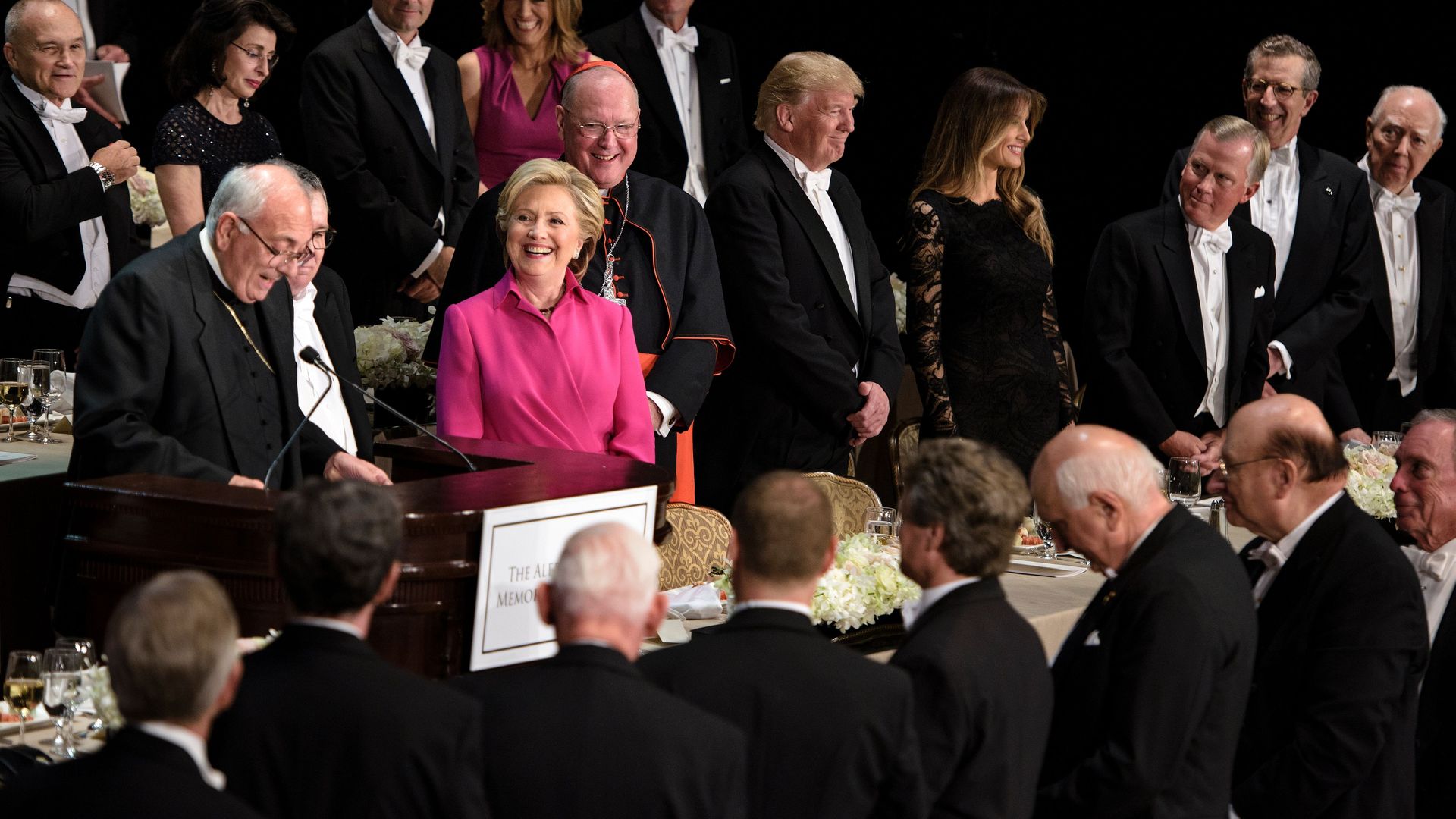
The 2016 Alfred E. Smith Memorial Foundation Dinner was a pivotal event that raised approximately $6 million for Catholic charities. Held on October 20, 2016, it featured Donald J. Trump and Hillary Clinton in their final joint appearance before the election, marking a significant departure from the event's traditional lighthearted civility.
The Alfred E. Smith Memorial Foundation Dinner, commonly known as the Al Smith Dinner, has long served as a cornerstone of the New York social and political calendar. Traditionally held on the third Thursday of October, the event is organized by the Archdiocese of New York to benefit various Catholic charities. While its primary mission is philanthropic, its cultural significance stems from its role as a "white-tie" roast where presidential candidates from both major parties are expected to set aside their partisan animosity for an evening of self-deprecating humor and charitable goodwill.
As we look back from the perspective of 2026, the 71st annual dinner in 2016 stands out as a watershed moment. It was an evening where the traditional boundaries of political decorum were tested, reflecting the intense polarization of the era. To understand the event's impact, one must examine its historical roots, the specific fundraising outcomes, and the rhetorical shifts that occurred during the keynote addresses.
The Legacy of the Alfred E. Smith Memorial Foundation
To appreciate the gravity of the 2016 event, it is essential to understand the namesake of the foundation. Alfred E. Smith was a four-term Governor of New York and the first Catholic to be nominated for President by a major party (the Democrats) in 1928. Although Smith lost the election, his legacy as a reformer and a champion of the marginalized endured. The foundation was established in 1945 by Francis Cardinal Spellman to honor Smith’s memory by supporting the poor, the sick, and the underprivileged of New York, regardless of race, creed, or color.
Since the mid-20th century, the dinner has hosted nearly every major presidential candidate. The ritual usually follows a specific pattern: the candidates sit in close proximity, often separated only by the Archbishop of New York, and deliver speeches that poke fun at themselves and their opponents. The goal is to demonstrate that despite profound political differences, leaders can still share a meal and a laugh for a greater cause.
The 2016 Event Details and Fundraising Impact
The 2016 dinner was held at the Waldorf Astoria Hotel in New York City. This venue, iconic for its historical connection to American elites, provided a stark backdrop for a campaign characterized by populist rhetoric. The event was presided over by Cardinal Timothy Dolan, the Archbishop of New York, who famously sat between Donald Trump and Hillary Clinton, describing his seat as "the iciest place on the planet" during the height of the campaign.
Fundraising Metrics and Beneficiaries
The financial success of the 2016 dinner was undeniable. The event raised roughly $6 million, a record-breaking sum at the time for the foundation. These funds were directed toward numerous programs under the umbrella of Catholic Charities of the Archdiocese of New York. The impact of these funds is felt across several sectors:
- Maternal and Child Health: Funding for clinics and support services for low-income mothers.
- Education: Scholarships and after-school programs for inner-city youth.
- Housing Services: Assistance for the homeless and those facing eviction.
- Food Security: Support for parish-based food pantries and soup kitchens.
The scale of the fundraising was a testament to the high interest in the 2016 election cycle. Tickets for the event were highly sought after, with prices reflecting the premier nature of the gala and the critical needs of the charities it supported.
Analyzing the Speeches: Trump vs. Clinton
The core of the Al Smith Dinner is the series of speeches delivered by the candidates. In 2016, the tension between Donald Trump and Hillary Clinton was palpable, following several contentious debates. While the audience expected a traditional "roast," the rhetoric frequently crossed into the territory of campaign-style attacks.
Donald Trump’s Performance: From Self-Deprecation to Confrontation
Donald Trump spoke first. Initially, he followed the traditional format, making light of his own wealth and the size of his rallies. He even joked about his wife Melania's speech at the Republican National Convention, which had been criticized for its similarities to a speech by Michelle Obama, saying, "Michelle Obama gives a speech and everyone loves it... my wife Melania gives the exact same speech and people get on her case!"
However, the tone shifted when Trump began to levy more direct accusations against Hillary Clinton. When he referred to her as "corrupt" and suggested she was "pretending not to hate Catholics" (a reference to leaked emails from her campaign staff), the audience responded with audible boos. This was a rare occurrence in the dinner’s history, as the crowd—comprised of New York’s business, political, and religious elite—typically maintains a polite, if occasionally lukewarm, demeanor.
Hillary Clinton’s Performance: Self-Reflexive Wit and Sharp Critiques
Hillary Clinton’s speech was more traditionally structured as a roast, though it was equally pointed. She focused heavily on Trump’s public image and his relationship with Russia. One of her more memorable lines involved the "pardon" tradition, where she remarked, "I’m so surprised Donald agreed to come. I didn't think he’d be okay with a peaceful transition of power."
Clinton also poked fun at her own reputation for being overly prepared and "robotic," acknowledging that she wasn't known for her comedic timing. Her speech was generally better received by the room in terms of adherence to the event's format, but it did little to lower the temperature of the room. The mutual disdain between the two candidates was visible, even during the ceremonial handshake that traditionally signifies a momentary truce.
Breaking Tradition: Why the 2016 Dinner Was Different
The 2016 Al Smith Dinner is frequently cited by political historians as the moment the "roast" format broke down. Historically, candidates used the dinner to humanize themselves. For example, in 2000, George W. Bush and Al Gore engaged in lighthearted banter that helped soften their public images. In 1960, John F. Kennedy and Richard Nixon used the platform to demonstrate that their religious and political differences did not preclude mutual respect.
In 2016, the "truce" failed to hold. The primary reasons for this departure include:
- Personalized Conflict: The 2016 campaign was uniquely personal, with both candidates viewing the other as fundamentally unfit for office.
- External Pressures: The dinner took place just 24 hours after the third and final presidential debate, where the candidates had refused to shake hands.
- The Rise of Social Media: The need for "viral" moments encouraged more aggressive punchlines that could be clipped for social media, rather than the subtle wit of previous decades.
| Feature of the Event | Traditional Al Smith Dinner | 2016 Al Smith Dinner |
|---|---|---|
| Primary Atmosphere | Jovial, self-deprecating humor | Tense, confrontational rhetoric |
| Audience Reaction | Polite laughter and applause | Notable booing and heckling |
| Candidate Interaction | Surface-level civility/warmth | High tension/minimal interaction |
| Fundraising Goal | Support Catholic Charities | Support Catholic Charities |
| Speech Content | Roasts of self and opponent | Direct campaign-style attacks |
Logistics and Attendance: The Waldorf Astoria’s Role
The choice of the Waldorf Astoria was significant. For years, the hotel served as the unofficial headquarters for the dinner. In 2016, the setting added a layer of irony to the proceedings. Donald Trump, a real estate mogul synonymous with New York luxury, was "at home" in the venue, yet he was booed by the very demographic (the New York donor class) that he had long courted.
The guest list included over 1,500 people, ranging from CEOs of major financial institutions to leaders of labor unions. The presence of Cardinal Dolan was perhaps the most crucial element. As the mediator, his role was to remind the attendees—and the candidates—of the religious and charitable mission that superseded the political theatre.
Cultural and Political Impact: A Decade of Reflection
Writing from 2026, we can see that the 2016 dinner foreshadowed the future of political engagement in the United States. It signaled the end of an era where "gentlemanly" or "ladylike" political norms could be assumed. Subsequent dinners have struggled to return to the pre-2016 level of lightheartedness, as the stakes of national elections have only increased.
However, the event’s impact on the charity sector remains its most positive legacy. Despite the vitriol on stage, the millions of dollars raised provided essential services to New Yorkers in need. It proved that the Alfred E. Smith Memorial Foundation could still leverage political star power to achieve significant humanitarian ends, even when the stars themselves were at odds.
FAQ: Understanding the 2016 Al Smith Dinner
Was Donald Trump really booed at the Al Smith Dinner?
Yes, Donald Trump was booed by the audience during his speech. The heckling occurred when he moved away from self-deprecating humor and began making direct, aggressive attacks on Hillary Clinton, specifically regarding her private email server and her attitudes toward the Catholic faith.
How much money was raised in total during the 2016 event?
The 2016 dinner raised approximately $6 million. This set a record for the foundation at the time, highlighting the significant draw of the Trump-Clinton matchup and the continued generosity of the foundation's donors.
Who organizes the Al Smith Dinner?
The event is organized by the Alfred E. Smith Memorial Foundation, which is closely associated with the Archdiocese of New York. The sitting Archbishop of New York, currently Cardinal Timothy Dolan, typically serves as the host and moderator.
Is the Al Smith Dinner held every year?
Yes, the dinner is an annual event. However, presidential candidates are only invited to speak together during election years. In non-election years, the foundation invites other prominent figures, such as journalists, comedians, or business leaders, to serve as keynote speakers.
Why do the candidates wear "White Tie"?
The "White Tie" dress code (tails and white bow ties) is the most formal level of evening wear. It has been a tradition of the dinner since its inception, symbolizing the prestige of the event and the importance of the charitable cause it supports.
Did the 2016 dinner change the format for future events?
While the format remained officially the same, the 2016 event prompted discussions about how to maintain the spirit of the dinner in a more polarized era. In 2020, due to the COVID-19 pandemic, the event moved to a virtual format, and in 2024, candidates again navigated the fine line between humor and hostility.
Practical Recommendation for Researchers and Donors
For those looking to understand the intersection of religion, charity, and politics, the Alfred E. Smith Memorial Foundation provides a wealth of historical data. Researchers should examine the transcripts of the 2016 speeches as a primary source for understanding the shift in American political rhetoric.
If you are interested in the philanthropic side of the event, consider reviewing the annual reports of Catholic Charities of the Archdiocese of New York. These reports detail how the funds raised at events like the Al Smith Dinner are distributed to serve the community. Even a decade after the 2016 event, the foundation remains a critical source of support for New York’s social safety net.