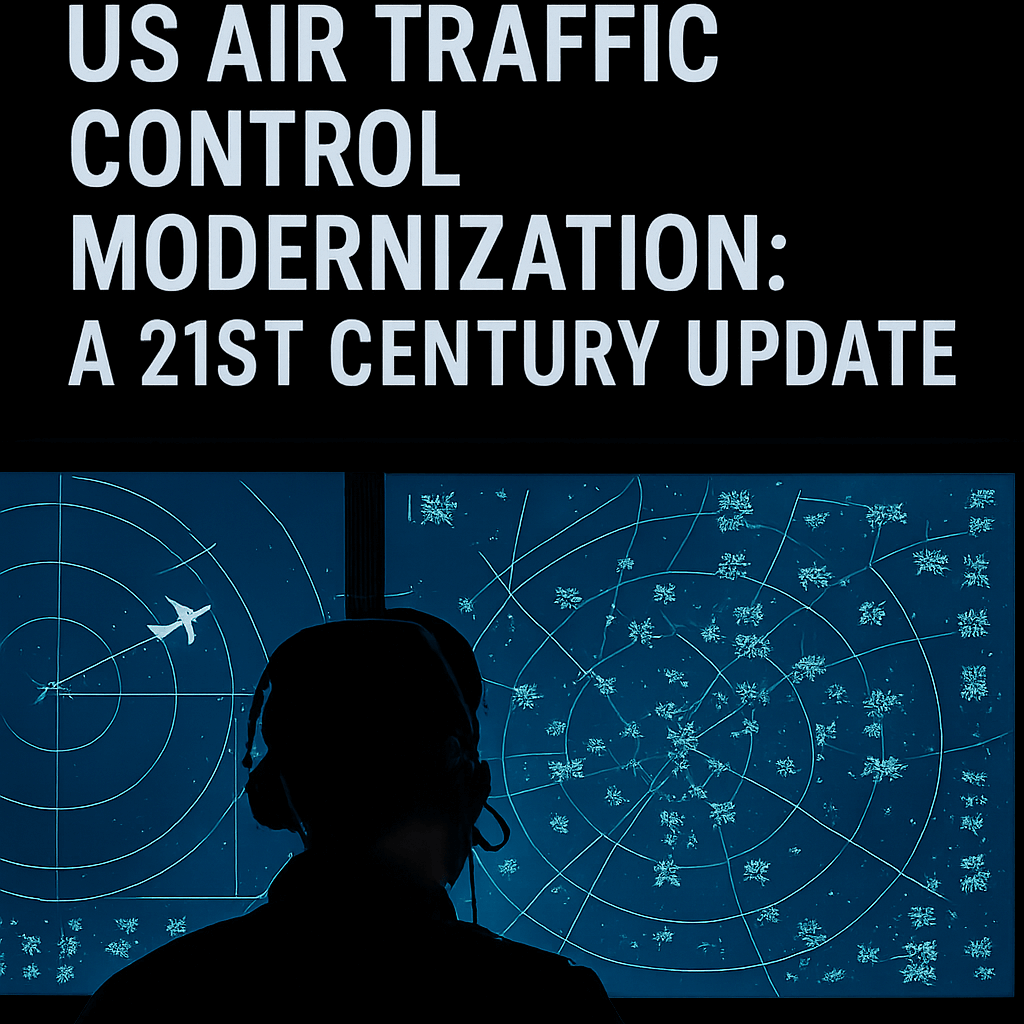
Air traffic control system modernization is the comprehensive, multi-year upgrading of legacy radar, communication, and software infrastructure used by aviation authorities to manage aircraft movement safely and efficiently. Driven by increasing flight volumes, aging hardware, and the transition from ground-based radio positioning to satellite-guided navigation, modernization efforts replace paper-strip flight tracking with digital automation, high-speed data networks, and advanced decision-support tools that reduce delays and expand airspace capacity.
The Imperative for Modernizing Legacy Airspace Architecture
Global aviation operates under unprecedented pressure. Commercial flight numbers consistently strain the operational thresholds of legacy infrastructure originally designed in the mid-to-late 20th century. Traditional air traffic management (ATM) systems rely heavily on analog voice communications, ground-based Very High Frequency (VHF) omnidirectional range (VOR) beacons, and primary and secondary radar systems that are increasingly expensive to maintain.
As demand for airspace rises, these legacy systems create operational bottlenecks. Ground controllers often rely on manual calculation, voice check-ins, and physical flight progress strips to track aircraft separation. This workflow limits the density of traffic an individual sector can handle safely.
Modernization addresses these structural limitations by shifting the paradigm from tactical voice-based control to strategic, data-driven trajectory management. Authorities such as the Federal Aviation Administration (FAA) in the United States and Eurocontrol in Europe have structured major modernization programs—such as the Next Generation Air Transportation System (NextGen) and the Single European Sky ATM Research (SESAR) initiative—to overhaul these foundations.
The primary goals of modernization include:
- Enhanced Safety Margins: Reducing reliance on voice readbacks by automating conflict detection and resolution alerts.
- Increased Capacity: Enabling tighter aircraft spacing en route and in terminal areas through precision navigation.
- Environmental Efficiency: Facilitating continuous descent operations (CDOs) that burn less fuel and reduce carbon emissions.
- System Resilience: Replacing vacuum-tube-era electronics and obsolete mainframe computers with secure, scalable cloud and IP-based networks.
Core Pillars of Air Traffic Control Modernization
Transforming national airspace requires synchronized upgrades across multiple interdependent domains. These pillars form the technical backbone of modern air traffic management.
Satellite-Based Navigation and ADS-B
The shift from ground-based infrastructure to space-based architectures represents the most visible transformation in modern aviation.
- GNSS Integration: Global Navigation Satellite Systems (GNSS), including GPS and Galileo, provide continuous, highly accurate three-dimensional positioning for aircraft, independent of line-of-sight ground radar.
- Automatic Dependent Surveillance-Broadcast (ADS-B): ADS-B technology requires aircraft to continuously broadcast their precise GPS-derived position, altitude, and vector data to ground stations and other nearby aircraft. This provides controllers with real-time situational awareness that surpasses traditional radar sweep intervals, particularly in remote oceanic and mountainous regions where radar coverage is historically sparse.
Digital Communications and Data Networking
Voice communication over analog radio frequencies remains vulnerable to congestion, misinterpretation, and static interference. Modernization introduces digital data-link communications.
- Controller-Pilot Data Link Communications (CPDLC): CPDLC enables text-based digital messaging between air traffic controllers and flight crews for routine clearances, altitude assignments, and route modifications. This reduces radio frequency congestion and eliminates verbal transcription errors.
- System Wide Information Management (SWIM): SWIM acts as an aviation-specific digital data highway. It integrates disparate data streams—including meteorological reports, flight plans, airport capacity, and airline schedules—into a single, standardized platform accessible by all stakeholders.
Automation and Decision Support Tools
Modernization moves beyond simply tracking aircraft to predicting their future trajectories.
- Time-Based Flow Management (TBFM): Traditional air traffic management relies on distance-based spacing. TBFM uses advanced algorithms to calculate exact times when aircraft must cross specific metering fixes, optimizing arrival flows hours before landing and reducing costly holding patterns.
- Conflict Detection and Resolution (CD&R): Automated safety nets continuously scan flight trajectories for predicted separation losses, alerting controllers minutes before a potential conflict occurs and suggesting optimal resolution vectors.
Comparison of Legacy and Modern Air Traffic Control Systems
To understand the scope of modernization, it is helpful to examine the operational differences between legacy infrastructure and modern, digitized airspace systems.
| Operational Domain | Legacy Air Traffic Control | Modernized Air Traffic Control |
|---|---|---|
| Surveillance | Ground-based primary and secondary radar sweeps (4-to-12-second update intervals). | Integrated ADS-B and multilateration feeds with real-time position updates. |
| Navigation | VOR beacons, NDBs, and ground-based instrument landing systems (ILS). | Satellite-based GNSS, RNAV, and RNP procedures with curved approach paths. |
| Communication | Analog VHF/UHF voice radio prone to congestion and misinterpretation. | Digital CPDLC data links alongside voice, supplemented by secure IP networks. |
| Data Sharing | Isolated local systems, telephone coordination, and paper flight strips. | System Wide Information Management (SWIM) providing shared, real-time data to all users. |
| Traffic Flow Management | Reactive distance-based spacing and tactical holding patterns. | Predictive time-based flow management (TBFM) optimizing arrivals hours out. |
Implementation Challenges and Complexities
While the operational benefits of modernization are well-documented, executing these transitions involves monumental engineering, financial, and logistical hurdles.
Legacy Integration and Interoperability
Airspace is a continuous, international continuum, yet modernization occurs unevenly across national borders and regional centers. A major challenge involves ensuring that new digital automation platforms can communicate seamlessly with legacy hardware still operating in adjacent sectors or smaller regional facilities. Furthermore, general aviation aircraft and older commercial airframes require costly avionics retrofits to utilize ADS-B Out and data-link services, creating financial burdens for aircraft owners.
Cybersecurity and Vulnerabilities
As air traffic management transitions from closed, proprietary analog networks to open IP-based architectures and cloud environments, the attack surface expands significantly. Protecting critical national infrastructure from electronic spoofing, GPS jamming, and sophisticated cyberattacks requires continuous security audits, robust encryption standards, and redundant fallback systems that can operate independently if primary digital networks fail.
Human Factors and Controller Adaptation
Introducing advanced automation alters the fundamental cognitive workload of air traffic controllers. Transitioning from active tactical control to supervisory monitoring of automated systems requires comprehensive retraining programs. Human-machine interfaces (HMIs) must be rigorously evaluated to prevent automation complacency, ensure situational awareness during system degradation, and maintain manual fallback skills in the event of software anomalies.
Frequently Asked Questions
What is the primary purpose of air traffic control system modernization?
Modernization aims to transition global airspace from analog, ground-based radar and voice communication to digital, satellite-guided, and automated data-driven management. This increases airspace capacity, improves safety margins, reduces flight delays, and lowers environmental emissions through optimized routing.
How does ADS-B improve upon traditional radar tracking?
Traditional radar relies on ground antennas sweeping a radio beam to detect aircraft reflections, which is limited by line-of-sight and terrain obstructions. ADS-B uses onboard GNSS receivers to determine an aircraft's exact position and broadcast it automatically to ground stations and other aircraft, providing real-time, highly accurate tracking even in remote areas.
What is System Wide Information Management (SWIM)?
SWIM is an FAA and Eurocontrol initiative that creates a secure digital network infrastructure. It integrates real-time data regarding weather, flight plans, airport statuses, and special use airspace, allowing airlines, airports, and controllers to access a shared, common operating picture.
Why do modernization projects often face delays and cost overruns?
Modernization programs involve massive scale, highly complex software integration, and the requirement to maintain 24/7 continuous operations without service disruption. Upgrading millions of lines of legacy code, deploying nationwide sensor networks, and coordinating avionics mandates across commercial and general aviation fleets introduce significant scheduling and financial variables.
How do modern systems reduce environmental impact?
Modernization enables precision navigation, such as Required Navigation Performance (RNP) and Continuous Descent Operations (CDOs). These procedures allow aircraft to descend continuously from cruising altitude to the runway throttle-idle, rather than stepping down in high-fuel-burn level segments, significantly reducing carbon emissions and noise pollution around airports.
Strategic Next Steps for Aviation Stakeholders
Navigating the transition toward modernized air traffic management requires proactive alignment across regulatory compliance, technical readiness, and operational planning. Commercial airlines, regional airport authorities, and general aviation operators must track evolving mandates regarding avionics equipage—such as ADS-B Out compliance and data-link capabilities—to avoid operational restrictions.
Stakeholders should engage with regional ANSP (Air Navigation Service Provider) deployment schedules, invest in crew training programs focused on glass-cockpit and digital data-link workflows, and establish robust cybersecurity frameworks for connected aircraft systems. By preparing infrastructure and operational procedures ahead of regulatory deadlines, the aviation community can maximize the safety, efficiency, and capacity dividends of modernized airspace.