Understanding the weight of a 20-foot trailer requires examining multiple factors, including empty weight, maximum load capacity, trailer configuration, and how materials affect the overall mass. A standard 20-foot utility or enclosed cargo trailer typically weighs between 2,000 and 4,000 pounds when empty, while heavy-duty equipment or dump trailers of the same length can weigh anywhere from 4,500 to 7,000 pounds or more before adding any cargo.
Navigating the logistics of towing, purchasing, or registering a trailer depends heavily on accurate weight measurements. Whether you are hauling construction equipment, vehicles, or household goods, knowing the precise specifications prevents overloading, ensures compliance with highway safety laws, and protects your tow vehicle from excessive wear. This guide explores the different types of 20-foot trailers, how to calculate their load limits, and the crucial factors that influence total weight.
Defining Trailer Weight Terminology
Before evaluating specific trailer models, it is essential to understand the standardized terminology used in the towing and manufacturing industries. Trailer weight is not a single number; rather, it consists of several distinct ratings that dictate how much weight the structure can safely handle and how it interacts with your towing vehicle.
Manufacturers and regulatory bodies use specific acronyms to define these limits. Knowing these terms ensures you choose a trailer that matches your vehicle's capabilities without risking legal infractions or safety hazards on the road.
Key Weight Classifications
- Dry Weight (Empty Weight): This is the baseline weight of the trailer as it leaves the factory, with no cargo, fluids, or aftermarket accessories onboard.
- Gross Vehicle Weight Rating (GVWR): The maximum total weight the trailer is legally and structurally rated to support, which includes the dry weight of the trailer plus all cargo, fuel, and supplies. Exceeding this limit violates safety regulations and can cause structural failure.
- Payload Capacity (Cargo Capacity): The maximum weight of cargo you can load onto the trailer. This is calculated by subtracting the dry weight from the GVWR.
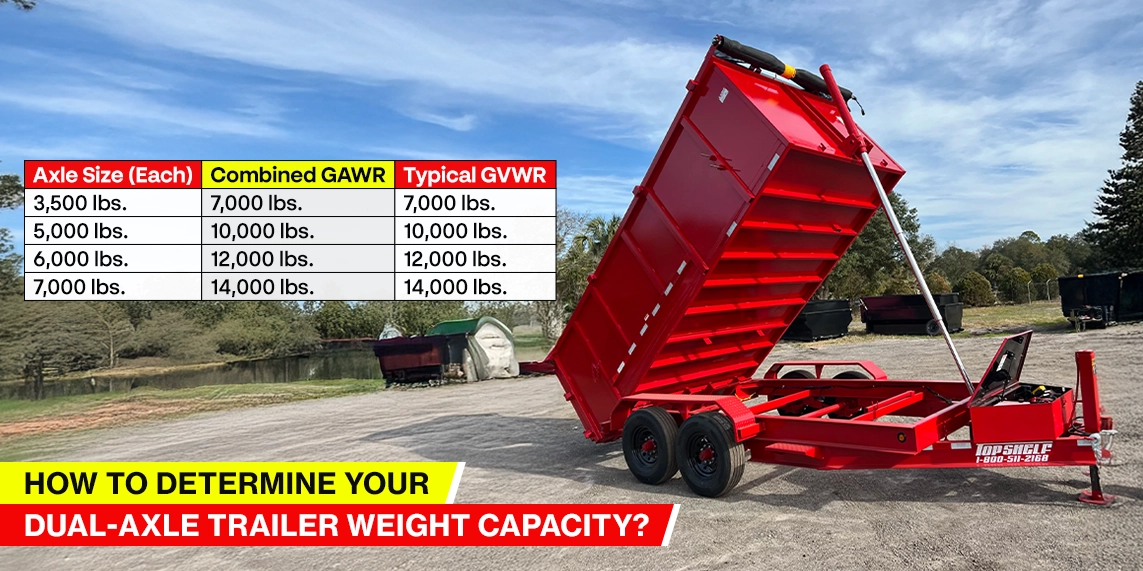
- Gross Axle Weight Rating (GAWR): The maximum weight that a single axle assembly is designed to support. If a 20-foot trailer has two axles, it will feature a GAWR for each axle.
- Tongue Weight: The downward force that the trailer's coupler exerts on the hitch ball of the tow vehicle. Ideally, this should fall between 10% and 15% of the total loaded trailer weight.
Variations by Trailer Type and Design
A 20-foot length is a common platform size, but the intended use drastically changes how much the trailer weighs. The structural materials, frame design, and enclosed features dictate the baseline empty weight.
When shopping for or utilizing a 20-foot trailer, categorizing the design helps clarify what kind of tow vehicle is required. The primary configurations include utility trailers, enclosed cargo trailers, equipment haulers, and dump trailers.
Utility and Flatbed Trailers
Open utility and flatbed trailers are constructed with steel or aluminum frames, wooden or metal decking, and open sides. Because they lack walls and a roof, their dry weight is generally lower than enclosed models.
A standard 20-foot steel utility trailer usually weighs between 2,000 and 3,000 pounds, offering a payload capacity that often pushes the GVWR to 7,000 or 10,000 pounds. Aluminum alternatives for the same length can reduce the empty weight significantly—sometimes dropping below 1,800 pounds—though they come at a higher purchase price and require specialized welding for repairs.
Enclosed Cargo Trailers
Enclosed cargo trailers feature walls, a roof, and rear ramp doors or side doors, transforming them into mobile storage units. The framing, plywood interior lining, and exterior skin add substantial weight compared to open flatbeds.
A typical 20-foot enclosed trailer (often configured as a car hauler or large cargo carrier) generally has an empty dry weight ranging from 3,000 to 4,500 pounds. Because their GVWR is frequently rated at 7,000, 10,000, or even 14,000 pounds, they provide ample cargo capacity for heavy items, provided the tow vehicle has the appropriate towing capacity and GCWR (Gross Combined Weight Rating).
Equipment and Car Haulers
Designed specifically to transport heavy machinery, skid steers, tractors, or automobiles, 20-foot equipment trailers feature heavy-duty steel channel frames, reinforced ramps, and heavy-duty deck flooring.
These trailers typically weigh between 2,500 and 4,000 pounds empty. Their robust construction allows for much higher payload thresholds, with many models rated for 10,000 to 14,000 pounds GVWR, requiring dual axles equipped with electric or hydraulic brakes.
Dump Trailers
Dump trailers are engineered for hauling gravel, dirt, demolition debris, and heavy materials. They require hydraulic lifting mechanisms, heavy-gauge steel walls, and deep-cycle onboard batteries to power the dump system.
Consequently, a 20-foot dump trailer is the heaviest category of trailer for its length. Empty weights frequently range from 4,500 to 7,000 pounds, with GVWRs scaling up to 14,000 or 21,000 pounds.
Weight Specifications Comparison Table
To visualize how construction style impacts load limits, the following table compares the typical weights, payload capacities, and common configurations for 20-foot trailers.
| Trailer Type | Average Empty (Dry) Weight | Typical GVWR Range | Maximum Payload Capacity | Common Axle Configuration |
|---|---|---|---|---|
| Open Utility / Flatbed | 2,000 – 3,000 lbs | 7,000 – 10,000 lbs | 5,000 – 7,000 lbs | Tandem Axle (Dual) |
| Enclosed Cargo / Hauler | 3,000 – 4,500 lbs | 7,000 – 14,000 lbs | 4,000 – 9,500 lbs | Tandem Axle (Dual) |
| Equipment Trailer | 2,500 – 4,000 lbs | 10,000 – 14,000 lbs | 7,500 – 10,000 lbs | Tandem Axle (Dual) |
| Dump Trailer | 4,500 – 7,000 lbs | 14,000 – 21,000 lbs | 9,500 – 14,000 lbs | Tandem or Triple Axle |
Factors Influencing 20-Foot Trailer Weight
Understanding why two 20-foot trailers can have vastly different weights requires looking at the engineering choices made during manufacturing. Several core factors determine both the dry weight and the ultimate carrying capacity.
Frame Material and Gauge
The primary structural skeleton of the trailer is usually built from steel or aluminum. Steel is durable, affordable, and easy to repair, but it adds considerable weight. The thickness (gauge) of the steel tubing or channel iron directly affects how heavy the trailer is. Thicker steel provides a higher load rating but increases the baseline dry weight. Aluminum reduces weight by 30% to 50% compared to steel, improving fuel efficiency for the tow vehicle, but it lacks steel’s fatigue resistance under extreme, continuous stress.
Axle Count and Suspension
A 20-foot trailer almost always utilizes a tandem-axle (two-axle) configuration, though some heavy-duty dump or equipment haulers use triple axles. Each additional axle, along with its associated leaf springs, torsion bars, hubs, and brakes, adds several hundred pounds to the empty weight of the trailer while doubling or tripling the weight distribution capabilities.
Built-In Features and Accessories
Additional factory-installed equipment contributes to the overall dry weight. Items such as:
- Built-in toolboxes and generator compartments
- Heavy-duty steel ramps or hydraulic tail lifts
- Winches and internal tie-down rails
- Electrical systems, interior lighting, and battery banks
- Water tanks or specialized shelving inside enclosed units
Each added feature consumes a portion of the trailer's total payload capacity before a single piece of cargo is loaded.
Legal, Safety, and Tow Vehicle Considerations
Towing a 20-foot trailer safely requires strict adherence to weight limits enforced by federal, state, and local transportation authorities. Exceeding these limits can result in mechanical failure, loss of control, and legal penalties.
Matching the Tow Vehicle
Your tow vehicle must be rated to handle not just the dry weight of the trailer, but the fully loaded weight (GVWR). Key metrics to verify in your vehicle owner’s manual include:
- Maximum Towing Capacity: The absolute heaviest trailer weight your vehicle can pull.
- Payload Capacity of the Tow Vehicle: The maximum weight that can be placed inside the truck or SUV, which includes passengers, cargo, and the trailer's tongue weight.
- Gross Combined Weight Rating (GCWR): The maximum allowable combined weight of the loaded tow vehicle and the loaded trailer.
Trailer Brakes and Licensing
Most 20-foot trailers have a GVWR exceeding 3,000 pounds, which legally requires trailer brakes in the vast majority of jurisdictions. These are typically electric brakes wired directly to a brake controller inside the tow vehicle, or surge brakes activated by the momentum of the trailer pushing against the hitch.
Additionally, depending on your local motor vehicle department regulations, trailers exceeding specific weight thresholds may require separate registration, annual safety inspections, and specialized driver's license endorsements.
Frequently Asked Questions
Can a half-ton pickup truck pull a 20-foot trailer?
A half-ton pickup truck (such as a Ford F-150, Chevrolet Silverado 1500, or Ram 1500) can pull an open utility or light equipment 20-foot trailer, provided the total loaded weight stays within the truck's specific towing capacity. However, pulling a heavy enclosed cargo trailer or a fully loaded 20-foot dump trailer typically requires a three-quarter-ton (2500/F-250) or one-ton truck to manage the weight and braking demands safely.
How do I find the exact weight of my specific trailer?
The most accurate method is to locate the manufacturer’s certification label, usually affixed to the left front side or tongue of the trailer. This metal placard lists the official dry weight, GVWR, and GAWR specifications. Alternatively, you can drive your empty trailer to a certified public scale (such as a CAT scale at a truck stop) to get an exact certified measurement.
Does a 20-foot trailer require special permits to tow?
In most regions, a standard 20-foot trailer does not require oversized load permits, as standard lane widths easily accommodate a trailer of this length (typically 8.5 feet wide or less). Permits are generally only required if the total combination length of the tow vehicle and trailer exceeds state-specific statutory limits, or if the trailer width exceeds 102 inches.
What is the ideal tongue weight for a 20-foot trailer?
The ideal tongue weight should fall between 10% and 15% of the total loaded weight of the trailer. If a fully loaded 20-foot trailer weighs 6,000 pounds, the tongue weight resting on your hitch should be between 600 and 900 pounds. Proper distribution prevents dangerous trailer sway and ensures the steering axle of your tow vehicle maintains adequate traction.
How much cargo can I legally put in a 20-foot enclosed trailer?
To determine your legal cargo limit, subtract the empty dry weight of the trailer from its assigned GVWR found on the manufacturer's VIN sticker. For example, if your enclosed trailer weighs 3,500 pounds empty and has a GVWR of 7,000 pounds, your maximum allowable payload is 3,500 pounds. Exceeding this figure violates federal and state weight laws.
Conclusion and Next Actions
Knowing the weight of a 20-foot trailer is essential for safe towing, legal compliance, and protecting your investment in equipment or goods. Before hooking up any trailer, verify its GVWR and empty weight using the manufacturer placard or a certified scale. Confirm that your tow vehicle's maximum towing capacity and payload limits exceed the total loaded weight of the trailer, and always ensure that trailer brakes and weight-distribution hitches are properly adjusted before hitting the highway.