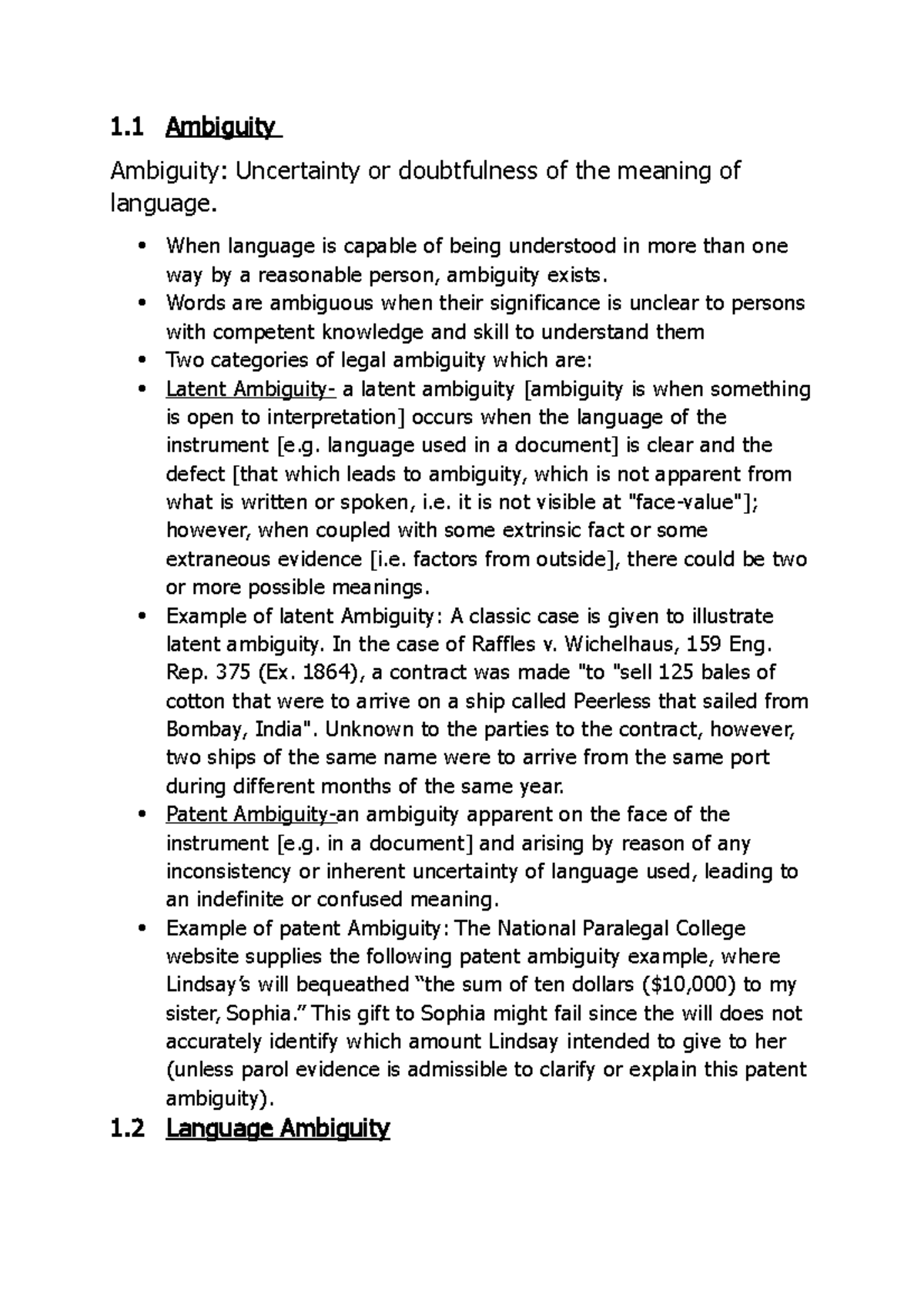
Ambiguity in legal language occurs when a word, phrase, or sentence is susceptible to more than one reasonable interpretation. A classic example is the "Oxford Comma" case (O’Connor v. Maine Superior Dairy, Inc.), where the absence of a comma in a list of activities led to a $5 million overtime pay dispute.
Legal ambiguity is often categorized as the "hidden trap" of jurisprudence. While the goal of any legal instrument—whether a statute, a commercial contract, or a last will and testament—is clarity and certainty, the inherent flexibility of the English language often introduces unintended meanings. By 2026, the legal community has increasingly adopted "Plain English" standards, yet the legacy of ambiguous drafting continues to populate court dockets across the globe.
Ambiguity is not merely a linguistic curiosity; it is a high-stakes vulnerability. When a contract is ambiguous, the parties may find themselves in protracted litigation where a judge, rather than the parties themselves, determines the meaning of their agreement. This article examines the most significant examples of legal ambiguity, the rules courts use to resolve them, and how modern drafting can mitigate these risks.
The Most Famous Example: The Multi-Million Dollar Oxford Comma
One of the most cited examples of syntactic ambiguity in recent legal history is the 2017 case of O’Connor v. Maine Superior Dairy, Inc. This case illustrates how a single missing punctuation mark can change the entire scope of a legal obligation.
The Statute in Question
The dispute centered on a Maine state law regarding overtime pay. The law stated that overtime was not required for workers involved in:
"The canning, processing, preserving, freezing, drying, marketing, storing, packing for shipment or distribution of: (1) Agricultural produce; (2) Meat and fish products; and (3) Perishable foods."
The ambiguity rested in the final phrase: "...packing for shipment or distribution."
The Conflict of Interpretation
The delivery drivers for the dairy argued that they were entitled to overtime because they were engaged in "distribution," but not in "packing for shipment or distribution." They contended that "packing for" modified both "shipment" and "distribution." Since they distributed the products but did not pack them, they argued the exemption did not apply to them.
The dairy company, conversely, argued that "distribution" was a standalone activity on the list, separate from "packing for shipment." In their view, any worker involved in distribution—whether they packed the goods or not—was exempt from overtime pay.
The Judicial Resolution
The United States Court of Appeals for the First Circuit ruled in favor of the drivers. The court noted that the absence of the Oxford comma (the comma before the "or") created a latent ambiguity. Because the list was not punctuated clearly, the court applied the "rule of lenity" or specific canons of construction that favor the remedial purpose of labor laws. This resulted in a $5 million settlement for the drivers, proving that a single comma—or the lack thereof—can have massive financial consequences.
Semantic vs. Syntactic Ambiguity: Defining the Difference
To understand legal ambiguity, one must distinguish between the two primary ways language fails to be precise: semantic and syntactic.
Semantic Ambiguity
Semantic ambiguity occurs when a single word has multiple meanings. A famous historical example is the case of Frigaliment Importing Co. v. B.N.S. International Sales Corp. (1960), often called the "What is Chicken?" case.
In this dispute, a contract called for the delivery of "chicken." The buyer expected young "broilers" or "fryers" suitable for roasting. The seller delivered "stewing hens," which are older, tougher birds. The court had to determine if the word "chicken" was ambiguous. The judge ultimately decided that the word "chicken" stood for everything from young fryers to old hens, and because the buyer had not specified the type, the seller's delivery of stewing hens was a valid performance of the contract.
Syntactic Ambiguity
Syntactic ambiguity, like the Maine dairy case, arises from the arrangement of words and punctuation rather than the words themselves. It often involves "modifier placement."
Consider the phrase: "The landlord shall provide insurance for the tenants and the guests who are registered."
- Interpretation A: Only the guests must be registered for the insurance to apply.
- Interpretation B: Both the tenants and the guests must be registered.
Without restructuring the sentence or adding clarifying punctuation, both interpretations are grammatically plausible, leading to potential disputes during an insurance claim.
The "Shall" vs. "Must" Debate in 2026
For decades, the word "shall" was the workhorse of legal drafting, intended to denote a mandatory obligation. However, "shall" is notoriously ambiguous because it is frequently used in three different ways:
- Mandatory: "The party shall pay the fee." (An obligation)
- Directory: "The notice shall be sent by mail." (A procedural suggestion)
- Future Tense: "The price shall be determined at a later date." (A prediction)
By 2026, many jurisdictions and professional organizations, including the American Bar Association, have recommended replacing "shall" with "must" to signify an obligation and "may" to signify a discretionary right. The U.S. Federal Government’s Plain Language Guidelines have long advocated for the elimination of "shall" to prevent courts from interpreting a mandatory requirement as merely a future possibility.
Latent vs. Patent Ambiguity
Courts categorize ambiguity based on when and how the confusion becomes apparent. This distinction is critical because it determines what kind of evidence a court will consider.
| Feature | Patent Ambiguity | Latent Ambiguity |
|---|---|---|
| Definition | Appears on the face of the document due to inconsistent or obscure language. | Appears only when the language is applied to external facts or circumstances. |
| Example | A contract that lists the price as "ten dollars ($1,000.00)." | A will leaving property to "my cousin John," when the testator has two cousins named John. |
| Evidence Allowed | Traditionally limited; courts often try to resolve it using only the document itself. | Extrinsic evidence (outside evidence) is almost always allowed to clarify the intent. |
| Resolution Complexity | Low to Medium; usually a drafting error. | High; requires investigation into the parties' history and context. |
Patent Ambiguity
A patent ambiguity is obvious to anyone reading the text. If a lease agreement states that the "term of the lease is twelve (24) months," the contradiction between the word and the number is a patent ambiguity. In these cases, courts often apply specific rules, such as "words prevail over numbers," to resolve the conflict without needing outside testimony.
Latent Ambiguity
A latent ambiguity is more "dangerous" because the document looks perfect until you try to execute it. In the "Cousin John" example, the language "my cousin John" is clear and unambiguous on its face. The ambiguity only arises (is "latent") when the executor discovers there are two individuals who fit that description. To solve this, the court must look at the testator’s relationships and communications—evidence outside the four corners of the will.
Canons of Construction: How Judges Resolve Ambiguity
When a case reaches the court due to ambiguous language, judges do not simply guess the meaning. They apply "canons of construction"—long-standing legal principles used to interpret text.
- Contra Proferentem: This rule dictates that an ambiguous term should be construed against the party who drafted the document. This is common in insurance contracts, where the insurer writes the policy and the consumer has no power to negotiate the terms. If the policy is unclear, the court usually favors the insured.
- Ejusdem Generis: Meaning "of the same kind." When a general word follows a list of specific words, the general word is interpreted to include only things of the same type as the specific ones. For example, in the phrase "lions, tigers, cheetahs, and other animals," the "other animals" would likely be interpreted as other large cats or predators, not domestic house pets.
- Noscitur a Sociis: Meaning "it is known by its associates." The meaning of an unclear word can be gathered from the words surrounding it.
- The Rule of Lenity: In criminal law, if a statute is ambiguous, it must be interpreted in the way most favorable to the defendant. This ensures that no one is punished under a law that does not clearly prohibit their conduct.
Modern Mitigation: The Role of the "Definitions" Section
In 2026, the primary tool for avoiding ambiguity in commercial and technical contracts is the robust use of a "Definitions" section. By explicitly defining terms at the outset, drafters can override the general or multiple meanings found in standard dictionaries.
For instance, a software license might define "User" specifically as "an individual employee of the Licensee located at the Seattle office," rather than leaving "User" open to include contractors, remote workers, or third-party vendors. This precision prevents the "Semantic Ambiguity" seen in the "Chicken" case.
Furthermore, modern drafting software now utilizes AI-driven "ambiguity checkers" that flag dangling modifiers and inconsistent terminology. Despite these technological leaps, the human element of interpretation remains the final arbiter in legal disputes.
Practical Recommendations for Drafting and Review
To ensure that legal documents are enforceable and their meanings are undisputed, parties should adhere to several best practices:
- Standardize Punctuation: Always use the Oxford comma in lists to ensure each item is treated as a distinct entity.
- Avoid "And/Or": This phrase is a common source of confusion. Instead, use "X or Y, or both" to be explicit.
- Use Active Voice: Ambiguity often hides in the passive voice. "The payment shall be made" does not specify who must make the payment. "The Buyer must pay the Seller" leaves no doubt.
- Define Technical Terms: If a word has a specific meaning in an industry (like "bandwidth" or "gross negligence"), define it within the contract rather than relying on common usage.
- Consistency is Key: Do not use "The Vehicle" in one paragraph and "The Automobile" in another. Choose one term and stick to it throughout the document.
Frequently Asked Questions
What is the most common cause of legal ambiguity?
The most common cause is the use of vague modifiers and inconsistent terminology. Often, a drafter will use a word that seems clear in their own mind but fails to account for how that word might be interpreted by a stranger to the transaction or by a court years later.
Can a contract be voided due to ambiguity?
Typically, a contract is not voided just because it is ambiguous. Instead, the court will apply rules of construction to determine the "correct" meaning. However, if the ambiguity is so fundamental that there was no "meeting of the minds" (mutual agreement) on essential terms, the contract could potentially be found unenforceable.
Does the "Oxford Comma" really matter in all legal jurisdictions?
While not every court is as strict as the First Circuit was in the Maine Dairy case, the trend in 2026 is toward strict grammatical interpretation. Using the Oxford comma is considered a "best practice" globally to eliminate syntactic risk, regardless of whether the specific jurisdiction has a landmark case on it.
How does "reasonable" qualify as an ambiguous term?
"Reasonable" is a term of deliberate ambiguity (often called "vague" rather than ambiguous). It is used when parties cannot agree on a specific number or timeframe but want to establish a standard of conduct. While it provides flexibility, it often leads to disputes over what constitutes "reasonable" under specific circumstances.
What should I do if I find an ambiguity in a contract I’ve already signed?
The first step is to draft an amendment or an "Addendum of Clarification" that both parties sign. This document should explicitly state the intended meaning of the ambiguous phrase. Resolving it while the parties are still on good terms is significantly cheaper than waiting for a dispute to trigger litigation.
Final Guidance for Legal Clarity
Ambiguity is the enemy of legal certainty. Whether you are a business owner signing a lease or an individual drafting a will, the goal of your legal language should be "unidirectionality"—the text should point to only one possible conclusion. When in doubt, simplify the sentence structure, define your terms, and never underestimate the power of a well-placed comma. If a provision feels slightly unclear during the drafting phase, it will almost certainly become a point of contention if the relationship between the parties sours. Prioritize clarity over "legalese" to ensure your intentions are protected by the law, not obscured by it.