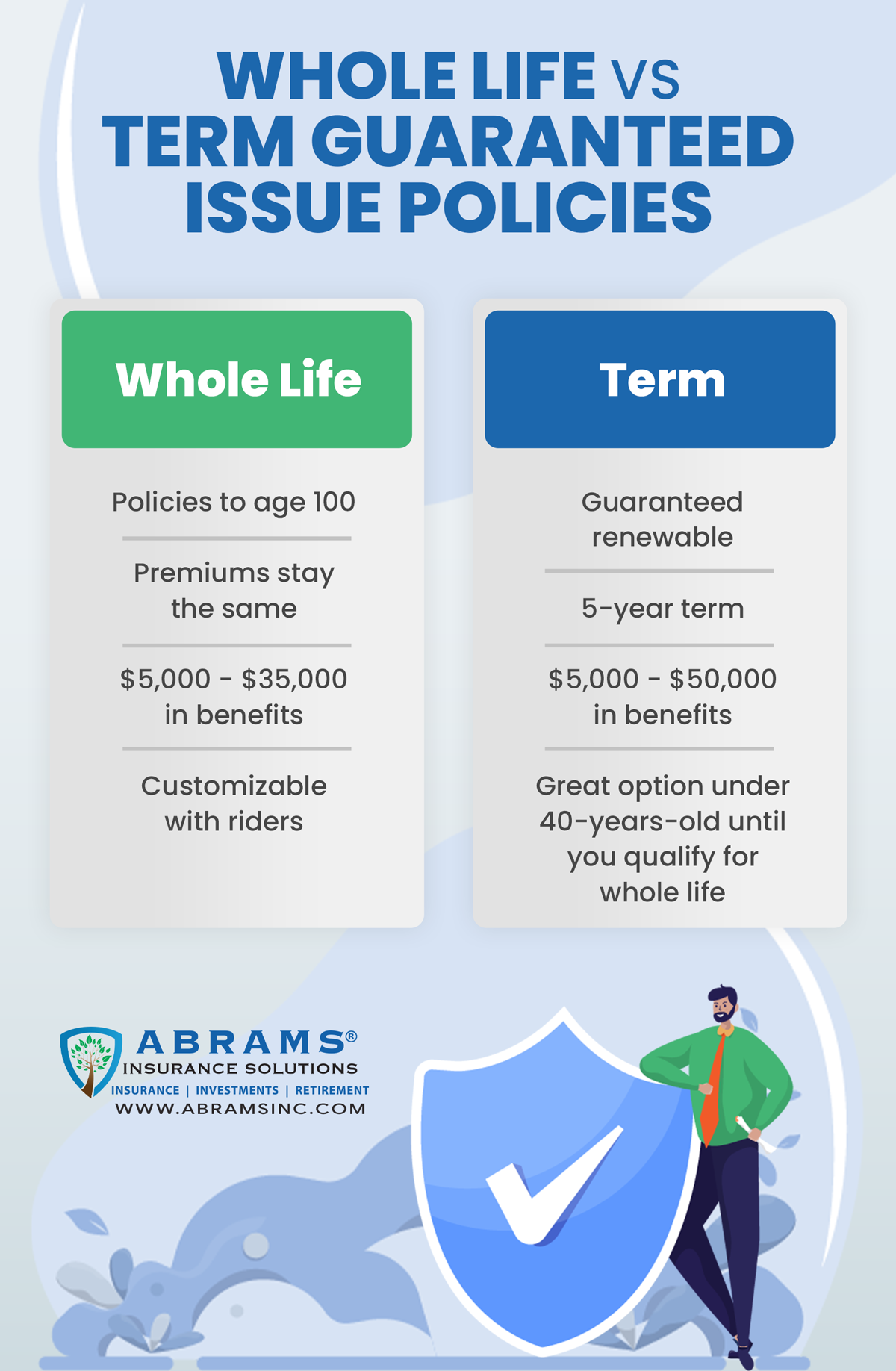
When searching for American National guaranteed issue term life insurance, it is essential to clarify a common industry distinction: American National Insurance Company (ANICO) offers Guaranteed Issue Whole Life Insurance for permanent final expense coverage without health questions, alongside Simplified Issue Term Life Insurance (such as Signature Term) which provides temporary coverage without a physical medical exam but still requires health history screening.
Understanding the difference between guaranteed acceptance permanent policies and simplified issue term policies is crucial when shopping for life insurance. Many applicants use the term "guaranteed issue term insurance" when they mean high-approval term insurance that skips traditional blood work and physical examinations. Others seek a policy that guarantees approval regardless of severe pre-existing medical conditions.
Evaluating how American National structures its life insurance products, how accelerated underwriting works, what costs to expect, and how to select the right policy for your financial goals will ensure you secure the proper coverage.
Understanding American National's Policy Landscape: Term vs. Guaranteed Issue
American National Insurance Company, headquartered in Galveston, Texas, has provided life insurance and financial products since 1905. When evaluating their policy portfolio, understanding insurance industry underwriting categories is necessary to avoid purchasing an inadequate policy or facing unexpected coverage limitations.
American National Life Insurance Products:
- Simplified Issue Term (e.g., Signature)
- Temporary (10–30 years)
- Health questions required
- No physical exam (qualifying)
- High coverage limits ($1M+)
- Includes Living Benefits
- Guaranteed Issue Whole (e.g., Value Guard)
- Permanent (Lifetime)
- Zero health questions
- Guaranteed approval (50–80)
- Lower coverage ($5k–$25k)
- 2-Year Graded Death Benefit
In the life insurance industry, policies fall into distinct underwriting frameworks:
- Guaranteed Issue Life Insurance: Requires no physical medical exam and asks zero health questions. Approval is guaranteed for applicants who fall within the eligible age bracket (typically ages 50 to 80). Because the insurer assumes high risk without knowing the applicant's medical history, these policies are issued almost exclusively as Whole Life Insurance (permanent coverage), feature modest maximum face amounts (typically $5,000 to $25,000), and include a two-year graded death benefit period.
- Simplified Issue Term Life Insurance: Requires no physical medical exam (no blood draws or urine samples) for qualifying applicants, but does require answering medical questions on the application. The insurer checks background health databases, prescription histories, and motor vehicle records. If approved, applicants obtain term insurance with higher death benefits (often up to $1,000,000 or more) at significantly lower rates than guaranteed issue policies.
- Fully Underwritten Term Life Insurance: Requires a detailed health questionnaire, medical record reviews, and frequently a paramedical exam (blood, urine, blood pressure, EKG). This offers the lowest possible premium rates for healthy individuals.
Because pure "guaranteed issue term insurance" is largely non-existent in individual retail life insurance—as term insurance carries high death benefit amounts that insurers cannot risk granting without health screening—consumers looking for American National coverage generally choose between Signature Term (simplified/accelerated term coverage) and Guaranteed Issue Whole Life (permanent final expense coverage).
American National Signature Term Life Insurance (Simplified & Accelerated Options)
For consumers seeking level term protection without the hassle of a medical exam, American National offers individual term coverage through products like Signature Term.
Policy Durations and Coverage Amounts
Signature Term provides level death benefit protection for specified timeframes:
- Term Lengths: 10, 15, 20, and 30-year initial level premium periods.
- Coverage Amounts: Available from $250,000 up to several million dollars, depending on age, financial need, and underwriting tier.
Accelerated Underwriting (ANICO Xpress)
American National utilizes an accelerated underwriting process known as ANICO Xpress. For eligible applicants meeting age and coverage limits (often up to age 65 and up to $1,000,000 in coverage), the insurer can streamline or waive the paramedical exam entirely.
Instead of requiring blood work and physical exams, the company relies on automated data sources to evaluate risk:
- Medical Information Bureau (MIB) Reports: Checks prior life and health insurance application records.
- Prescription History Databases (Rx Checks): Analyzes past and current medications to identify underlying health conditions.
- Motor Vehicle Records (MVR): Assesses driving history for risky behaviors.
- Credit-Based Insurance Scores: Evaluates financial stability metrics correlated with policy longevity.
If data checks show a clean health profile, approval can occur within days without physical examination. However, if data sources indicate underlying health risks, American National reserves the right to request full medical underwriting or traditional exam procedures.
Accelerated Benefit Riders (Living Benefits)
A primary advantage of American National's term policies is the inclusion of Built-in Living Benefits through Accelerated Benefit Riders (ABRs) at no extra upfront premium cost in eligible states. These riders allow policyholders to access a portion of their death benefit while still living if diagnosed with a qualifying condition:
- Terminal Illness: Option to accelerate funds if diagnosed with a terminal condition resulting in a limited life expectancy (typically 12 to 24 months).
- Chronic Illness: Option to accelerate funds if unable to perform at least 2 of the 6 Activities of Daily Living (ADLs)—such as bathing, dressing, eating, or transferring—or requiring substantial supervision due to severe cognitive impairment.
- Critical Illness: Option to accelerate funds if suffering from a specified critical condition such as stroke, major heart attack, invasive cancer, or end-stage renal failure.
Conversion Options
Signature Term policies contain conversion privileges. Policyholders can convert their term policy into a permanent whole life or universal life policy issued by American National without presenting evidence of insurability or undergoing new medical exams, provided the conversion occurs within the designated conversion period (typically prior to age 65 or 70, depending on contract terms).
American National Guaranteed Issue Whole Life Insurance
For individuals who cannot qualify for term insurance due to severe pre-existing medical conditions, advanced age, or recent health events, American National provides Guaranteed Issue Whole Life Insurance (often marketed under product names like Value Guard).
Timeline of Guaranteed Issue Whole Life Death Benefit (2-Year Graded Period):
- Year 1 & Year 2 (Non-Accidental):
- Payout = All Premiums Paid + 10%
- Accidental Death = 100% Full Face
- Year 3 and Beyond:
- Payout = 100% Full Face Amount
Key Policy Specifications
- Guaranteed Approval: No health questions, no medical exams, and no attending physician statements (APS). If you meet the age requirement, your application cannot be declined due to health status.
- Issue Ages: Designed primarily for older adults, typically available to individuals aged 50 to 80.
- Face Amounts: Lower coverage ceilings designed specifically for final expenses, burial costs, and small outstanding debts (commonly ranging from $5,000 to $25,000 or $50,000 depending on state limits).
- Fixed Premiums: Premiums are locked in at policy issue and will never increase due to age or changing health conditions.
- Cash Value Accumulation: As a permanent whole life policy, it builds tax-deferred cash value over time, which can be borrowed against via policy loans.
Understanding the 2-Year Graded Death Benefit
Because guaranteed issue coverage accepts applicants with severe chronic or fatal health conditions without underwriting, state regulations and actuarial principles require a Graded Death Benefit during the first two policy years to prevent adverse selection:
- Non-Accidental Death (Years 1–2): If the insured dies from natural causes (e.g., illness, heart disease, cancer) within the first two years of policy issuance, the beneficiary does not receive the full face amount. Instead, the insurer pays a return of all premiums paid to date plus interest (typically 10%).
- Accidental Death (Years 1–2): If the insured dies as a direct result of an accident during the first two years, the full face amount is paid to the beneficiary immediately.
- All Causes of Death (Year 3+): Once the policy has been active for two full years, 100% of the face amount is payable for death due to any cause.
Comparing American National Coverage Options
To help evaluate whether simplified term or guaranteed issue whole life fits your situation, review this feature comparison:
| Feature / Parameter | Signature Term Life (Simplified / Accelerated) | Guaranteed Issue Whole Life |
|---|---|---|
| Policy Type | Temporary Term (10, 15, 20, 30 years) | Permanent Whole Life (Lifetime) |
| Target Age Group | Ages 18 to 65–70 (varies by term length) | Ages 50 to 80 |
| Maximum Coverage Amount | $250,000 to $1,000,000+ | $5,000 to $25,000 (up to $50,000 in select states) |
| Medical Exam Required? | Usually waived for qualified applicants | Never required |
| Health Questions Required? | Yes (Detailed medical questionnaire) | No (Zero health questions) |
| Database Checks | MIB, Rx history, MVR, background records | None (Identity and age verification only) |
| Death Benefit Structure | 100% full face benefit from Day 1 | Graded benefit (Return of premium + 10% for natural death in Years 1–2; 100% after Year 2) |
| Living Benefits (ABRs) | Included (Terminal, Critical, Chronic Illness) | Generally not included |
| Cash Value Accumulation | No cash value | Yes (Tax-deferred growth over time) |
| Cost per $1,000 of Coverage | Low to moderate | High (Reflects un-underwritten risk) |
| Primary Use Case | Income replacement, mortgage protection, family protection | Burial costs, final expenses, debt payoff |
Cost Considerations and Premium Factors
Life insurance pricing is direct function of risk. When choosing between simplified term and guaranteed whole life, pricing structures vary significantly.
Relative Premium Cost per $1,000 of Coverage:
- Fully Underwritten Term [$$]: Lowest Cost / Requires Exam
- Simplified Issue Term [$$$]: Low to Moderate / Requires Health Questions
- Guaranteed Issue Whole [$$$$$$$$$$]: Highest Cost / No Health Questions
Why Guaranteed Issue Costs More Per Dollar of Coverage
With guaranteed issue policies, the insurance company accepts high-risk individuals—including those undergoing active cancer treatments, experiencing end-stage renal disease, or facing terminal conditions—without reviewing medical records. To compensate for this unmanaged mortality risk, the insurer charges a significantly higher premium per dollar of coverage compared to underwritten term insurance.
For example:
- A relatively healthy 55-year-old male might secure a $250,000 20-year term policy via simplified underwriting for a modest monthly premium.
- That same 55-year-old male purchasing a $25,000 Guaranteed Issue Whole Life policy might pay a similar or higher monthly premium for just one-tenth of the total death benefit.
Premium Rate Factors
For both policy types, premiums are calculated based on key parameters:
- Age at Application: Rates increase with each year of age.
- Gender: In most jurisdictions, females receive lower rates than males due to longer average life expectancy.
- Tobacco Use: Nicotine use significantly raises premiums across both term and guaranteed issue products.
- Coverage Amount (Face Value): Higher death benefit amounts increase total premium cost, though rates per $1,000 of coverage often decrease at higher benefit tiers on term insurance.
The National Association of Insurance Commissioners (NAIC) offers official consumer education resources regarding how policy premiums are calculated and regulated across state jurisdictions.
Step-by-Step Guide: How to Apply for American National Coverage
Navigating the application process for American National insurance involves several steps depending on which product pathway you select.
Applying for Coverage:
Simplified Issue Term:
- Select Term Length & Amount
- Answer Health Questionnaire
- Automated Database Checks (MIB, Rx, Motor Vehicle)
- Approval / Underwriting Decision
- Policy Issued (Day 1 Benefit)
Guaranteed Issue Whole:
- Select Coverage ($5k–$25k)
- Provide ID & Age Proof
- Automatic Approval
- First Premium Payment
- Policy Issued (2-Yr Graded)
Step 1: Define Your Financial Need
Determine what financial risk you are trying to mitigate:
- If you need to replace lost income, pay off a mortgage, or cover children's future tuition, you require a large death benefit ($250,000+) only achievable through Term Life Insurance.
- If you only need to cover funeral expenses ($10,000 to $20,000) and have severe health conditions, Guaranteed Issue Whole Life is the proper fit.
Step 2: Evaluate Your Health Eligibility
Assess your health status realistically:
- If you have manageable health conditions (controlled hypertension, mild cholesterol, well-controlled type 2 diabetes), apply for Simplified Issue Term. Answering health questions allows you to qualify for full coverage from day one at a much lower cost.
- If you have severe health issues (recent heart attack, active cancer treatment, organ failure, oxygen use, dialysis, or residence in a nursing facility), skip term applications and apply directly for Guaranteed Issue Whole Life.
Step 3: Gather Personal and Financial Information
Prepare the necessary information before starting your application:
- Social Security number and government-issued photo identification.
- Full legal name and contact details for designated beneficiaries.
- Detailed list of current medications and prescribing physicians (if applying for term coverage).
- Banking information for automatic premium payments (EFT).
Step 4: Complete the Application
- For Signature Term: Complete the health history section thoroughly and accurately. Authorize American National to perform electronic database checks (MIB, Rx, MVR).
- For Guaranteed Issue: Complete the basic application confirming identity, age, and beneficiary designations. No health questions will be asked.
Step 5: Review Underwriting Decision and Policy Terms
Upon approval, review your official policy document during the Free-Look Period. State insurance laws typically grant a 10 to 30-day free-look period during which you can review your policy terms and cancel for a 100% refund of any premiums paid if the policy does not meet your expectations.
Common Pitfalls and How to Avoid Them
1. Confusing Simplified Issue with Guaranteed Issue
The most common mistake consumers make is assuming that "no medical exam" means "no health questions." If you apply for simplified issue term coverage believing it is guaranteed issue, and fail to disclose pre-existing medical conditions on the questionnaire, your application will be declined. Worse, if non-disclosures are made intentionally, the insurance company can rescind the policy during the two-year contestability period.
2. Overlooking the Two-Year Graded Period on Guaranteed Issue
Purchasing guaranteed issue whole life coverage under the assumption that it pays full face value immediately for natural death can lead to disappointment for beneficiaries. Always remember that natural death within the first two policy years results in a return of paid premiums plus interest, not the full death benefit.
3. Failing to Utilize Term Conversion Options
Many term policyholders allow their policy to expire at the end of the 10, 20, or 30-year term without evaluating their health status. If your health has declined late in the term, exercising your term conversion privilege allows you to transition to an American National permanent policy without undergoing medical underwriting.
4. Relying Solely on Employer Group Life Insurance
Group life insurance provided by employers is often "guaranteed issue up to a basic limit" (e.g., $50,000 or 1x salary). However, group coverage is usually tied to employment. If you leave your job or retire due to failing health, you may lose that coverage when you need it most. Securing an individual policy independently ensures permanent protection.
Alternative Coverage Options
If American National's term or guaranteed issue policies do not precisely align with your budget or health profile, several alternative approaches exist within the marketplace:
1. Fully Underwritten Life Insurance
If you are in relatively good health and willing to undergo a paramedical exam (blood draw, urine sample, blood pressure check), fully underwritten policies from top-tier carriers provide the lowest cost per thousand dollars of coverage available.
2. Simplified Issue Whole Life (Final Expense)
If you do not qualify for term insurance due to moderate health issues, but are not severe enough to require guaranteed issue, consider Simplified Issue Final Expense Whole Life. These policies ask 10 to 15 health questions but skip physical exams. If you pass the health questions, you receive Day 1 full coverage (avoiding the 2-year graded period) at a lower cost than guaranteed issue.
3. Mutual Benefit Societies and Fraternal Organizations
Some fraternal benefit societies offer small-value life insurance options with alternative underwriting criteria for members and their families.
State-specific insurance consumer protections and policy regulation details can be confirmed directly through your state's Department of Insurance or the National Association of Insurance Commissioners (NAIC).
Frequently Asked Questions
Does American National offer guaranteed issue term life insurance with high death benefits?
No. Guaranteed issue coverage—which features zero medical questions and guaranteed approval—is offered by American National as Whole Life insurance with lower maximum face amounts (typically up to $25,000 or $50,000). American National's Term Life insurance (Signature Term) offers high death benefits ($250,000 to $1,000,000+) and may waive physical medical exams, but it still requires applicants to answer health questions.
Can I get denied for American National Signature Term insurance?
Yes. Signature Term uses simplified or accelerated underwriting. While it may skip physical blood work for qualified applicants, American National reviews medical questionnaires, MIB records, prescription databases, and driving records. Applicants with severe health conditions or high-risk lifestyles can be declined or rated up in price.
How does the 2-year graded death benefit work on American National guaranteed issue whole life?
If the insured dies of natural causes (such as an illness) within the first two years after policy issue, the policy pays a graded benefit consisting of all premiums paid to date plus interest (typically 10%). If death occurs due to an accident during the first two years, or from any cause after year two, the full face value is paid to the beneficiary.
Are living benefits included in American National guaranteed issue policies?
Living benefits (Accelerated Benefit Riders for critical, chronic, or terminal illness) are standard features on American National's underwritten and simplified term policies like Signature Term in eligible states. However, guaranteed issue whole life policies generally do not include living benefit riders due to the un-underwritten nature of the coverage.
What is the age limit to apply for American National life insurance?
Age limits depend on the specific product. Signature Term is generally available to applicants up to age 65 or 70 (depending on the term length selected). Guaranteed Issue Whole Life (Value Guard) is typically available to applicants between the ages of 50 and 80.
Actionable Next Steps
To select the right American National insurance coverage for your financial situation:
- Assess Your Medical History: If you have minor or controlled medical conditions, request a quote for American National Signature Term. You can secure a higher death benefit at a lower premium while taking advantage of no-exam accelerated underwriting.
- Review Guaranteed Acceptance Needs: If you are between ages 50 and 80 and have severe pre-existing conditions that prevent passing underwriting health questions, evaluate Guaranteed Issue Whole Life to cover final expenses.
- Compare Quotes with an Independent Broker: Work with a licensed independent life insurance agent who represents American National alongside other carrier options. An independent broker can pre-screen your health profile across multiple insurance companies without placing formal declines on your record.
- Read Policy Disclosures Carefully: Prior to signing your application, verify whether your policy includes a 2-year graded benefit period, review the exact terms of any accelerated benefit riders, and confirm your locked-in monthly premium schedule.
Disclaimer: Life insurance product specifications, age limits, availability, riders, and policy terms vary by state jurisdiction and are subject to carrier underwriting rules. For specific legal, financial, or tax guidance regarding life insurance policy selection and estate planning, consult a qualified professional financial advisor or licensed insurance professional.