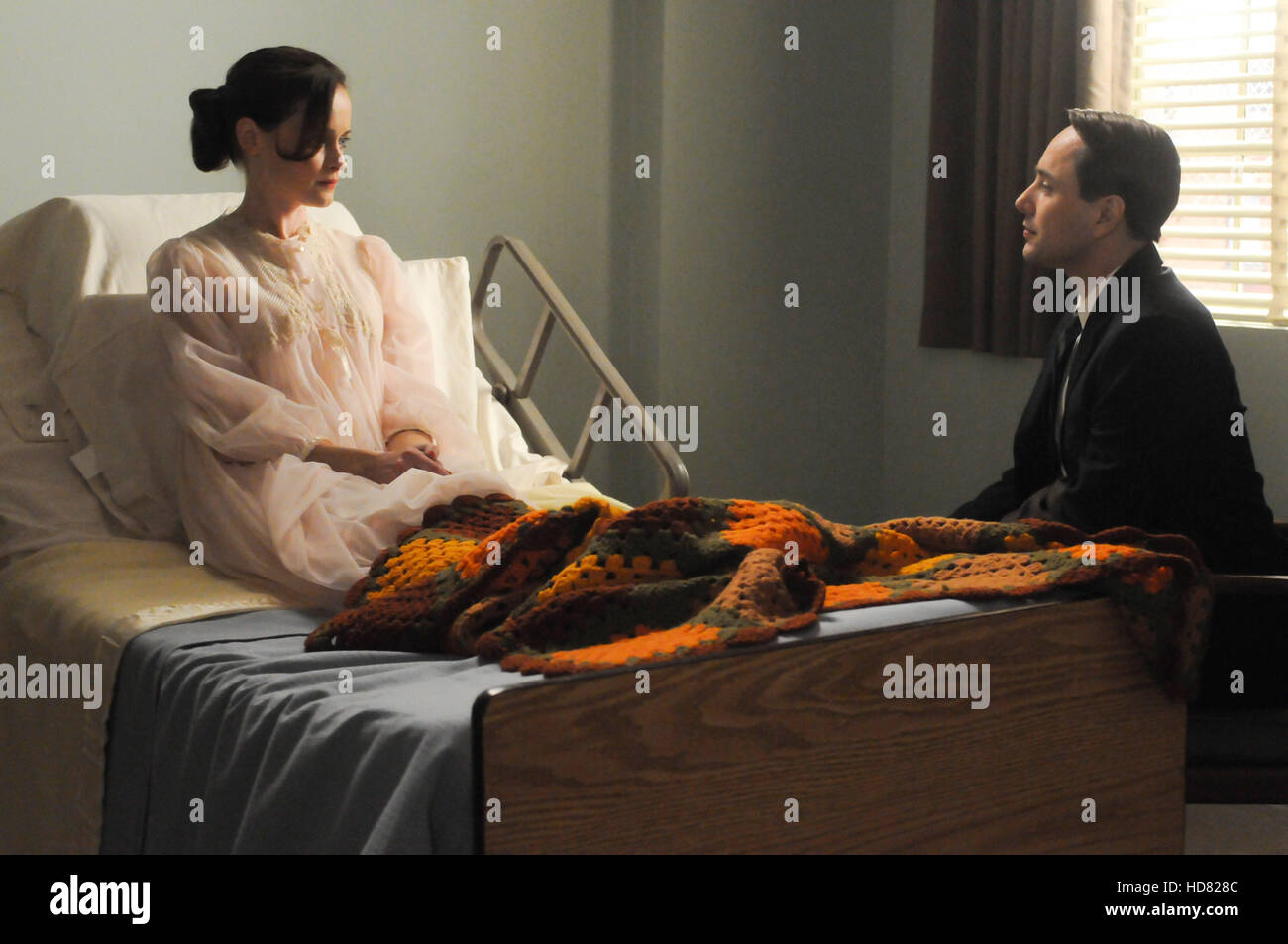
Alexis Bledel portrayed Beth Dawes across three episodes of Mad Men Season 5 in 2012. Her character, an emotionally distressed suburban housewife who engages in a short-lived affair with Pete Campbell before undergoing electroconvulsive therapy, served as an existential turning point for Pete and sparked a real-life romance between Bledel and co-star Vincent Kartheiser.
Who Was Beth Dawes? Alexis Bledel’s Arrival in the Mad Men Universe
When Alexis Bledel joined the cast of AMC's acclaimed period drama Mad Men during its fifth season, viewers were introduced to a stark departure from the actress’s most famous role. Having spent seven seasons portraying the sharp, ambitious, and sheltered Rory Gilmore on Gilmore Girls, Bledel arrived on Matthew Weiner’s 1960s Madison Avenue drama wrapped in melancholy, vulnerability, and mid-century disillusionment.
Bledel was cast as Beth Dawes, a young housewife residing in the affluent suburbs of Westchester County, New York. Beth is introduced through her husband, Howard Dawes (played by Jeff Clarke), an insurance salesman who shares a daily commute on the Metro-North train with Sterling Cooper Draper Pryce partner Pete Campbell (Vincent Kartheiser). Howard represents an overt example of casual, mid-century suburban infidelity. He openly boasts to Pete about maintaining an apartment in Manhattan specifically to pursue extramarital affairs, leaving his wife isolated in their suburban home under the guise of working late.
Beth enters the narrative not as a glamorous siren, but as an isolated woman suffocated by the rigid expectations of suburban domesticity and battling profound psychological distress. Bledel’s performance brought a haunting, fragile aura to the series. Her large, expressive eyes and subdued vocal delivery highlighted Beth's emotional detachment and deep-seated longing for genuine connection, making her an immediate, irresistible counterweight to Pete Campbell's escalating midlife discontent.
The Season 5 Arc: Breakdown of Beth Dawes’s Three Episodes
Beth Dawes appears in three pivotal episodes of Season 5: "Lady Lazarus" (Episode 8), "Dark Shadows" (Episode 9), and the season finale, "The Phantom" (Episode 13). Though her screen time was limited, the emotional weight of her arc left an indelible mark on the season's thematic framework.
| Episode | Air Date | Core Story Events | Significance to Pete |
|---|---|---|---|
| "Lady Lazarus" (Season 5, Ep. 8) | May 6, 2012 | Pete encounters Beth after Howard strands her; they sleep together in his Manhattan apartment. | Pete crosses ethical boundaries; sparks his obsessive fixation. |
| "Dark Shadows" (Season 5, Ep. 9) | May 13, 2012 | Beth meets Pete at a hotel but rejects his attempts to start an ongoing romantic relationship. | Shakes Pete's ego; exposes his inability to find true intimacy. |
| "The Phantom" (Season 5, Ep. 13) | June 10, 2012 | Pete visits Beth in a psychiatric ward post-ECT; she has amnesia and fails to recognize him. | Pete confronts his own profound loneliness through a surrogate. |
"Lady Lazarus" (Season 5, Episode 8): The Sparks of Adultery
Beth first appears when she is left stranded at a train station waiting room because Howard failed to return from the city. Pete, recognizing his commuter companion's wife, offers her a ride and eventually welcomes her into his pied-à-terre in Manhattan.
The chemistry between them is driven not by standard lust, but by a shared sense of alienation. Beth is keenly aware of her husband's infidelity and treats her own loneliness with quiet resignation. Pete, who has achieved everything he thought he wanted—a partnership at the agency, a home in the suburbs, a wife (Trudy, played by Alison Brie), and a child—finds himself miserable and adrift.
Their brief sexual encounter culminates in a poetic, melancholic visual metaphor: Beth draws a small heart on the condensation of Pete’s car window, warning him that their liaison is a fleeting moment that will vanish just like the steam on the glass. Pete touches the drawing, an act that underscores his immediate, desperate fixation on her.
"Dark Shadows" (Season 5, Episode 9): Rejection and Desperation
In her second appearance, Pete attempts to turn their single encounter into a sustained affair. He arranges an elaborate assignation, coordinating a meeting at a Manhattan hotel. However, the rendezvous does not yield the romantic validation Pete desires.
Beth arrives, but her posture is defensive and guarded. She makes it clear that while she succumbed to the encounter in "Lady Lazarus," she does not view Pete as an escape route from her life. She identifies the emptiness inside him, bluntly informing him that he cannot use her to remedy his own inner dissatisfaction. When Pete attempts to press forward, she firmly cuts off contact, leaving him humiliated, angry, and increasingly destabilized in his personal and professional life.
"The Phantom" (Season 5, Episode 13): ECT and the Erasure of Identity
The culmination of Beth’s story occurs in the Season 5 finale, titled "The Phantom," providing one of the most tragic storylines in Mad Men history. Pete learns that Howard has had Beth admitted to a psychiatric hospital to undergo electroconvulsive therapy (ECT) to treat severe depression.
Pete travels to the clinic under false pretenses, posing as a family friend or relative to gain entry to Beth’s room. When he sits beside her bed, he discovers the physical and mental fallout of 1960s psychiatric intervention. Beth is languid, bruised, and suffers from temporary retrograde amnesia—a common side effect of bilateral ECT at the time.
When Beth looks at Pete, she displays no recognition whatsoever. She treats him with gentle, polite detachment, viewing him as a stranger who simply stopped by to check on her. Unable to break through her medically induced memory loss, Pete delivers a devastating monologue under the guise of describing a "friend":
"He had an affair with a woman... and he realized that this woman was the only thing holding him together. But she didn't care. And now she doesn't even remember him."
Beth listens with sympathetic pity, unaware that she is the woman in question. The sequence ends with Pete realizing that the temporary connection they shared has been surgically erased from her mind, leaving him utterly alone in his despair.
Character Analysis: Beth Dawes as Pete Campbell's Psychological Mirror
Beth Dawes was not simply another romantic conquest in Pete Campbell's long history of indiscretions; she represented a structural mirror to his internal breakdown during Season 5.
Throughout the earlier seasons of Mad Men, Pete strove relentlessly to mimic Don Draper’s swagger, professional success, and masculine independence. By Season 5, Pete has achieved wealth, an attractive marriage, and high standing at SCDP, but the rewards prove hollow. He finds suburban life with Trudy suffocating, and the commute on the train symbolizes a daily march into domestic boredom.
- Suburban Discontent
- Beth Dawes
- Clinical depression
- Domestic isolation
- Erased through ECT
- Pete Campbell
- Existential dread
- Status-driven emptiness
- Imprisoned in routine
- Beth Dawes
- The Inability to Connect
When Pete meets Beth, he sees someone experiencing the same profound dislocation from normal life. Unlike Don Draper’s mistresses, who are often independent artists, professionals, or bohemians, Beth is a captive of the very suburban ecosystem that Pete dreads. Pete’s obsession with her is narcissistic: he wants to save her so he can save himself.
Beth’s electroconvulsive therapy serves as a narrative execution of Pete’s hope. Her memory loss denies him the closure or validation he seeks. By stripping away her recollection of their affair, the narrative leaves Pete trapped inside his own memory, forced to carry the burden of his guilt and unfulfilled desires completely alone.
Electroconvulsive Therapy in the 1960s: Historical Context
Beth Dawes's psychiatric treatment provides a grim window into how mental health conditions—particularly among women—were handled in the United States during the mid-to-late 1960s.
During this era, inpatient psychiatric facilities frequently employed unmodified or minimally modified electroconvulsive therapy to treat severe major depressive disorder, bipolar depression, and conditions labeled broadly as "hysteria" or "neurosis." While modern ECT is an evidence-based, highly refined psychiatric treatment administered under precise anesthesia and muscle relaxation, mid-century ECT often involved:
- Higher dosages of electrical stimulation: Early machines lacked the brief-pulse technology used today, often leading to greater cognitive impairment.
- Significant retrograde and anterograde amnesia: Patients routinely lost memories spanning weeks, months, or even years surrounding the treatment periods.
- Gendered coercion: Husbands held immense legal and medical authority over their wives' institutionalization and consent for medical procedures, a dynamic depicted through Howard's unilateral decision to commit Beth.
In Mad Men, Matthew Weiner used ECT not merely as medical drama, but as a thematic device reflecting the era's compulsion to smooth over domestic cracks. Howard Dawes does not seek to understand Beth's sorrow; he seeks to reboot her mind so she can resume functioning as an agreeable, non-disruptive homemaker. Her blank slate at the end of Season 5 demonstrates how society enforced suburban conformity at the expense of individual identity and memory.
Off-Screen Romance: Alexis Bledel and Vincent Kartheiser
While the dynamic between Beth Dawes and Pete Campbell ended in tragedy and emotional estrangement, the dynamic between the two actors took the opposite trajectory.
Alexis Bledel and Vincent Kartheiser met on the set of Mad Men in early 2012 while filming Season 5. Co-stars and crew members noted that both actors remained entirely professional throughout production. Matthew Weiner later noted that the pair did not begin dating until after filming on Season 5 had completely wrapped.
| Year | Milestone |
|---|---|
| Early 2012 | Meet during the production of Mad Men Season 5. Maintain professional rapport. |
| Mid-2012 | Begin dating publicly after Season 5 concludes airing. |
| March 2013 | Announce their formal engagement. |
| June 2014 | Marry in a private, intimate ceremony in Ojai, California. |
| Autumn 2015 | Welcome their first child, a son, keeping the news private until mid-2016. |
| August 2022 | Kartheiser files for divorce after eight years of marriage; finalized quietly. |
The couple was known in the entertainment industry for fiercely protecting their personal privacy. They rarely walked red carpets together, maintained no public social media presence detailing their home life, and kept the birth of their son in autumn 2015 hidden from the public until Bledel's former Gilmore Girls co-star, Scott Patterson, inadvertently mentioned it during an interview in 2016.
In August 2022, Kartheiser filed for divorce in the Putnam County Supreme Court in New York, formally concluding their eight-year marriage. Despite the dissolution of their partnership, their collaboration on Mad Men remains one of television's most famous examples of genuine off-screen romance emerging from on-screen tragedy.
Career Pivot: Moving Beyond Rory Gilmore
For Alexis Bledel, appearing on Mad Men represented an essential transitional phase in her acting career. After spending most of the 2000s associated with the fast-talking, wholesome Rory Gilmore, Bledel faced the common challenge of typecasting.
Her three-episode arc on Mad Men functioned as an industry showcase of her dramatic range:
- Maturity and Complexity: Playing Beth required subverting the innocent persona she had developed on network television, allowing her to portray adultery, psychological collapse, and profound melancholia.
- Prestige Pedigree: Entering Matthew Weiner’s meticulously constructed world demonstrated that Bledel could handle demanding, subtext-heavy dialogue and high-prestige ensemble staging.
- Foundation for Future Roles: The darker emotional territory explored in Mad Men directly foreshadowed her celebrated performance as Emily Malek (Ofglen) in Hulu's adaptation of The Handmaid’s Tale, which premiered in 2017. For that role, which also demanded profound internal grief, resilience, and quiet fury, Bledel earned critical acclaim and won the Primetime Emmy Award for Outstanding Guest Actress in a Drama Series.
Frequently Asked Questions
How many episodes of Mad Men was Alexis Bledel in?
Alexis Bledel appeared in three episodes of Mad Men, all within Season 5: Episode 8 ("Lady Lazarus"), Episode 9 ("Dark Shadows"), and Episode 13 ("The Phantom").
What happened to Alexis Bledel's character, Beth Dawes?
Beth Dawes suffered from chronic clinical depression and was institutionalized by her husband, Howard Dawes. While in the psychiatric hospital, she underwent electroconvulsive therapy (ECT), which relieved her severe depressive state but caused significant retrograde amnesia, causing her to completely forget Pete Campbell and their affair.
Did Alexis Bledel meet her husband on Mad Men?
Yes. Alexis Bledel met Vincent Kartheiser, who played Pete Campbell, when filming their Season 5 storyline in 2012. The pair began dating after production wrapped, married in June 2014, had a son in 2015, and remained married until Kartheiser filed for divorce in August 2022.
Why did Beth Dawes forget Pete Campbell?
Beth forgot Pete due to the retrograde amnesia caused by the electroconvulsive therapy (ECT) she received at the psychiatric hospital. In the 1960s, ECT was administered with higher currents and less focal delivery than modern procedures, frequently resulting in short-term memory loss that erased recent events and relationships.
What season of Mad Men does Alexis Bledel appear in?
Alexis Bledel appears exclusively in Season 5 of Mad Men, which originally aired on AMC between March and June of 2012.
How to Revisit Alexis Bledel's Arc
Viewers revisiting Alexis Bledel’s performance should approach the episodes as an interconnected thematic trilogy embedded within Season 5. Rather than watching the episodes in isolation, observe how her appearances mirror Pete Campbell's broader storyline throughout the season, beginning with his suburban relocation in early Season 5 and concluding with his emotional estrangement from his wife Trudy.
For the complete narrative progression, watch:
- Season 5, Episode 8 ("Lady Lazarus") – Focus on the introductory dynamics, the commuter train subculture, and the temporary heart on the fogged car window.
- Season 5, Episode 9 ("Dark Shadows") – Observe the shifting power dynamic between Pete and Beth in the hotel room.
- Season 5, Episode 13 ("The Phantom") – Pay close attention to Pete's closing monologue in the hospital room, which functions as one of the definitive character statements of Vincent Kartheiser’s entire run on the series.
Watching these episodes reveals how a brief, three-episode guest stint can alter the trajectory of a long-running character and leave an indelible impression on television history.