Small business owners can access several 401(k) structures, primarily the Solo 401(k) for owner-only businesses and the Safe Harbor or Traditional 401(k) for companies with employees. These plans allow for significantly higher contribution limits than IRAs, provide substantial tax deductions for the business, and, as of 2026, leverage enhanced tax credits under the SECURE 2.0 Act to offset nearly all setup and administrative costs.
Operating a small business in 2026 involves navigating a complex financial landscape where talent retention and tax efficiency are paramount. For many entrepreneurs, the 401(k) is no longer a luxury reserved for large corporations; it is a foundational tool for building personal wealth and maintaining a competitive workforce. However, the variety of "401(k)" labels can be confusing. Choosing the wrong structure can lead to administrative headaches or missed contribution opportunities. This guide breaks down the mechanics, costs, and strategic advantages of the primary 401(k) options available to small business owners today.
Understanding the Small Business Retirement Landscape in 2026
The retirement plan market for small businesses has undergone a radical transformation over the last few years. Following the full implementation of the SECURE 2.0 Act, the barriers to entry—namely cost and complexity—have been significantly lowered. In 2026, the Internal Revenue Service (IRS) and the Department of Labor (DOL) have streamlined reporting requirements for smaller plans, while fintech providers have automated much of the "heavy lifting" associated with compliance.
For a small business owner, a 401(k) serves two primary functions. First, it acts as a personal tax-advantaged savings vehicle that allows for much higher annual contributions than a standard Individual Retirement Account (IRA). Second, for businesses with staff, it serves as a powerful incentive for employee retention. Under current 2026 regulations, most new 401(k) plans are required to include automatic enrollment features, a move designed to boost national savings rates but one that requires owners to be diligent about plan design from day one.
The Solo 401(k): The Powerhouse for Solopreneurs
The Solo 401(k), also known as an Individual 401(k) or Uni-401(k), is designed specifically for business owners who have no employees other than a spouse. This is often cited as the most powerful retirement tool for freelancers, consultants, and independent contractors because it treats the individual as both the employer and the employee.
Eligibility and "Solopreneur" Status
To qualify for a Solo 401(k) in 2026, you must have self-employment income and no full-time employees. The IRS defines "full-time" generally as anyone working more than 1,000 hours per year. However, your spouse can work for the business and still participate, effectively doubling the household's ability to squirrel away tax-deferred or Roth funds. If you hire a non-spouse employee who meets the age and service requirements, the Solo 401(k) must typically be converted into a standard small business 401(k) to avoid compliance violations.
Contribution Limits and the "Double-Dipping" Advantage
The standout feature of the Solo 401(k) is the ability to contribute as both the employer and the employee.
- Employee Contribution: You can contribute up to 100% of your earned income, up to the annual elective deferral limit (which for 2026 is projected to be approximately $23,500 to $24,000, plus catch-up contributions for those 50 and older).
- Employer Contribution: The business can contribute an additional "profit-sharing" amount, typically up to 25% of your compensation (or roughly 20% if you are a sole proprietor/single-member LLC).
In 2026, the combined total contribution limit for a Solo 401(k) can reach $70,000 or more, depending on the latest IRS inflation adjustments. This far exceeds the limits of a SEP IRA for many lower-to-middle income earners because the elective deferral doesn't depend on a percentage of income.
Safe Harbor 401(k): The Solution for Growing Teams
For small businesses with 2 to 50 employees, the "Safe Harbor" 401(k) is often the most practical choice. Traditional 401(k) plans are subject to complex annual "non-discrimination" testing to ensure that highly compensated employees (HCEs) and owners do not benefit disproportionately compared to rank-and-file staff. If a plan fails these tests, the owners may be forced to take taxable refunds of their contributions.
Eliminating Non-Discrimination Testing
A Safe Harbor 401(k) automatically passes these tests by requiring the employer to make specific contributions to all eligible employees. By committing to these contributions, owners are free to contribute the maximum allowed amount to their own accounts regardless of how much (or how little) their employees save.
Mandatory Employer Contributions
In 2026, business owners typically choose between two Safe Harbor contribution models:
- Basic Match: The company matches 100% of the first 3% of employee deferrals, and 50% of the next 2%.
- Nonelective Contribution: The company contributes 3% of each eligible employee's compensation, regardless of whether the employee contributes their own money.
While these contributions represent a fixed cost, they are 100% tax-deductible for the business and are often offset by the administrative ease and the ability for the owner to maximize their own retirement savings.
Traditional 401(k) vs. Roth 401(k) Options
In 2026, small business owners must decide between Traditional (pre-tax) and Roth (after-tax) versions of their 401(k).
- Traditional 401(k): Contributions are made before taxes are taken out. This lowers your current taxable income, which is highly beneficial for owners in high tax brackets today. Taxes are paid upon withdrawal in retirement.
- Roth 401(k): Contributions are made with after-tax dollars. There is no immediate tax break, but the money grows tax-free, and qualified withdrawals in retirement are also tax-free.
Under the SECURE 2.0 provisions active in 2026, employers can now also offer "Roth matching" contributions. Previously, all employer match money had to be pre-tax. Now, if the plan allows, the employer can put matching funds into the employee’s Roth account, though the employee must pay income tax on that match in the year it is granted.
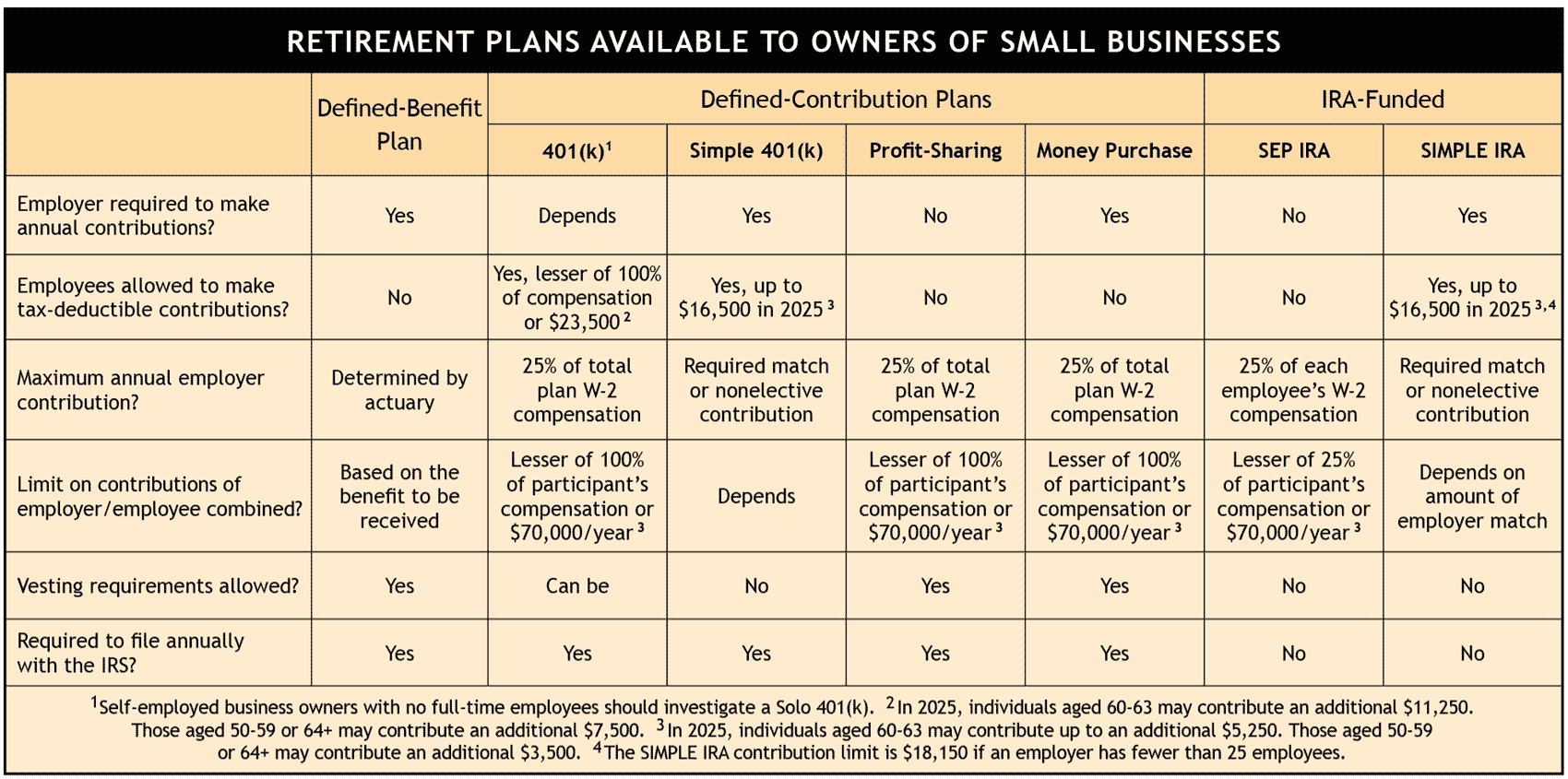
Comparison of Small Business Retirement Options
| Feature | Solo 401(k) | Safe Harbor 401(k) | SIMPLE IRA | SEP IRA |
|---|---|---|---|---|
| Ideal For | Owner-only businesses | Businesses with 2-50+ employees | Small firms wanting low costs | High-income solopreneurs |
| Max Contribution (2026 Est.) | ~$70,000+ | ~$23,500 (Employee) + Match | $16,500 + Match | 25% of pay (up to ~$70k) |
| Catch-up (Age 50+) | Yes ($7,500+) | Yes ($7,500+) | Yes ($3,500+) | No |
| Employer Match | Optional (Profit share) | Mandatory | Mandatory | Employer only |
| Setup Cost | Low | Moderate | Very Low | Very Low |
| Annual Testing | None | Exempt | Exempt | Exempt |
Note: Contribution limits are subject to annual IRS cost-of-living adjustments.
Tax Credits and Financial Incentives for Small Business Owners
One of the most compelling reasons to start a 401(k) in 2026 is the robust federal tax credit system. The government essentially subsidizes the cost of starting a plan for small employers (typically those with 100 or fewer employees).
- Retirement Plan Startup Costs Tax Credit: Eligible employers can claim a tax credit of 50% to 100% of their qualified startup costs, up to $5,000 per year for the first three years. For businesses with 50 or fewer employees, the credit covers 100% of costs.
- Employer Contribution Credit: This credit applies to the contributions an employer makes on behalf of employees. For businesses with up to 50 employees, the credit can be up to $1,000 per employee for the first few years, gradually phasing out over five years.
- Automatic Enrollment Credit: An additional $500 annual tax credit is available for three years if the plan includes an eligible automatic enrollment feature.
When these credits are combined, many small business owners find that the net cost of providing a 401(k) for the first three years is nearly zero.
Administrative Responsibilities and Fiduciary Duties
Establishing a 401(k) involves more than just picking an investment lineup. As a plan sponsor, the business owner takes on fiduciary responsibilities. This means you are legally obligated to act in the best interest of the plan participants.
ERISA Compliance and Form 5500
Most 401(k) plans are governed by the Employee Retirement Income Security Act (ERISA). This requires annual filing of Form 5500 with the DOL. Solo 401(k) plans are generally exempt from this filing until the plan assets exceed $250,000. For larger plans, the 2026 filing process is mostly digital and integrated with payroll providers, but the owner remains responsible for the accuracy of the data.
Outsourcing with 3(16) and 3(38) Fiduciaries
To mitigate risk, many small business owners hire external fiduciaries.
- 3(16) Plan Administrator: Handles the day-to-day operations, such as signing Form 5500, processing distributions, and ensuring notices are sent to employees.
- 3(38) Investment Manager: Takes full discretion over the investment menu, selecting and monitoring the funds so the business owner doesn't have to be an investment expert.
Step-by-Step Implementation Guide
If you are ready to set up a plan in 2026, follow these steps to ensure a smooth launch:
- Evaluate Workforce Needs: Determine if you are a candidate for a Solo 401(k) or if your hiring plans necessitate a Safe Harbor design.
- Select a Provider: Compare traditional brokerage firms with modern "robo-recordkeepers." Modern providers often offer better payroll integration, which is critical for the 2026 auto-enrollment requirements.
- Draft the Plan Document: This legal document outlines eligibility (e.g., age 21, one year of service), the vesting schedule (how long employees must stay to keep employer matches), and contribution types.
- Integrate Payroll: High-quality 401(k) providers in 2026 sync directly with payroll software like Gusto, QuickBooks, or ADP. This ensures that deferrals are calculated correctly and deposited on time, which is a major area of DOL scrutiny.
- Employee Communication: You must provide a Summary Plan Description (SPD) and other mandatory notices to employees before the plan goes live.
Common Pitfalls and How to Avoid Them
Even with modern tools, small business owners often stumble in a few key areas. First is the failure to deposit deferrals. The DOL requires that employee contributions be deposited as soon as they can be reasonably segregated from the employer’s general assets—usually within seven business days for small plans. Delays can result in excise taxes and required "make-whole" payments.
Second is ignoring eligibility rules. If you have part-time employees, the "Long-Term, Part-Time Employee" rules (refined in 2024–2025 and fully active in 2026) may require you to let workers into the plan if they have completed two consecutive years with at least 500 hours of service. Failing to include these employees can disqualify the entire plan.
Professional Advice Limitation: This article is for informational purposes only and does not constitute legal, tax, or financial advice. Tax laws and IRS limits are subject to change. Small business owners should consult with a qualified CPA, tax attorney, or certified financial planner before establishing a retirement plan to ensure compliance with current local and federal regulations.
Frequently Asked Questions
Can I have a 401(k) if I am the only employee?
Yes. This is called a Solo 401(k). It is specifically designed for business owners with no employees (except a spouse). It offers the same high contribution limits as a large-company 401(k) but with much simpler administrative requirements and lower costs.
What is the deadline to set up a small business 401(k)?
Under current rules, you generally have until your business's tax filing deadline (including extensions) to adopt a new plan and have it be effective for the prior tax year. However, if you want to make employee elective deferrals, the plan typically must be in place before those wages are earned. For a Safe Harbor plan, you must generally notify employees 30 to 90 days before the start of the plan year.
Are employer matches mandatory in a 401(k)?
In a Traditional 401(k), matching is optional. However, if you choose a Safe Harbor 401(k) design to avoid non-discrimination testing, the matching (or a 3% nonelective contribution) becomes mandatory. Most small business owners find the mandatory match is worth the trade-off for the administrative ease it provides.
How much does it cost to maintain a small business 401(k) in 2026?
Costs have dropped significantly. A Solo 401(k) can often be found for $0 to $500 in annual fees at major brokerages. For a plan with employees, expect a base fee of $500 to $2,000 per year, plus a small monthly fee per participant ($5 to $10). Remember that tax credits in 2026 can often offset 100% of these costs for the first three years.
Can I borrow money from my small business 401(k)?
Most 401(k) plans, including Solo 401(k)s, can be designed to allow for "Participant Loans." Generally, you can borrow up to 50% of your vested balance or $50,000, whichever is less. This loan must be repaid with interest (which goes back into your account) usually within five years.
What happens to the 401(k) if I hire employees later?
If you start with a Solo 401(k) and later hire full-time employees, your plan must be updated to a standard 401(k). You will need to adhere to ERISA reporting requirements and potentially move to a Safe Harbor design to ensure you can still maximize your own contributions.
Practical Next Action
If you are a solopreneur, your next step is to compare the "Big Three" low-cost Solo 401(k) providers (Fidelity, Vanguard, and Charles Schwab) to see which fits your investment preference. If you have employees, contact your current payroll provider to see if they offer an integrated 401(k) solution; this integration is the single most effective way to reduce the administrative burden of running a plan in 2026.