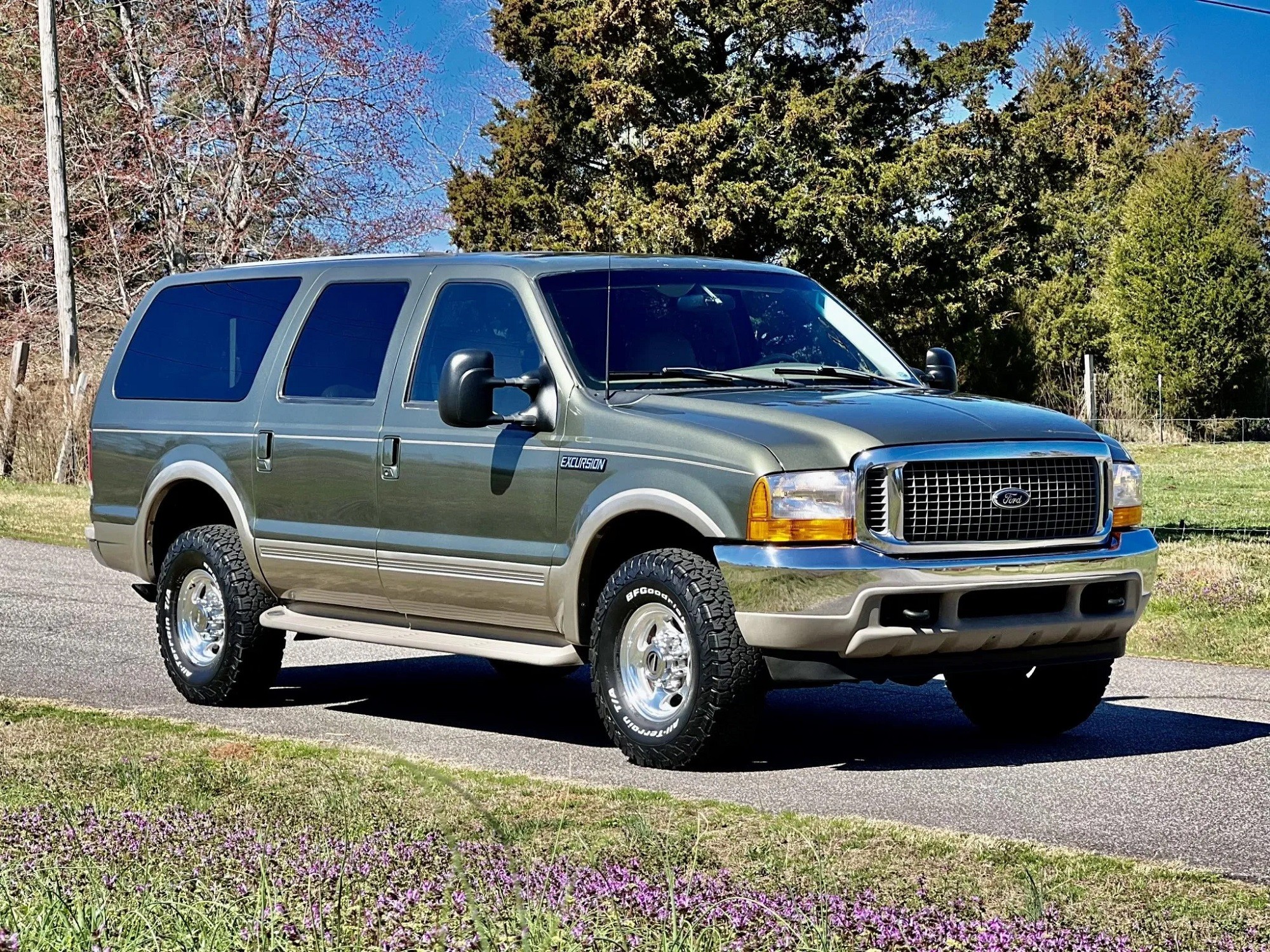
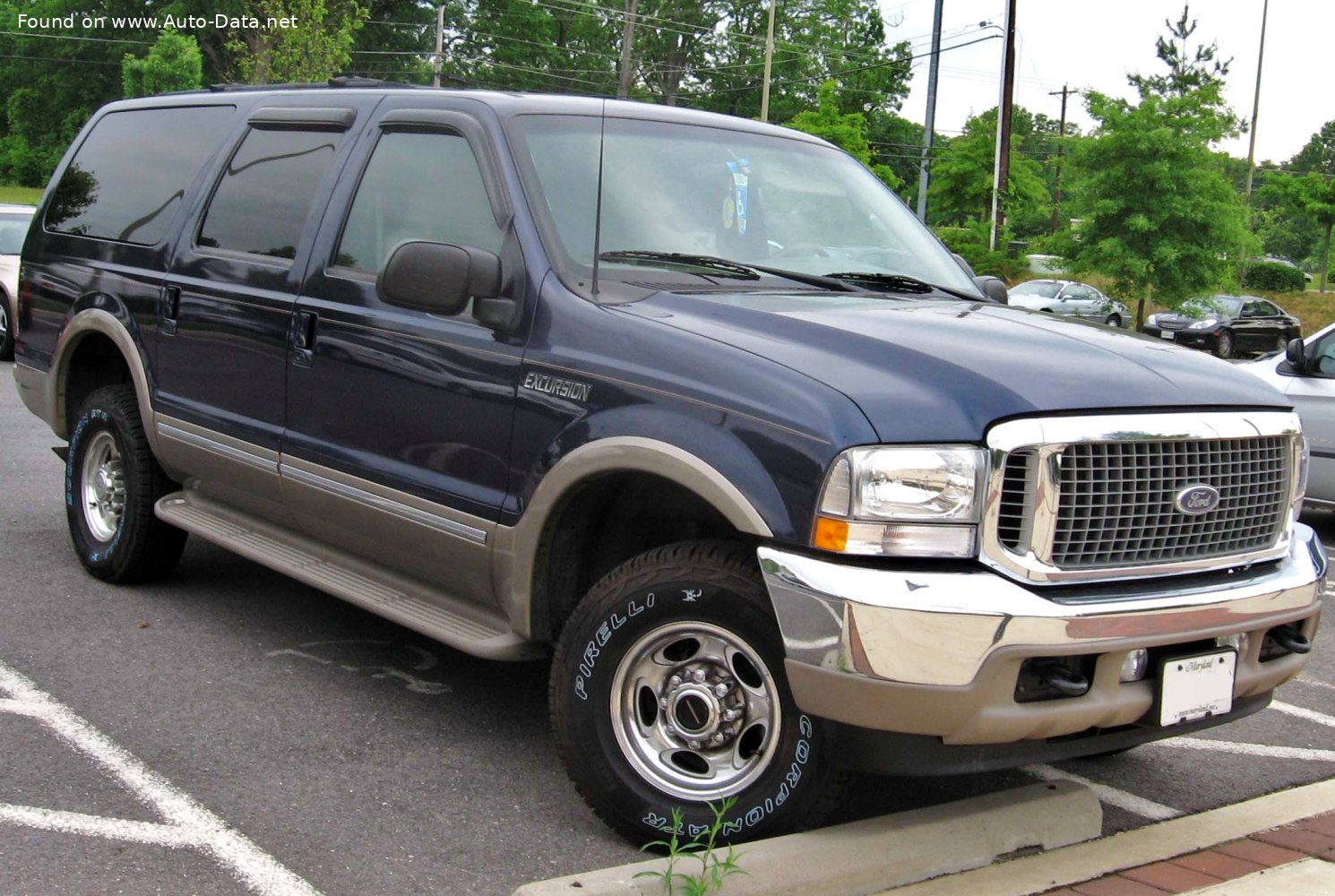
The 2000 Ford Excursion features an overall length of 226.7 inches, a width of 79.9 inches (excluding mirrors), and a height ranging from 77.2 to 80.4 inches depending on the drivetrain. Built on the Ford Super Duty platform, its massive 137.1-inch wheelbase provides a maximum cargo capacity of 146.4 cubic feet.
The 2000 Ford Excursion remains one of the largest production passenger vehicles ever built. Introduced as a direct competitor to the Chevrolet Suburban 2500, the Excursion was designed for consumers who needed maximum interior volume combined with heavy-duty towing capabilities. As we look at these specifications from the perspective of 2026, the "King of SUVs" still holds a unique place in automotive history, often serving as a dedicated tow rig or a platform for overlanding builds due to its sheer scale and robust construction.
Exterior Dimensions: Understanding the Footprint
When discussing the 2000 Ford Excursion, the first thing most owners and enthusiasts notice is its physical presence. It was built using the chassis architecture of the Ford F-250 Super Duty, which dictated its significant proportions.
Length and Wheelbase
The total exterior length of the 2000 Ford Excursion is 226.7 inches. To put this into perspective, a standard parking space in many municipal lots is roughly 180 to 210 inches long. This means the Excursion frequently overhangs standard parking spots. The wheelbase—the distance between the center of the front and rear wheels—is 137.1 inches. This long wheelbase is a primary contributor to the vehicle’s exceptional straight-line stability, especially when pulling heavy trailers, though it results in a wide turning radius.
Width and Track
The body width of the Excursion is 79.9 inches. However, this measurement does not include the side-view mirrors. With the standard mirrors or the optional telescoping trailer tow mirrors extended, the width increases significantly, often exceeding 95 inches. The front track (the distance between the center of the tires on the same axle) is 68.4 inches, while the rear track is slightly narrower at 68.1 inches. This wide stance is necessary to support the high center of gravity and provide lateral stability.
Height and Ground Clearance
The height of a 2000 Ford Excursion varies based on whether it is a 4x2 (two-wheel drive) or 4x4 (four-wheel drive) model.
- 4x2 Models: Approximately 77.2 inches high.
- 4x4 Models: Approximately 80.4 inches high.
Owners must be particularly cautious with the 4x4 models when entering older parking garages, as many have a clearance limit of 6 feet 6 inches (78 inches) or 7 feet (84 inches). Ground clearance is another vital metric for those using the vehicle off-road; the 2000 model provides roughly 8.1 inches of clearance, which can be further increased with aftermarket suspension lifts—a common modification for this vehicle.
Interior Dimensions: Passenger Comfort and Volume
The interior of the 2000 Ford Excursion was designed to provide "living room" levels of space for up to nine passengers, depending on the seating configuration (bench vs. captain’s chairs). Ford engineers utilized the wide frame to ensure that even the third-row passengers had more room than most contemporary SUVs offered in their second rows.
First-Row Space
The driver and front passenger enjoy the most significant amount of room. The headroom in the front is 41.0 inches, providing ample space even for taller individuals wearing hats or helmets. Legroom is generous at 42.3 inches, and the shoulder room is 68.3 inches, ensuring that two large adults can sit side-by-side without feeling cramped.
Second-Row Space
The second row was available as either a three-passenger 60/40 split-bench seat or two individual captain's chairs. The headroom remains consistent with the front at 41.1 inches. Legroom is measured at 40.5 inches, which is comparable to the rear seat of a luxury long-wheelbase sedan. Shoulder room stays wide at 67.0 inches, allowing three child seats to be installed side-by-side in bench-equipped models.
Third-Row Space
Unlike many "three-row" SUVs where the final row is reserved for children, the Excursion’s third row is genuinely adult-sized.
- Headroom: 37.7 inches
- Legroom: 39.0 inches
- Shoulder Room: 64.9 inches
- Hip Room: 52.5 inches
The third row is easily accessible and features its own dedicated climate control vents, which was a critical inclusion given the massive interior volume that the HVAC system had to manage.
| Dimension Category | Specification (4x4 Model) |
|---|---|
| Overall Length | 226.7 inches |
| Overall Width (No Mirrors) | 79.9 inches |
| Overall Height | 80.4 inches |
| Wheelbase | 137.1 inches |
| Ground Clearance | 8.1 inches |
| Curb Weight (V10 4x4) | ~7,190 lbs |
| Max Cargo Volume | 146.4 cu. ft. |
| Cargo Volume (Behind 3rd Row) | 48.2 cu. ft. |
| Fuel Tank Capacity | 44 gallons |
Cargo Capacity and Utility
The 2000 Ford Excursion's cargo dimensions are often the deciding factor for buyers. The vehicle utilizes a unique "Tri-Panel" rear door system. This consists of a top glass hatch that lifts upward and two lower "barn doors" that swing outward. This design allows for easy loading of groceries through the glass or full access to the cargo bay for large items.
Cargo Volume Breakdown
The Excursion offers three primary cargo configurations:
- Behind Third Row: Even with all seats occupied, the Excursion provides 48.2 cubic feet of space. This is more than the total cargo capacity of many small crossover SUVs with their seats folded down.
- Behind Second Row: With the third-row seat removed (it is a heavy, removable bench on rollers), the cargo space expands to 100.7 cubic feet.
- Maximum Cargo Space: With the third row removed and the second row folded down, the Excursion offers a cavernous 146.4 cubic feet.
The floor length with all rear seats removed or folded is nearly 8 feet, which famously allows the vehicle to carry 4x8 sheets of plywood completely flat with the rear doors closed—a feat few other passenger vehicles can replicate.
Weight, GVWR, and Towing Dimensions
Because the 2000 Ford Excursion is built on a heavy-duty truck chassis, its weight specifications are significantly higher than standard SUVs. These dimensions are critical for understanding registration requirements and towing safety.
Curb Weight and Payload
The curb weight (the weight of the vehicle with a full tank of fuel but no passengers or cargo) varies by engine and drivetrain. A 2000 Excursion with the 7.3L Power Stroke Diesel engine and 4WD can weigh approximately 7,700 pounds. The V10 gas models typically weigh between 7,100 and 7,200 pounds.
The Gross Vehicle Weight Rating (GVWR) for the 2000 model is generally 8,900 pounds for the 4x2 and 9,200 pounds for the 4x4. This leaves a payload capacity of approximately 1,500 to 2,000 pounds. It is important to note that because the GVWR is over 8,500 pounds, the EPA classified the Excursion as a "Heavy Duty" vehicle, which meant it was exempt from fuel economy labeling requirements at the time of its release.
Towing Capacities
The physical dimensions of the frame and the long wheelbase allow for high towing limits. For the 2000 model year:
- V8 (5.4L): Rated for approximately 6,200 to 7,600 lbs depending on the axle ratio.
- V10 (6.8L): Rated for up to 10,000 lbs.
- Diesel (7.3L): Rated for up to 10,000 lbs.
The 137.1-inch wheelbase helps prevent "the tail wagging the dog," a common issue where a heavy trailer causes a shorter vehicle to pivot or sway dangerously at highway speeds.
Driving and Storage Considerations
The dimensions of the 2000 Ford Excursion create specific challenges for daily use. If you are considering purchasing one in 2026, you must account for these physical constraints.
Garage Fitment
A standard residential garage door is usually 7 feet high (84 inches) and 8 or 9 feet wide. While a stock 4x4 Excursion (80.4 inches high) will technically fit under a 7-foot door, it leaves less than 4 inches of clearance. If you add a roof rack or larger tires, it will likely no longer fit. Furthermore, at 226.7 inches long (nearly 19 feet), the Excursion will not fit in a standard 20-foot deep garage if there are any cabinets, workbenches, or stairs at the front of the bay.
Maneuverability
The turning circle of the 2000 Ford Excursion is approximately 50.4 feet. For comparison, a modern Ford Explorer has a turning circle of about 39 feet. This means U-turns are rarely possible on standard two-lane roads, and navigating tight "drive-thru" lanes or compact parking structures requires significant skill and often multiple-point turns.
Fuel Tank and Range
While not a physical exterior dimension, the fuel tank size is a vital "internal" dimension. All 2000 Ford Excursions come with a 44-gallon fuel tank. This large capacity was necessary to provide a reasonable driving range, given the vehicle's weight and aerodynamic profile (which has a drag coefficient similar to a small barn). With the 7.3L Diesel engine, a highway range of over 700 miles is possible, whereas the V10 gas engine may only manage 400 to 500 miles on a full tank.
Frequently Asked Questions
Will a 2000 Ford Excursion fit in a standard parking space?
Generally, no. A standard parking space is usually 18 to 20 feet long. The Excursion is 18.9 feet long. While it fits the length of some spots, its width (nearly 80 inches without mirrors) makes it very difficult to open the doors if other vehicles are parked in adjacent spots. Owners often choose to park at the back of lots to avoid door dings and to find "pull-through" spots.
What is the difference in height between the 2WD and 4WD models?
The 4WD (4x4) model sits about 3.2 inches higher than the 2WD (4x2) model. The 4x2 model has an overall height of 77.2 inches, while the 4x4 model reaches 80.4 inches. This difference is due to the taller suspension components and front axle required for the four-wheel-drive system.
Can the 2000 Ford Excursion carry a 4x8 sheet of plywood?
Yes, the Excursion is one of the few SUVs that can carry a standard 4x8 sheet of plywood flat on the floor with the rear doors closed. To do this, you must remove the third-row seat and fold the second-row seats down. The interior width between the wheel wells is slightly over 48 inches, making it a favorite for contractors and DIY enthusiasts.
How much does the 2000 Ford Excursion weigh?
The curb weight typically ranges from 7,190 lbs for the V10 gas model to roughly 7,725 lbs for the 7.3L Diesel 4x4 model. Because of this weight, the vehicle is classified as a Class 2b truck, which impacts how it is taxed and registered in some jurisdictions.
What are the "Tri-Panel" rear doors?
The Tri-Panel door system is a hallmark of the Excursion's design. It consists of a top glass window that flips up like a traditional SUV hatch and two small doors below it that swing out to the sides (barn doors). This allows you to open the glass to drop in small items or open the barn doors for loading heavy cargo with a forklift or by hand without a tailgate getting in the way.
Practical Recommendation for Potential Buyers
If you are measuring for a 2000 Ford Excursion in 2026, always prioritize the height and length of your storage area. Before purchasing, verify your garage door height and the actual depth of your parking space. If you plan to use the vehicle for towing, ensure your hitch setup accounts for the vehicle's height to keep the trailer level. Given its 226.7-inch length, it is also advisable to install a modern backup camera if the previous owner hasn't already, as rear visibility is limited by the vehicle's scale.