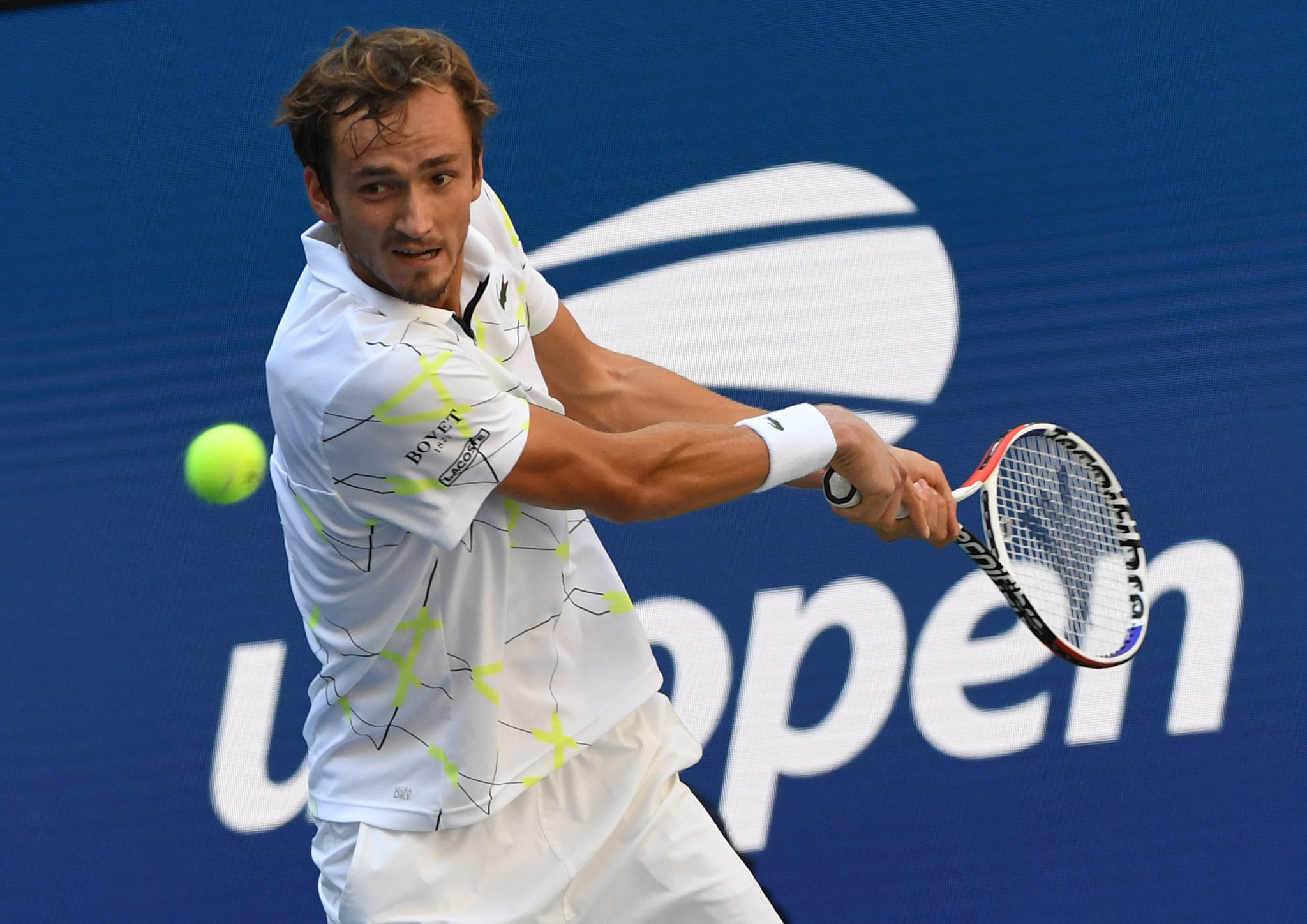
Rafael Nadal secured his 19th Grand Slam title on September 8, 2019, by defeating Daniil Medvedev in a grueling five-set final at the US Open. This victory brought him within one major title of Roger Federer’s all-time record at the time, marking a pivotal moment in the professional tennis "GOAT" (Greatest of All Time) race.
The 2019 US Open final is frequently cited by sports historians as one of the most dramatic and physically demanding matches in the history of the tournament. Lasting four hours and 50 minutes, the contest was a battle of generational styles, pitting the relentless physical intensity and topspin of Rafael Nadal against the idiosyncratic, defensive, and counter-punching brilliance of a rising Daniil Medvedev. For Nadal, the victory was more than just another trophy; it was a testament to his evolution as a hard-court player and his ability to withstand the surge of the "Next Gen" players who were finally beginning to challenge the dominance of the "Big Three."
Looking back from 2026, the 2019 triumph stands as the bridge between Nadal’s dominance of the 2010s and his historic double-slam season in 2022. It remains a masterclass in psychological resilience, showing how a veteran champion manages a match that threatens to spiral out of control.
The Road to the 2019 US Open Final
Nadal entered the 2019 US Open as the second seed, coming off a dominant victory at the Montreal Masters (Rogers Cup). His form on hard courts that summer was arguably the best it had been since his 2013 season. While his rivals faced various hurdles—Novak Djokovic retired due to a shoulder injury in the fourth round, and Roger Federer was upset by Grigor Dimitrov in the quarterfinals—Nadal remained clinical throughout the fortnight.
His path to the final was marked by efficient victories. He dispatched John Millman and Chung Hyeon with ease, and received a walkover in the second round against Thanasi Kokkinakis, which allowed him to conserve vital energy for the second week. In the quarterfinals, he overcame a spirited Diego Schwartzman, and in the semifinals, he halted the momentum of Matteo Berrettini in straight sets. By the time he reached the final, Nadal had dropped only one set (to Marin Cilic in the fourth round), positioning him as the heavy favorite against the first-time Grand Slam finalist, Daniil Medvedev.
The Emergence of Daniil Medvedev
To understand the weight of Nadal’s victory, one must consider the form of Daniil Medvedev during the 2019 North American hard-court swing. Medvedev had reached the final in every tournament he played that summer: Washington, Montreal, and Cincinnati (where he won the title).
Medvedev’s game was a puzzle that many veterans struggled to solve. Standing 6'6", he possessed a flat, penetrating backhand and a serve that could bail him out of trouble. More importantly, his court coverage and ability to redirect pace made him a "human wall." During the 2019 US Open, he also embraced a "villain" persona after clashes with the New York crowd, which seemed to fuel his competitive fire. By the time he faced Nadal in the final, he was the most match-tough player on the ATP Tour, despite the exhaustion of playing so many matches in a six-week span.
Set-by-Set Analysis: A Match of Two Halves
The final at Arthur Ashe Stadium began as many expected. Nadal’s heavy topspin forehand pushed Medvedev deep behind the baseline, and the Spaniard’s tactical variety, including frequent serve-and-volley plays, kept the Russian off-balance.
The Early Dominance
Nadal took the first set 7-5 and the second 6-3. When he broke Medvedev’s serve in the third set to lead 3-2, the match appeared to be heading toward a routine straight-sets conclusion. Nadal was effectively neutralizing Medvedev’s flat strikes by utilizing short slices and high-looping balls to the Russian’s backhand, preventing him from finding a comfortable rhythm.
The Medvedev Fightback
The turning point occurred late in the third set. Medvedev, seemingly finding a second wind and perhaps realizing he had nothing to lose, began to take more risks. He flattened out his groundstrokes even further and began coming to the net more frequently. He broke back and eventually took the third set 7-5.
The fourth set saw a shift in momentum. Nadal began to show signs of physical fatigue, and his first-serve percentage dipped. Medvedev’s defensive capabilities forced Nadal to hit "one more ball" in every rally, leading to increased unforced errors from the Spaniard. Medvedev took the fourth set 6-4, forcing a decider and stunning the New York crowd.
The Fifth Set Drama
The fifth set was a micro-drama of Nadal’s entire career. Despite losing a two-set lead, Nadal refocused. He saved break points early in the set and then managed to break Medvedev twice to lead 5-2. However, the drama was far from over. Nadal was called for time violations on his serve, lost one of the breaks, and faced more break points while serving for the championship at 5-4. In a moment of sheer brilliance, Nadal hit a drop shot followed by a winner to save the game and eventually closed out the match on his third championship point.
Statistical Comparison: 2019 US Open Final
The following table highlights the razor-thin margins that defined this championship match.
| Statistic | Rafael Nadal | Daniil Medvedev |
|---|---|---|
| Aces | 5 | 14 |
| Double Faults | 5 | 4 |
| First Serve % | 62% | 58% |
| Win % on 1st Serve | 77% | 65% |
| Winners | 62 | 75 |
| Unforced Errors | 46 | 57 |
| Break Points Won | 6/15 (40%) | 5/15 (33%) |
| Net Points Won | 51/66 (77%) | 29/50 (58%) |
| Total Points Won | 177 | 164 |
Technical and Tactical Mastery
Nadal’s 19th Grand Slam was a triumph of tactical evolution. Traditionally known for his baseline grinding, Nadal used the 2019 season to refine his aggressive transition game.
- Net Approach: Nadal came to the net 66 times during the final, winning 77% of those points. This was a significantly higher frequency than in his previous US Open wins (2010, 2013, 2017). By shortening the points, he was able to mitigate the physical toll of Medvedev’s baseline consistency.
- The Serve: Under the guidance of coach Carlos Moya, Nadal had modified his service motion to gain more free points. While he didn't hit as many aces as Medvedev, his "body serve" into the Russian’s chest proved effective at jamming the tall opponent.
- Mental Fortitude: Perhaps the most critical factor was Nadal’s ability to suppress the frustration of losing a two-set lead. In the fifth set, rather than playing defensively, he increased his aggression, particularly with his inside-out forehand, which is the hallmark of his game.
Historical Significance and the "Big Three" Race
At the conclusion of the 2019 US Open, the standings in the race for the most men's singles Grand Slam titles were as follows:
- Roger Federer: 20
- Rafael Nadal: 19
- Novak Djokovic: 16
This victory was the moment the tennis world realized that Federer’s record, which many thought was untouchable, was likely to fall. It also solidified Nadal’s status as a cross-surface legend. While his 14 French Open titles are his primary legacy, his four US Open titles at that time placed him in elite company, tied with John McEnroe and just one behind Jimmy Connors, Pete Sampras, and Roger Federer in the Open Era.
The win also highlighted the physical longevity of the "Big Three." At 33, Nadal became the oldest man to win the US Open since Ken Rosewall in 1970 (though this record was later surpassed by Novak Djokovic). It served as a stern reminder to the younger generation that while they were closing the gap in skill, they had yet to match the mental resolve of the established icons.
The 2026 Perspective: Legacy of the 19th Title
From the vantage point of 2026, we can see how the 2019 US Open victory acted as a catalyst for the final chapter of Nadal’s career. It proved he could still win five-set marathons on hard courts against opponents nearly a decade younger. This confidence arguably paved the way for his legendary comeback in the 2022 Australian Open final, where he again won a five-set match against Medvedev to claim his 21st title.
The 2019 triumph also serves as a benchmark for Daniil Medvedev’s career. While he lost that day, the match established him as a premier hard-court player and set the stage for his own US Open title in 2021, where he prevented Novak Djokovic from completing a Calendar Grand Slam.
Frequently Asked Questions
How long did the 2019 US Open final last?
The match lasted 4 hours and 50 minutes. It was one of the longest finals in US Open history, falling just short of the record of 4 hours and 54 minutes set by Mats Wilander and Ivan Lendl in 1988, and later matched by Andy Murray and Novak Djokovic in 2012.
Was the 2019 US Open Nadal's last hard-court Grand Slam?
No. After his 19th title in 2019, Rafael Nadal went on to win the 2022 Australian Open, defeating Daniil Medvedev again in another historic five-set comeback to claim his 21st Grand Slam title.
Why was the 2019 US Open final significant for the GOAT race?
This win brought Nadal to 19 Grand Slams, placing him just one behind Roger Federer (20). It was the closest Nadal had ever been to Federer’s record up to that point and intensified the debate over who would finish with the most titles among Federer, Nadal, and Djokovic.
Did Nadal face any penalties during the 2019 final?
Yes, Nadal received multiple time violations for exceeding the 25-second serve clock. One of these violations occurred at a critical juncture in the fifth set, resulting in the loss of a first serve, which contributed to the high tension of the closing games.
What was the score of the 2019 US Open final?
Rafael Nadal defeated Daniil Medvedev with a final score of 7-5, 6-3, 5-7, 4-6, 6-4.
Recommendation for Tennis Enthusiasts
To truly appreciate the technical depth of Nadal's 19th title, students of the game should study the match film specifically for Nadal's net transitions. In an era dominated by baseline play, his willingness to finish points at the net was the deciding factor against a counter-puncher like Medvedev. For those interested in the psychological aspect of sports, observing Nadal’s composure during the first four games of the fifth set provides a masterclass in "flushing" previous mistakes and focusing on the immediate task.