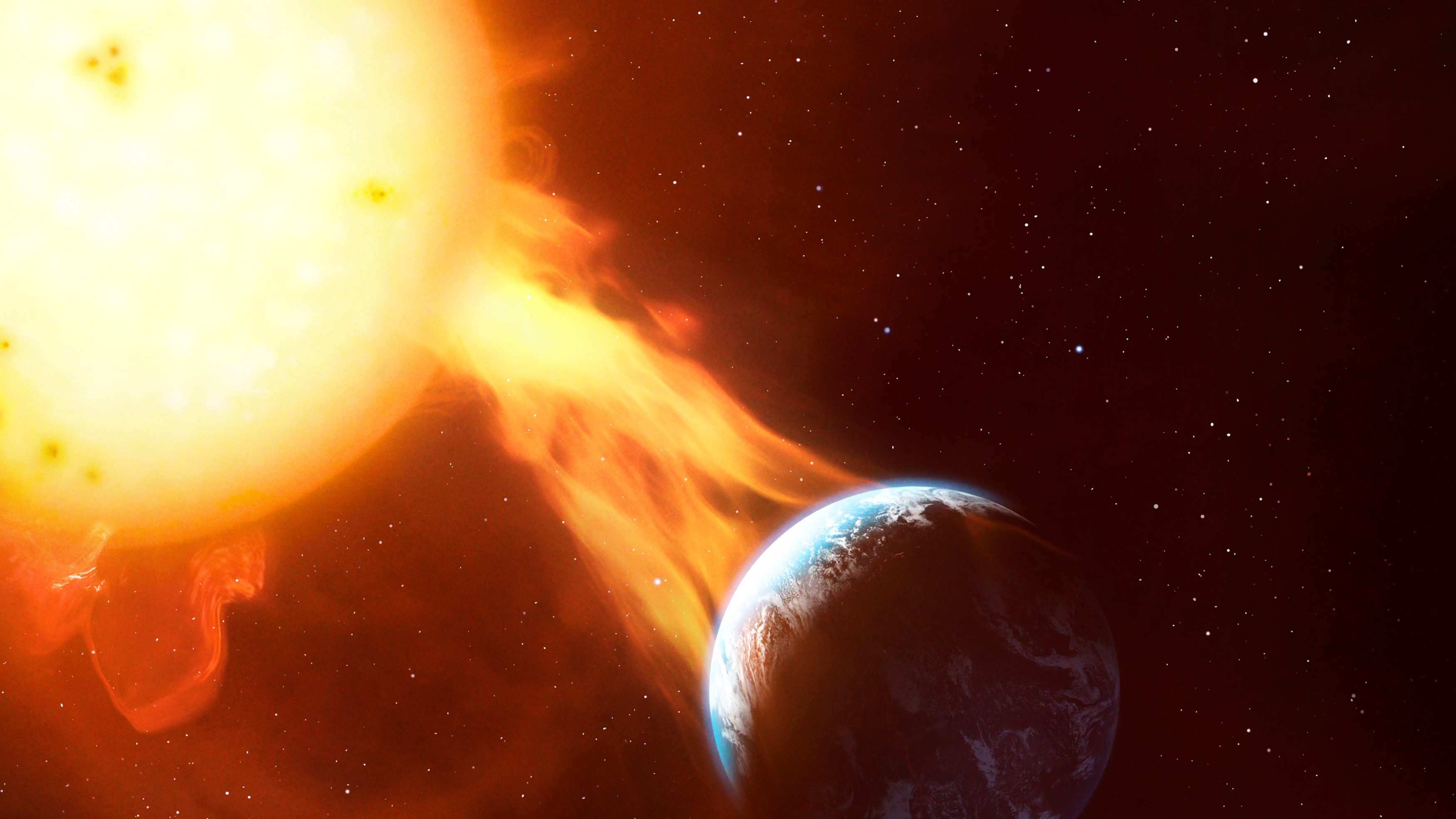
The 1859 Carrington Solar Storm was the most powerful geomagnetic storm in recorded history, triggered by a massive coronal mass ejection from the Sun that struck Earth's magnetosphere. It caused worldwide auroras visible near the equator, disrupted global telegraph networks, and serves today as the premier benchmark for extreme space weather hazards.
Understanding the Carrington Event of 1859
The events of late August and early September 1859 marked a watershed moment in humanity's interaction with space weather. Before this solar storm, electricity and magnetism were largely laboratory curiosities and the subjects of nascent industrial experimentation. The sudden onslaught of severe geomagnetic activity brought the raw power of the cosmos directly into the daily lives of 19th-century citizens, demonstrating that Earth is not isolated from the violent outbursts of its parent star.
The storm derived its name from Richard Carrington, an English amateur astronomer who, alongside his contemporary Richard Hodgson, independently made the first recorded observation of a solar flare. On September 1, 1859, Carrington was projecting and sketching sunspots in his private observatory when he witnessed a blinding flash of white light emanating from a complex sunspot group. This unprecedented observation provided the crucial missing link between solar disturbances and terrestrial disruptions, though the physical mechanisms linking the Sun and Earth would take decades more to fully understand.
The physical sequence began days before the optical flash. The Sun had been active for weeks, displaying a high density of massive sunspots. When the magnetic energy stored within these sunspot loops finally snapped, it propelled a billion-ton cloud of magnetized plasma—a coronal mass ejection (CME)—directly toward Earth. While typical CMEs take three to four days to traverse the 93 million miles between the Sun and our planet, the 1859 CME completed the journey in a astonishing 17.6 hours, fueled by an already saturated interplanetary medium from preceding solar ejections.
Scientific Mechanics: How Extreme Space Weather Works
To understand the severity of the Carrington Event, one must examine the complex interplay between solar physics, interplanetary space, and Earth's protective geomagnetic shield. The Sun constantly emits a stream of charged particles known as the solar wind, but violent solar flares and CMEs introduce massive anomalies into this steady flow.
When a CME impacts Earth, it compresses the dayside magnetosphere and sweeps back the nightside magnetotail. The severity of the resulting geomagnetic storm depends heavily on the orientation of the CME’s internal magnetic field relative to Earth’s magnetic field. If the magnetic field of the CME points southward, it undergoes magnetic reconnection with Earth's northward-pointing magnetic field, allowing massive amounts of solar wind energy to pour into the upper atmosphere and magnetosphere.
[Sunspot Eruption] ---> [High-Speed CME] ---> [Magnetopause Compression] ---> [Geomagnetic Induction]
This sudden influx of energy drives intense electrical currents through the ionosphere and magnetosphere, known as auroral electrojets. Through electromagnetic induction, these shifting currents generate secondary electric currents—known as geomagnetically induced currents (GICs)—directly within Earth's conductive crust and long-conductor infrastructure like telegraph lines and power grids. In 1859, the sheer density and southward orientation of the Carrington CME created an induction event of unprecedented magnitude, overwhelming the rudimentary electrical networks of the era.
Terrestrial Impacts and Historical Observations
The most immediate and visually stunning consequence of the 1859 storm was the global display of auroras. Typically confined to high-latitude polar regions, the aurora borealis and aurora australis pushed deep into the tropics. Observers in Cuba, Hawaii, Mexico, and the Caribbean reported crimson, green, and purple lights so bright that people could read newspapers by their luminescence in the middle of the night. Gold miners in the Rocky Mountains woke up and began preparing breakfast at 1:00 AM, mistaking the brilliant auroral glow for the breaking dawn.
Beyond the atmospheric light show, the storm wreaked havoc on the global telegraph network—the primary telecommunication infrastructure of the mid-19th century. Telegraph systems were uniquely vulnerable because they relied on long, unshielded copper wires strung across thousands of miles of terrain, acting effectively as massive antennas that gathered geomagnetically induced currents.
Operators across North America and Europe reported unprecedented anomalies:
- Spontaneous Operation: Telegraph machines began printing gibberish or transmitting messages entirely on their own without batteries connected to the circuits.
- Arcing and Fire: Sparks jumped from telegraph equipment, setting fire to telegraph offices in Boston and Philadelphia.
- Battery-Free Communication: Operators discovered they could disconnect their power supplies entirely and still send and receive messages using only the ambient current induced in the lines by the storm.
Historical Impact Comparison
| Feature / Metric | Typical Moderate Geomagnetic Storm | The 1859 Carrington Event | Modern Severe Scenario (Reference) |
|---|---|---|---|
| Kp Index Range | 5 to 7 (Minor to Strong) | Estimated 9+ (Extreme) | 9+ (Estimated benchmark) |
| CME Transit Time | 48 to 72 hours | ~17.6 hours | 15 to 24 hours |
| Auroral Reach | Mid-latitudes (e.g., northern US) | Deep Tropics (Cuba, Hawaii) | Mid-to-low latitudes |
| Infrastructure Affected | High-frequency radio, satellite operations | 19th-century telegraph networks | Power grids, GPS, satellites, fiber-optics |
| Economic Loss | Minimal to localized satellite glitches | Negligible (limited technology) | Trillions of dollars (estimated) |
Modern Vulnerabilities and Societal Risk
While the 1859 storm disrupted 19th-century telegraph systems, society today faces a vastly different risk profile. Modern civilization is deeply dependent on complex, highly interconnected technological systems that are acutely sensitive to geomagnetic disturbances. A modern recurrence of the Carrington Event would not merely disrupt telecommunications; it could paralyze global critical infrastructure.
The primary vulnerability lies in modern electrical power grids. Extra-high-voltage power transformers are susceptible to saturation when flooded with direct-current GICs. This saturation causes severe overheating, permanent damage, or catastrophic failure of core grid components. The collapse of key transformers could trigger cascading blackouts affecting entire continents, potentially leaving millions of people without electricity for weeks or months. Repairing or replacing these massive, custom-built transformers is a slow process, as they are not mass-produced on demand.
Beyond power grids, secondary vulnerabilities cascade across multiple technological domains:
- Satellite Operations: High-energy particles from an extreme solar storm can damage sensitive microelectronics, degrade solar panels, and cause orbital decay by expanding Earth's outer atmosphere.
- Global Navigation Satellite Systems (GNSS): Ionospheric scintillation induced by severe geomagnetic activity can disrupt GPS and timing signals essential for aviation, maritime navigation, financial transactions, and telecommunications synchronization.
- Submarine Communication Cables: Long undersea fiber-optic cables rely on submerged repeaters powered by electrical conductors running along the ocean floor, making them susceptible to induction effects similar to telegraph lines.
Scientific Context and Subsequent Events
To place the Carrington Event in perspective, scientists study subsequent solar storms to gauge its relative magnitude. The most notable modern counterpart occurred in March 1989, causing a massive geomagnetic storm that collapsed the Hydro-Québec power grid in Canada within 90 seconds, plunging six million people into darkness for nine hours and disrupting satellite operations worldwide. However, scientific estimates suggest the 1989 storm was roughly one-third to one-half the strength of the Carrington Event.
A closer near-miss occurred on July 23, 2012, when a CME of Carrington-class magnitude erupted from the Sun and crossed Earth's orbital path. Fortunately, Earth was not in the direct line of fire; the solar blast struck NASA's STEREO-A spacecraft instead, allowing scientists to measure its immense speed and magnetic intensity. Had that eruption occurred just nine days earlier, when Earth was positioned directly in the path of the CME, modern technological infrastructure would have faced a catastrophic test.
Researchers continue to analyze polar ice cores and tree rings for historical isotopes like beryllium-10 and carbon-14, which record past solar proton events. These studies indicate that extreme solar storms comparable to or even larger than the Carrington Event occur roughly once every 500 to 1,000 years, underscoring that such events are historical realities rather than theoretical anomalies.
Frequently Asked Questions
Could a Carrington-level solar storm destroy the internet permanently?
While an extreme solar storm would cause widespread communication outages and potential damage to electronics connected to long-line infrastructure, it is unlikely to destroy the internet permanently. Most data centers and core routing hardware are housed locally and protected, though long-distance fiber-optic repeaters and satellite links would suffer severe, prolonged disruptions.
How do scientists monitor the Sun for potential solar storms today?
Space agencies such as NASA and NOAA maintain a fleet of dedicated spacecraft—including the Solar and Heliospheric Observatory (SOHO) and the Deep Space Climate Observatory (DSCOVR)—positioned at the L1 Lagrange point between Earth and the Sun. These instruments provide continuous, real-time telemetry on solar wind speed, magnetic orientation, and coronal mass ejections, offering advance warning ranging from 15 to 60 minutes before a CME impacts Earth's magnetosphere.
Are residential solar panels at risk from a geomagnetic storm?
Standard residential rooftop solar panel systems are generally safe from direct geomagnetically induced currents because they operate on short circuits and localized DC-to-AC micro-inverters connected to household wiring. The primary danger to residential power systems stems from utility-scale grid fluctuations and transformer failures rather than direct damage to the panels themselves.
What is the financial cost of a modern Carrington-type event?
Economic analyses by organizations such as the National Academy of Sciences estimate that a recurrence of the 1859 storm today could result in initial economic losses ranging from one to two trillion dollars in the United States alone, with recovery timelines spanning anywhere from several months to multiple years depending on grid hardening and spare transformer availability.
What steps are governments taking to mitigate space weather risks?
Governments worldwide have established national space weather strategies, improved early-warning monitoring networks, and required grid operators to implement mitigation procedures. These measures include installing series capacitor banks to block GICs, developing rapid-response protocols for satellite operators, and stockpiling critical spare high-voltage transformers.
Conclusion and Preparedness
The 1859 Carrington Solar Storm remains a defining benchmark in the study of space weather, demonstrating the profound vulnerability of technological societies to solar activity. While scientists cannot prevent solar storms, ongoing advancements in space-based monitoring, grid hardening, and emergency response planning continue to improve global resilience against future extreme space weather events.