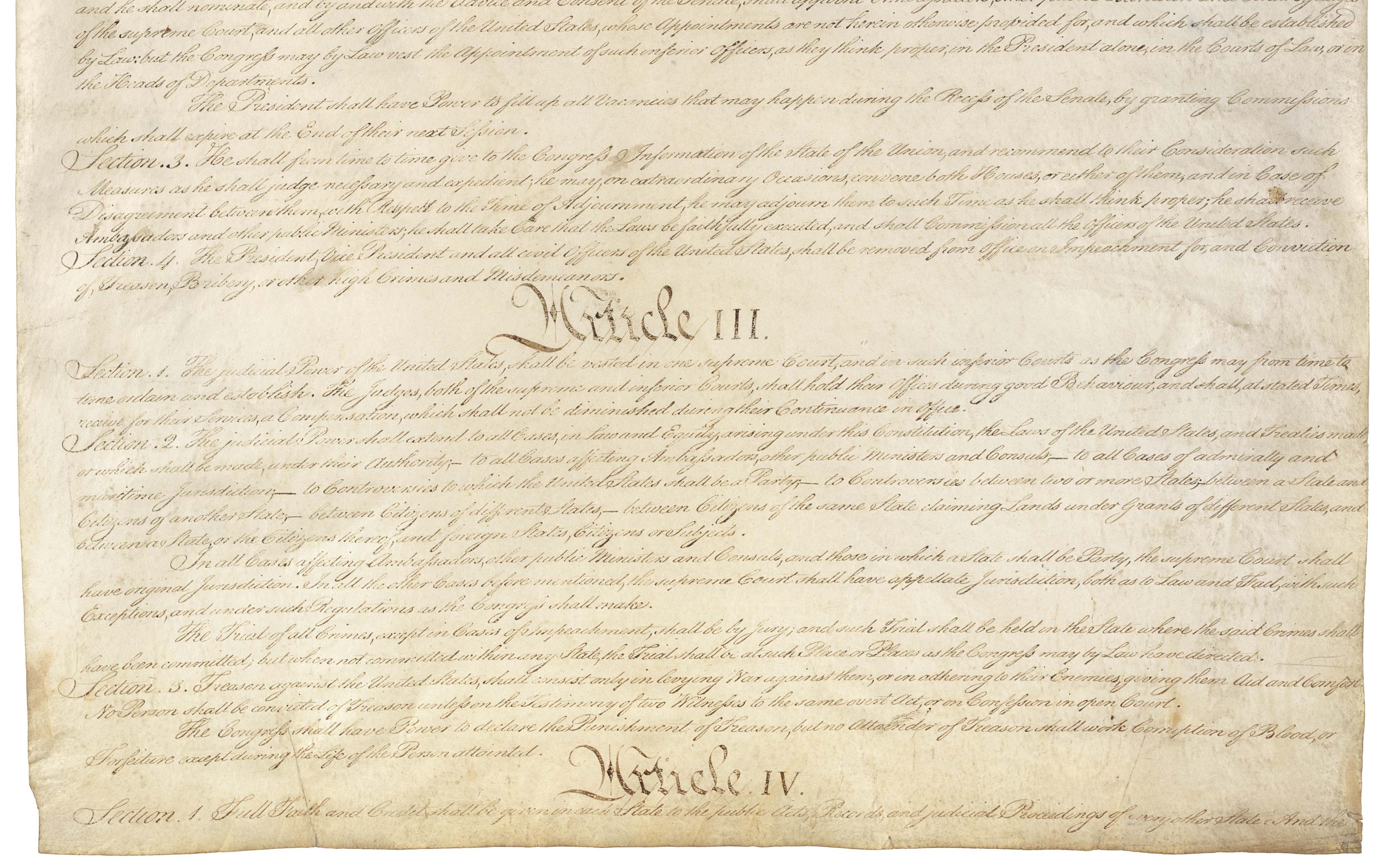
Article III courts are the constitutional courts of the United States, established under Article III of the Constitution to exercise the federal judicial power. These courts—which include the Supreme Court of the United States, the U.S. Courts of Appeals, and the U.S. District Courts—are staffed by judges who serve lifetime appointments during "good behavior," ensuring their independence from political pressure and the executive branch.
The Constitutional Foundation of Federal Judicial Power
To understand what Article III courts are, one must look directly at the text of the United States Constitution. Article III, Section 1 states: "The judicial Power of the United States, shall be vested in one supreme Court, and in such inferior Courts as the Congress may from time to time ordain and establish." This singular sentence created the framework for a third, co-equal branch of government.
Unlike the legislative or executive branches, which are inherently political and subject to the changing winds of electoral cycles, the federal judiciary was designed to be insulated. The framers of the Constitution recognized that for the rule of law to persist, judges needed the ability to make decisions based on the law and the Constitution, even when those decisions were unpopular with the president, Congress, or the majority of the public.
By establishing Article III courts, the Constitution mandates a system where judicial independence is protected through two specific mechanisms: life tenure and undiminished compensation. Judges appointed to these courts hold their seats for life unless they resign, retire, or are removed through the difficult process of impeachment and conviction by Congress. Furthermore, their salaries cannot be reduced during their time in office. These protections ensure that Article III judges do not have to fear financial or professional retribution for ruling against the government.
Distinguishing Article III Courts from Legislative Courts
A common point of confusion for students and legal observers is the distinction between Article III courts and "legislative courts" (also known as Article I courts). While both perform judicial functions, their authority and protections differ significantly.
Article I courts are created by Congress under its enumerated powers, such as the power to collect taxes, regulate commerce, or oversee the armed forces. Examples include the U.S. Tax Court, the U.S. Court of Appeals for Veterans Claims, and bankruptcy courts. Unlike Article III judges, the judges presiding over these courts are generally appointed to fixed terms—often ranging from 10 to 15 years—and do not enjoy the same constitutional protections against salary reduction or removal.
The primary role of an Article I court is often specialized or administrative. They handle specific areas of law where Congress has decided that expert, non-life-tenured review is appropriate. In contrast, Article III courts possess the "judicial power" to hear all cases arising under the Constitution, federal laws, and treaties.
Comparison of Judicial Structures
| Feature | Article III Courts | Article I (Legislative) Courts |
|---|---|---|
| Constitutional Basis | Article III, Section 1 | Article I, Section 8 |
| Judge Tenure | Life tenure (during "good behavior") | Fixed terms (e.g., 10–15 years) |
| Salary Protection | Protected from reduction | Not constitutionally guaranteed |
| Primary Jurisdiction | General federal jurisdiction | Specialized/administrative |
| Independence | Highly insulated | Varies by legislative design |
The Three-Tiered Architecture of the Federal Judiciary
The federal court system operates as a hierarchy. While the Constitution mandated a Supreme Court, it left the creation of "inferior" courts to Congress, which formalized the structure through the Judiciary Act of 1789 and subsequent updates.
1. United States District Courts
The District Courts serve as the trial courts of the federal system. Every state, as well as the District of Columbia and several U.S. territories, has at least one district court. This is where federal cases begin. A judge (or a jury) hears testimony, reviews evidence, and decides the facts of the case before applying the law. Most federal civil and criminal cases—from bank robberies to constitutional challenges regarding civil rights—originate at this level.
2. United States Courts of Appeals
Above the district courts are the Courts of Appeals, or circuit courts. The United States is divided into 13 judicial circuits. These courts do not conduct trials or hear new evidence. Instead, they review the decisions made by the district courts to ensure that the law was applied correctly. A panel of judges typically reviews the trial transcript and legal briefs, listening to oral arguments to determine if a legal error occurred that warrants reversing or modifying the lower court’s decision.
3. The Supreme Court of the United States
At the pinnacle of the Article III hierarchy sits the Supreme Court. While it has original jurisdiction in a very limited set of circumstances (such as disputes between states), it functions primarily as an appellate court. The Supreme Court maintains absolute discretion over which cases it chooses to hear, typically selecting those that present significant questions of federal law or deep "circuit splits"—where two different courts of appeals have reached contradictory conclusions on the same issue.
Jurisdictional Limits and the Case-or-Controversy Requirement
Article III courts are not omnipotent. Their power is limited by the "case-or-controversy" clause of Article III, Section 2. This means that these courts cannot provide advisory opinions or weigh in on hypothetical political scenarios. There must be an actual, live dispute between two parties who have a stake in the outcome.
For a case to be heard in an Article III court, the plaintiff must demonstrate standing. This involves three elements:
- Injury-in-fact: The plaintiff must have suffered a concrete, actualized harm.
- Causation: The injury must be fairly traceable to the defendant's actions.
- Redressability: A court order must be able to provide relief that corrects the harm.
If these requirements are not met, the court must dismiss the case for lack of subject-matter jurisdiction. This restriction is crucial because it limits the judiciary to its core role of resolving disputes rather than engaging in policy-making or governance.
The Role of Judicial Review
One of the most profound powers exercised by Article III courts is judicial review—the ability to declare acts of Congress or actions of the executive branch unconstitutional. This power was famously affirmed in the 1803 case Marbury v. Madison.
While the Constitution does not explicitly use the words "judicial review," it is understood as a necessary consequence of the courts' duty to interpret the law. If a law passed by Congress conflicts with the supreme law of the land (the Constitution), the judiciary must favor the Constitution. This ensures that the government remains within the boundaries set by the people.
Appointment and Confirmation Processes
The independence of Article III judges is further supported by the constitutional appointment process. Article II, Section 2 mandates that the President "shall nominate, and by and with the Advice and Consent of the Senate, shall appoint" judges to Article III courts.
This check-and-balance system ensures that no single branch of government controls the judiciary. The President identifies candidates, and the Senate, as the representative body of the states, must vet and confirm those candidates. Once confirmed, the life tenure provision ensures that these judges are no longer beholden to the political forces that placed them on the bench.
Challenges and Modern Perspectives (2026)
As of 2026, the role and function of Article III courts remain subjects of significant public debate. Discussions often center on the balance between judicial restraint—where judges limit their own power—and judicial activism. Critics occasionally argue that Article III courts overreach when they strike down major legislation, while proponents argue that such actions are the exact purpose of a system designed to protect constitutional rights from majoritarian influence.
Furthermore, the workload of these courts continues to grow. With an increasing number of federal statutes, complex digital-era litigation, and regulatory challenges, Article III judges are often tasked with managing massive dockets. This has led to ongoing discussions regarding the need for additional judgeships and the potential for technological modernization to assist in case management.
Frequently Asked Questions
Why do Article III judges serve for life?
Life tenure is designed to protect judicial independence. By removing the fear of being fired or having their pay reduced, the Constitution ensures that judges can rule according to the law without worrying about how their decisions will affect their job security or personal finances.
Are bankruptcy judges Article III judges?
No. Bankruptcy judges are typically appointed as units of the district courts but are considered Article I (legislative) judges. They serve for fixed 14-year terms and are subject to appointment and removal by the circuit courts of appeals, rather than the presidential nomination and Senate confirmation process.
Can Article III judges be fired?
They cannot be "fired" for their decisions. They can only be removed through the process of impeachment by the House of Representatives and conviction by the Senate, which is reserved for cases of "Treason, Bribery, or other high Crimes and Misdemeanors."
What happens if I file a lawsuit in the wrong court?
If a case is filed in a court that lacks jurisdiction (e.g., an Article I court handling an issue reserved strictly for an Article III court, or a federal court handling a matter that belongs in state court), the court will typically dismiss the action. It is essential to consult with legal counsel to determine the appropriate forum for any specific grievance.
Is the Supreme Court an Article III court?
Yes. The Supreme Court is the only court explicitly mandated by Article III of the Constitution. All other federal courts are considered "inferior" courts created by Congress under that same constitutional authority.
Practical Next Steps for Understanding Federal Litigation
For individuals involved in federal litigation, it is vital to recognize that the Article III court process is highly technical and formal. The rules of procedure—specifically the Federal Rules of Civil Procedure and the Federal Rules of Evidence—govern how these courts operate.
If you believe your legal matter requires the attention of an Article III court, you should:
- Consult with an Attorney: Federal law is complex, and navigating the procedural requirements requires a professional with experience in federal practice.
- Verify Jurisdiction: Ensure that your specific legal issue qualifies for federal court, as many cases are rightfully confined to state courts unless there is "diversity of citizenship" (parties from different states) or a "federal question" involved.
- Review Official Resources: Utilize the administrative office of the United States Courts website for current guidelines, local court rules, and procedural updates.
By understanding the unique constitutional status and the structural importance of Article III courts, you can better appreciate the system that serves as the ultimate arbiter of federal law in the United States.