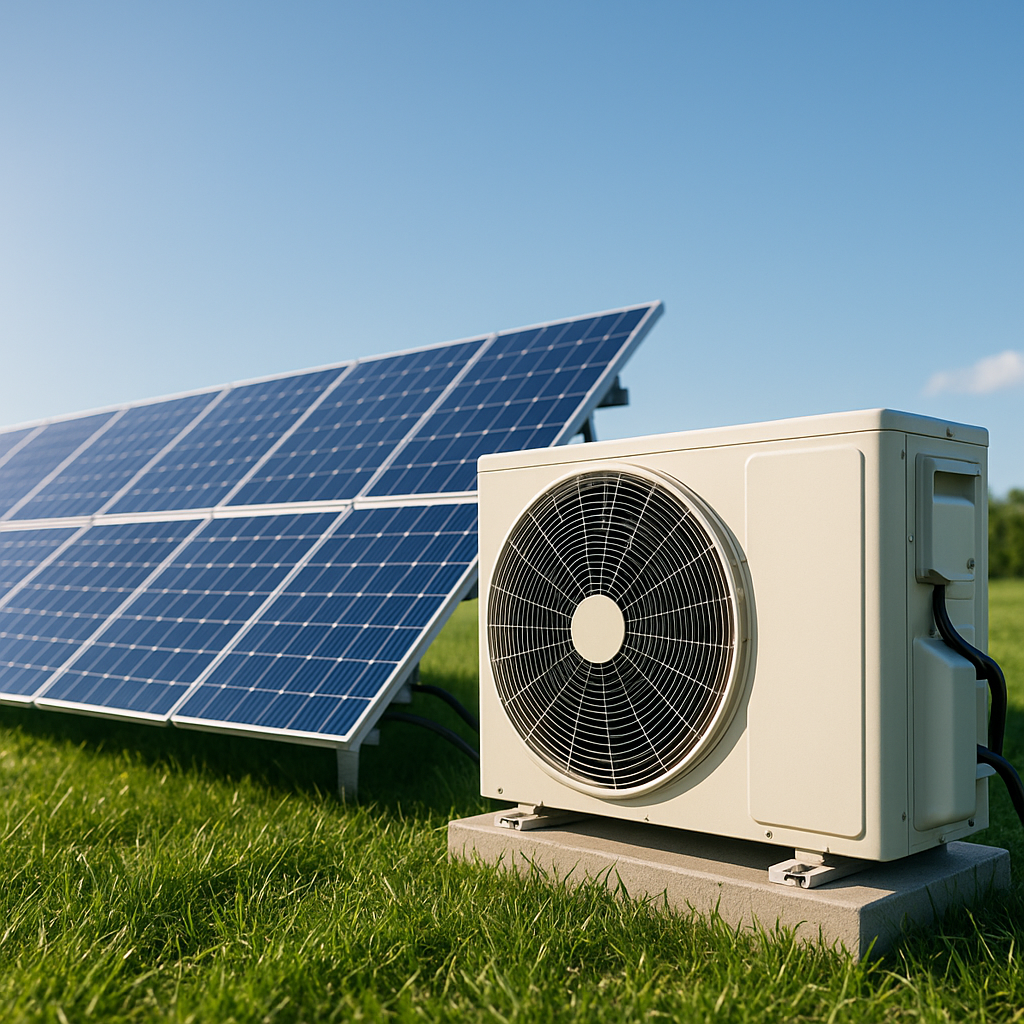
Running a 1-ton air conditioner on solar power requires a dedicated solar array ranging from 1.5kW to 2kW, paired with an inverter of at least 2kVA to 3kVA and an appropriately sized battery bank if off-grid operation is desired. Because air conditioners have high startup surge currents and continuous running loads, careful calculation of wattage, inverter capacity, and storage is essential to prevent system trips and equipment damage.
Understanding the Energy Demands of a 1-Ton Air Conditioner
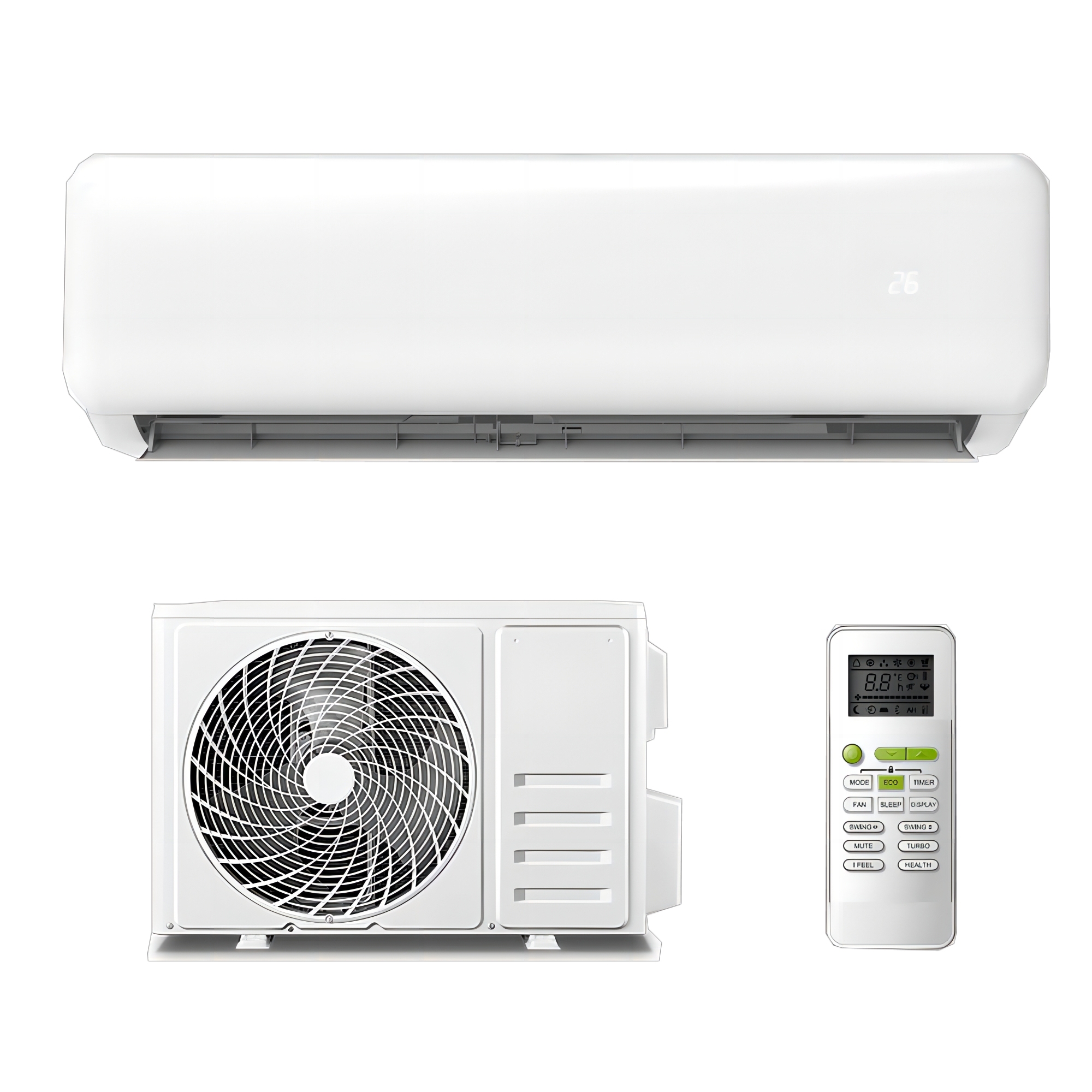
To successfully run a 1-ton air conditioner on solar power, you must first understand the distinction between its running wattage and its starting surge wattage. A standard 1-ton window or split air conditioner typically consumes between 900 watts and 1,200 watts of continuous electrical power while running, depending on its energy efficiency rating (such as an Inverter AC versus a fixed-speed non-inverter model).
However, the compressor inside the air conditioner requires a much higher burst of energy—known as the starting surge or locked-rotor amps (LRA)—to kickstart the motor. This surge can momentarily spike the power requirement to 2,000 watts or even 3,000 watts for a fraction of a second.
Neglecting this surge capacity is the most common reason solar setups fail or cause inverter overloads. When designing a system, the inverter must be rated to handle this peak load comfortably, while the solar panels must generate enough sustained energy to cover both the running wattage of the AC and the simultaneous loads of any other household appliances running concurrently.
Solar System Components Required for a 1-Ton AC
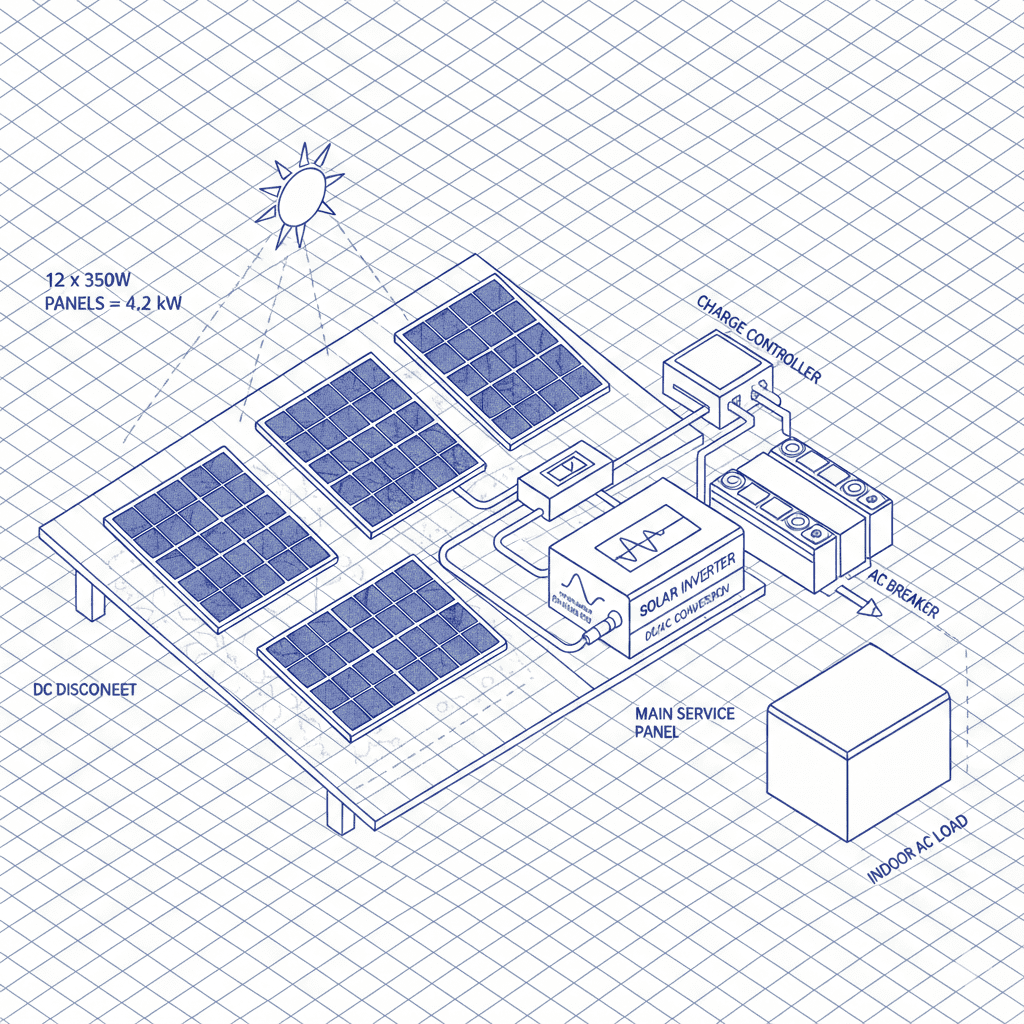
Transitioning a cooling appliance to renewable energy involves integrating several core hardware components. Each part plays a critical role in capturing sunlight, converting it into usable electricity, regulating the voltage, and storing excess energy.
Solar Panels
To reliably run a 1-ton AC during peak sunshine hours, you need a minimum of 1,500 watts (1.5kW) to 2,000 watts (2kW) of solar panel capacity. This translates to roughly four to six high-efficiency 400W or 500W monocrystalline panels. Oversizing the array slightly is recommended to account for energy losses caused by elevated panel temperatures, dust, wiring resistance, and less-than-ideal tilt angles or overcast weather conditions.
Solar Inverter
The inverter converts the direct current (DC) generated by the panels into alternating current (AC) used by the air conditioner. For a 1-ton AC, a standard 1kW inverter will not suffice due to the compressor's startup surge. You require a pure sine wave inverter rated between 2kVA and 3kVA.
- Off-Grid Inverters: Manage power exclusively from panels and batteries.
- Hybrid Inverters: Allow you to pull supplementary power from the utility grid or feed excess energy back into it, providing a seamless fail-safe during extended cloudy periods.
Battery Storage vs. Grid-Tied Setups
How you store or utilize your solar energy depends on whether you choose an off-grid, hybrid, or net-metered grid-tied configuration:
- Off-Grid Systems: Require a robust battery bank (lithium iron phosphate or deep-cycle lead-acid) capable of storing at least 2kWh to 3kWh of usable energy per hour of operation if you plan to run the AC at night or during overcast weather.
- Grid-Tied / Hybrid Systems: Often run without heavy battery storage during the day. The solar panels power the AC directly while the sun shines, and the grid steps in automatically when clouds pass or after sunset.
| System Type | Minimum Panel Capacity | Inverter Size | Battery Storage Required | Best Use Case |
|---|---|---|---|---|
| Grid-Tied (Solar + Grid) | 1.5 kW - 2.0 kW | 2 kVA - 3 kVA | None (Optional for backup) | Daytime cooling with stable grid access |
| Hybrid (Solar + Grid + Battery) | 2.0 kW | 3 kVA | 2.4 kWh - 4.8 kWh (LiFePO4) | Continuous cooling with unstable grid/outages |
| Standalone Off-Grid | 2.5 kW+ | 3 kVA+ | 5.0 kWh+ | Remote locations without grid infrastructure |
Inverter AC vs. Non-Inverter AC on Solar
The type of air conditioner you own drastically alters your solar system requirements. Modern Inverter ACs use variable-speed compressors that ramp up and down smoothly, avoiding the aggressive startup spikes associated with older technology. Once the room reaches the set temperature, an inverter AC can dial back its power consumption to as low as 400W–500W, making it remarkably easy for a modest solar setup to sustain.
Conversely, Non-Inverter (Fixed-Speed) ACs operate on a rigid binary cycle: they run at 100% capacity until the room cools down, then shut off completely before cycling back on. Every time the compressor kicks back on, it draws that heavy electrical surge. This constant fluctuating load places intense strain on solar inverters and depletes battery banks much faster, requiring a larger, more expensive solar configuration to maintain stable operation.
Step-by-Step Calculation for a Dedicated Solar AC Setup
Determining your exact energy footprint ensures you do not under-engineer or overspend on your solar installation. Follow these steps to calculate your requirements:
- Check the Energy Label (BEE / Energy Star): Locate the wattage rating on your 1-ton AC unit. A standard unit consumes roughly 1,000 watts per hour.
- Calculate Daily Energy Consumption: If you run the AC for 5 hours a day, your daily consumption is $1,000 \text{ watts} \times 5 \text{ hours} = 5,000 \text{ Watt-hours}$ (or 5 kWh).
- Account for System Inefficiencies: Factor in a 20% loss due to inverter conversion heat, wiring resistance, and battery charging cycles. $5\text{ kWh} \div 0.8 = 6.25\text{ kWh}$ of total solar generation required daily.
- Determine Peak Sun Hours: If your geographical location averages 4 peak sun hours per day, divide your daily requirement by those hours: $6.25\text{ kWh} \div 4 = 1.56\text{ kW}$ minimum panel array size.
Practical Installation and Operational Considerations
Proper installation safeguards your investment and maximizes energy yield. Keep the following technical factors in mind during setup:
- Panel Orientation and Tilt: Install panels facing true South (in the Northern Hemisphere) or true North (in the Southern Hemisphere) at an angle roughly equal to your geographical latitude to capture maximum annual sunlight.
- Shading Analysis: Ensure zero shade falls across your solar array during peak generation hours (9:00 AM to 4:00 PM). Even partial shade on a single panel can drastically reduce the output of an entire string in traditional setups.
- Wiring and Circuit Protection: Use appropriately rated DC cabling (typically 4mm² or 6mm² copper wires) alongside dedicated DC isolators, circuit breakers (MCBs), and surge protection devices (SPDs) between the panels, inverter, and AC unit to prevent electrical fires and equipment failure.
Frequently Asked Questions
Can I run a 1-ton AC directly on solar panels without batteries?
Yes, this is known as a DC-direct solar air conditioner or a hybrid grid-tied setup without storage. During daylight hours, the solar panels generate electricity to run the compressor directly. However, if a cloud passes over or the sun sets, the unit will either shut down or automatically draw power from the electrical grid unless a battery bank or grid connection is present.
How many solar panels are needed for a 1-ton inverter AC?
Generally, four to five high-efficiency 400W solar panels (totaling 1,600W to 2,000W) are required. This accounts for environmental degradation, temperature-induced power losses, and the need to generate surplus energy to power home loads while keeping the AC running smoothly.
Will a 1kW inverter run a 1-ton AC?
No. A 1kW inverter cannot handle a 1-ton AC because the compressor's startup surge routinely exceeds 2kW. Attempting to run an AC on an undersized inverter will trigger immediate overload protection shutdowns and can permanently fry the inverter's internal switching transistors.
Do I need a special solar-compatible air conditioner?
No, standard household ACs—especially modern Inverter models—can run on solar power as long as they are connected to a properly sized solar inverter and generation system. However, specialized DC solar air conditioners also exist that run directly on solar DC voltage without needing an inverter conversion step.
How long will a battery backup run a 1-ton AC at night?
Running a 1-ton inverter AC through the night requires a substantial battery bank. If the AC consumes an average of 600 watts per hour on low modulation over 8 hours, you need at least 4.8kWh of usable battery storage. Due to depth-of-discharge limits, this typically requires a 5kWh to 10kWh lithium battery pack, which represents a significant financial investment.
Next Actions for Your Solar Project
Before purchasing equipment, conduct a detailed site audit of your roof space and shading conditions. Consult a certified solar technician or electrical engineer to verify local grid-interconnection codes, net-metering regulations, and structural load limits on your roof. Opting for a professional load assessment ensures your chosen inverter, panels, and storage components work in complete harmony to deliver reliable, long-term cooling performance.