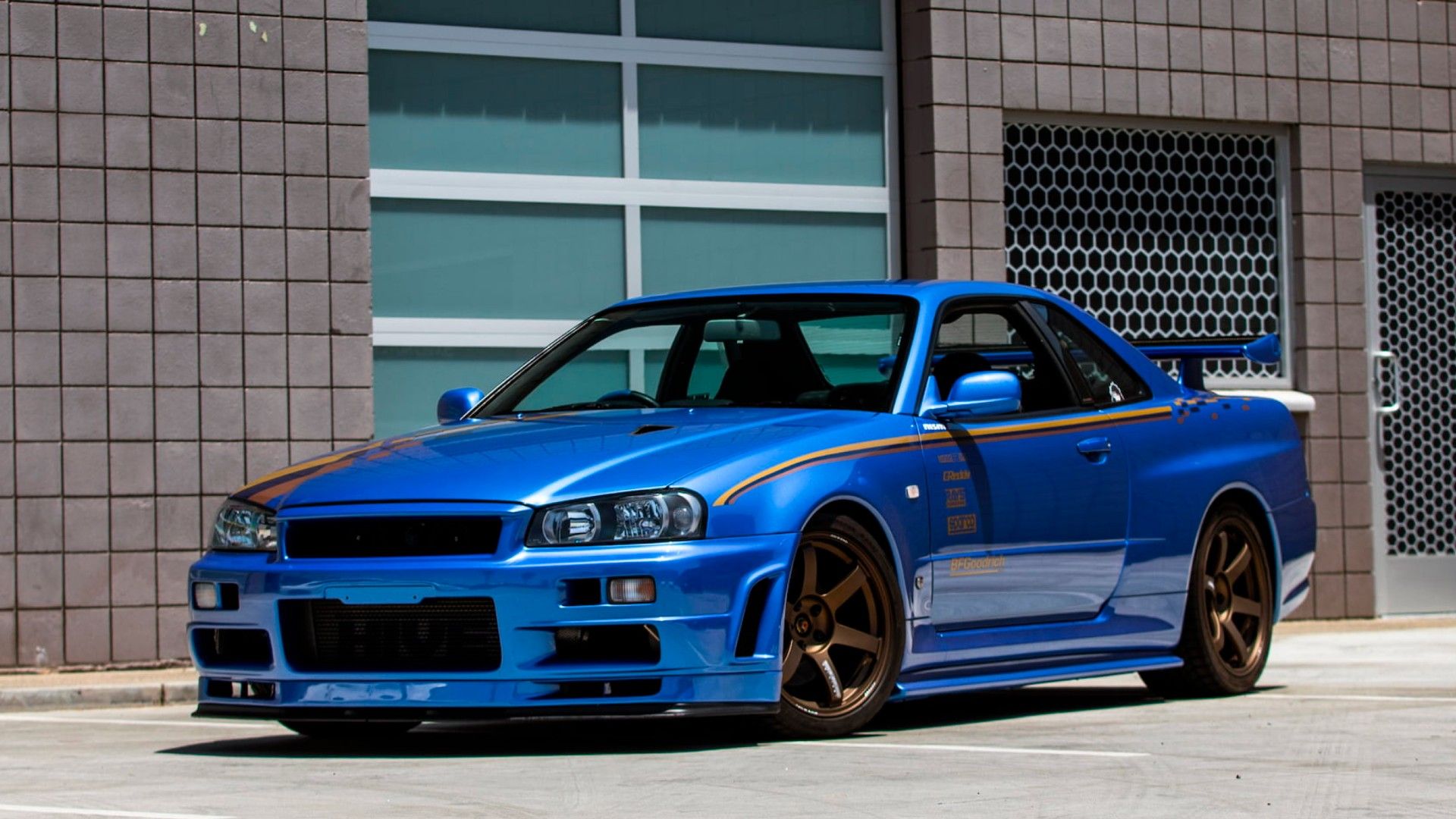
The Nissan Skyline GT-R R34 has an electronically limited top speed of 112 mph (180 km/h) to comply with Japanese "Gentlemen’s Agreement" regulations. When unrestricted, a stock R34 GT-R can achieve a top speed of approximately 155–165 mph (250–265 km/h). This performance places it firmly alongside contemporaries like the Toyota Supra MKIV and the BMW M3 E46.
The Engineering Behind the R34 GT-R’s Velocity
To understand the top speed of the Nissan Skyline GT-R R34 (produced from 1999 to 2002), one must look beneath its iconic "Bayside Blue" exterior. The heart of the machine is the RB26DETT engine, a 2.6-liter inline-six equipped with parallel twin-turbochargers. While officially rated at 276 horsepower due to the voluntary limit set by Japanese manufacturers, actual dynamometer tests of stock units frequently revealed outputs closer to 320–330 horsepower.
The R34’s ability to reach and maintain high speeds is not merely a product of raw power but of sophisticated power delivery. The car utilizes the ATTESA E-TS Pro (Advanced Total Traction Engineering System for All-Terrain Electronic Torque Split) all-wheel-drive system. At high speeds, this system primarily sends power to the rear wheels to reduce mechanical drag, but it can instantaneously divert torque to the front wheels to maintain stability during high-velocity lane changes or cornering.
Aerodynamics also play a crucial role. The R34 V-Spec and V-Spec II models featured carbon fiber rear diffusers and adjustable rear wings. These components were designed to manage airflow under the car, creating a venturi effect that sucked the chassis toward the tarmac. This downforce is essential for stability as the car approaches its physical limit of 165 mph, preventing the front end from becoming "light" and unresponsive.
The Gentlemen’s Agreement and the 180 km/h Ceiling
In the late 1990s, the Japanese automotive industry operated under a self-imposed "Gentlemen’s Agreement." This agreement dictated two main restrictions: a maximum advertised power output of 276 hp (280 PS) and an electronic speed limiter set at 180 km/h (112 mph). Consequently, every R34 GT-R that left the factory in Japan was technically incapable of exceeding 112 mph.
However, for the international market and enthusiast community, these limiters were easily bypassed. In markets like the United Kingdom, where a small number of R34s were officially imported (the V-Spec UK-spec), the cars were often "de-restricted" during the Pre-Delivery Inspection (PDI). Without the electronic shackles, the gear ratios of the 6-speed Getrag manual transmission allowed the RB26DETT to pull until aerodynamic drag finally overcame engine torque.
Comparing the R34 to Its Domestic Rivals
The late 90s was the golden era of the Japanese "Super GT" style street cars. The R34 faced stiff competition from Toyota, Mazda, and Honda. Each manufacturer took a different approach to reaching the 150+ mph threshold.
Toyota Supra MKIV (A80)
The Supra is often cited as the R34's primary rival. Equipped with the legendary 2JZ-GTE engine, the Supra shared the same 180 km/h limit in Japan. When de-restricted, the Supra MKIV generally possessed a slightly higher top speed than the R34, often reaching 170+ mph in its export (Euro/US) configurations. This was largely due to the Supra’s lower drag coefficient and its rear-wheel-drive layout, which suffers from less drivetrain power loss than the R34’s complex AWD system.
Mazda RX-7 (FD3S)
The RX-7 relied on a lightweight chassis and a sequential twin-turbo 13B rotary engine. While the RX-7 was exceptionally agile, its top speed was slightly lower than the R34's, typically topping out around 155–160 mph. The rotary engine, while high-revving, often struggled with heat soak during sustained high-speed runs, a factor where the iron-block RB26DETT in the Nissan had a distinct durability advantage.
Honda NSX-R
The Honda NSX-R took a naturally aspirated approach with its 3.2-liter V6. Because it was mid-engined and featured an all-aluminum body, its power-to-weight ratio was superb. An NSX-R could reach a top speed of approximately 170 mph. In a straight-line top-speed battle, the NSX-R often edged out the R34 due to superior high-speed aerodynamics and lower weight, though it lacked the R34's mid-range "punch" provided by turbocharging.
International Benchmarks: The European Perspective
In 2026, looking back at the R34's performance, it is vital to compare it to the European sports cars of the same period. This context reveals why the Skyline gained such a legendary "giant killer" reputation.
The BMW M3 E46, released shortly after the R34, featured a 3.2-liter S54 inline-six producing 338 hp. Like the Nissan, it was electronically limited to 155 mph (250 km/h). When de-restricted, the M3 could reach approximately 170 mph. The M3 was more of a "grand tourer" at high speeds, offering a smoother ride, whereas the R34 felt like a precision instrument designed for the racetrack.
The Porsche 911 (996) Carrera was another contemporary. With a top speed of 174 mph, the Porsche was objectively faster in a straight line than a stock, unrestricted R34. However, the R34’s ATTESA AWD gave it a level of high-speed stability in adverse conditions (such as wet highway runs) that the rear-engine, rear-drive Porsche could not match.
Comparative Performance Data Table
The following table compares the estimated unrestricted top speeds and engine specifications of the R34 GT-R and its primary rivals from the 1999–2002 era.
| Vehicle Model | Engine Type | Horsepower (Actual Est.) | Top Speed (Unrestricted) |
|---|---|---|---|
| Nissan Skyline GT-R R34 | 2.6L I6 Twin-Turbo | 320–330 hp | 155–165 mph |
| Toyota Supra MKIV (A80) | 3.0L I6 Twin-Turbo | 320–330 hp | 170–175 mph |
| Honda NSX-R (NA2) | 3.2L V6 NA | 290 hp | 170–172 mph |
| Mazda RX-7 (FD3S) | 1.3L Rotary Twin-Turbo | 276–280 hp | 155–160 mph |
| Mitsubishi Lancer Evo VI | 2.0L I4 Turbo | 280–300 hp | 150–155 mph |
| BMW M3 (E46) | 3.2L I6 NA | 338 hp | 170–175 mph |
| Porsche 911 (996) Carrera | 3.4L Flat-6 NA | 300 hp | 174 mph |
Note: Speeds are based on period-correct testing and factory gearing limitations.
Factors Limiting the R34's Top Speed
While the R34 is a performance icon, several technical factors prevented it from reaching the 180+ mph territory occupied by modern supercars without significant modification.
- Drivetrain Loss: The R34’s all-wheel-drive system is heavy and mechanically complex. Rotating the transfer case, front driveshaft, and front differentials consumes energy. At speeds above 140 mph, parasitic drag within the drivetrain becomes a significant hurdle.
- Gear Ratios: The Getrag 6-speed gearbox was optimized for acceleration and mid-range response rather than ultimate top-end velocity. The sixth gear acts as an overdrive, but the engine often runs out of torque to overcome wind resistance before reaching the redline in top gear.
- Frontal Area: The R34 has a relatively "boxy" silhouette compared to the sleek, low-slung Toyota Supra or Honda NSX. This larger frontal area results in a higher coefficient of drag, meaning the engine has to work harder to push the car through the air at high speeds.
The Role of Tuning and the 300 km/h Club
No discussion of the R34's top speed is complete without mentioning the Japanese tuning culture. In the early 2000s, legendary tuning houses like HKS, Top Secret, and Mine’s used the R34 to shatter speed records.
By increasing the displacement of the RB26 to 2.8 liters (the "RB28" stroker kit) and swapping the factory twin-turbos for a large single turbocharger, these tuners easily pushed the R34 past the 200 mph (322 km/h) barrier. The famous "Top Secret" R34, tuned by Smoky Nagata, became an icon of the "Yatabe" and "Nardo" high-speed test tracks, proving that the R34 chassis could handle speeds far in excess of its factory design limits.
High-Speed Stability and Handling
Where the R34 often "beat" its rivals was not in the absolute top speed number, but in how it felt at those speeds. High-speed runs on the Tokyo Metropolitan Expressway (Wangan) required a car that could handle expansion joints, curves, and heavy traffic.
The R34’s Super HICAS (High Capacity Actively Controlled Steering) system provided four-wheel steering. At high speeds, the rear wheels turn in the same direction as the front wheels, effectively lengthening the wheelbase and making lane changes exceptionally stable. This gave drivers the confidence to push the car to its 165 mph limit, whereas an RX-7 or a Supra might feel more "nervous" or prone to oversteer at similar velocities.
Frequently Asked Questions
Is the Nissan Skyline GT-R R34 faster than a modern Nissan GT-R R35?
No. The modern R35 GT-R is significantly faster, with a factory top speed of 196 mph (315 km/h). The R35 benefits from twenty years of advancements in aerodynamics, a much more powerful V6 twin-turbo engine, and a dual-clutch transmission that shifts faster than the R34’s manual Getrag unit.
Can a stock R34 GT-R really only go 112 mph?
Technically, yes, if it still has the factory-installed electronic speed limiter. This was a mandatory safety feature for cars sold in the Japanese domestic market. However, almost all R34s found in the enthusiast market today have had this limiter removed via an ECU reflash or a "Speed Limit Defencer" (SLD) device.
How does the R34 compare to the Subaru Impreza WRX STI in top speed?
The R34 is generally faster than the contemporary Subaru Impreza WRX STI (GC8 or GDB generations). While the STI has incredible acceleration and grip on loose surfaces, its short gear ratios and "rally-style" aerodynamics (including large, high-drag wings) usually limit its top speed to around 145–150 mph.
Why was the R34 restricted while European cars were not?
The Japanese "Gentlemen's Agreement" was an informal pact between manufacturers to avoid a "speed war" that might lead to government intervention or more stringent safety laws. European manufacturers, particularly those in Germany, had a different agreement—limiting most cars to 155 mph (250 km/h)—which allowed for much higher speeds than the Japanese 112 mph limit.
Does the V-Spec II have a higher top speed than the standard R34 GT-R?
No, the engine and transmission remain the same between the standard GT-R and the V-Spec II. However, the V-Spec II features better cooling (NACA duct on the hood) and improved aerodynamics (carbon fiber rear diffuser), which can make the car more stable and consistent during sustained high-speed driving.
Final Recommendation for Enthusiasts
For those looking to experience the R34's high-speed capabilities in 2026, the primary focus should be on maintenance and safety rather than just power. The R34 is now a classic vehicle. To safely reach its potential 165 mph top speed, ensure that the following areas are addressed:
- Tire Integrity: Use only "Z" or "Y" speed-rated tires. Aging tires, even with good tread, can delaminate under the heat and centrifugal force of a 150+ mph run.
- Suspension Bushings: The rubber bushings in the R34’s multi-link suspension can perish over two decades. Replacing these with polyurethane or new OEM units is vital for high-speed stability.
- Cooling System: Sustained high-speed runs generate immense heat in the RB26. An upgraded aluminum radiator and an external oil cooler are highly recommended to prevent engine failure.
The R34 GT-R may not be the fastest car by 2026 standards, but its combination of mechanical feel, high-speed stability, and the iconic RB26 soundtrack ensures its place as one of the most rewarding high-performance machines ever built.