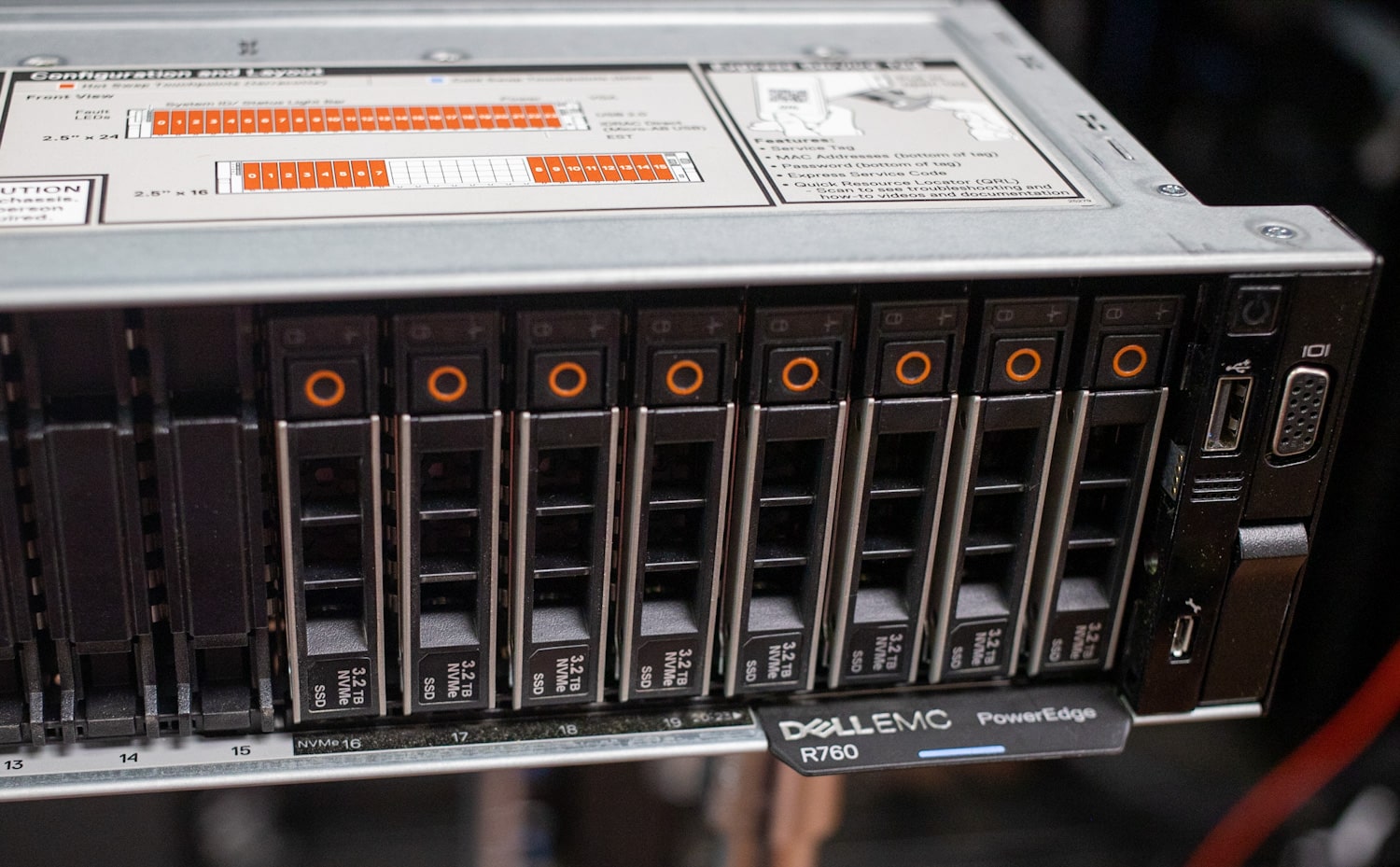
The Dell PowerEdge R760xs is a 2U, single-socket rack server purpose-built to deliver optimized performance, high memory capacity, and enterprise-grade manageability for virtualization, scale-out databases, and mid-range cloud environments without the enterprise-level cost of dual-socket platforms.
Choosing the right server hardware for a modern enterprise environment requires balancing compute density, memory bandwidth, power consumption, and capital expenditure. In the dense ecosystem of enterprise rack servers, the Dell PowerEdge R760xs occupies a highly specific and strategic niche. Built to support 4th and 5th Generation Intel Xeon Scalable processors, this 2U platform strips away redundant dual-socket complexities to focus entirely on efficient, single-socket execution. This review examines the architectural design, performance capabilities, storage configurations, management ecosystem, and overall value proposition of the PowerEdge R760xs to help IT decision-makers determine its suitability for modern virtualized datacenters.
Architectural Overview and Design Philosophy
The Dell PowerEdge R760xs is engineered around a fundamental industry shift: single-socket processors have evolved to offer core counts and memory channels that easily rival older dual-socket platforms. By centering its architecture on a single 4th or 5th Gen Intel Xeon Scalable processor (up to 32 cores in standard configurations), the R760xs minimizes socket-to-socket interconnect latencies and reduces overall power and cooling overhead.
The chassis itself is designed with a reduced depth compared to traditional heavy-duty enterprise servers, making it exceptionally friendly for edge deployments, colocation facilities, and space-constrained server rooms. Despite its streamlined profile, it maintains a robust thermal architecture. Dell utilizes advanced airflow management techniques, including direct-to-component shrouds and high-efficiency fan modules, ensuring the system can sustain peak workloads without thermal throttling.
Furthermore, the server supports up to 16 DDR5 Registered DIMMs (RDIMMs). While this is lower than its fully-loaded enterprise sibling, the standard R760, the R760xs provides more than enough memory bandwidth and capacity for typical virtualization clusters, virtual desktop infrastructure (VDI) nodes, and containerized microservices architectures.
Technical Specifications and Hardware Configuration Options
Understanding the hardware parameters of the PowerEdge R760xs requires looking at how compute, memory, and expansion slots interact within a single-socket framework. The following breakdown outlines the primary hardware dimensions available to IT architects during configuration:
- Processor Support: One 4th Generation (Sapphire Rapids) or 5th Generation (Emerald Rapids) Intel Xeon Scalable processor, supporting up to 32 cores per socket.
- Memory Architecture: 16 DDR5 DIMM slots supporting speeds up to 4800 MT/s, with a maximum capacity of 1 TB using 64 GB RDIMMs.
- Storage Subscriptions: Flexible front-bay configurations supporting up to 12 x 3.5-inch SAS/SATA drives, or up to 16 x 2.5-inch SAS/SATA/NVMe drives, alongside optional rear storage configurations.
- Expansion Slots: Up to 6 PCIe Generation 4 and Generation 5 slots, enabling high-speed network interface card (NIC) deployments and hardware RAID controllers.
- Power Supplies: Redundant hot-swap power supply units (PSUs) ranging from 600W to 1800W, certified for Titanium and Platinum efficiency standards.
Storage and I/O Flexibility
Storage performance is a critical bottleneck in modern database and virtualization environments. The PowerEdge R760xs addresses this by offering modular storage front ends. Administrators can deploy cost-effective SATA solid-state drives (SSDs) for general-purpose application hosting or leverage high-throughput NVMe drives via EDSFF (Enterprise and Datacenter Standard Form Factor) or traditional U.2/U.3 formats for demanding transactional workloads.
The inclusion of PCIe Gen 5 slots ensures that the platform is future-proofed for high-bandwidth networking. Enterprises running software-defined storage (SDS) clusters, such as VMware vSAN or Microsoft Azure Stack HCI, can take full advantage of dual-port 100GbE or 200GbE network adapters without encountering internal bus bottlenecks.
Performance and Workload Suitability
Evaluating the R760xs in real-world scenarios reveals a machine optimized for predictable, scale-out workloads rather than monolithic, ultra-dense high-performance computing (HPC) tasks. Because it relies on a single processor, software licensing models that tie costs to socket counts—such as certain enterprise hypervisors and database platforms—yield significant financial savings.
Virtualization and Cloud Infrastructure
In virtualization clusters running VMware ESXi, Microsoft Hyper-V, or KVM, the R760xs excels as a standard hypervisor node. A fully populated memory footprint combined with a 32-core Intel Xeon processor provides ample headroom to host dozens of virtual machines or hundreds of lightweight containers. The absence of a second socket reduces idle power draw, translating into noticeable operational expenditure (OPEX) reductions over a three-to-five-year hardware lifecycle.
Virtual Desktop Infrastructure (VDI)
VDI environments require a careful balance of memory capacity, core density, and graphics acceleration. The R760xs supports single-width enterprise GPUs, making it a viable entry-to-mid-range node for Citrix or VMware Horizon deployments. While it may not house the massive multi-GPU arrays found in purpose-built AI training servers, it handles standard knowledge-worker and task-worker graphics demands smoothly.
| Workload Category | Suitability | Primary Advantage | Primary Limitation |
|---|---|---|---|
| Virtualization (VMware/Hyper-V) | Excellent | Lower per-socket software licensing costs | Hard ceiling at 32 cores per node |
| Enterprise Databases (SQL/Oracle) | Moderate | High memory bandwidth and fast NVMe support | Single-socket compute limits massive OLTP concurrency |
| Virtual Desktop Infrastructure (VDI) | Good | Balanced memory density and GPU support | Limited to single-width or fewer GPU options |
| AI / Deep Learning Training | Poor | Standard PCIe expansion available | Insufficient multi-GPU density and power delivery |
Management, Security, and Enterprise Ecosystem
Dell’s proprietary management ecosystem remains a primary differentiator for the PowerEdge line, and the R760xs benefits fully from the latest iterations of hardware monitoring tools.
iDRAC9 and OpenManage Enterprise
The Integrated Dell Remote Access Controller 9 (iDRAC9) provides out-of-band server management with a responsive HTML5-based web interface. Administrators can perform remote BIOS updates, monitor component health, and execute virtual console sessions without relying on the host operating system.
When paired with OpenManage Enterprise, IT teams can automate lifecycle management across hundreds of PowerEdge servers simultaneously. Zero-touch deployment profiles allow new R760xs units to be unboxed, racked, and automatically configured with baseline security policies within minutes.
Silicon-Root-of-Trust and Cyber Resilience
Security is deeply embedded into the R760xs hardware design. Dell implements a Silicon Root of Trust that validates the system's firmware integrity from the moment power is applied. Secure Boot, System Lockdown modes, and cryptographically signed firmware updates protect against sophisticated supply chain attacks and unauthorized firmware modifications. These features align with strict federal and corporate compliance frameworks.
Comprehensive Comparison: R760xs vs. R760
To fully appreciate the design intent of the R760xs, it is helpful to compare it directly with its flagship counterpart, the standard Dell PowerEdge R760. While both occupy a 2U form factor and utilize the same generation of Intel Xeon processors, their target markets diverge significantly.
- Processor Architecture: The standard R760 is a dual-socket machine capable of supporting up to 128 cores total (64 cores per socket), whereas the R760xs is strictly single-socket, capping out at 32 cores.
- Memory Density: The dual-socket R760 supports up to 32 DDR5 DIMMs (up to 8 TB of RAM), doubling the capacity and memory channel bandwidth of the R760xs, which maxes out at 16 DIMMs (1 TB of RAM).
- Target Audience: The R760 is built for heavy computational loads, monolithic databases, and dense enterprise consolidation. The R760xs is designed for cost-conscious organizations that need modern architecture and storage flexibility without paying for dual-socket overhead.
Cost Considerations and Value Proposition
The financial appeal of the PowerEdge R760xs lies in right-sizing infrastructure investments. Many organizations purchase dual-socket servers out of habit, only to utilize a fraction of the second processor's compute capacity and memory channels. By selecting the R760xs, buyers save on initial capital expenditure (CAPEX) regarding the second CPU, extra memory modules, and more robust power supplies.
Furthermore, software licensing optimization represents a hidden financial benefit. Because enterprise software vendors frequently price licenses per socket, eliminating the second socket can reduce annual software maintenance and subscription costs by half for that node. When multiplied across a multi-node cluster, these software savings often eclipse the hardware cost delta.
Limitations and Operational Constraints
Despite its many strengths, the PowerEdge R760xs is not a universal solution. IT planners must evaluate its hard constraints before committing to a deployment:
- Compute Ceiling: Applications that demand massive parallel processing within a single physical node will hit a wall at the 32-core limit.
- Expansion Limits: While it features multiple PCIe slots, the single-socket architecture restricts the total number of high-speed lanes available for ultra-dense multi-card expansions.
- Upgrade Path: Because the platform is architecturally bound to single-socket configurations, administrators cannot simply drop in a second CPU later if workloads scale up; a complete node replacement or supplementary server addition becomes necessary.
Frequently Asked Questions
Can the Dell PowerEdge R760xs be upgraded to a dual-socket server later?
No. The R760xs motherboard is physically and electrically engineered with a single CPU socket. If your organization anticipates a need for dual-socket compute density in the near future, you should invest in the standard PowerEdge R760.
What is the maximum RAM supported by the PowerEdge R760xs?
The server features 16 DDR5 DIMM slots and supports a maximum memory capacity of 1 TB when populated with 64 GB RDIMMs operating at speeds up to 4800 MT/s.
Is the R760xs suitable for VMware vSAN deployments?
Yes. With flexible drive bays supporting NVMe, SAS, and SATA drives, combined with high-speed PCIe Gen 5 slot options for networking, the R760xs serves as a cost-effective and reliable node for VMware vSAN and Microsoft Azure Stack HCI clusters.
How does the "xs" designation differ from standard Dell models?
The "xs" suffix denotes an optimized, value-focused enterprise tier. These models strip away redundant high-end features—such as maximum memory channel counts and dual-socket support—to provide core enterprise reliability and modern architecture at a lower price point.
What power supply options are available for this platform?
Dell offers a range of hot-swappable, redundant power supply units from 600W up to 1800W, featuring 80 PLUS Titanium and Platinum efficiency ratings to match varying workloads and facility power constraints.
Final Recommendation and Next Actions
The Dell PowerEdge R760xs successfully bridges the gap between budget constraints and modern enterprise requirements. By focusing on a single-socket, high-efficiency design, it delivers robust virtualization performance, flexible storage options, and advanced security without charging for enterprise capacity that goes unused.
Organizations planning hardware refreshes for standard virtualization clusters, VDI environments, or scale-out cloud nodes should evaluate their actual core and memory utilization metrics. If workloads consistently fall within single-socket parameters, deploying the PowerEdge R760xs provides an effective path to modernizing infrastructure while optimizing both capital expenditures and ongoing software licensing costs. To proceed, consult with a certified Dell infrastructure partner to model your specific workload requirements against the R760xs configuration builder.