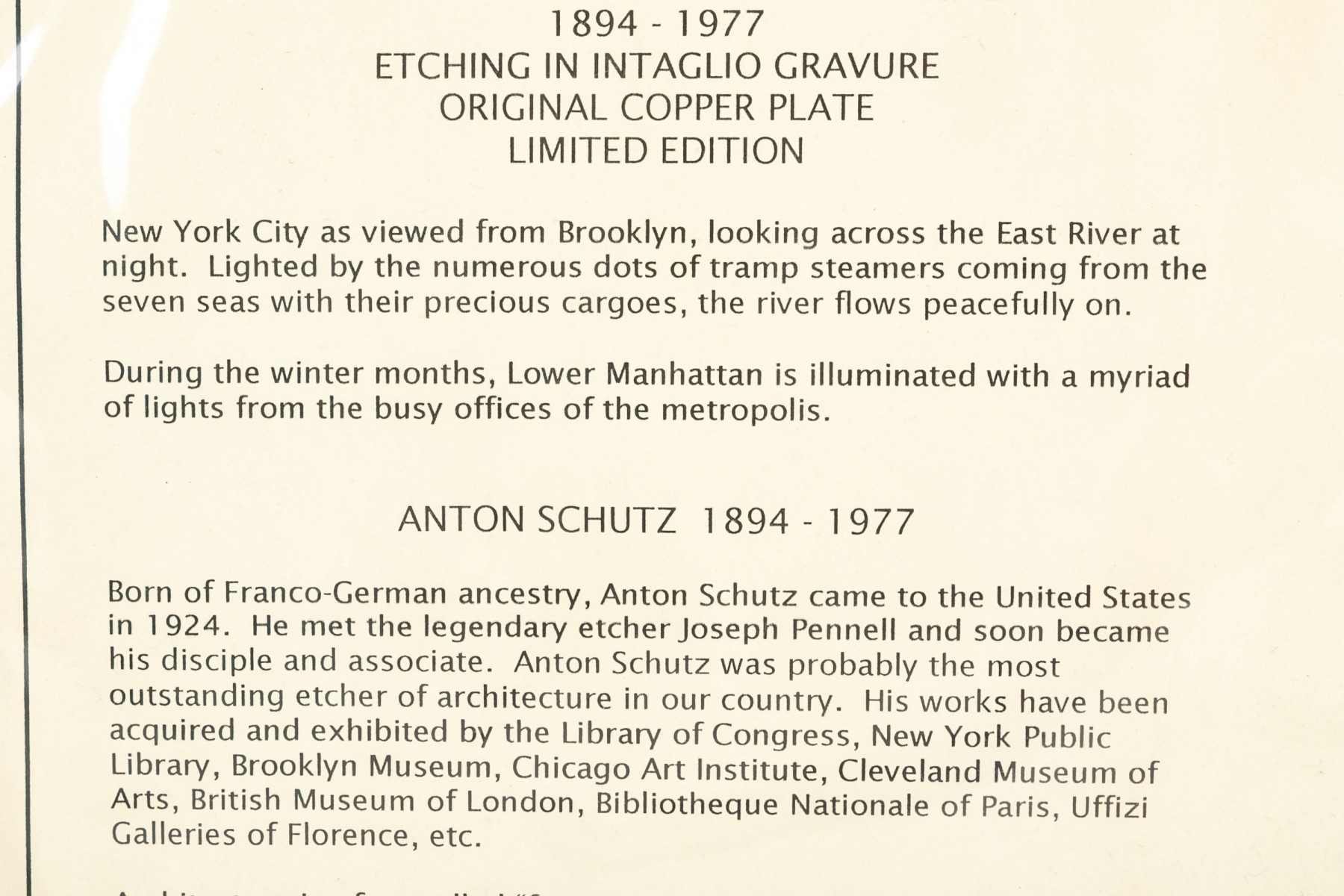
Anton Schutz was a German-American etcher and entrepreneur widely recognized as a printmaking pioneer for his meticulous architectural etchings and for founding the New York Graphic Society in 1925. His work bridged fine art and commercial publishing, making high-quality art reproductions accessible to a global audience while documenting the rise of the modern skyscraper.
The Formative Years: Munich and the European Influence
To understand why Anton Friedrich Schutz (1894–1977) became a central figure in American printmaking, one must look at his rigorous training in Germany. Born in Berndorf, Schutz’s early education was grounded in the meticulous traditions of European draftsmanship. Before the Great War interrupted his studies, he pursued mechanical engineering and architecture, disciplines that would later inform the structural accuracy of his artistic output.
Following World War I, Schutz enrolled at the Academy of Fine Arts in Munich. During this period, he studied under the renowned master Peter Halm, a figure who played a significant role in the revival of original etching in Germany. Under Halm’s tutelage, Schutz mastered the intaglio process—a technique where an image is incised into a surface, and the sunken line holds the ink. This mechanical precision, combined with an artist’s eye for light and shadow, allowed Schutz to develop a style that was uniquely suited for the burgeoning "verticality" of the 20th century.
By the time Schutz moved to the United States in 1924, he was not merely an aspiring artist but a highly skilled technician. He arrived in New York City at the height of the "Roaring Twenties," a period defined by an unprecedented building boom. The city was transforming from a mid-rise metropolis into a soaring forest of steel and stone, and Schutz was perfectly positioned to document this evolution.
Capturing the New York Skyline: The Architect of Copper Plates
Upon his arrival in New York, Schutz began a series of etchings that would define his career. His subjects were the giants of the era: the Woolworth Building, the Equitable Building, and eventually the Empire State Building. Unlike many of his contemporaries who focused on the grit of the streets or the social conditions of the city, Schutz focused on the majesty of the architecture itself.
His work caught the attention of Joseph Pennell, perhaps the most influential American etcher of the early 20th century. Pennell, who had been a close associate of James Abbott McNeill Whistler, recognized in Schutz a kindred spirit. While Pennell’s own style was often more impressionistic and atmospheric, Schutz’s work was characterized by a startling clarity. Every window, cornice, and setback of a skyscraper was rendered with architectural fidelity, yet he managed to avoid the dryness of a blueprint by using dramatic lighting and "wiped" ink effects to create mood.
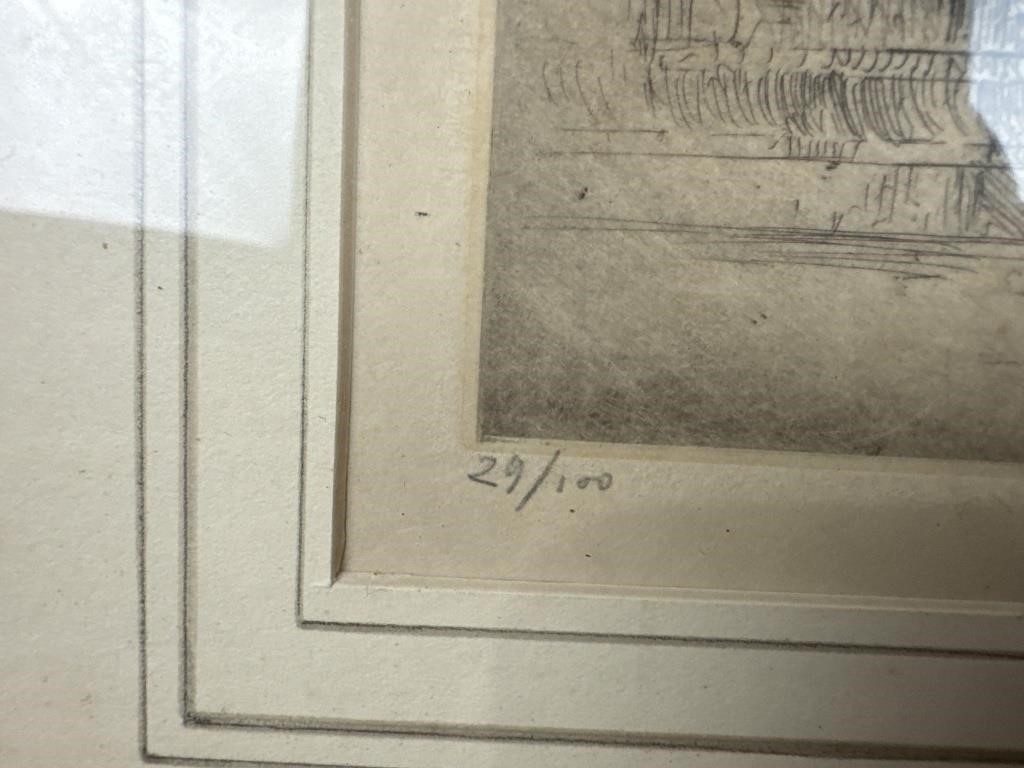
This period (1924–1930) was the peak of Schutz’s personal artistic output. He traveled across the United States, documenting the skylines of Chicago, Detroit, and Cleveland. His etchings became the definitive visual record of the American city’s golden age of construction. These prints were typically issued in limited editions, hand-signed by the artist, and sold to collectors and the very architectural firms that designed the buildings he depicted.
The Founding of the New York Graphic Society (NYGS)
While his skill as an etcher earned him critical acclaim, it was Schutz’s entrepreneurial vision that secured his legacy as a "printmaking pioneer." In 1925, he founded the New York Graphic Society (NYGS). Initially, the society served as a vehicle to publish and distribute his own etchings. However, Schutz quickly realized that there was a massive, untapped market for high-quality art reproductions among the growing American middle class.
Before the NYGS, art reproduction was often poor in quality or prohibitively expensive. Schutz applied his technical knowledge of printing to create high-end reproductions of masterpieces from around the world. He was among the first to utilize advanced color lithography and photogravure processes to mimic the depth and texture of original oil paintings.
Under Schutz’s leadership, the NYGS grew into one of the largest and most respected art publishers in the world. By 1926, and continuing through the mid-20th century, the NYGS catalog became a staple of schools, libraries, and middle-class homes. Schutz wasn't just creating art; he was democratizing it. He believed that a high-quality reproduction of a Van Gogh or a Rembrandt was a valuable educational tool, and he set the industry standards for color accuracy and paper quality.
Technical Mastery: The Etching Process and Materials
The label of "pioneer" is often used in a business sense, but for Schutz, it was equally grounded in his technical approach to the plate. His process involved several distinct stages that differentiated his work from the more commercial "etchings" of the day:
- Preparation of the Plate: Schutz typically used polished copper plates. He would apply a "ground"—an acid-resistant wax—to the surface.
- The Drawing: Using a needle, he would draw his architectural subjects into the wax, exposing the copper underneath. Because he was depicting architecture, his perspective had to be flawless; a single misplaced line on a 50-story building would ruin the illusion of height.
- The "Bite" (Acid Bath): The plate was submerged in nitric acid or ferric chloride. The acid would eat into the exposed copper, creating grooves. Schutz was known for his "multiple bites," where he would stop out certain areas with varnish to create varying depths of lines, resulting in a range of tones from light grey to deep, velvety black.
- Drypoint Additions: To add texture and softness—particularly in the sky or for the shadows of clouds—Schutz often used drypoint. This involved scratching directly into the copper with a diamond-tipped or steel needle, creating a "burr" (a ridge of metal) that caught more ink, resulting in a soft, blurred line.
- Inking and Wiping: Schutz was a master of "plate tone." He would not wipe the plate completely clean of ink; instead, he would leave a thin film of ink on the surface in specific areas to create a sense of atmosphere or sunset, a technique known as retroussage.
Comparing Schutz’s Media and Distribution
As Schutz transitioned from an independent artist to a major publisher, his output varied in terms of rarity and value. The following table provides a comparison for collectors and historians to distinguish between his different types of work.
| Feature | Original Signed Etchings (1920s-30s) | NYGS Limited Edition Portfolios | NYGS Commercial Reproductions |
|---|---|---|---|
| Medium | Hand-pulled intaglio on paper | High-quality lithography/photogravure | Mass-produced color offsets |
| Signature | Hand-signed in pencil (usually bottom right) | Often "signed in the plate" (printed) | Printed name only |
| Paper Quality | Heavy, deckle-edged rag paper | High-grade archival paper | Standard commercial cardstock |
| Edition Size | Usually 50 to 150 impressions | Several hundred | Thousands |
| Primary Value | High (Collector's market) | Moderate (Decorative/Historical) | Low (Educational/Vintage) |
| Visual Texture | Raised ink lines; visible plate mark | Smooth surface; deep color saturation | Flat surface; dot pattern visible |
Global Influence and UNESCO Collaboration
Schutz’s influence extended far beyond the shores of Manhattan. In the years following World War II, his reputation as a master of art reproduction led to a prestigious partnership with UNESCO (United Nations Educational, Scientific and Cultural Organization).
Beginning in the late 1940s, Schutz and the New York Graphic Society were commissioned to produce the "UNESCO World Art Series." This ambitious project aimed to document and share the art of various cultures—such as the frescoes of medieval Norway or the tomb paintings of ancient Egypt—with the rest of the world. Schutz traveled internationally, overseeing the photography and reproduction processes to ensure that the colors were as faithful to the originals as humanly possible.
This collaboration cemented Schutz's status as a global ambassador for art. He moved from capturing the specific architecture of New York to preserving the visual heritage of humanity. The catalogs produced during this era remain highly sought after by art historians for their technical excellence.
Collecting Anton Schutz in 2026
For modern collectors in 2026, Schutz’s work represents a bridge between the 19th-century etching tradition and the 20th-century commercial art world. His original etchings from the 1920s remain his most valuable assets.
When evaluating a Schutz print, collectors should look for the following:
- The Plate Mark: A genuine etching will have an indentation in the paper where the metal plate was pressed.
- The Signature: Schutz typically signed his name in pencil. A printed signature significantly reduces the market value.
- The Subject Matter: His depictions of the New York Stock Exchange, the Brooklyn Bridge, and the early Empire State Building are the most desirable.
- Condition: Because many of his prints were framed during an era before acid-free matting was standard, "mat burn" (a brown staining along the edges) is common. Prints that have been professionally conserved or kept in archival portfolios command a premium.
Preservation and Conservation Standards
Because Schutz’s work spans several decades, the paper types vary significantly. Early etchings were printed on high-quality handmade papers that have survived well. However, the commercial reproductions from the 1940s and 50s often used wood-pulp-based papers that are prone to acidity and brittleness.
Preserving a Schutz "original" requires a climate-controlled environment with a humidity level between 40% and 50%. Exposure to UV light should be strictly limited, as the inks used in 1920s etchings—while generally stable—can fade if the paper itself begins to degrade. For those holding NYGS portfolios, it is recommended to store them flat in acid-free boxes to prevent the "cockling" (rippling) of the paper.
FAQs About Anton Schutz
Did Anton Schutz only etch buildings in New York?
While he is most famous for his New York City series, Schutz was a prolific traveler. He produced extensive series of etchings in London, Paris, Tokyo, and various cities across the United States. His "European Cities" series is particularly noted for its focus on Gothic cathedrals and historic bridges, contrasting with the modern steel of his American work.
What is the difference between an Anton Schutz etching and an NYGS print?
An "Anton Schutz etching" usually refers to a hand-pulled print where Schutz himself manipulated the plate and the ink. An "NYGS print" refers to a reproduction published by his company. While the NYGS prints are of high quality, they are mechanical reproductions (lithographs or offsets) and do not hold the same value as the original hand-signed etchings.
Why is Anton Schutz considered a pioneer?
He is considered a pioneer for two reasons: his technical mastery of architectural etching during a period of rapid urban change, and his revolutionary approach to art distribution. By founding the New York Graphic Society, he created a model for high-quality art publishing that made fine art accessible to the general public, rather than just the elite.
Where can I see Anton Schutz's work today?
His work is held in major institutions worldwide, including the Metropolitan Museum of Art in New York, the Brooklyn Museum, and the Library of Congress. Many of his architectural etchings are also housed in the archives of the historical societies of the cities he depicted.
Is the New York Graphic Society still in existence?
The New York Graphic Society underwent various ownership changes over the decades. In the latter half of the 20th century, it was acquired by Time Inc. and later by other entities. While the original iteration founded by Schutz has evolved, the brand name remains synonymous with high-quality art publishing and distribution.
Final Recommendation for Historians and Collectors
If you are researching the architectural history of the early 20th century or looking to start a collection of American prints, Anton Schutz remains a foundational figure. For the best historical value, prioritize his 1924–1930 New York City etchings. These works capture a specific, unrepeatable moment in time when the skyline was transitioning from masonry to steel. Always verify the presence of a pencil signature and a physical plate mark to ensure you are acquiring an original work of art rather than a later reproduction.