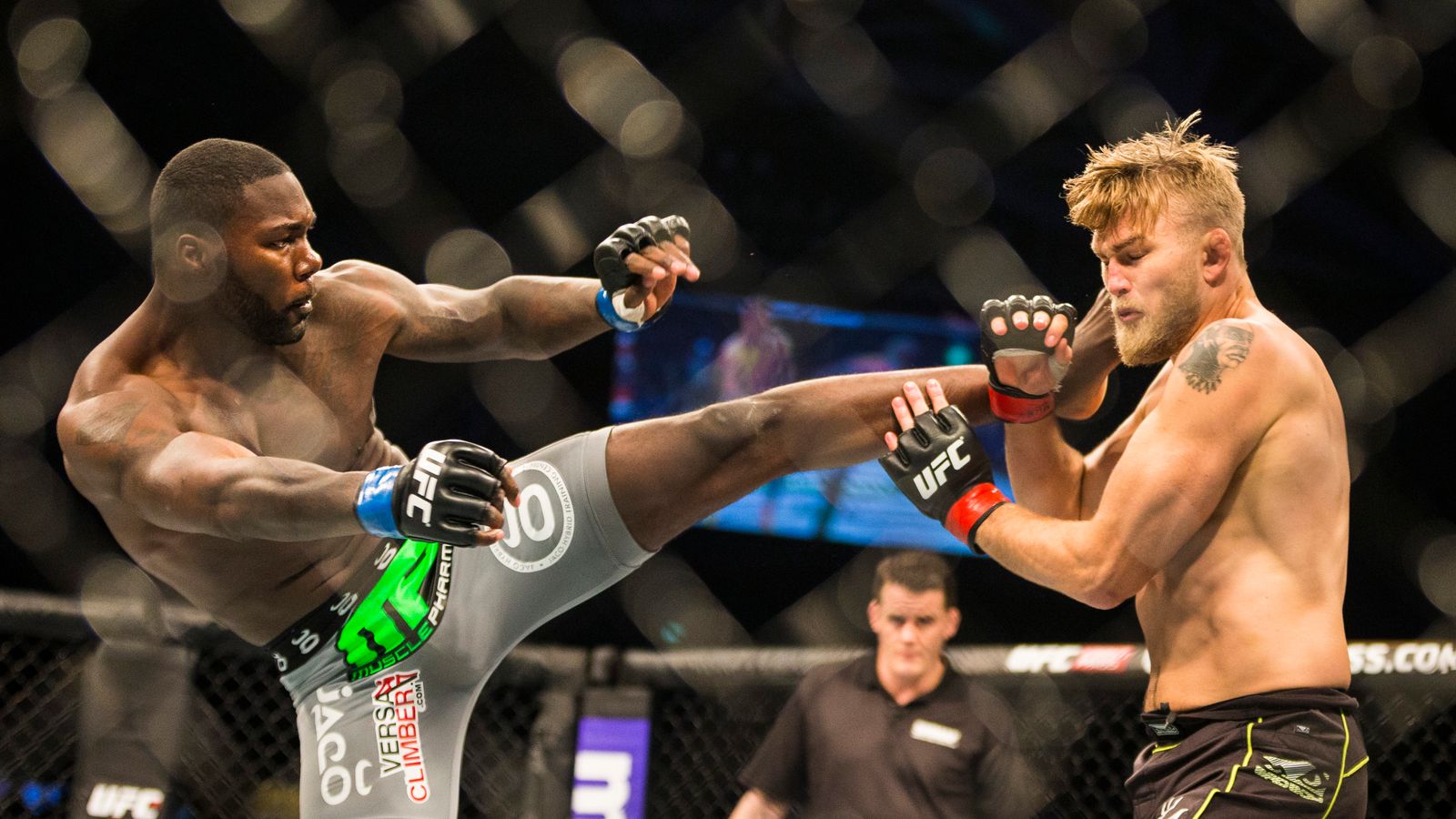
Anthony "Rumble" Johnson was a legendary mixed martial artist renowned for possessing perhaps the most devastating one-punch knockout power in the history of the Ultimate Fighting Championship (UFC). Competing across four weight classes, Johnson’s "touch of death" earned him iconic status. Despite his untimely passing in 2022, his impact on the sport remains a focal point for fans and analysts in 2026.
The Evolution of a Powerhouse: From Welterweight to Heavyweight
Anthony Johnson’s career is one of the most unique trajectories in combat sports history. He began his UFC journey in 2007 as a welterweight (170 lbs), an almost unfathomable feat considering his natural frame and the muscle mass he would later carry as a light heavyweight and heavyweight. During this early phase, Johnson was a "glass cannon"—capable of spectacular finishes but often compromised by the physiological toll of extreme weight cutting.
The struggles with the scale were well-documented. Johnson missed weight multiple times, most notably in a middleweight bout against Vitor Belfort. These failures led to his temporary release from the UFC in 2012. However, this setback proved to be a catalyst for his transformation. By moving up to higher weight classes in promotions like World Series of Fighting (WSOF), Johnson stopped fighting his own body and started focused entirely on his opponents.
When he returned to the UFC in 2014, he was a different animal. Now competing at light heavyweight (205 lbs), he maintained his explosive speed but added a layer of durability and strength that made him nearly impossible to out-muscle. His victory over Phil Davis upon his return proved he wasn't just a brawler; he was an elite martial artist who could shut down a world-class wrestler’s game plan over three rounds.
The Mechanics of the "Touch of Death"
To understand why Anthony Johnson is considered a knockout legend, one must look beyond the highlight reels and into the technical mechanics of his striking. While many fighters possess "heavy hands," Johnson’s power was a product of a rare kinetic chain involving his wrestling base, hip explosiveness, and hand speed.
The Wrestling Foundation
Before he was a striker, Johnson was a high-level wrestler, winning a junior college national championship at Lassen Community College. This background gave him the core strength and balance necessary to plant his feet and generate maximum torque. Unlike many strikers who fear the takedown and fight with a narrower stance, Johnson’s wrestling credentials allowed him to stand his ground, knowing he could defend most clinch or shot attempts.
Explosive Speed and Timing
What separated "Rumble" from other heavy hitters like Mark Hunt or Roy Nelson was his "twitch" fiber. Johnson didn't need a wind-up. His punches often looked like short, effortless jabs or hooks, yet they carried the force of a sledgehammer. His knockout of Glover Teixeira in 2016 is the quintessential example: a short uppercut delivered in just 13 seconds that literally dislodged Teixeira’s tooth.
The Head Kick Threat
While his hands were his primary weapons, Johnson’s high kicks were equally lethal. Because opponents were so focused on avoiding his overhand right, they often dipped their heads into the path of his shins. His finishes of Yoshiyuki Yoshida and Antônio Rogério Nogueira demonstrated that his power was distributed equally across all four limbs.
Defining Moments: The Light Heavyweight Title Runs
Johnson’s tenure at the top of the 205-pound division coincided with one of the most competitive eras in UFC history. His path to the title was blocked by two of the greatest fighters to ever grace the Octagon: Daniel Cormier and Jon Jones.
The rivalry with Daniel Cormier (DC) remains a defining chapter of his career. In their first meeting at UFC 187 for the vacant title, Johnson landed a monstrous overhand right in the opening seconds that sent Cormier flying across the cage. It was perhaps the hardest Cormier had ever been hit. However, Cormier’s elite wrestling and championship grit allowed him to weather the storm and eventually submit Johnson.
In their 2017 rematch at UFC 210, the result was similar, leading to Johnson’s first retirement. While he never captured the undisputed UFC gold, his status as the "uncrowned king" of the division was widely accepted. He was the man that every other contender—including the champions—feared the most.
Career Statistics and Iconic Victories
The following table highlights the most significant victories in Anthony Johnson's career, illustrating his dominance over elite-level competition.
| Opponent | Event | Year | Method | Round/Time |
|---|---|---|---|---|
| Charlie Brenneman | UFC Live 6 | 2011 | KO (Head Kick) | R1, 2:49 |
| Andrei Arlovski | WSOF 2 | 2013 | Decision (Unanimous) | R3, 5:00 |
| Phil Davis | UFC 172 | 2014 | Decision (Unanimous) | R3, 5:00 |
| Antônio Rogério Nogueira | UFC on Fox 12 | 2014 | KO (Punches) | R1, 0:44 |
| Alexander Gustafsson | UFC on Fox 14 | 2015 | TKO (Punches) | R1, 2:15 |
| Jimi Manuwa | UFC 191 | 2015 | KO (Punch) | R2, 0:28 |
| Ryan Bader | UFC on Fox 18 | 2016 | KO (Punches) | R1, 1:26 |
| Glover Teixeira | UFC 202 | 2016 | KO (Punch) | R1, 0:13 |
| José Augusto Azevedo | Bellator 258 | 2021 | KO (Punch) | R2, 1:10 |
The Final Chapter and the Battle with Illness
After a four-year hiatus following his 2017 retirement, Johnson returned to competition in 2021 under the Bellator MMA banner. His debut against José Augusto Azevedo showed that the power had not faded; after being dropped early, Rumble rallied to score a thunderous one-punch knockout in the second round. It would tragically be his final fight.
In late 2021 and throughout 2022, rumors circulated regarding Johnson's health. He withdrew from the Bellator Light Heavyweight Grand Prix due to an undisclosed illness. On November 13, 2022, the MMA world was devastated by the news of his death at age 38. It was later revealed that he succumbed to organ failure caused by non-Hodgkin’s lymphoma and hemophagocytic lymphohistiocytosis (HLH), a rare autoimmune disorder.
The outpouring of grief from the combat sports community was a testament to Johnson’s character. Despite being a terrifying presence inside the cage, he was known as a "gentle giant" outside of it—kind, soft-spoken, and deeply respected by his peers.
The "Rumble" Legacy in 2026
Standing in 2026, the legacy of Anthony Johnson is more than just a collection of viral knockouts. He represents a specific archetype in MMA: the ultimate equalizer. Even in fights where he was being outclassed technically, the threat of his power kept the atmosphere tense.
Analysts often use the "Rumble Scale" when evaluating new prospects with high power ratings. He remains the benchmark for what it means to be a "power puncher." Furthermore, his career serves as a cautionary and educational tale regarding weight cutting. Modern weight-management programs in the UFC and Bellator often cite Johnson’s early struggles as a primary reason for encouraging fighters to compete closer to their natural walk-walk weight.
His influence is seen in the striking styles of modern heavy hitters who prioritize placement and explosiveness over volume. He proved that wrestling, when combined with elite boxing, creates a terrifying hybrid that can dominate any era.
Frequently Asked Questions
What was Anthony Johnson's knockout percentage?
Anthony Johnson finished 17 of his 23 professional wins by knockout or technical knockout, resulting in a staggering 74% knockout rate. This is one of the highest percentages for any fighter with more than 20 professional bouts in major organizations like the UFC and Bellator. His ability to finish fights early was his most prominent professional trait.
Why did Anthony Johnson struggle to make weight early in his career?
At 6'2" with an naturally large frame, Johnson was essentially a light heavyweight trying to squeeze into the 170-pound welterweight division. The extreme dehydration required to hit that mark frequently led to his body shutting down. Once he moved to 205 pounds, his performance improved drastically because his muscles were properly hydrated and fueled, allowing his natural explosiveness to shine.
Did Anthony Johnson ever win a UFC title?
No, Anthony Johnson never won an undisputed UFC title, though he challenged for the Light Heavyweight Championship twice. Both times he faced Daniel Cormier (UFC 187 and UFC 210) and lost via rear-naked choke. Despite the lack of a belt, he is widely regarded as one of the greatest fighters to never hold a UFC title, alongside names like Dan Henderson and Joseph Benavidez.
How did Anthony Johnson's wrestling background help his MMA career?
His wrestling was the "invisible" part of his success. By having an elite takedown defense (averaging over 70% success in the UFC), he forced opponents to stay standing with him. Most fighters wanted to take Johnson down to avoid his power, but his ability to stay upright forced them into a striking battle where they were inevitably at a disadvantage.
What is Hemophagocytic Lymphohistiocytosis (HLH)?
HLH is a rare but life-threatening immune system disorder where the body produces too many activated immune cells (lymphocytes and macrophages). These cells then begin to attack the patient’s own organs, including the liver, spleen, and bone marrow. In Johnson’s case, this condition, combined with non-Hodgkin’s lymphoma, led to the multi-organ failure that resulted in his passing.
Final Recommendation for Fans and Historians
For those looking to truly appreciate the technical nuances of Anthony Johnson’s career, it is recommended to study his fight against Alexander Gustafsson (2015). This bout, held in Gustafsson's home country of Sweden, showcases Johnson’s ability to remain calm in a hostile environment, utilize his reach, and find the perfect opening against a taller, mobile striker.
Watching his post-fight interviews is also highly encouraged to understand the duality of his persona—the transition from a ferocious competitor to a humble, respectful sportsman. As we reflect on his career in 2026, the best way to honor his legacy is to advocate for fighter health and to appreciate the rare, raw talent that "Rumble" brought to the Octagon.