Albert Pujols concluded his 22-season Major League Baseball career as one of the most prolific hitters in the history of the sport. His accomplishments include 703 career home runs, 3,384 hits, 2,218 RBIs, and three National League MVP awards. As of 2026, he stands as a definitive first-ballot Hall of Fame lock.
The Foundation of Greatness: The St. Louis Cardinals Era (2001–2011)
The most dominant stretch of Albert Pujols’ career occurred during his initial 11-season tenure with the St. Louis Cardinals. Entering the league in 2001 as a relatively unheralded 13th-round draft pick, Pujols immediately defied expectations. His rookie season saw him post a .329 batting average with 37 home runs and 130 RBIs, earning him the National League Rookie of the Year award unanimously.
During this decade-plus in St. Louis, Pujols established a level of consistency that earned him the nickname "The Machine." From 2001 to 2010, he achieved something no other player in history had ever done: he recorded a batting average of at least .300, 30 or more home runs, and 100 or more RBIs in ten consecutive seasons. This streak is often cited by sabermetricians as the greatest decade-long offensive peak in the modern era of baseball.
His impact was not limited to the regular season. Pujols was the centerpiece of a Cardinals franchise that reached the postseason seven times during his first stint, winning three National League pennants and two World Series titles (2006 and 2011). His performance in the 2011 World Series, specifically Game 3, remains one of the greatest single-game displays in history, where he joined Babe Ruth and Reggie Jackson as the only players to hit three home runs in a single World Series game.
Joining the 700 Home Run Club
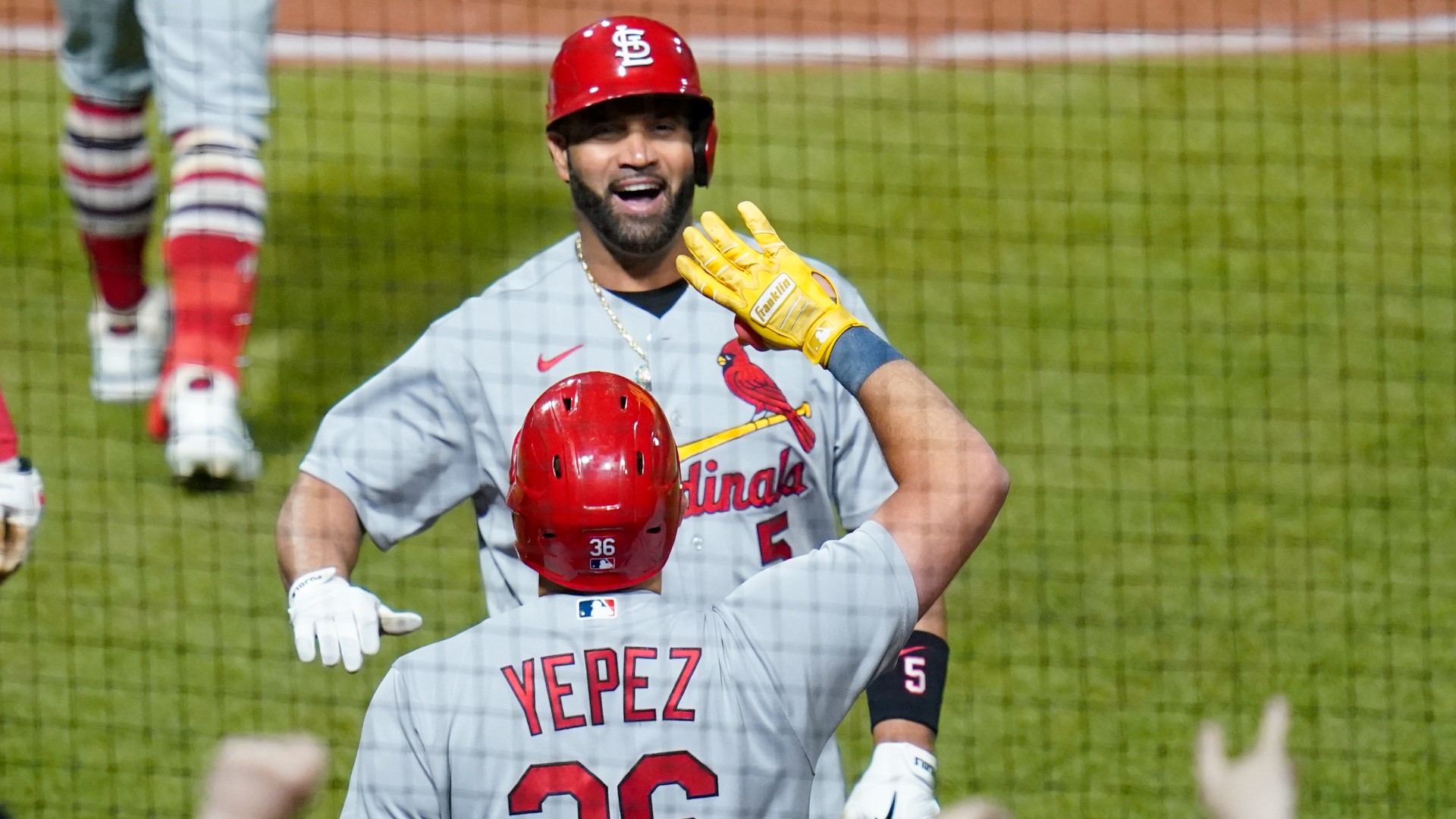
The most significant statistical milestone of Pujols' career is his membership in the 700 Home Run Club. On September 23, 2022, while playing for the Cardinals in a second stint that served as his retirement tour, Pujols hit his 699th and 700th career home runs in the same game against the Los Angeles Dodgers.
This accomplishment placed him in a tier occupied by only three other players in the history of Major League Baseball: Barry Bonds, Hank Aaron, and Babe Ruth. What made Pujols’ pursuit of 700 particularly impressive was his late-career resurgence. After several years of declining production with the Los Angeles Angels, his return to St. Louis saw him rediscover his power stroke, hitting 24 home runs in his final season at the age of 42.
His 703 career home runs rank fourth all-time. Beyond the raw total, the context of his home runs is notable; he hit them against 458 different pitchers, a testament to his longevity and his ability to adapt to multiple generations of pitching talent.
Elite Statistical Rankings and Career Totals
While the home runs often garner the headlines, Pujols’ overall statistical profile is balanced across all major offensive categories. He was not merely a "slugger"; he was a comprehensive hitter who prioritized contact and plate discipline.
Total Bases and RBIs
Pujols finished his career second all-time in total bases (6,211), trailing only Hank Aaron. This metric is frequently used by historians to measure the total offensive value a player provides over their career. Additionally, his 2,218 RBIs rank second all-time according to MLB's official records, placing him ahead of legendary figures like Babe Ruth and Alex Rodriguez.
Hits and Doubles
With 3,384 career hits, Pujols ranks 10th on the all-time list. He is one of only a handful of players to record both 3,000 hits and 700 home runs, a feat that demonstrates both elite precision and elite power. Furthermore, his 686 doubles rank fifth all-time, highlighting his ability to drive the ball into the gaps throughout his two decades in the league.
Historical Statistical Comparison
The following table illustrates where Pujols stands relative to the "Mount Rushmore" of historical baseball hitters:
| Player | Career Home Runs | Career Hits | Career RBIs | Career WAR (bWAR) |
|---|---|---|---|---|
| Barry Bonds | 762 | 2,935 | 1,996 | 162.8 |
| Hank Aaron | 755 | 3,771 | 2,297 | 143.1 |
| Babe Ruth | 714 | 2,873 | 2,214 | 182.6 |
| Albert Pujols | 703 | 3,384 | 2,218 | 101.7 |
| Alex Rodriguez | 696 | 3,115 | 2,086 | 117.5 |
Awards, Accolades, and Defensive Excellence
Albert Pujols' trophy case is among the most crowded in sports history. His accomplishments extend beyond offensive statistics into the realm of peer recognition and defensive value.
- 3x National League MVP (2005, 2008, 2009): Pujols won three MVP awards, but he was also a perennial contender, finishing in the top five of MVP voting in ten different seasons.
- 11x All-Star: He was selected to the All-Star game 11 times, spanning his time with the Cardinals and the Angels.
- 2x Gold Glove Award Winner (2006, 2010): Often overlooked due to his hitting, Pujols was an elite defensive first baseman in his prime. He currently holds the major league record for the most assists by a first baseman in a single season (185 in 2009).
- 6x Silver Slugger Award: This award, given to the best offensive player at each position, was a mainstay for Pujols throughout the 2000s.
- NL Rookie of the Year (2001): As mentioned, he burst onto the scene with one of the most productive rookie seasons in history.
- Roberto Clemente Award (2008): This is perhaps the achievement Pujols prizes most, as it recognizes the player who best exemplifies the game of baseball through sportsmanship, community involvement, and positive contributions to their team.
The Legacy of "The Machine" and Sabermetric Impact
In the era of advanced analytics, Pujols' accomplishments hold up under intense scrutiny. His career Wins Above Replacement (WAR) stands at 101.7 according to Baseball-Reference, making him one of fewer than 35 players in history to cross the 100-WAR threshold.
His Adjusted OPS+ (145) indicates that he was 45% better than the league-average hitter over the course of 22 years. At his peak (2001–2011), his OPS+ was a staggering 170. This period is regarded as one of the highest levels of sustained offensive production in the history of the game, rivaling the peaks of icons like Lou Gehrig and Ted Williams.
Pujols was also remarkably durable. Despite battling chronic plantar fasciitis and other lower-body injuries during his time with the Los Angeles Angels, he remained a fixture in the lineup, consistently appearing in over 140 games per season well into his late 30s.
Off-Field Contributions: The Pujols Family Foundation
To discuss Albert Pujols' accomplishments without mentioning his humanitarian work would be an incomplete assessment of his career. In 2005, Albert and his wife, Deidre, launched the Pujols Family Foundation. The foundation focuses on two primary missions: supporting individuals with Down Syndrome and their families, and improving the lives of the impoverished in the Dominican Republic.
The foundation has organized countless medical missions to the Dominican Republic, providing dental care, eye exams, and basic medical necessities to thousands who lack access to healthcare. In the United States, the foundation hosts events ranging from prom nights for young adults with Down Syndrome to educational programs for parents. Pujols’ commitment to these causes earned him the aforementioned Roberto Clemente Award and has solidified his reputation as one of the most respected figures in professional sports.
Future Outlook: The Path to Cooperstown
As we look toward 2028, the baseball world anticipates Albert Pujols’ induction into the National Baseball Hall of Fame. Under the current rules, players are eligible for the ballot five years after their final game. Having retired following the 2022 season, Pujols will be eligible for the Class of 2028.
Given his statistical milestones—specifically being part of the 3,000-hit club and the 700-home run club—there is little debate regarding his candidacy. The primary question among writers and fans is whether he will become the second unanimous inductee in history, following Mariano Rivera. His clean record during the "Steroid Era," combined with his counting stats and two World Series rings, makes him the prototypical Hall of Fame candidate.
Frequently Asked Questions
When will Albert Pujols be inducted into the Hall of Fame?
Albert Pujols will first appear on the Hall of Fame ballot in late 2027 for the Class of 2028. Because he retired after the 2022 season, the mandatory five-year waiting period concludes at that time. He is widely expected to be a first-ballot inductee with a very high percentage of the vote.
How many World Series rings does Albert Pujols have?
Pujols won two World Series championships, both with the St. Louis Cardinals. The first came in 2006 against the Detroit Tigers, and the second came in 2011 against the Texas Rangers. While he played for the Los Angeles Angels and Los Angeles Dodgers later in his career, he did not win additional titles with those franchises.
What is Albert Pujols' most impressive record?
While the 703 home runs are the most famous, many historians point to his ten consecutive seasons of a .300+ average, 30+ HRs, and 100+ RBIs as his most impressive feat. This level of sustained, elite production is virtually unmatched in the history of the game, highlighting a decade of "The Machine-like" consistency.
Did Albert Pujols ever win a Triple Crown?
Pujols never won the official Triple Crown (leading the league in batting average, home runs, and RBIs in the same season), though he came very close several times. In 2003, he led the league in batting average (.359) and hits, and in 2009, he led the league in home runs (47) and runs scored. His career was marked by being near the top of all three categories simultaneously for over a decade.
Who did Albert Pujols hit his 700th home run against?
Pujols hit his 700th career home run off Los Angeles Dodgers pitcher Phil Bickford on September 23, 2022. Earlier in that same game, he had hit home run number 699 off Andrew Heaney. The game took place at Dodger Stadium, where Pujols had briefly played the previous season.
Practical Recommendation for Fans and Historians
For those looking to truly appreciate the magnitude of Albert Pujols’ career, it is recommended to study his "splits" and situational hitting data on Baseball-Reference. His performance in "High Leverage" situations—moments where the game was on the line—was consistently elite. Beyond the stats, visiting the National Baseball Hall of Fame in Cooperstown, New York, provides a physical context for his gear, including the bats and jerseys used during his milestone home runs. As his 2028 induction approaches, staying updated via the National Baseball Hall of Fame's official site will provide information on the induction ceremony and commemorative events celebrating his legendary career.