Completing the Free Application for Federal Student Aid (FAFSA) for the Spring 2026 semester is a critical step in securing financial assistance for your education. By submitting this form, you determine your eligibility for federal grants, work-study programs, and low-interest federal student loans, providing a foundation for your spring term funding.
Understanding the FAFSA Cycle for Spring 2026
The FAFSA process operates on an annual cycle, but your specific timeline depends on when you intend to enroll. For students planning to begin or continue their studies in the Spring 2026 semester, the application process is tied to the 2025–2026 academic year. It is a common misconception that there is a separate "Spring FAFSA"; rather, you are completing the 2025–2026 FAFSA form to cover both the preceding fall and the current spring terms.
If you have already completed the FAFSA for the Fall 2025 semester, you do not need to file a new application for Spring 2026. Your financial aid eligibility is assessed for the full academic year. However, if you are a new student entering in the spring or if you previously skipped the fall term, you must file the 2025–2026 FAFSA immediately to receive aid for the spring session.
Prerequisites and Necessary Documentation
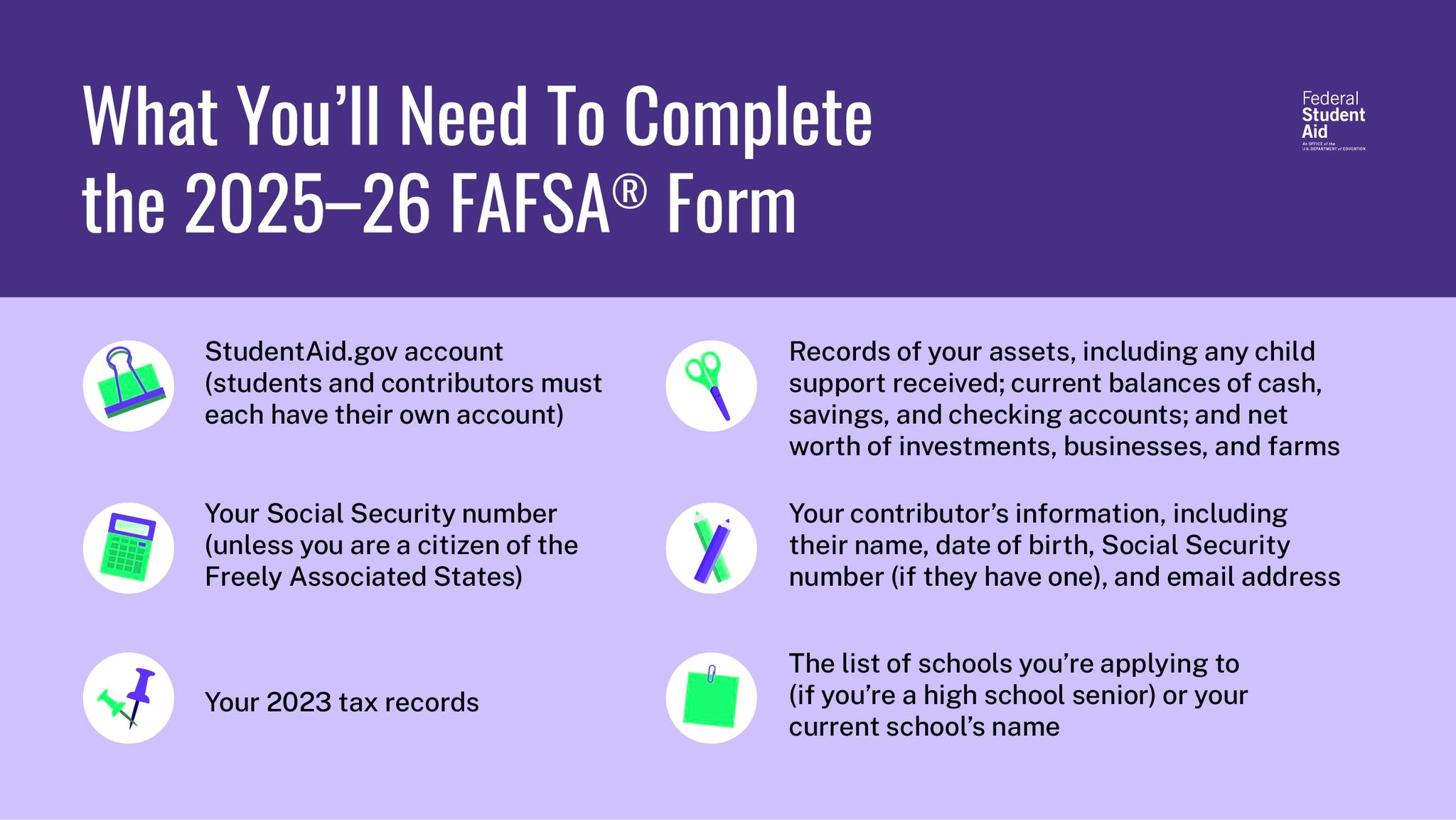
Before starting your application, gather the necessary documentation to ensure a smooth filing process. Having these items organized beforehand prevents session timeouts and reduces the likelihood of manual entry errors.
Personal Identification and Tax Data
You will need your Social Security number and, if applicable, your Alien Registration number. For the 2025–2026 academic year, the FAFSA relies on federal tax information from the 2023 tax year. In most cases, the FAFSA processing system will automatically import this data directly from the Internal Revenue Service (IRS) via the Direct Data Exchange (DDX). If you or your parents did not file taxes for 2023, you will need to indicate this clearly in the application.
FSA ID Requirements
The StudentAid.gov account, accessed via your FSA ID (username and password), serves as your legal signature. Every contributor—including the student, the student’s spouse, or the student’s parents—must have their own individual FSA ID. Do not share credentials, as these function as your official electronic signature. If you do not have an FSA ID, create one at the official StudentAid.gov website at least three days before you intend to submit your FAFSA, as verification processes can take time.
Step-by-Step Filing Procedure
Filing for Spring 2026 requires precision. Follow these steps to ensure your application reaches your institution’s financial aid office before their specific deadlines.
- Access the Official Portal: Navigate only to the official StudentAid.gov website. Avoid third-party sites that claim to charge for FAFSA processing; the application is entirely free.
- Add Your School Codes: You must include the Federal School Code for the college or university you plan to attend in Spring 2026. This allows the Department of Education to transmit your FAFSA Submission Summary to your institution.
- Invite Contributors: If you are a dependent student, identify your parents or stepparents as contributors. Send them the necessary invitations via the FAFSA portal so they can provide their required financial information and sign the document.
- Review and Submit: Once all sections are completed and all contributors have signed, review the summary for accuracy. After submission, you will receive a confirmation email. Keep this for your records as proof of submission.
Common Pitfalls and Troubleshooting
Errors on the FAFSA can lead to delays in your aid disbursement or, in severe cases, the denial of funds. Understanding these common mistakes allows you to proactively avoid them.
- Incorrect Social Security Numbers: Double-check your SSN. A typo here is the most frequent cause of application rejection.
- Missing Signatures: Ensure that every required contributor has signed the form. An incomplete signature section renders the FAFSA invalid.
- Waiting Until the Last Minute: Even if the federal deadline is months away, your school may have an earlier "priority deadline" for Spring 2026 aid. Failing to meet a school-specific deadline can result in less available institutional grant money.
- Unverified FSA IDs: If you or your contributors have not verified your email addresses or phone numbers associated with the FSA ID, you may face login issues when trying to sign the application.
Institutional Deadlines vs. Federal Deadlines
It is vital to distinguish between federal and institutional deadlines. The federal deadline for the 2025–2026 FAFSA is June 30, 2026. However, this is the final date for the entire academic year. Most universities and colleges set their own, much earlier, deadlines for Spring 2026 disbursement.
Check your school’s financial aid office website immediately. Some institutions require your FAFSA information to be on file 30 to 60 days before the start of the spring term to ensure that your financial aid package is processed in time for tuition payment deadlines.
Comparison of Financial Aid Action Items
| Task | Deadline Type | Impact of Missing |
|---|---|---|
| FAFSA Submission | Institutional | Loss of school-based grants |
| FAFSA Submission | Federal | Ineligibility for Federal Pell Grants |
| FSA ID Creation | Pre-requisite | Inability to sign or submit FAFSA |
| Verification Documents | School-specific | Frozen financial aid disbursement |
Verification and Corrections
After submitting your FAFSA, you will receive a FAFSA Submission Summary. Review this document carefully. If you discover a mistake—such as an incorrect income figure or a missing school code—you can log back into your StudentAid.gov account to make corrections.
Furthermore, some students are selected for "Verification." This is a standard process where the school requests additional documentation, such as tax transcripts or household size verification, to ensure the accuracy of the FAFSA data. If you are selected, respond to your school’s requests immediately. Failure to provide requested verification documents will prevent your aid from being released, leaving you responsible for out-of-pocket tuition costs.
Managing Your Financial Aid Package
Once your FAFSA is processed and your school receives your information, the financial aid office will build an offer package. This package typically outlines the federal grants, loans, and work-study opportunities you are eligible to receive for the Spring 2026 term.
Carefully evaluate the difference between "gift aid" (grants and scholarships that do not need to be repaid) and "self-help aid" (loans that accrue interest and must be repaid). If your aid offer does not cover the full cost of attendance, communicate with your financial aid office to discuss potential payment plans or additional scholarship opportunities.
Frequently Asked Questions
1. Can I submit the FAFSA if I have not been accepted to a school yet?
Yes. You can and should include the school codes of any institution you are considering. Listing a school on your FAFSA does not commit you to attending, but it does ensure that if you are accepted, your financial aid data is already available to the school’s office.
2. What if my financial situation changed since 2023?
The FAFSA requires 2023 tax data, but if you have experienced a significant change in income due to job loss, medical expenses, or other unforeseen events, you should contact your school's financial aid office. They have the authority to perform a "Professional Judgment" review, which may allow them to adjust your financial aid eligibility based on your current reality.
3. Does the Spring 2026 FAFSA cover summer classes?
Generally, summer sessions are considered part of the preceding or following academic year depending on your school’s policy. You should confirm with your financial aid office whether your Spring 2026 financial aid includes a summer component or if you need to file a separate aid application.
4. Do I need to re-file FAFSA every year?
Yes. You must complete a new FAFSA for every academic year that you seek financial assistance. Aid does not automatically renew; it is contingent upon your continued eligibility and current financial information.
5. Who is considered a "contributor" on my application?
A contributor is anyone who is required to provide information and a signature on your FAFSA, which includes you, your spouse, your biological or adoptive parent, or your parent’s spouse. The FAFSA system will identify who your specific contributors are based on the answers you provide regarding your dependency status.
Practical Recommendations
For a successful Spring 2026 experience, prioritize these actions:
- Identify your school’s financial aid portal: Most colleges use a proprietary student portal to communicate missing documents. Check this portal at least weekly.
- Use the IRS Direct Data Exchange: Always opt to transfer your tax information directly from the IRS. It reduces your chances of being selected for manual verification.
- Maintain communication: If you have questions about your aid, call your school’s financial aid office directly. They are the only ones with the authority to modify your aid offer or explain specific institutional policies.
By staying proactive and organized, you ensure that your financial aid is ready for the Spring 2026 semester, allowing you to focus on your academic goals.