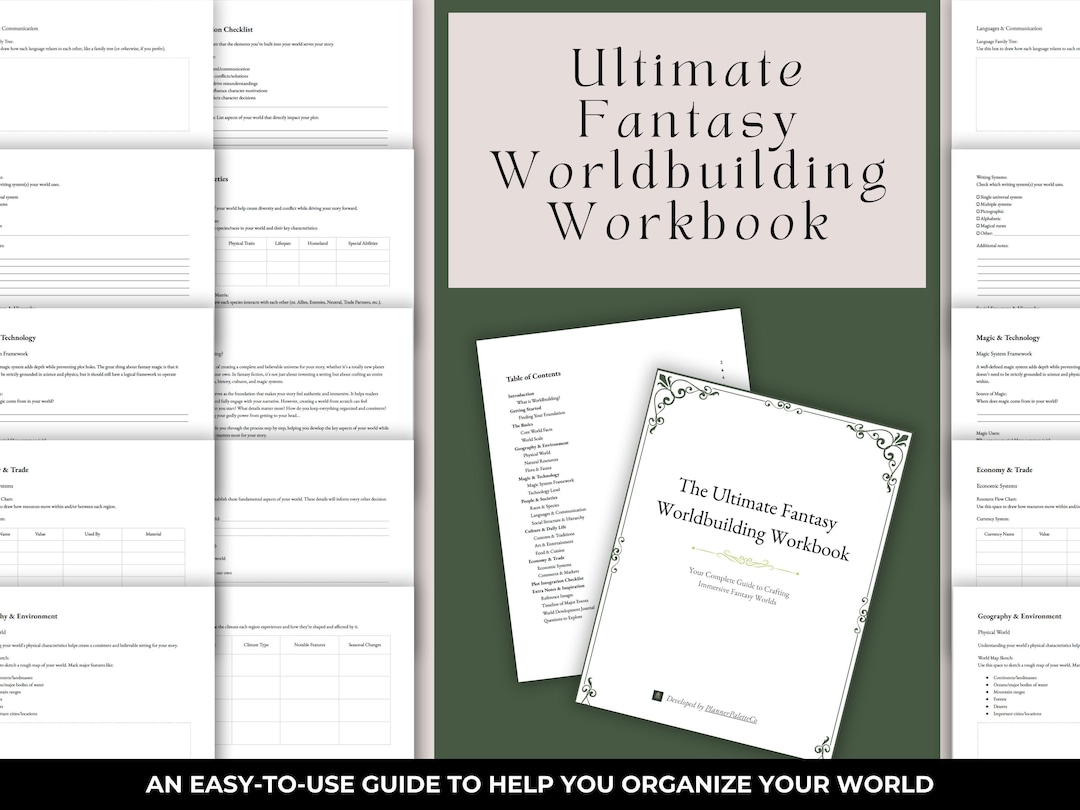
Creating a consistent, immersive, and believable setting requires a systematic approach to balancing imaginative concepts with the structural limitations that ground a story in reality. This practical world building checklist serves as a modular framework for novelists, game designers, and screenwriters, ensuring that every element—from physical geography to socioeconomic systems—functions as a coherent foundation for your narrative without overwhelming the reader or player.
Establishing the Foundational Constraints
Before diving into the creative flourishes of your setting, you must define the boundaries of your world. These constraints provide the "rules" that dictate how characters interact with their environment. If you begin without these, your world-building will likely suffer from inconsistencies that break the audience's immersion.
The Macro-Environment
The physical nature of the world dictates the lives of its inhabitants. Are you building a terrestrial planet, an artificial habitat, or a metaphysical plane? Define the following early:
- Physical Constants: Determine the gravity, atmosphere, and day-night cycle. Even if these are similar to Earth, deviations (such as a 30-hour day or higher gravity) will ripple through biology, architecture, and technology.
- Geography and Climate: Create a rough map. Consider how mountain ranges, coastlines, and rivers dictate trade routes and settlement patterns. Climate zones determine resources, which in turn define the wealth and expansionist goals of nations.
- The "Hook" of Reality: If your world defies physics, what is the specific cost or limitation? For example, if magic or advanced technology exists, what prevents it from solving every problem instantly? Defining these limitations early prevents "deus ex machina" scenarios later.
Temporal Placement
Your world is not static; it is a historical result of what came before. Determine the "Age" in which your story takes place. A world in the midst of a technological or magical revolution will have vastly different social tensions than one in a period of stagnation or post-apocalyptic collapse. Establish the key events from the previous century that shape current political or religious attitudes.
Societal Structures and Governance
Once the physical world is defined, you must populate it with systems that organize human (or non-human) behavior. Societies function based on shared myths, survival requirements, and power structures.
Governance and Power
How is order maintained? Is it a centralized empire, a loose collection of city-states, or an anarchic frontier?
- The Legitimization of Authority: Who makes the laws, and why do the people obey them? Is it through divine right, democratic mandate, or sheer force?
- Resource Distribution: Power is rarely about philosophy; it is usually about control over essential resources. Whether it is water, rare minerals, or magical essence, the entity that controls the source of life or wealth controls the political landscape.
Cultural Identity
Culture is the manifestation of geography and history. A society living in a harsh, frozen environment will place high value on communal cooperation and resource conservation, while a society with abundant, easily accessible resources may value individualistic competition. Use the following checklist to flesh out cultural depth:
- Belief Systems: Religions or philosophical frameworks serve as a moral compass. They do not have to be "true" in your world, but they must be perceived as true by the people living in them.
- Taboos and Traditions: What are the social boundaries? What behaviors are rewarded versus shunned? Traditions often stem from old practical needs that have evolved into social rituals.
- Communication: Languages, dialects, and idioms reflect the history of interaction between groups. Shared languages often indicate past conquest or trade dominance.
Technical and Economic Integration
To make a world feel "practical," it must function like a machine. If your world has advanced technology or a magic system, you must treat it as an industry rather than a plot device.
The "Cost" of Advancement
If your world includes magic or advanced science, apply the "Principle of Scarcity." If everyone can use fireballs or teleportation, there is no threat. There must be a limiting factor, such as training time, resource consumption, or social/legal restrictions.
- Availability: Is the technology/magic available to the masses, or is it the exclusive domain of an elite class?
- Integration: How does this technology change daily life? If you have electricity, how is it generated? If you have magic, does it replace labor, and what happens to the people who previously did that work?
Economic Foundations
A world without a clear economic engine feels artificial. Even if you aren't writing about banking, your characters need to eat, clothe themselves, and travel.
- Currencies: Beyond coins, consider what items function as store-of-value. In frontier regions, labor or specific resources may hold more weight than minted currency.
- Trade Routes: Where do essential goods come from? Disrupting a trade route should feel like a major crisis to the characters in your world.
| Element | Focus Area | Essential Question |
|---|---|---|
| Geography | Physicality | How does the terrain dictate population density? |
| Economy | Survival | What is the primary export that supports the local government? |
| Religion | Morality | What is the greatest social taboo in this culture? |
| Technology | Limitation | What are the physical risks of using this power/tech? |
| History | Causality | What event from 50 years ago creates current tensions? |
Avoiding Common World Building Pitfalls
As you finalize your world, watch for the most frequent mistakes that lead to shallow world building.
The "Kitchen Sink" Syndrome
Many writers try to cram every cool idea into one world. This leads to a lack of cohesion. If your world has steam-powered mechs, ancient wizards, space travel, and talking animals, ask if these elements serve the same central theme. If they don't, cut them. A focused, consistent world is always more impactful than a cluttered one.
Static Worlds
The most common mistake is creating a world that feels like a museum display rather than a living, breathing ecosystem. If your story concludes and the world looks exactly as it did at the beginning, you have missed a significant opportunity for world-building growth. Your setting should be evolving in the background. If a war starts or a government falls, the consequences should be felt in the economy, the culture, and the daily lives of the background characters.
Lack of Practical Detail
Characters shouldn't exist in a vacuum. If they are soldiers, they need uniforms that make sense for their climate. If they are mages, they need tools or reagents to focus their power. Small, practical details—such as the way a society disposes of waste, the way they light their homes at night, or the way they handle internal travel—add a layer of authenticity that allows the reader to suspend their disbelief entirely.
Practical Steps to Finalize Your World
- Map the Geography: Draw the basic layout. Even a sketch helps identify travel times and regional conflicts.
- Define the Conflict: Every good world has a "friction point." Identify the major tension—be it political, environmental, or social—and ensure it touches all parts of the setting.
- Draft a Daily Routine: Write a short scene describing a "normal" day for a citizen who is not the protagonist. If you cannot describe how they eat, work, and sleep, you need to expand that area of your world.
- Stress Test: Challenge your own rules. Ask "What happens if this resource disappears?" or "What happens if this law is broken?" If the answer is "nothing," your world-building lacks stakes.
Frequently Asked Questions
How much world building is too much? World building is only "too much" when it interferes with the narrative. If the reader finds themselves reading pages of history that do not advance the plot or the character arcs, it is time to stop. Use only what is necessary to make the story clear and impactful.
Should I create a map before writing the story? While not mandatory, a rough sketch of your world's geography is highly recommended. A visual reference helps ensure consistent travel times and provides a concrete base for planning military movements or trade routes.
How do I make a magic system feel logical? Logic in magic comes from consistency. Establish clear rules, costs, and limitations, and never break them for the sake of a plot convenience. If magic has a cost (e.g., physical exhaustion or monetary expense), that cost must be applied equally to every character.
How do I handle different cultures without relying on tropes? Research real-world history and geography. Tropes usually arise from lazy shorthand. Instead of relying on stereotypes, base a culture on its environment and its history. A society built on a mountain range will develop naturally different survival strategies than one built in a fertile delta.
When should I stop building the world? You are finished when the world supports the story you want to tell. You do not need to know the entire history of every continent if your story only takes place in one province. Build just enough to make the world feel deep, then let the narrative expand it as needed.
Final Recommendation
Start with a "Core Constraint" document. Write down the three most important rules of your world and ensure every creative decision you make afterward adheres to them. If you are ever unsure about a new detail, ask yourself if it reinforces or contradicts those core constraints. By maintaining this focus, you ensure that your world remains a practical, functional, and immersive stage for your characters to occupy.