Advanced Practice Registered Nurses (APRNs) pursuing the Doctor of Nursing Practice (DNP) path can expect a rigorous curriculum focused on clinical leadership, evidence-based practice, and systems improvement. In 2026, while the DNP is not yet a universal legal requirement for all APRN practice, it has become the preferred standard for entry-level nurse anesthetists and is increasingly prioritized by top-tier healthcare systems for all advanced practice roles.
The nursing profession has undergone a seismic shift over the last two decades. What began as a recommendation by the American Association of Colleges of Nursing (AACN) in 2004—to move the level of preparation for advanced nursing practice from the Master’s to the Doctoral level—has largely come to fruition in the academic and clinical landscapes of 2026. For the modern APRN, which includes Nurse Practitioners (NPs), Certified Registered Nurse Anesthetists (CRNAs), Clinical Nurse Specialists (CNSs), and Certified Nurse-Midwives (CNMs), the DNP represents the terminal degree for clinical practice, distinct from the research-focused PhD.
Understanding the DNP path requires a deep dive into the educational requirements, the evolving regulatory environment, and the tangible impact this degree has on patient outcomes and institutional leadership.
The Evolution of the DNP Requirement in 2026
As of 2026, the transition toward the DNP is no longer a "future goal" but a present reality for many nursing specialties. The most significant shift occurred within the Council on Accreditation of Nurse Anesthesia Educational Programs (COA), which mandated that all students entering nurse anesthesia programs after January 1, 2022, must be enrolled in a doctoral program. By 2025, all graduating CRNAs were required to hold a doctoral degree. This move set a precedent that other APRN specialties are closely following.
While the National Organization of Nurse Practitioner Faculties (NONPF) committed to moving all entry-level NP education to the DNP level by 2025, the transition across all 50 states remains a complex mix of academic shifts and state board regulations. In 2026, most new NP students find that DNP programs are the default offering at major universities, though MSN (Master of Science in Nursing) programs still exist for specific bridge pathways.
The primary driver behind this evolution is the increasing complexity of the healthcare system. Modern APRNs are expected to manage multifaceted chronic conditions, navigate sophisticated health informatics, and lead interprofessional teams. The DNP curriculum is specifically designed to provide the "Essentials" that a traditional MSN might lack, particularly in the realms of organizational leadership and policy advocacy.
Navigating the Two Primary DNP Pathways
For an APRN or a prospective student in 2026, there are two main entries into the DNP path. The choice depends entirely on the individual's current educational attainment and clinical experience.
1. The BSN-to-DNP Track
This path is designed for Registered Nurses who hold a Bachelor of Science in Nursing and wish to become an APRN while simultaneously earning their doctorate.
- Duration: Typically 3 to 4 years of full-time study.
- Focus: These programs combine the foundational advanced practice training (pathophysiology, pharmacology, and physical assessment) with doctoral-level courses in ethics, leadership, and health policy.
- Clinical Hours: Students must complete a minimum of 1,000 post-baccalaureate clinical hours, a standard reaffirmed by the AACN.
2. The MSN-to-DNP Track
Often referred to as a "Post-Master's DNP," this track is for currently practicing APRNs who already hold a Master’s degree.
- Duration: Usually 1 to 2 years.
- Focus: Because the student is already certified as an NP, CRNA, CNS, or CNM, the focus shifts entirely to "systems-level" thinking. This includes quality improvement projects, healthcare economics, and advanced informatics.
- Gap Analysis: Schools perform a "gap analysis" to determine how many clinical hours from the student’s previous MSN program can count toward the 1,000-hour doctoral requirement.
Core Competencies: The DNP Essentials
The curriculum of a DNP program is governed by the AACN Essentials, which were updated to provide a competency-based framework. In 2026, these essentials are the backbone of every CCNE (Commission on Collegiate Nursing Education) accredited program.
Advanced Nursing Practice
At the heart of the DNP is the mastery of a specialty area of nursing. Whether it is psychiatric mental health, family practice, or adult-gerontology, the DNP student must demonstrate a higher level of clinical judgment than is expected at the MSN level. This includes the ability to synthesize complex data and design innovative care models.
Evidence-Based Practice and Quality Improvement
DNP-prepared APRNs are trained to be "translators." They take the latest nursing research (often produced by PhDs) and apply it directly to the clinical setting. In 2026, this involves a heavy emphasis on Data Analytics. Students learn how to use "Big Data" from Electronic Health Records (EHR) to identify trends in patient falls, infection rates, or readmission patterns, and then design interventions to fix them.
Systems Leadership and Policy
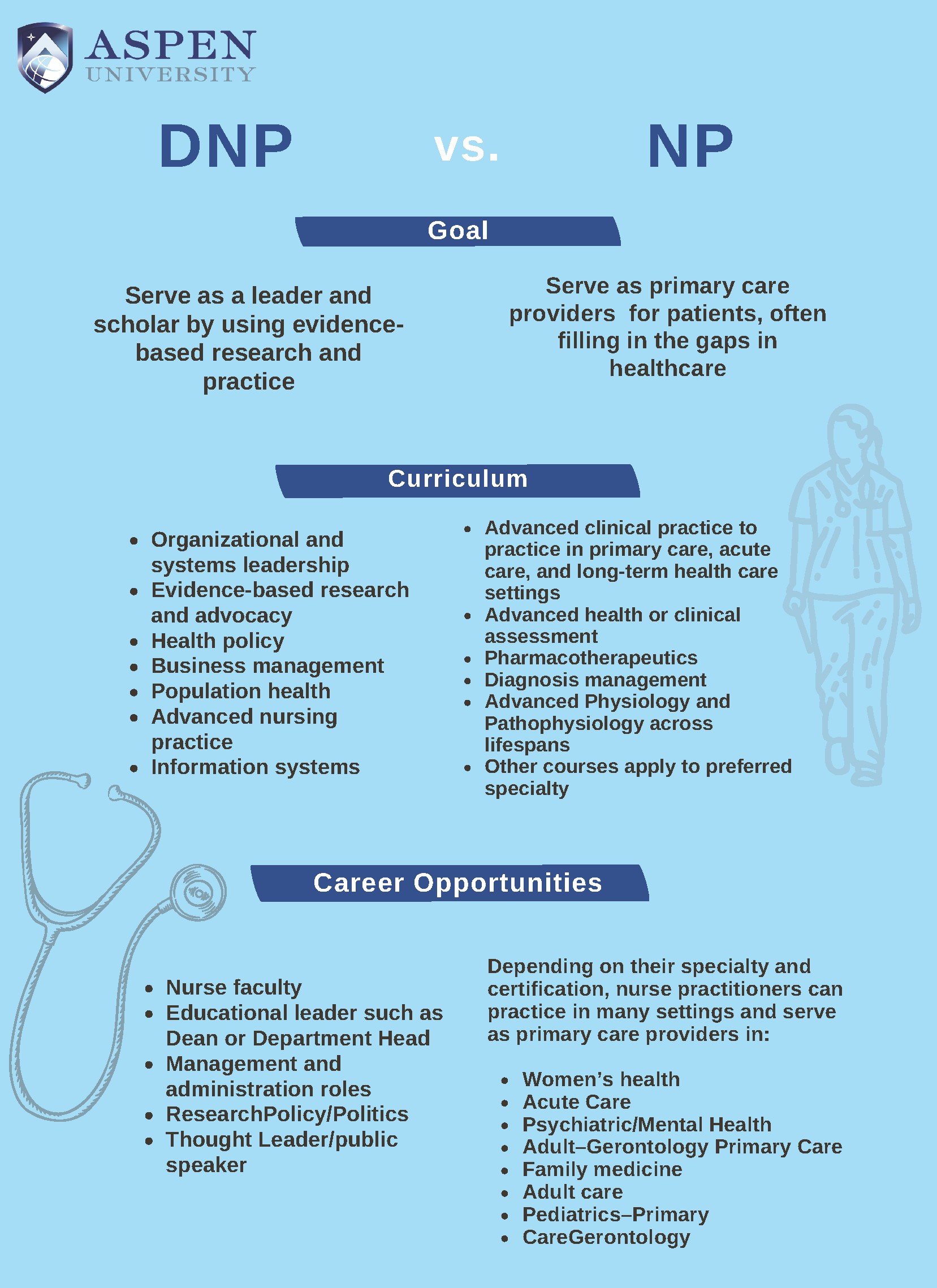
One of the distinct advantages of the DNP path is the preparation for "C-suite" roles. DNP students study organizational behavior and healthcare finance. This enables them to serve as Chief Nursing Officers (CNOs) or directors of clinical departments, where they can advocate for policy changes at the local, state, and federal levels.
| Feature | MSN (Master of Science in Nursing) | DNP (Doctor of Nursing Practice) |
|---|---|---|
| Primary Focus | Advanced clinical specialty training | Clinical leadership and systems-level impact |
| Clinical Hours | Generally 500+ | Minimum of 1,000 |
| Final Project | Often a thesis or clinical rotation | Evidence-based DNP Project (Capstone) |
| Typical Role | Direct patient care provider | Lead clinician, Policy advocate, Faculty |
| Research Scope | Application of research | Translation and integration of research |
| 2026 Status | Still valid for grandfathered APRNs | Preferred/Mandatory for new entries (varies) |
The DNP Project: Beyond the Thesis
A defining feature of the APRN's journey through the DNP path is the DNP Project. Unlike a PhD dissertation, which focuses on generating new knowledge through original research, the DNP Project focuses on the application of knowledge to solve a real-world problem.
In 2026, these projects are increasingly collaborative and technology-driven. A student might partner with a local hospital to implement a new telehealth protocol for rural diabetic patients. Another might develop an AI-driven triage system for an urban emergency department.
The project must demonstrate:
- Sustainability: How will the intervention continue after the student graduates?
- Scalability: Can this project be implemented in other departments or hospitals?
- Measurable Outcomes: Did the project actually improve patient safety, reduce costs, or increase efficiency?
The completion of this project is often the most challenging part of the DNP path, requiring the student to act as a project manager, a data analyst, and a clinical expert simultaneously.
Financial Considerations and ROI in 2026
The cost of a DNP program can be significant, ranging from $30,000 to over $120,000 depending on the institution. For many APRNs, the question of Return on Investment (ROI) is paramount.
In 2026, the financial benefits are often indirect but substantial. While many hospitals pay NPs the same hourly rate regardless of whether they have an MSN or a DNP, the DNP opens doors to higher-paying administrative and faculty positions. Furthermore, as the "Doctor" title becomes more recognized in clinical settings, DNP-prepared APRNs are increasingly finding themselves eligible for "Equal Pay for Equal Service" initiatives in states with full practice authority.
Additionally, for those interested in academia, the DNP is the standard requirement for tenure-track faculty positions in 2026. With the ongoing nursing faculty shortage, DNP graduates are in a strong position to negotiate competitive salaries in university settings.
Legal and Regulatory Landscape: Title Use and Authority
A point of contention that remains relevant in 2026 is the use of the title "Doctor" in clinical settings. Several states have passed legislation regarding how DNP-prepared nurses must identify themselves to avoid patient confusion. Typically, a DNP must introduce themselves as "Dr. [Name], a Nurse Practitioner," rather than just "Dr. [Name]."
Furthermore, the DNP path is inextricably linked to the "Full Practice Authority" (FPA) movement. In 2026, more than 30 states have granted APRNs full practice authority, allowing them to evaluate patients, diagnose, order tests, and manage treatments without physician oversight. The advanced training provided by the DNP degree has been a significant talking point in lobbying efforts to expand FPA, as it provides a robust argument for the safety and competence of doctoral-level nursing practice.
Challenges of the DNP Path
While the benefits are clear, the path is not without its hurdles. Many working APRNs struggle with the "clinical hour" requirements, especially if their MSN program only provided 500 hours. Finding 500 additional hours of doctoral-level clinical experience—which must be focused on leadership or systems rather than just "shadowing"—can be difficult.
Moreover, the rigor of doctoral-level writing and data analysis can be a shock to those who have been out of school for many years. Schools have responded in 2026 by offering more "executive" formats, which utilize hybrid online learning and intensive weekend sessions to accommodate the schedules of working professionals.
Future Outlook: The APRN in 2027 and Beyond
Looking past 2026, the DNP is likely to become the undisputed entry-level degree for all new APRNs. The trend is moving toward a highly specialized, highly educated nursing workforce that serves as the primary care backbone of the United States.
As healthcare continues to shift toward value-based care—where providers are paid for patient outcomes rather than the number of procedures—the DNP-prepared APRN's skills in quality improvement and population health will become even more valuable.
Frequently Asked Questions
Is the DNP mandatory for all Nurse Practitioners in 2026?No, it is not a legal mandate for all NPs yet. If you currently hold an MSN and are certified as an NP, you are "grandfathered" in and can continue to practice. However, many new programs have phased out the MSN, making the DNP the primary route for new students.
Can I still get a PhD in Nursing instead of a DNP?Yes. The PhD in Nursing remains the standard for those who wish to pursue a career in pure scientific research and the development of new nursing theory. The DNP is for those who want to stay in clinical practice or clinical leadership.
How many clinical hours are required for the DNP path?The AACN requires a total of 1,000 post-baccalaureate clinical hours. If you earned 500 hours during your MSN, you would typically need to complete an additional 500 hours during your DNP program.
Will I earn more money with a DNP than an MSN?In direct patient care, the pay difference may be minimal at first. However, the DNP qualifies you for leadership roles, hospital administration, and faculty positions that generally offer higher salary ceilings than standard clinical roles.
What is the difference between a DNP and a medical degree (MD/DO)?A DNP is a nursing degree focused on a holistic approach to patient care, systems leadership, and evidence-based practice. An MD or DO is a medical degree focused on the biological systems of disease, surgery, and medical interventions. While their roles can overlap in primary care, their educational philosophies remain distinct.
Final Recommendation for APRNs
For current APRNs, the decision to pursue the DNP path should be based on long-term career goals. If you aspire to lead a department, influence health policy, or teach at the university level, the DNP is essential. For those entering the field in 2026, choosing a BSN-to-DNP program is the most future-proof way to ensure your credentials remain competitive for the duration of your career. Begin by conducting a thorough "gap analysis" of your current hours and education to find a program that maximizes your previous experience.