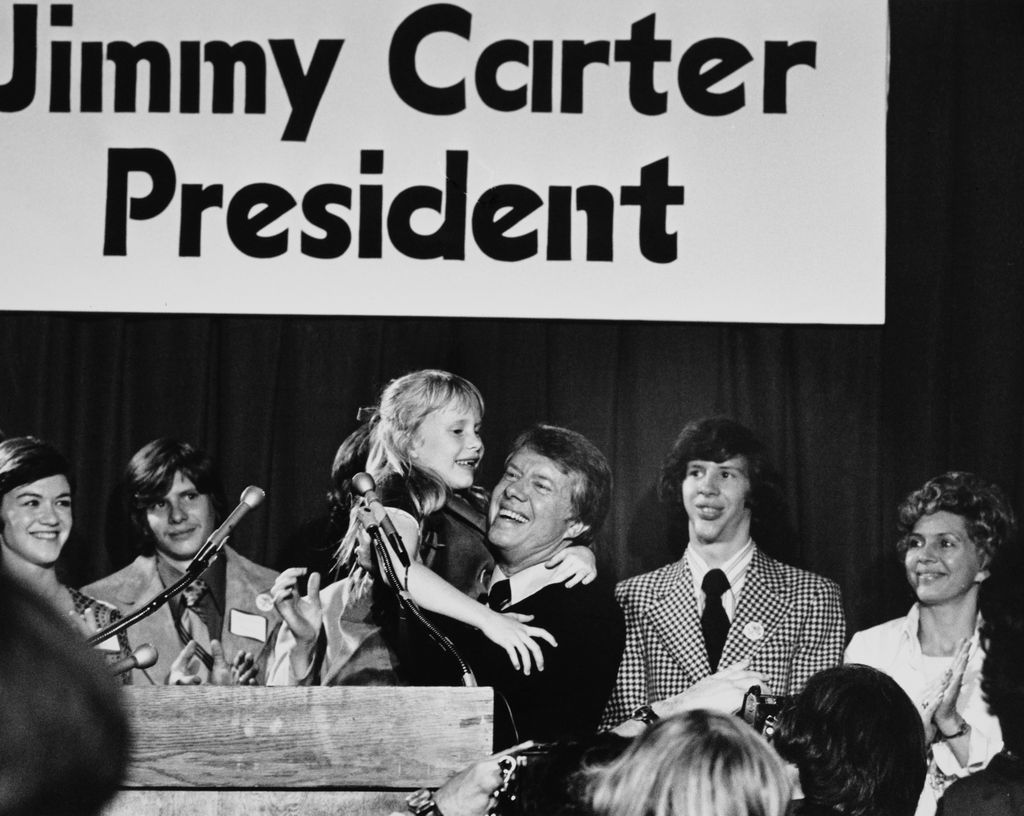
Amy Lynn Carter is the youngest child and only daughter of the 39th U.S. President Jimmy Carter and the late Rosalynn Carter. Rising to national prominence as a child in the White House during the late 1970s, she transitioned from a highly scrutinized "First Kid" into a committed political activist, illustrator, and board member of The Carter Center, largely maintaining a private life in the decades since.
Early Life and the Move to 1600 Pennsylvania Avenue
Amy Carter was born on October 19, 1967, in Plains, Georgia. Her arrival came at a pivotal moment for the Carter family, as Jimmy Carter was beginning his ascent in Georgia politics, eventually serving as the state’s governor from 1971 to 1975. By the time Amy was nine years old, her father had won the 1976 presidential election, thrusting the young girl into the global spotlight.
The move to the White House in January 1977 marked the first time a young child had lived in the Executive Mansion since the Kennedy administration. Unlike the older Carter sons—Jack, Chip, and Jeff—who were already adults, Amy’s upbringing was subject to the unique pressures of the presidency. However, the Carters were determined to provide her with as normal an existence as possible, a goal that often clashed with the security and protocol requirements of the Secret Service.
One of the most defining aspects of Amy’s early White House years was her education. In a move that signaled a commitment to the public school system and desegregation, the Carters enrolled Amy in Stevens Elementary School, a predominantly Black public school in Washington, D.C., and later Hardy Middle School. This was a significant departure from the tradition of presidential children attending elite private institutions like Sidwell Friends.
A Childhood Under the Microscope
Living in the White House during the late 1970s meant that Amy Carter’s every move was cataloged by the press. She was often seen roller-skating through the East Room or playing in a treehouse built by the Seabees on the White House lawn. Her Siamese cat, Misty Malarky Ying Yang, became a minor celebrity in its own right, appearing in numerous photographs of the First Family.
Despite the charm of these anecdotes, Amy faced intense media scrutiny. She was occasionally criticized for reading at the table during official state dinners—a behavior many child psychologists defended as a natural coping mechanism for a young girl thrust into formal adult environments. Perhaps the most famous incident occurred during the 1980 presidential debates when Jimmy Carter mentioned that he had discussed nuclear proliferation with his daughter. While intended to humanize the issue of arms control, the "Amy card" backfired, with critics and late-night comedians mocking the idea of a president seeking policy advice from a pre-teen.
Education and the Path to Political Activism
Following the Carter presidency, the family returned to Plains, Georgia, but Amy soon moved on to her own academic and social pursuits. She attended Brown University in Providence, Rhode Island, in the mid-1980s. It was during this period that Amy shed the image of the quiet presidential daughter and emerged as a fervent political activist.
The 1980s were a time of intense student activism, particularly regarding the South African apartheid regime and U.S. foreign policy in Central America. Amy was at the forefront of these movements. Her involvement was not merely symbolic; she was arrested multiple times during protests.
The 1986 CIA Protest and the "Necessity Defense"
The most significant moment in Amy Carter's activist career occurred in 1986. She, along with legendary activist Abbie Hoffman and 13 others (collectively known as the "Northampton 15"), was arrested for protesting CIA recruitment at the University of Massachusetts Amherst. The protesters occupied a building to voice their opposition to the CIA's clandestine activities in Nicaragua.
The subsequent trial in 1987 became a landmark for political protest. Carter and her co-defendants utilized the "necessity defense," arguing that their illegal actions (trespassing and disturbing the peace) were necessary to prevent a greater crime—namely, the CIA’s involvement in paramilitary operations that they alleged violated international law.
In a surprising verdict that stunned many legal observers, the jury acquitted all defendants. The trial featured testimony from former CIA agents and whistleblowers, and Amy’s participation brought unprecedented media attention to the cause. This acquittal reinforced the idea that civil disobedience could be legally justified if it sought to stop larger, systemic harms.
Academic Transitions and Artistic Pursuits
While her activism was successful, her academic life at Brown University suffered due to her focus on political causes. Amy was eventually dismissed from Brown in 1987 for failing to keep up with her coursework. However, she did not abandon her education. She later enrolled at the Memphis College of Art and subsequently earned a Master of Fine Arts (MFA) from Tulane University in New Orleans.
Amy’s artistic talents provided a new medium for her to connect with her father’s legacy. In 1995, she illustrated her father’s children’s book, "The Little Baby Snoogle-Fleejer." The book tells the story of an unlikely friendship between a young boy and a sea monster, and Amy’s illustrations were praised for their whimsical and expressive style. This collaboration highlighted the close bond between the former president and his daughter, showing a softer side of the family’s post-White House life.
Personal Life and the Transition to Privacy
As the 1990s progressed, Amy Carter made a conscious decision to withdraw from the public eye. In 1996, she married James Wentzel, a computer consultant she met while working at a bookstore in Atlanta. The wedding was held at the Carter family estate in Plains and was a relatively modest affair compared to the high-profile weddings of other presidential children.
The couple had a son, Hugo James Wentzel, born in 1999. In the years following his birth, Amy largely remained out of the headlines, focusing on her family and her work. While reports indicated that Amy and James eventually divorced, she has continued to maintain a high level of privacy regarding her personal relationships and current residence.
Hugo Wentzel and the Public Eye
In recent years, the Carter family’s privacy was briefly interrupted when Hugo Wentzel appeared on the reality television show Claim to Fame in 2023. His appearance reminded the public of the Carter legacy and provided a rare glimpse into the life of Amy’s son. Hugo spoke fondly of his grandfather, Jimmy Carter, noting the close-knit nature of the family despite their historical significance.
Engagement with The Carter Center
Although she avoids the limelight, Amy Carter remains deeply involved in the family’s philanthropic mission. She serves as a member of the Board of Councilors at The Carter Center, the non-profit organization founded by her parents in 1982.
The Board of Councilors is a leadership body that helps advance the Center’s mission of "Waging Peace, Fighting Disease, and Building Hope." Amy’s role involves:
- Supporting the Center’s efforts in monitoring international elections.
- Advocating for the eradication of neglected tropical diseases like Guinea worm.
- Participating in the Center’s mental health initiatives, which were a primary focus of her mother, Rosalynn Carter.
Her work with the Center ensures that the values of human rights and diplomacy champion by her father continue into the next generation.
Key Milestones in the Life of Amy Carter
The following table outlines the significant periods and events that have shaped Amy Carter’s public and private life.
| Year | Event | Significance |
|---|---|---|
| 1967 | Born in Plains, Georgia | Youngest child of Jimmy and Rosalynn Carter. |
| 1977 | Moves into the White House | Becomes the most visible presidential child in decades. |
| 1981 | Leaves the White House | Returns to private life in Georgia at age 13. |
| 1986 | Arrested at UMass Amherst | Participates in a major anti-CIA recruitment protest. |
| 1987 | Acquittal in Northampton Trial | Legal victory for the "necessity defense" in political protest. |
| 1995 | Publishes "The Little Baby Snoogle-Fleejer" | Collaborates with her father as an illustrator. |
| 1996 | Marriage to James Wentzel | Begins a period of heightened personal privacy. |
| 1999 | Birth of son, Hugo James Wentzel | Jimmy Carter’s grandson is born. |
| 2024 | Jimmy Carter's 100th Birthday | Remains a key support figure for the former president. |
| 2026 | Current Status | Active board member at The Carter Center and private citizen. |
Amy Carter's Impact on the Perception of "First Children"
Amy Carter’s time in the White House and her subsequent life choices helped redefine the role of the "First Child." Unlike many of her successors, she did not leverage her name for a career in media or politics. Instead, she used her platform for direct action during her college years and then chose a life of quiet contribution.
She was one of the first presidential children to be caught in the 24-hour news cycle's infancy, yet she managed to reclaim her identity. Her choice to attend public school in D.C. remains a benchmark for presidential families attempting to stay connected to the public they serve. Furthermore, her willingness to risk her reputation and legal standing for her political beliefs at Brown University set her apart as a figure of genuine conviction rather than mere celebrity.
Frequently Asked Questions
Where does Amy Carter live now?
As of 2026, Amy Carter resides in the Atlanta, Georgia area. She has purposefully kept her exact location and lifestyle private to protect her family's anonymity. She occasionally appears at official functions for The Carter Center but does not maintain a public social media presence or participate in media interviews.
What was Amy Carter's role in her father's presidency?
While she was only nine to thirteen years old during the presidency, Amy served as a symbol of the "average American family" the Carters sought to represent. Her attendance at a public school was a political and social statement. Though she was not a policy advisor, her presence in the White House humanized the administration and sometimes inadvertently became a focal point for political debate.
Is Amy Carter still involved in activism?
While she is no longer arrested at protests as she was in the 1980s, Amy remains active in humanitarian causes through her work with The Carter Center. Her "activism" has evolved into institutional support for global health, peace, and democracy. She has consistently supported her father’s post-presidential work, which is often described as the most successful post-presidency in U.S. history.
What did Amy Carter study in college?
Amy initially studied at Brown University but did not complete her degree there. She later focused on the arts, earning a degree from the Memphis College of Art and a Master of Fine Arts from Tulane University. Her education reflects her lifelong interest in creative expression and the visual arts.
How many children does Amy Carter have?
Amy Carter has one son, Hugo James Wentzel, born in 1999. Hugo has lived a largely private life, though he gained some public attention in 2023 when he participated in the television program Claim to Fame.
Continuing the Carter Legacy
In 2026, the legacy of the Carter family is viewed through a lens of service and humility. Amy Carter embodies this transition from the intense scrutiny of the executive branch to a life of purposeful privacy. By balancing her responsibilities to The Carter Center with her desire for a normal life, she has navigated the complexities of being a former First Daughter with remarkable poise.
For those looking to support the causes Amy Carter champions, engaging with the initiatives of The Carter Center remains the most direct path. From supporting global health to participating in local democracy, the values that Amy and her parents have promoted for over half a century continue to influence global humanitarian efforts.