Allen Career Institute’s valuation in 2026 is estimated between $1.5 billion and $2 billion, bolstered by its successful transition into a "phygital" education powerhouse. The Maheshwari family, which retains majority ownership, holds a combined net worth exceeding ₹10,000 crore ($1.2 billion+), solidifying their status as the dominant figures in India’s competitive test-preparation market.
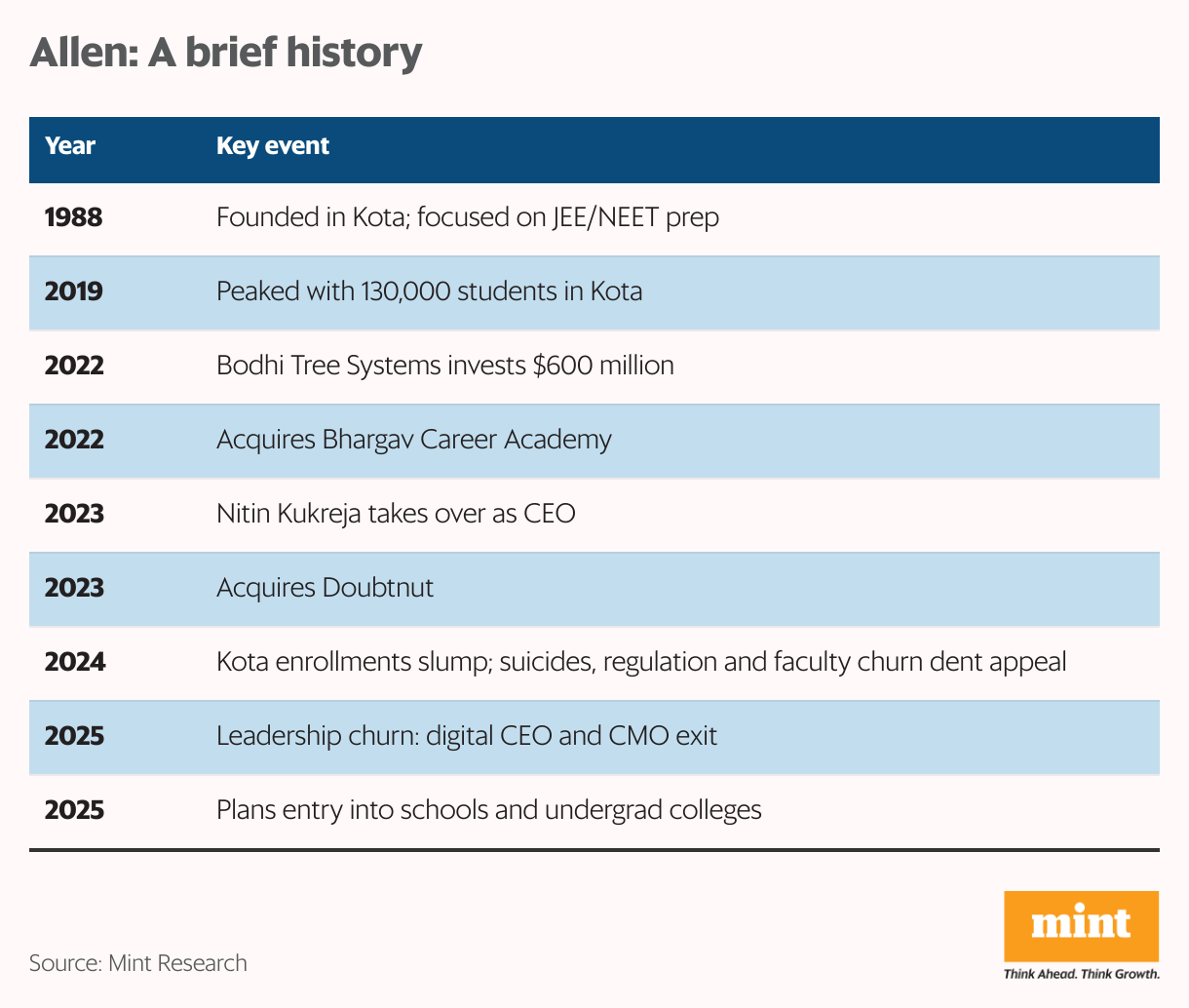
The story of Allen Career Institute is not merely one of academic success but of an unprecedented financial ascent. Founded in 1988 in the small city of Kota, Rajasthan, the institution has transformed from a local tutoring center into a global educational conglomerate. Understanding the "net worth" of Allen in 2026 requires looking beyond simple bank balances. It involves analyzing the valuation of its digital assets, its massive real estate footprint, and the brand equity that allows it to command a significant share of the multi-billion dollar Indian coaching industry.
The Evolution of Allen Career Institute: From Local Tuition to Global Powerhouse
To put Allen’s 2026 net worth in perspective, one must acknowledge its humble origins. Rajesh Maheshwari started the institute with just eight students in a single room, initially focusing on all subjects before specializing in science and mathematics for competitive exams. The subsequent entry of his three brothers—Govind, Naveen, and Brajesh—turned a small business into a family-led empire.
For decades, Allen operated as a traditional, cash-flow-positive partnership. Unlike modern edtech startups that burned through venture capital to acquire users, Allen grew organically through student results. By the time the institution sought external funding in 2022, it was already a profitable giant, a rarity in the education sector. This historical profitability is the bedrock of the family’s wealth, as they reinvested earnings into infrastructure rather than diluting equity early on.
In 2026, the "Kota Model"—characterized by rigorous schedules, high-pressure environments, and elite faculty—remains the core of the business. However, the perspective on their net worth has shifted from "how many students attend classes in Kota" to "how many students globally use Allen’s proprietary learning systems."
Quantifying the Worth: Valuation and Financial Milestones
The primary catalyst for Allen’s modern valuation was the landmark 2022 investment from Bodhi Tree Systems, a platform led by James Murdoch’s Lupa Systems and former Disney executive Uday Shankar. The $600 million investment for a significant minority stake was one of the largest in the history of Indian education.
The Impact of External Funding
Before this deal, Allen’s "net worth" was largely theoretical, based on annual revenues and assets. The Bodhi Tree investment provided a concrete market valuation of approximately $1.2 billion in 2022. By 2026, following the successful scaling of its digital wing and expansion into over 50 cities, that valuation has appreciated.
The Maheshwari family’s retention of the majority stake ensures that the bulk of the company's multi-billion dollar valuation translates directly to their personal net worth. Unlike founders of other edtech firms who often own less than 10% of their companies by the time they reach "Unicorn" status, the Maheshwaris remain firmly in control of their empire.
Revenue Growth and Profitability
In the fiscal years leading up to 2026, Allen has maintained a robust revenue stream. While pure-play digital competitors faced a "funding winter" and mounting losses, Allen’s hybrid model—combining physical classrooms with digital tools—proved more resilient.
- Classroom Revenue: Fees from over 300,000 students across India.
- Digital Revenue: Subscriptions to Allen Digital, which targets students who cannot travel to Kota.
- Ancillary Income: Revenue from publication units and testing services.
The Maheshwari Family Wealth: A Breakdown of Assets
The net worth of the Allen founders is not just tied to the valuation of the coaching institute. It is a diversified portfolio of physical and financial assets.
Real Estate Holdings
One of the most overlooked aspects of the "Allen Kota net worth" is the family’s massive real estate portfolio. In Kota alone, the institute owns dozens of state-of-the-art campuses, including the landmark "Satyarth" and "Samyak" buildings. These are not just functional spaces; they are prime commercial real estate in a city where land value has skyrocketed due to the coaching boom. Furthermore, as Allen expanded to cities like Ahmedabad, Bengaluru, and Chandigarh, they acquired significant property assets across the country.
The Transition to a Corporate Structure
Under the leadership of professional management, including CEO Nitin Kukreja, the Maheshwari family has transitioned from managing daily operations to serving as a strategic board. This professionalization has increased the "investor appeal" of the brand, potentially paving the way for an Initial Public Offering (IPO). Should Allen go public in the near future, the liquidity of the founders' shares would likely place them among the wealthiest families in India.
| Asset Category | Description | Estimated Impact on Net Worth (2026) |
|---|---|---|
| Equity in Allen | Majority stake in the parent company (Allen Career Institute Pvt Ltd). | $1.2 Billion - $1.5 Billion |
| Real Estate | Owned campuses, residential hostels, and commercial land in Kota and PAN India. | ₹2,500 - ₹3,500 Crore |
| Allen Digital | Proprietary technology, apps, and content libraries. | High growth potential; integrated into core valuation. |
| Brand Equity | Intangible value of the "Allen" name in the medical/engineering test-prep market. | Incalculable, but drives 40% premium on fees. |
The "Allen Digital" Impact: Driving Valuation in the 2020s
Between 2022 and 2026, the single biggest contributor to the expansion of Allen's net worth has been its digital transformation. For decades, Allen’s reach was limited by the physical capacity of its buildings. By launching Allen Digital, they removed these geographical constraints.
Competing with Edtech Giants
While companies like BYJU'S and Unacademy focused on "digital first," Allen used its 35 years of pedagogical experience to create a "results first" digital product. This shift allowed them to capture a segment of the market that was previously wary of online-only education. The integration of high-end analytics to track student performance has made their digital platform an asset worth hundreds of millions of dollars on its own.
The "Phygital" Advantage
The hybrid model is highly efficient. It allows Allen to utilize its famous faculty (whose reputations are part of the brand’s net worth) to teach thousands of students online simultaneously, while maintaining high-margin physical centers for those who want the full "Kota experience." This operational efficiency significantly boosts the EBTIDA (Earnings Before Interest, Taxes, Depreciation, and Amortization), which is the primary metric investors use to value the company.
Operational Costs and Profitability Factors
Maintaining a multi-billion dollar empire requires significant expenditure. To understand the net worth in perspective, one must account for the high costs of the coaching industry.
The "Star Teacher" Economy
A significant portion of Allen’s revenue is redirected into faculty salaries. In Kota, top-tier HODs (Heads of Departments) for Physics or Chemistry can command annual salaries exceeding ₹1 crore to ₹5 crore. Keeping this talent is essential for maintaining the results that drive student enrollment. Allen’s ability to consistently pay these high salaries while remaining profitable is a testament to its financial health.
Student Acquisition and Marketing
While Allen relies heavily on word-of-mouth and its track record of AIR (All India Rank) toppers, the competition in 2026 is fierce. Large-scale advertising campaigns, particularly around the time of NEET and JEE results, cost the institute hundreds of crores annually. However, because their "cost per acquisition" is lower than digital-only competitors (due to brand legacy), their profit margins remain superior.
Market Positioning and Competitive Landscape in 2026
In 2026, the coaching market in India has consolidated. Allen stands as one of the "Big Three" alongside Aakash (now a separate entity post-BYJU’S restructuring) and PhysicsWallah.
- Allen vs. Aakash: While Aakash has a larger number of centers, Allen is often perceived as having a higher "intensity" and better results in the top 100 ranks.
- Allen vs. PhysicsWallah: PW disrupted the market with low pricing, but Allen has maintained its premium status, catering to students who are willing to pay for a proven legacy of selections.
This positioning allows Allen to maintain high "pricing power." In financial terms, the ability to increase fees without losing student volume is a massive driver of valuation and, consequently, the net worth of the owners.
Ethical and Social Perspectives on the Wealth
The net worth of Allen Kota is often a subject of public debate. Critics point to the high-pressure environment of Kota and the commercialization of education. However, from a financial perspective, the Maheshwaris have also engaged in significant philanthropic efforts through the Allen Hope Foundation.
The perspective on their wealth is often balanced by the economic ecosystem they support. The city of Kota’s economy—from hostels and mess halls to bookstores and transport—is estimated to be worth over ₹5,000 crore annually, with Allen being the primary engine driving this local GDP.
Frequently Asked Questions
What is the estimated net worth of the Maheshwari family in 2026?
The combined net worth of the four Maheshwari brothers—Rajesh, Govind, Naveen, and Brajesh—is estimated to exceed ₹10,000 crore (approximately $1.2 billion). This includes their majority stake in Allen Career Institute and their extensive real estate holdings.
How much did Bodhi Tree Systems invest in Allen?
In 2022, Bodhi Tree Systems invested $600 million into Allen Career Institute. At the time, this was one of the largest private equity investments in a traditional Indian educational institution and valued the company at over $1 billion.
Is Allen Career Institute a "Unicorn"?
Yes, Allen reached Unicorn status (a valuation of $1 billion or more) following the 2022 investment. As of 2026, its valuation is estimated to have grown to between $1.5 billion and $2 billion due to its successful digital expansion.
How many students does Allen have in 2026?
While exact numbers vary by session, Allen typically enrolls over 300,000 students annually across its classroom and digital programs. Their digital reach significantly expanded their student base beyond the physical constraints of their Kota campuses.
Who is the CEO of Allen in 2026?
Nitin Kukreja serves as the CEO of Allen Career Institute. His appointment marked a major shift in the company's history, moving from a family-run partnership to a professionally managed corporate entity.
Final Perspective and Next Actions
The net worth of Allen Kota in 2026 is a reflection of a transition from a local success story to a permanent fixture in the global education economy. The Maheshwari family has successfully navigated the "Edtech disruption" by staying true to their core strength—pedagogical excellence—while adopting the technology necessary to scale.
For students and parents, the high net worth of the institution is a sign of stability and the ability to invest in the best faculty and technology. For investors, it represents a rare example of a "profitable unicorn" in the education space.
Next Actions:
- For Investors: Monitor any filings related to an Allen IPO, as it would be one of the most anticipated market debuts in the Indian education sector.
- For Students: Evaluate Allen’s digital offerings versus their physical centers; the "phygital" model now provides more flexible options than were available five years ago.
- For Educators: Study the Allen business model as a case study in scaling a service-based business into a multi-billion dollar asset through brand consistency and reinvestment.