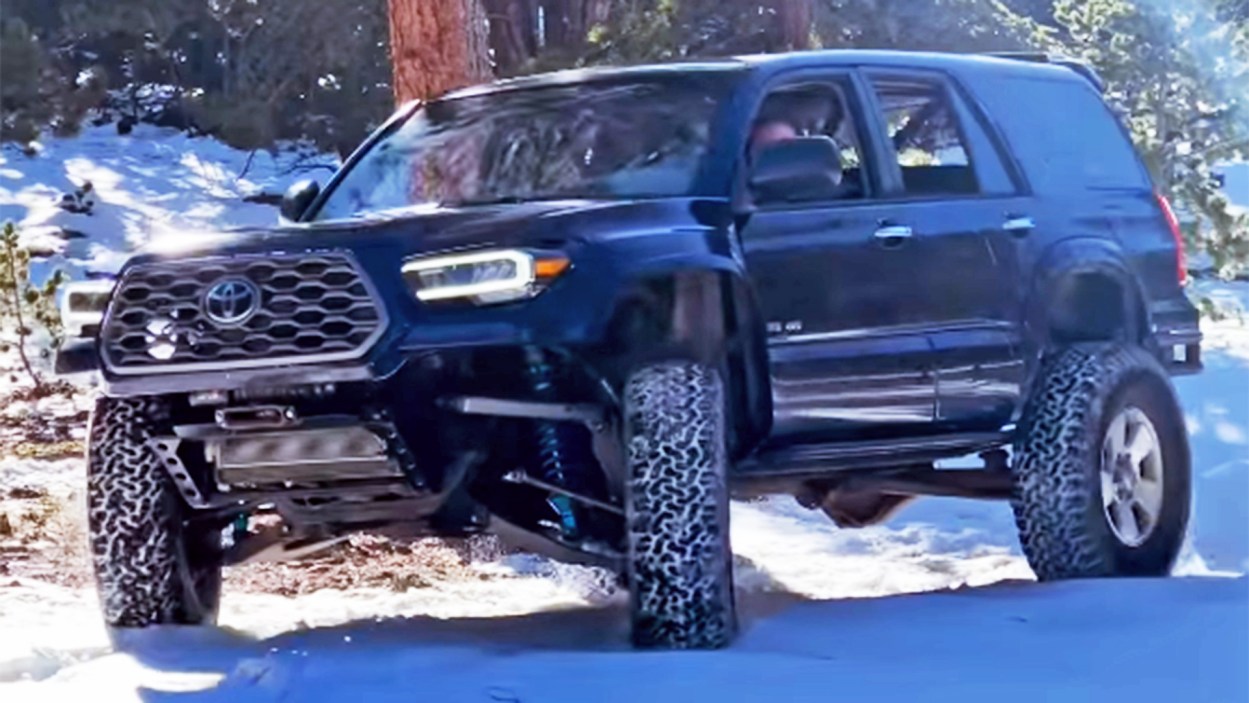
A Toyota 4Runner motor swap involves replacing the factory-installed engine—often the aging 22R-E, the underpowered 3VZ-E, or the high-mileage 5VZ-FE—with a more modern or powerful powerplant. Successful execution requires precise management of engine mounts, wiring harness integration, cooling system capacity, and drivetrain alignment to ensure long-term reliability and off-road performance.
The Toyota 4Runner has earned its reputation as a legendary off-road platform, but across its many generations, certain factory engines have left enthusiasts wanting more. Whether it is the quest for better fuel efficiency, more torque for rock crawling, or the raw horsepower needed for highway passing, a motor swap is the ultimate modification. As of 2026, the aftermarket support for these conversions has reached a peak, offering specialized components that bridge the gap between vintage Toyota steel and modern powertrain technology.
Assessing the Foundation: Why Swap a 4Runner?
Before turning a single wrench, it is vital to understand the primary motivations behind a 4Runner motor swap. For owners of first-generation (1984–1989) and second-generation (1990–1995) models, the goal is often to escape the limitations of the 3.0L 3VZ-E V6, famously nicknamed the "3-slow" due to its lack of power and tendency for head gasket failure.
In later models, such as the third-generation (1996–2002) and fourth-generation (2003–2009), swaps are typically driven by the desire for V8 power or the efficiency of a modern diesel. While the 3.4L 5VZ-FE is a masterpiece of reliability, it can struggle when the vehicle is burdened with heavy armor, 35-inch tires, and camping gear. A technical overview must account for these varying goals, as the hardware requirements for a "daily driver" swap differ significantly from those of a dedicated "trail rig."
The 3.4L 5VZ-FE: The "Gold Standard" for Early Generations
For owners of the first and second-generation 4Runners, the 3.4L 5VZ-FE from the 1996–2004 Tacoma and 4Runner remains the most popular and technically sound swap. Because this engine is part of the same Toyota family, it shares a similar physical footprint, making the mechanical installation relatively straightforward.
Mechanical Integration
The 5VZ-FE swap is favored because it often retains the original transmission. When swapping into a 3.0L V6 4Runner, the R150F manual transmission can usually be kept, though a specific bellhousing or input shaft modification may be required depending on the donor vehicle's year. One of the most critical technical details is the oil pan. To clear the front differential on an Independent Front Suspension (IFS) 4Runner, builders typically use a "rear-sump" oil pan found on the Toyota T100 pickup.
Electrical and ECU Management
The primary hurdle in the 3.4L swap is the wiring. The 1990s-era 3.0L wiring is entirely different from the OBD-II system of the 3.4L. Conversion harnesses, provided by specialists like Off Road Solutions, allow for a "plug-and-play" experience by bridging the 4Runner’s body harness with the donor engine's ECU. This ensures that the factory tachometer, oil pressure gauge, and temperature sensors function correctly.
V8 Power: The 2UZ-FE and GM LS Conversions
When the goal is maximum torque, builders often look toward V8 engines. This path is technically more complex, requiring significant modifications to the engine bay and the drivetrain.
Toyota 2UZ-FE (4.7L V8)
The 2UZ-FE is the iron-block V8 found in the fourth-generation 4Runner and the Lexus GX470. Swapping this into a third-generation 4Runner is a popular "OEM+" upgrade. Technically, this requires custom engine mounts and often a body lift to clear the taller intake manifold. Because the 2UZ-FE was designed for the 4Runner chassis family, it maintains a level of reliability and serviceability that aftermarket engines cannot match.
General Motors LS Series
The GM LS (LS1, LS3, or LMG 5.3L) swap is the pinnacle of power-to-weight performance. The LS is compact, lightweight (thanks to aluminum blocks in many variants), and has an astronomical level of aftermarket support. However, it requires an adapter plate to mate with Toyota transmissions, or more commonly, the installation of a GM 4L60E or 6L80 transmission. Companies like Advanced Adapters provide the necessary hardware to connect these GM transmissions to the Toyota transfer case, preserving the 4Runner's four-wheel-drive capabilities.
Diesel Conversions: Efficiency and Torque
For overlanders prioritizing range and low-end grunt, diesel swaps have become increasingly viable. As of 2026, the most common choices involve the Cummins R2.8 Turbo Diesel and the Volkswagen 1.9L or 2.0L TDI.
The Cummins R2.8 is a "crate" engine designed specifically for the aftermarket. It offers a compact package with integrated electronics. The technical challenge here is weight; the 4Runner's front suspension must be beefed up to handle the heavy iron block of a diesel. Furthermore, the cooling system must be upgraded to a triple-core radiator to manage the thermal loads generated by turbocharged diesel combustion.
The VW TDI swap is lighter and more affordable but requires a complex adapter kit to mate to the Toyota W56 or R150F transmission. This swap is particularly popular in first and second-generation 4Runners where weight savings are paramount.
Comparison of Common 4Runner Swap Engines
| Engine Model | Displacement | Horsepower (Approx) | Torque (lb-ft) | Best Generation for Swap | Technical Difficulty |
|---|---|---|---|---|---|
| Toyota 5VZ-FE | 3.4L V6 | 190 hp | 220 lb-ft | 1st & 2nd Gen | Moderate |
| Toyota 2UZ-FE | 4.7L V8 | 270 hp | 315 lb-ft | 3rd Gen | High |
| Toyota 1GR-FE | 4.0L V6 | 236–270 hp | 266–278 lb-ft | 2nd & 3rd Gen | Very High |
| GM LS3 | 6.2L V8 | 430 hp | 425 lb-ft | 3rd, 4th, 5th Gen | Very High |
| Cummins R2.8 | 2.8L I4 (D) | 161 hp | 310 lb-ft | All Generations | High |
| VW 1.9L TDI | 1.9L I4 (D) | 100–150 hp | 177–250 lb-ft | 1st & 2nd Gen | Moderate |
Critical Technical Components and Requirements
Regardless of the engine chosen, several technical subsystems must be addressed to ensure the vehicle remains safe and drivable.
Cooling System Upgrades
Most swap engines produce significantly more heat than the factory units. Moving from a 22R-E (four-cylinder) to a V6 or V8 requires an increase in radiator surface area. Aluminum radiators with high-cfm electric fans are the standard. For 3.4L swaps, the 3.0L radiator can sometimes be reused if it is in good condition, but for V8 or diesel swaps, a custom-shrouded setup is mandatory.
Fuel System Modification
Modern engines operate on higher fuel pressures than older 4Runner engines. Swapping an LS or a 1GR-FE into an early 4Runner requires replacing the factory fuel pump with a high-flow unit (such as a Walbro 255) and installing a return-style or returnless fuel regulator depending on the ECU's requirements. Fuel lines must also be inspected and often replaced with stainless steel or braided lines to handle the increased pressure.
Drivetrain and Clearance
Driveline angles are a frequent point of failure in poorly executed swaps. When a new engine and transmission are installed, the transfer case position may shift. This necessitates the shortening or lengthening of the front and rear driveshafts. Furthermore, if the 4Runner has an Independent Front Suspension, the engine must be positioned high enough to avoid the front differential, but low enough to allow the hood to close. Some V8 swaps require a 1-inch to 2-inch body lift to provide the necessary clearance for the transmission tunnel and intake manifold.
Exhaust Routing
Exhaust becomes a puzzle, especially on the driver-side frame rail where the steering shaft is located. For the 3.4L swap, "crossover" pipes are often custom-made or purchased to route the exhaust away from the firewall and steering components. For LS swaps, "block-hugger" headers are frequently used to keep the exhaust manifold profile as slim as possible.
Electrical Integration and CAN Bus Challenges
In 2026, the electrical aspect of a motor swap is more daunting than the mechanical. For fourth and fifth-generation 4Runners, the vehicle uses a Controller Area Network (CAN bus) system. This means the engine ECU, transmission controller, ABS module, and instrument cluster all "talk" to each other.
If you install a non-Toyota engine into a 5th Gen 4Runner, the dashboard will likely light up like a Christmas tree because the body control module cannot find the engine. Solving this requires the use of CAN bus translators or standalone engine management systems like those from Haltech or Link Engine Management. These systems can be programmed to mimic the factory Toyota signals, allowing features like Hill Start Assist and Traction Control to remain functional.
Safety and Legal Considerations
A motor swap can affect the vehicle's legality and safety. In many jurisdictions, a swapped vehicle must meet the emissions standards of either the chassis year or the engine year—whichever is newer. This often requires the retention of all original emissions equipment, including catalytic converters, EGR valves, and EVAP canisters.
From a safety perspective, the added power of a V8 or turbo-diesel necessitates an upgrade to the braking system. Many 4Runner owners perform a "Tundra Brake Swap," utilizing the larger calipers and rotors from a 2000–2006 Toyota Tundra to provide the stopping power needed for the increased vehicle mass and speed.
Frequently Asked Questions
Which engine is the easiest to swap into an older 4Runner?
The 3.4L 5VZ-FE is widely considered the easiest swap for 1st and 2nd Gen 4Runners. Because it shares engine mount patterns with the 3.0L V6 and has extensive aftermarket wiring support, it can often be completed in a few weekends by an experienced hobbyist.
Will a motor swap pass emissions testing?
This depends entirely on your local laws. In states like California, the swap must be inspected by a "Referee." The engine must generally be from the same vehicle class (light-duty truck) and be newer than the vehicle it is being installed into. All factory emissions components from the donor engine must be present and functional.
Do I need to replace my transmission during a swap?
Not always. Many Toyota engines share bellhousing patterns or have available adapters. However, if you are significantly increasing horsepower (e.g., swapping an LS V8), the factory Toyota manual transmissions (like the W56) may not be able to handle the torque. In these cases, upgrading to a heavier-duty transmission is recommended.
How much does a 4Runner motor swap cost?
Costs vary wildly based on the engine. A DIY 3.4L swap can be done for $2,500 to $4,000 using used parts. A professional LS V8 or Cummins diesel swap can easily exceed $15,000 to $20,000 when factoring in the crate engine, adapter kits, custom fabrication, and labor.
Is a V8 swap better than a Turbocharged V6?
A V8 swap (like the 2UZ-FE) generally offers better off-idle torque and long-term reliability due to less complexity. A turbocharged V6 can produce similar power but introduces more heat and potential points of failure (piping, intercoolers, turbo bearings), which can be a liability in remote off-road environments.
Final Recommendations for Your Swap Project
To successfully complete a 4Runner motor swap, begin with a clear goal and a defined budget. If you are looking for a reliable daily driver with a bit more pep, the 3.4L 5VZ-FE is the most logical choice. If you are building a heavy overlanding rig or a rock crawler, the torque of a 4.7L V8 or an LS engine is worth the additional technical complexity.
Always source a complete donor vehicle when possible, rather than just an engine; having the wiring, ECU, and accessories from the same VIN will save hundreds of hours of troubleshooting. Finally, prioritize the cooling and electrical systems early in the build process, as these are the areas where most custom swaps fail.