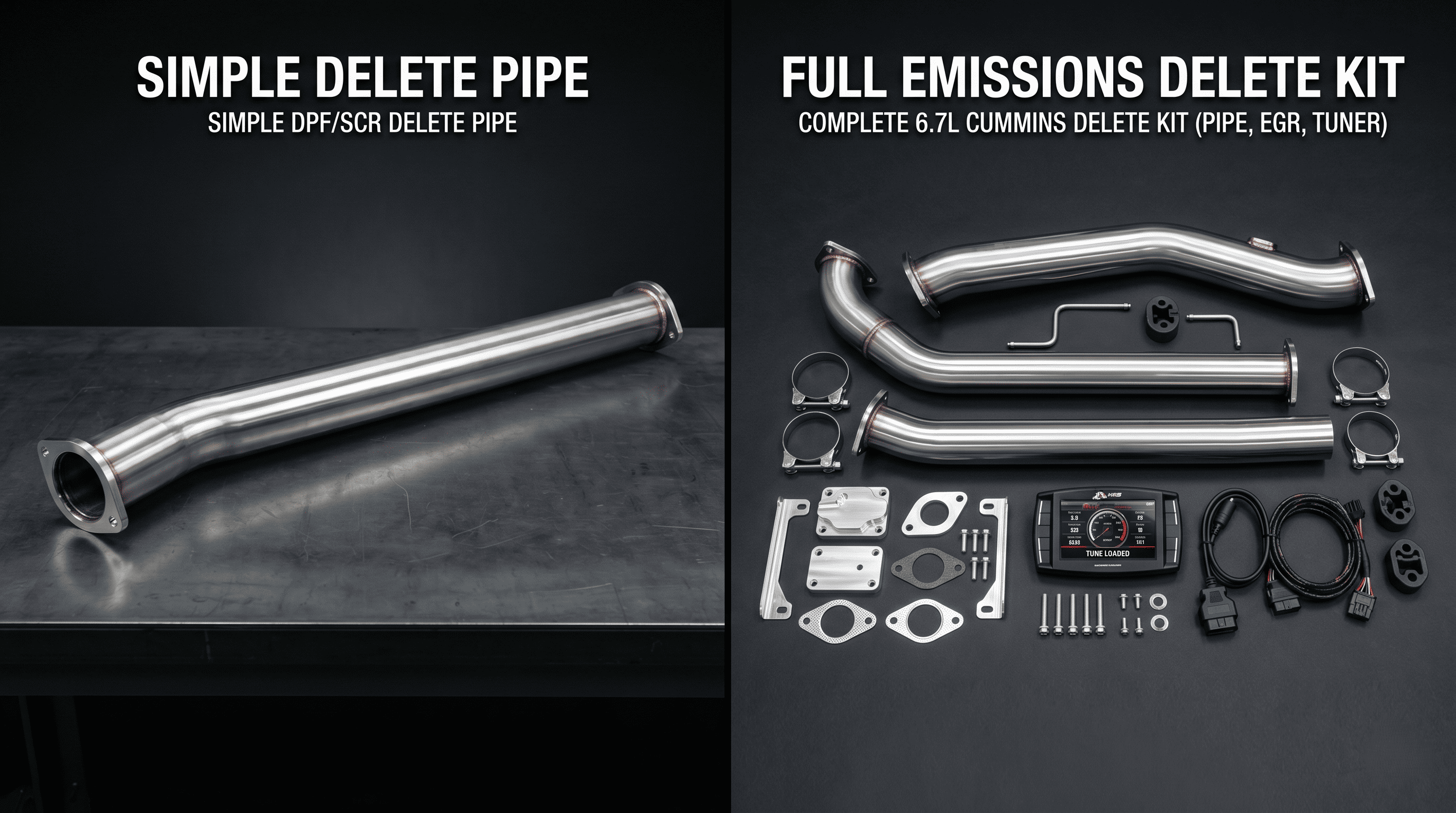
A 2020 Cummins delete kit typically ranges from $1,000 to over $3,500 depending on whether you purchase a full hardware replacement package or a basic software-only tuning bundle, with professional installation often adding several hundred dollars. These aftermarket modifications remove or bypass the diesel particulate filter, exhaust gas recirculation, and selective catalytic reduction systems to alter engine performance metrics.
Modifying a modern heavy-duty diesel engine requires navigating a complex landscape of hardware packages, software tuners, and legal considerations. For owners of the 6.7L Cummins-powered Ram 2500 and 3500 trucks built in 2020, understanding the true scope of a delete procedure involves examining kit configurations, cost structures, and technical implications. Because diesel emissions equipment has become increasingly integrated into vehicle architecture, upgrading or removing these components is no longer a simple mechanical swap.
Understanding the 2020 Cummins Emissions Architecture
The 2020 Ram heavy-duty truck utilizes the 6.7L Cummins turbo diesel engine, which is available in standard output and high output variants. To comply with federal and state environmental regulations enforced by agencies such as the Environmental Protection Agency, this powertrain relies on a sophisticated suite of emissions control systems.
These factory mechanisms include the Diesel Particulate Filter (DPF) to trap soot, the Exhaust Gas Recirculation (EGR) valve and cooler to lower combustion temperatures and reduce nitrogen oxide emissions, and the Selective Catalytic Reduction (SCR) system, which injects Diesel Exhaust Fluid (DEF) into the exhaust stream.
Over time, these components can experience operational failures, sensor faults, and frequent regeneration cycles that consume extra fuel and reduce overall efficiency. This has driven interest in aftermarket delete kits, which physically remove or bypass these assemblies and reflash the Engine Control Module (ECM) to run the engine without factory emission inputs. However, modifying these systems alters the factory design parameters and carries significant legal and operational repercussions that every truck owner must weigh carefully.
Core Components of a 2020 Cummins Delete Package
When shopping for a delete solution, buyers encounter various configurations packaged by different aftermarket manufacturers and tuning distributors. These packages generally fall into two categories: hardware-only kits, tuning-only solutions, and comprehensive bundles that combine both aspects.
Exhaust Hardware (DPF and Cat Delete Pipes)
The physical hardware typically consists of a replacement exhaust system, often called a "straight pipe" or "delete pipe," which replaces the factory DPF, diesel oxidation catalyst, and SCR canister. These pipes are usually constructed from mandrel-bent aluminized or stainless steel, ranging from 4 inches to 5 inches in diameter. Removing these restrictive components lowers exhaust backpressure, which can lower exhaust gas temperatures under heavy load and eliminate the need for active DPF regeneration cycles.
EGR Block-Off Plates and Coolant Reroutes
The EGR delete portion of a comprehensive kit involves removing or blocking off the EGR valve and cooler. Kit manufacturers supply heavy-duty steel or aluminum plates to seal off the exhaust manifold and intake horn ports where the EGR system once connected. Some advanced kits also include coolant bypass components to reroute engine coolant away from the defunct EGR cooler and back into the primary cooling loop, preventing potential leaks and simplifying the under-hood layout.
Electronic Tuning and ECM Calibration
Hardware removal alone will trigger severe diagnostic trouble codes, put the truck into "limp mode," and cause continuous fault warnings unless the ECM is recalibrated. Electronic tuners and calibration devices interface with the vehicle's data bus to rewrite the operating software. This software suppresses emission-related trouble codes, disables the DEF injection system, turns off EGR actuation, and adjusts fuel delivery curves to match the increased airflow of the modified exhaust.
Breakdown of Kit Prices and Market Options
Pricing for 2020 Cummins delete options varies widely based on the brand, material quality, inclusion of custom tuning, and the specific device used to flash the ECM.
| Kit Type | Typical Price Range | Included Components | Primary Considerations |
|---|---|---|---|
| Basic Tuning Only | $600 – $1,200 | ECM unlock, flash device, and tuning files | Requires existing hardware removal or custom pipe sourcing; leaves factory emissions gear in place or bypassed electronically. |
| Hardware & Pipe Kit | $400 – $900 | DPF delete pipe, manifold pipes, EGR block-off plates | Excludes electronic tuning; truck will enter limp mode unless paired with a separate ECM calibration device. |
| Complete Combo Kit | $1,500 – $3,500 | Full exhaust piping, EGR block-off, ECM unlock service, and custom multi-level tunes | Provides an all-in-one solution with matched hardware and software, though total cost scales with premium stainless steel options. |
Beyond the baseline kit costs, buyers must factor in auxiliary expenses. The 2020 Cummins ECM features advanced security protocols that often require the physical computer module to be shipped out for unlocking, or unlocked via specialized bypass cables, adding to the initial turnaround time and expense. Professional installation labor, if not performed independently, can add anywhere from $500 to $1,500 depending on shop rates and the stubbornness of rusted factory exhaust bolts.
Technical Prerequisites and Installation Considerations
Executing a delete procedure on a 2020 Ram 2500 or 3500 is an advanced mechanical undertaking. The factory exhaust system is heavy, continuous, and tightly routed through the chassis, often requiring the cutting or lowering of components to extract the stock DPF and SCR assembly.
Furthermore, working on the high-pressure common rail fuel system and turbocharger controls requires strict cleanliness and precise torque specifications.
Owners must verify whether their specific truck is a standard output or high-output model, as transmission pairings differ. The standard output 6.7L Cummins is mated to a 68RFE six-speed automatic transmission, while the high-output version utilizes an Aisin heavy-duty six-speed automatic transmission. Both transmissions have distinct torque capacity limits and software integration requirements. Poorly calibrated delete tunes that push excessive low-end torque without corresponding transmission tuning can lead to premature clutch slip, line pressure issues, and mechanical failure in the 68RFE unit.
Legal Status, Environmental Impact, and Operational Risks
Before purchasing or installing a delete kit, operators must evaluate the legal and regulatory framework governing vehicle emissions. The federal Clean Air Act prohibits the removal, bypass, or disabling of factory emissions control devices on motor vehicles operated on public roads.
Many state departments of transportation and environmental protection agencies enforce aggressive emissions testing, visual inspections, and electronic OBD-II scans during routine vehicle registration renewals. Vehicles found to be modified with delete kits can fail state inspections, incur substantial financial penalties, and be ordered out of service until factory equipment is restored.
From an operational perspective, removing emissions equipment voids any remaining factory powertrain warranty coverage provided by Ram or Cummins. Any engine, turbocharger, or transmission failure that can be linked to aftermarket tuning or hardware modification will become the financial responsibility of the vehicle owner.
While proponents cite improved fuel economy, lower exhaust temperatures, and elimination of DEF system maintenance headaches as primary benefits, these must be balanced against the loss of legal compliance, resale market restrictions, and potential liability associated with operating non-compliant vehicles on public highways.
Frequently Asked Questions
Can I install a 2020 Cummins delete kit without tuning the ECM?
No. Modern diesel engine management systems rely entirely on electronic feedback from exhaust sensors, pressure differentials, and temperature probes. Removing the physical DPF or EGR system without rewriting the ECM software will immediately trigger fault codes, illumination of the check engine light, and severe power derate or limp mode.
Why do 2020 Cummins trucks require an ECM unlock for tuning?
Starting with the 2019 and 2020 model years, Ram introduced encrypted security gateways inside the Powertrain Control Module and Engine Control Module to prevent unauthorized software modifications. Tuning devices cannot write new calibration files directly to these computers without an initial unlock procedure performed via specialized bench tools or authorized unlock services.
Will deleting my 2020 Cummins improve fuel economy?
Many operators report modest improvements in fuel economy after performing a delete and tuning package. This gain primarily stems from eliminating fuel-intensive DPF regeneration cycles and reducing parasitic exhaust backpressure, though actual fuel savings depend heavily on driving habits, tire size, and tune efficiency.
What happens to my factory warranty if I install a delete kit?
Installing a delete kit and aftermarket tuning will void the manufacturer's powertrain warranty for any related engine, fuel system, turbocharger, and transmission components. Dealership service departments can detect historical software flashes and hardware modifications even if the physical parts are later reinstalled.
Are there alternative options for a failing DPF or EGR system?
Yes. If your emissions equipment is failing due to soot buildup or component wear, alternatives include professional chemical cleaning or baking of the DPF, replacing faulty EGR valves or pressure sensors under applicable extended warranties, or installing genuine OEM replacement parts to maintain full legal compliance and warranty protection.
Conclusion and Next Actions
Deciding to invest in a 2020 Cummins delete kit requires a careful assessment of total costs, technical capabilities, and regulatory compliance. Owners facing expensive emissions repairs should first check for active manufacturer recalls, emissions warranty extensions, or goodwill assistance from authorized dealerships.
If you choose to proceed with aftermarket modifications, research reputable hardware manufacturers and custom tuning providers known for reliable calibrations rather than generic, mass-produced files. Verify your local state inspection laws and ensure you have a clear plan for storing or handling factory components if future regulatory changes require returning the vehicle to stock condition.