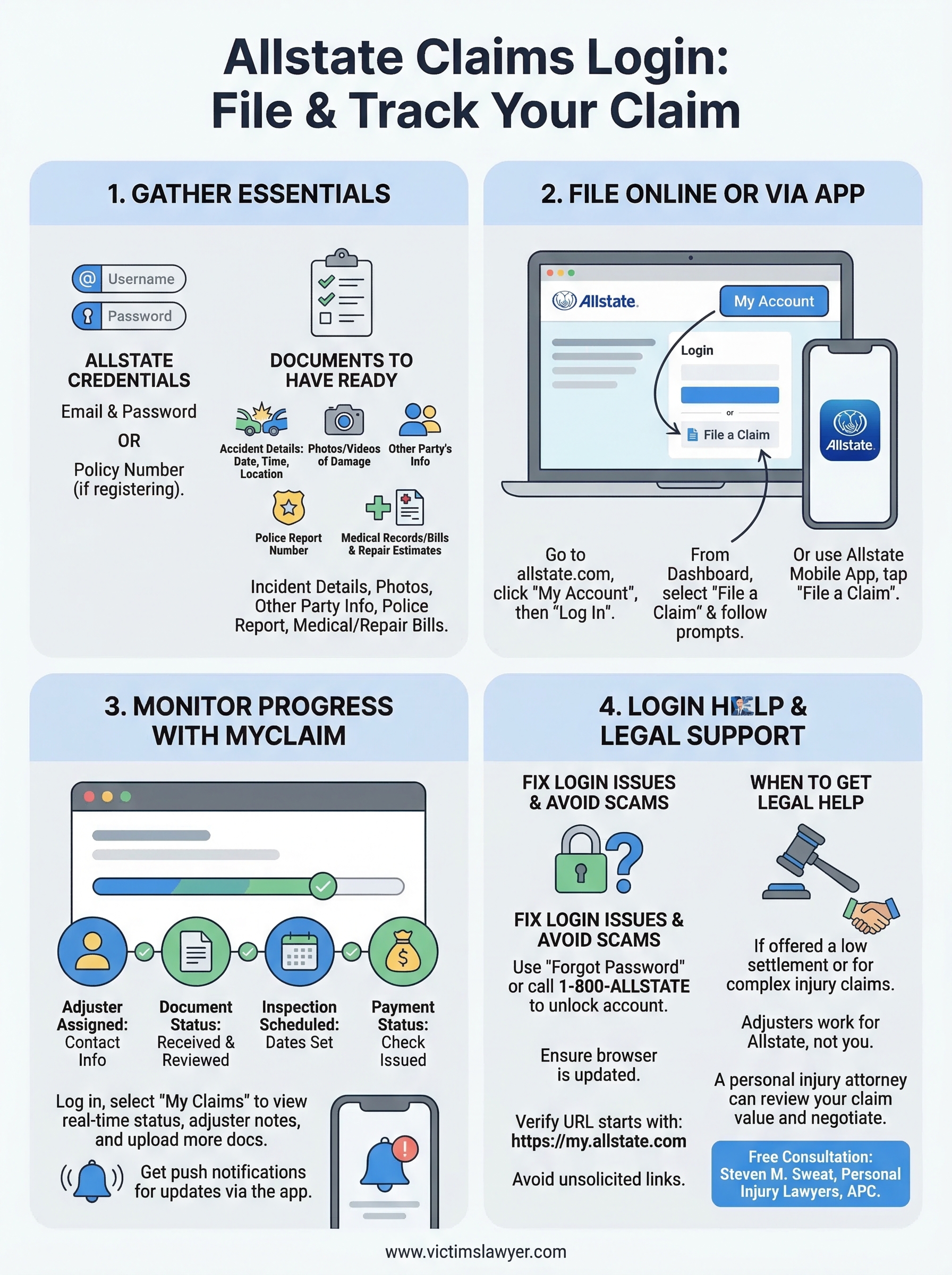
To file and manage Allstate group claims, policyholders must use the Allstate Benefits MyBenefits portal or the mobile application. These claims apply to supplemental insurance policies—such as accident, critical illness, and disability coverage—provided through an employer. Successful processing requires submitting specific documentation, including itemized medical bills (UB-04 or HCFA-1500 forms) and an Explanation of Benefits (EOB) from your primary health insurer.
Understanding Allstate Group Claims and Supplemental Benefits
Allstate group claims differ significantly from standard auto or homeowners insurance claims. They are processed through Allstate Benefits, the trade name for the American Heritage Life Insurance Company, a subsidiary of Allstate. These "voluntary benefits" are designed to supplement primary health insurance by providing cash payments directly to the policyholder, rather than to the medical provider.
As we navigate the 2026 insurance landscape, Allstate Benefits continues to focus on "indemnity" style coverage. This means that instead of paying for the cost of a service, the policy pays a predetermined flat fee based on a specific diagnosis or medical event. For example, if a policyholder sustains a bone fracture, the claim is paid based on the severity of the break as defined in the policy's Schedule of Benefits, regardless of what the hospital actually charges.
The "group" aspect refers to the fact that these policies are issued to employees through their workplace. Because these are group contracts, the premiums are often lower than individual policies, and the claims process is streamlined through employer-integrated systems. However, the responsibility for initiating a claim rests entirely on the employee, not the employer or the doctor.
The MyBenefits Portal: Your Central Claims Hub
In 2026, the primary method for managing Allstate group claims is the MyBenefits web portal. This platform acts as a secure repository for policy documents, claim history, and payment tracking. While traditional mail and fax options remain available for accessibility compliance, digital submission is the standard for faster adjudication.
Registration and Access Requirements
To access your claims dashboard, you must register an account on the Allstate Benefits website. You will need the following information:
- Social Security Number (SSN) or Member ID.
- Date of Birth.
- Zip Code associated with your employer's records.
- Policy Number (found on your certificate of insurance or enrollment materials).
Once registered, the portal allows you to sign up for Direct Deposit. This is a critical step for 2026 policyholders, as electronic fund transfers (EFT) typically reduce the time between claim approval and receipt of funds by five to seven business days compared to paper checks.
Common Types of Allstate Group Claims
Allstate Benefits offers a variety of products, each with unique claim requirements. Understanding which category your claim falls into is the first step in gathering the correct evidence.
1. Accident Insurance Claims
Accident claims are the most frequent type of group claim. These cover injuries resulting from a covered accident, such as a car crash, a fall, or a sports injury. The benefits are paid for specific services like emergency room visits, X-rays, physical therapy, and hospital stays.
- Key Requirement: The injury must be the direct result of an accident, not a pre-existing sickness or degenerative condition.
- Required Docs: Emergency room discharge papers and itemized bills showing the diagnosis codes (ICD-10).
2. Critical Illness Claims
Critical illness insurance provides a lump-sum payment upon the diagnosis of a major health event, such as a heart attack, stroke, or invasive cancer.
- Key Requirement: The diagnosis must meet the specific medical definition outlined in the policy. For instance, some "minor" skin cancers may not trigger a full benefit.
- Required Docs: A pathology report or a physician's statement confirming the exact diagnosis and the date it was first determined.
3. Hospital Indemnity Claims
This coverage pays a daily benefit for each day a policyholder is confined to a hospital. Some policies also include an "Initial Confinement" benefit, which pays a larger sum for the first day of admission.
- Key Requirement: The admission must be "inpatient." Observation stays (where you remain in the hospital but are classified as outpatient) often do not qualify for the full confinement benefit.
- Required Docs: A hospital bill showing the "Inpatient" status and the specific dates of admission and discharge.
4. Disability Claims (Short-Term and Long-Term)
Disability claims replace a portion of your income if you are unable to work due to a covered illness or injury.
- Key Requirement: You must satisfy the Elimination Period (a waiting period) before benefits begin.
- Required Docs: An employer’s statement regarding your work status and a detailed Attending Physician's Statement (APS) describing your functional limitations.
Step-by-Step Guide to Filing an Allstate Group Claim
Following a structured process reduces the likelihood of "Requests for Information" (RFIs), which are the leading cause of claim delays in 2026.
Step 1: Gather Proof of Service
Do not wait for Allstate to request records from your doctor. Proactively obtain the Itemized Bill or the UB-04/HCFA-1500 form from your medical provider. These forms contain the standardized medical codes (CPT and ICD-10) that Allstate's claims adjusters use to verify the event.
Step 2: Complete the Claim Form
Navigate to the "File a Claim" section of the MyBenefits portal. Select the appropriate claim type. You will be asked to provide:
- The date of the event or diagnosis.
- A brief description of how the injury occurred (if an accident).
- The names of the healthcare providers seen.
Step 3: Attach Supporting Documentation
Upload your digital files. Ensure that the patient's name, the provider's name, and the dates of service are clearly visible. If you are filing a Wellness Benefit claim (a small annual payment for routine checkups), you usually only need to provide the date of the exam and the doctor's name; a full itemized bill is often unnecessary for this specific benefit.
Step 4: Submission and Tracking
After submission, you will receive a claim number. In 2026, Allstate Benefits provides real-time status updates via the portal. The statuses typically progress from "Received" to "In Review," then "Pending" (if more info is needed), and finally "Processed" or "Paid."
Comparison of Claims Requirements by Policy Type
| Policy Type | Primary Trigger | Essential Documentation | Typical Benefit Structure |
|---|---|---|---|
| Accident | Accidental Injury | Itemized Bill + ER Records | Per-service (X-ray, Stitches, etc.) |
| Critical Illness | Major Diagnosis | Pathology/Lab Report | Lump-sum payment |
| Indemnity | Hospital Admission | Facility Bill (UB-04) | Daily confinement rate |
| Disability | Inability to Work | Physician Statement + Employer Form | Weekly or monthly percentage of salary |
| Cancer | Malignant Diagnosis | Pathology Report + Treatment Plan | Lump-sum or per-treatment (Chemo/Rad) |
The "Wellness Benefit": A Commonly Overlooked Claim
One of the most valuable features of Allstate group plans is the Wellness or Outpatient Physician Treatment Benefit. Many policyholders are unaware that they can claim a fixed amount (usually between $50 and $100) once per year simply for getting a routine physical, a mammogram, a colonoscopy, or even certain immunizations.
Because these benefits are small and high-volume, Allstate has simplified the process. For a wellness claim, you often do not need to upload a bill. You simply enter the date of the screening and the type of test performed into the MyBenefits portal. This "claim" essentially functions as a partial refund of your annual premium and should be filed every year you have the coverage.
Common Reasons for Claim Denial or Delay
Understanding why claims fail can help you avoid similar pitfalls. Based on historical data and 2026 processing standards, most delays stem from:
- Missing "Explanation of Benefits" (EOB): If your Allstate policy requires "Coordination of Benefits," they may need to see what your primary health insurance paid before they can process their portion. Always include your EOB from companies like Blue Cross or UnitedHealthcare if requested.
- Illegible Documentation: Photographs of crumpled bills taken in low light are often rejected. Use a mobile scanning app to create clear, high-contrast PDF documents.
- The "Sickness vs. Accident" Distinction: If you file an accident claim for an injury that the medical records describe as a chronic condition (like degenerative disc disease), the claim will likely be denied. The documentation must clearly state that the treatment was for an acute injury.
- Pre-existing Condition Exclusions: Many group policies have a "12/12" or "6/12" exclusion. This means if you received treatment for a condition in the 12 months before your policy started, that condition may not be covered for the first 12 months of the policy.
- Incomplete Physician Statements: For disability claims, if a doctor writes "unable to work" without providing clinical evidence of why (e.g., "patient cannot lift more than 10 lbs due to lumbar fracture"), the claim will be pended for more detail.
Troubleshooting and Contacting Allstate Benefits
If your claim is pended or denied, you have the right to an appeal. The first step should be reviewing the Explanation of Benefits (EOB) provided by Allstate. This document will contain a specific "Reason Code" explaining the decision.
If you need to speak with a representative, the Allstate Benefits Customer Care Center is the designated point of contact.
- Phone: 1-800-521-3535 (standard for Allstate Benefits).
- Hours: Typically 8:00 a.m. to 8:00 p.m. ET, Monday through Friday.
- Mailing Address for Claims: American Heritage Life Insurance Company, 1776 American Heritage Life Drive, Jacksonville, FL 32224.
For those whose employers use a third-party benefits administrator (TPA), you may need to initiate the claim through your company's internal HR portal before it reaches Allstate. Always verify your company's specific "Internal Claim Protocol" with your HR department.
Frequently Asked Questions (FAQs)
How long does it take for Allstate to process a group claim?
In 2026, most supplemental claims are processed within 5 to 10 business days once all required documentation is received. If you have signed up for direct deposit, funds are usually available in your account 48 to 72 hours after the claim status changes to "Paid" on the MyBenefits portal. Paper checks can take an additional 7 to 10 days for postal delivery.
Can I file a claim for a dependent on my policy?
Yes, you can file claims for any covered dependents, including spouses and children, through your primary MyBenefits account. When starting a new claim, the portal will ask you to select the "Patient." Ensure you have the specific medical records for that dependent, as the documentation must match the patient name exactly.
Is the money I receive from an Allstate group claim taxable?
The taxability of benefits depends on how your premiums were paid. If you paid your premiums with "post-tax" dollars (common in many voluntary plans), the benefits you receive are generally tax-free. However, if your employer paid the premiums or if you paid them with "pre-tax" dollars through a Section 125 cafeteria plan, the benefit payments may be considered taxable income. You should consult a tax professional regarding IRS Form 1099-MISC or 1099-LTC if applicable.
What if I leave my employer? Can I still file a claim?
This depends on whether your policy is "portable." Many Allstate Benefits policies allow you to take the coverage with you (portability) if you leave your job, provided you begin paying the premiums directly to Allstate. If you had an active policy at the time of the medical event, you can file a claim even if you are no longer with that employer, as long as the date of service falls within the period you were covered.
What is an itemized bill, and why is it necessary?
An itemized bill is a detailed statement from a healthcare provider that lists every individual service provided, along with its specific medical code (CPT) and diagnosis code (ICD-10). Allstate requires this because a simple receipt showing "Amount Paid: $500" does not tell them what happened. They need the codes to determine if the service is covered under your specific "Schedule of Benefits."
Practical Recommendation
To ensure the fastest possible payout for your Allstate group claim, always request a "HCFA-1500" or "UB-04" form from your doctor's billing office at the time of service. These are standard insurance billing forms that contain all the data points an Allstate adjuster needs. By uploading these standardized forms to the MyBenefits portal instead of standard patient receipts, you bypass most manual verification steps, often triggering automated approval for common accident or wellness claims.