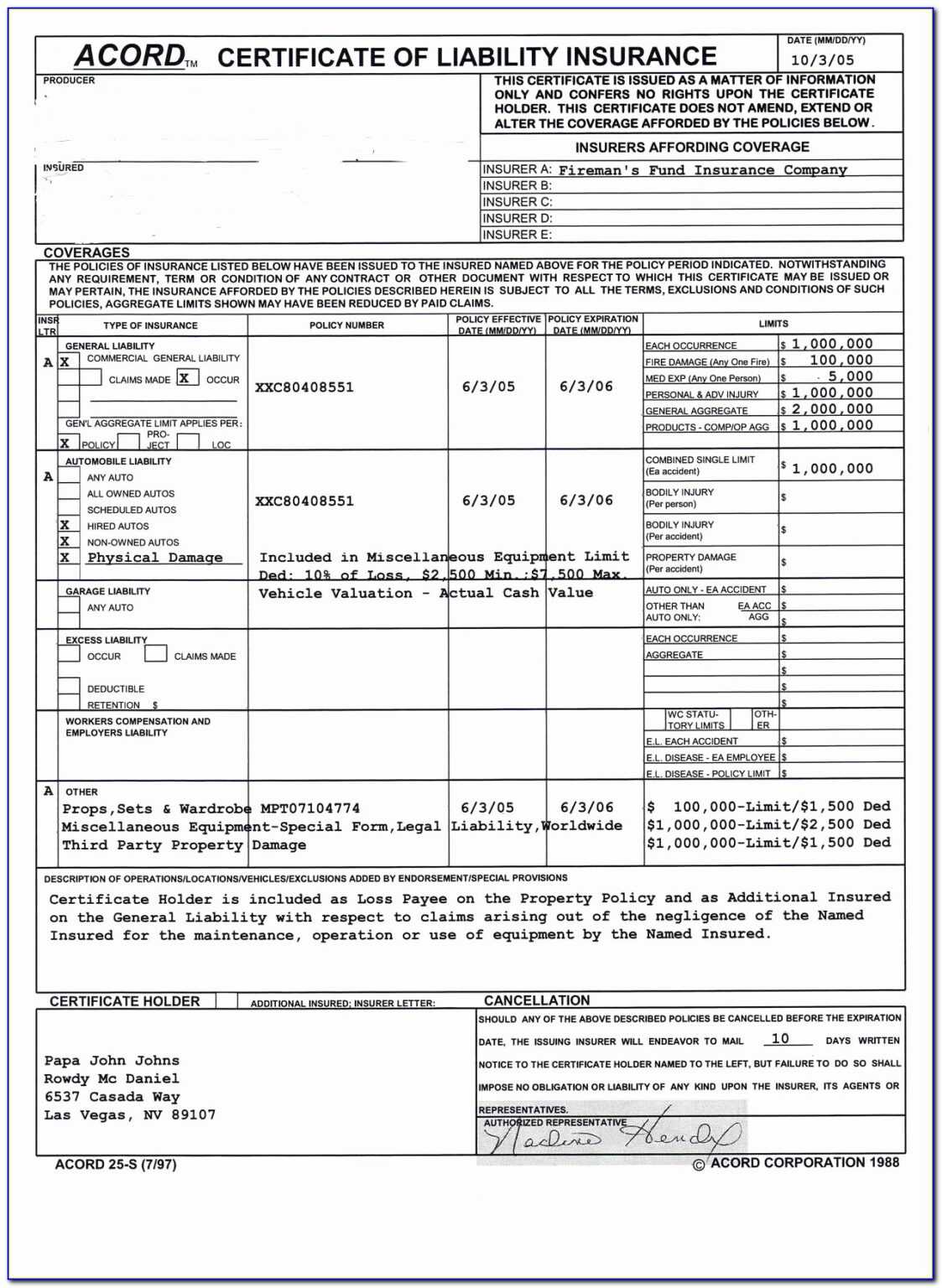
The primary document used as official proof of business auto insurance is the ACORD 25 Certificate of Liability Insurance. Issued by licensed insurance producers, the ACORD 25 outlines commercial auto coverage details, including policy numbers, effective dates, liability limits, and coverage scopes such as owned, hired, or non-owned vehicles, alongside general liability and workers' compensation details.
Understanding Business Auto Proof: Why ACORD Forms Matter
In commercial operations, demonstrating evidence of commercial automobile insurance is a standard requirement before executing contracts, accessing job sites, or establishing vendor partnerships. Commercial auto policies differ significantly from personal auto insurance; they cover legal liabilities, property damage, and bodily injury claims arising from business-related transportation, freight transit, and employee driving activities.
To standardize how coverage details are communicated across the insurance industry, the Association for Cooperative Operations Research and Development (ACORD) developed standardized forms. These standardized templates eliminate the confusion of interpreting custom insurance binders or complex policy pages from hundreds of different insurance carriers.
When a client, general contractor, municipality, or landlord asks for "ACORD form proof of business auto insurance," they are seeking an official, standardized summary confirming that your business maintains adequate commercial auto liability coverage to absorb loss without shifting financial risk onto third parties.
Disclaimer: Insurance regulations and policy terms vary by jurisdiction and carrier. This guide provides technical operational context and does not constitute legal or professional insurance advice. Consult a licensed insurance broker or attorney for specific contract reviews.
Primary ACORD Forms for Business Auto Coverage
While several ACORD documents handle commercial transportation applications and vehicle schedules, only specific forms serve as third-party proof of coverage or driver-level verification.
- COMMERCIAL AUTO ACORD FORMS
- Third-Party Verification
- ACORD 25 Certificate of Liability Insurance: Summary of auto liability limits, policy dates, and certificate holder rights.
- Vehicle / Driver Proof
- ACORD 50 Auto ID Card: State-specific proof kept in business vehicles for stops.
- Third-Party Verification
1. ACORD 25: Certificate of Liability Insurance
The ACORD 25 is the industry standard document used to verify business auto coverage to external parties (known as certificate holders). It aggregates multiple liability policies—including Commercial General Liability, Automobile Liability, Umbrella/Excess Liability, and Workers' Compensation—onto a single, standardized one-page document.
On the ACORD 25, the Automobile Liability section details:
- Types of covered autos (e.g., Any Auto, All Owned Autos, Scheduled Autos, Hired Autos, Non-Owned Autos).
- Policy numbers and active policy term dates.
- Liability financial limits, typically formatted as Combined Single Limits (CSL) or split limits for bodily injury and property damage.
2. ACORD 50: State-Specific Insurance Identification Card
While the ACORD 25 serves corporate compliance teams and commercial partners, the ACORD 50 (and its state-customized variants like ACORD 50 NY or ACORD 50 GA) acts as the driver's proof of insurance. Kept inside corporate fleet vehicles or stored digitally on driver devices, the ACORD 50 proves financial responsibility during law enforcement traffic stops, vehicle registrations, and accident reporting.
3. Application Forms: ACORD 127 and ACORD 137
It is critical to distinguish between proof documents and application forms:
- ACORD 127 (Business Auto Section): An underwriting document used by agents to gather details regarding company drivers, vehicle usage, and loss history when applying for coverage.
- ACORD 137 (Commercial Auto State Schedule): An application supplement that outlines state-specific coverages (such as Personal Injury Protection or Uninsured Motorist options).
Neither ACORD 127 nor ACORD 137 serves as valid proof of active coverage for third-party clients. They are policy assembly forms, whereas the ACORD 25 is an active proof document.
Deciphering the Commercial Auto Section on ACORD 25
To verify compliance, risk managers look beyond policy numbers and examine the checkbox indicators in the Automobile Liability section of the ACORD 25 form.
| AUTOMOBILE LIABILITY | |||
|---|---|---|---|
| [X] ANY AUTO | |||
| [ ] ALL OWNED AUTOS | [X] SCHEDULED AUTOS | [X] HIRED AUTOS | [X] NON-OWNED AUTOS |
Coverage Scope Symbols and Checkboxes
The checkboxes on the ACORD 25 correspond to standard Commercial Auto policy coverage symbols defined by the Insurance Services Office (ISO):
- Any Auto (Symbol 1): The broadest possible coverage designation. It covers all vehicles owned, hired, leased, borrowed, or used by the business, including vehicles acquired after policy inception. Securing an ACORD 25 with "Any Auto" checked is preferred by general contractors and hiring entities.
- All Owned Autos (Symbols 2, 3, 4): Indicates coverage applies exclusively to vehicles owned by the business (including private passenger autos, commercial units, or specific fleet categories).
- Scheduled Autos (Symbol 7): Coverage applies only to specific vehicles listed on the policy schedule on file with the carrier. If an unlisted vehicle causes an accident, the policy will not cover the claim.
- Hired Autos (Symbol 8): Covers vehicles the business leases, hires, rents, or borrows (e.g., short-term rental trucks rented for company operations).
- Non-Owned Autos (Symbol 9): Covers vehicles used in connection with the business that are not owned, leased, or rented by the company—most commonly employees driving their personal vehicles for business errands.
Financial Limits Definitions
The rightmost column of the Commercial Auto section outlines the monetary coverage limits established by the policy:
- Combined Single Limit (CSL): A single dollar threshold (commonly $1,000,000) that applies to all claims arising from a single accident, whether for bodily injury to multiple people or physical damage to property.
- Bodily Injury Per Person: The maximum payout for physical injuries sustained by one individual in an accident.
- Bodily Injury Per Accident: The maximum total payout for physical injuries across all persons injured in a single accident.
- Property Damage Per Accident: The maximum payout for structural or physical property damage caused by the business vehicle.
Comparing Commercial Auto ACORD Forms
The following table summarizes the distinct roles, users, and compliance applications of common business auto ACORD forms:
| Form Designation | Form Title | Primary Purpose | Target Audience / Recipient | Modifiable by Insured? |
|---|---|---|---|---|
| ACORD 25 | Certificate of Liability Insurance | Summarizes active liability coverage (Auto, CGL, WC, Umbrella). | Clients, General Contractors, Landlords, Project Owners. | No (Broker/Agent issued only). |
| ACORD 50 | Commercial Auto Identification Card | Serves as in-vehicle proof of state financial responsibility. | Law Enforcement, DMV, Accident Parties. | No (Issued by Insurer/Broker). |
| ACORD 127 | Business Auto Section | Collects fleet driver and vehicle data for policy underwriting. | Insurance Carrier Underwriters. | Completed by Insured / Agent. |
| ACORD 137 | Commercial Auto State Schedule | Selects state-specific statutory limits (PIP, UM/UIM). | Insurance Carrier Underwriters. | Completed by Insured / Agent. |
| ACORD 101 | Additional Remarks Schedule | Provides expanded text space for complex endorsement notes. | Certificate Holders, Compliance Officers. | Completed by Broker/Agent. |
How to Request and Obtain an ACORD 25 Auto Certificate
Obtaining proof of commercial auto insurance requires coordination between the business owner, their insurance producer, and the requesting party.
- Review Contract Requirements
- Submit Request to Broker / Agent
- Agent Generates ACORD 25 Form
- Verify Accuracy & Endorsements
- Submit to Client / Compliance Portal
Step 1: Review Contract Requirements
Before contacting your broker, collect the formal insurance requirements specified in your vendor agreement or contract. Key details include:
- Required minimum liability limits (e.g., $1,000,000 CSL vs. $2,000,000 CSL).
- Specific automobile coverage scopes required (e.g., requiring Symbol 1 Any Auto or requiring explicit Hired & Non-Owned Auto coverage).
- Exact Certificate Holder wording, including legal business names, corporate physical addresses, and compliance email accounts.
- Required endorsements, such as Additional Insured status or Waiver of Subrogation.
Step 2: Request the Certificate from Your Agent
Submit the written contract insurance clause to your licensed insurance agency. Most commercial brokerages provide online client self-service portals where certificates can be generated immediately for standard certificate holders. If custom endorsements are required, a customer service representative or account manager will process the request manually.
Step 3: Review the Issued ACORD 25 for Accuracy
Once generated, check the document carefully before sending it to your client:
- Confirm that the Producer block contains your agent’s correct contact info.
- Verify your business's legal entity name under Insured (it must match your contract name exactly).
- Check that the insurer names listed under Insuring Companies match recognized, solvent carriers rated by organizations like A.M. Best.
- Confirm that policy numbers and dates fall within active contract timeframes.
- Verify that the Description of Operations box contains only factual information that reflects actual policy endorsements.
Critical Compliance Rules and Common Pitfalls
Handling ACORD certificates incorrectly can expose businesses to legal disputes, breached contracts, or uninsured liabilities.
1. Certificates Do Not Grant Coverage
An ACORD 25 is an information-only document. It certifies that a policy was active on the date of issuance; it does not alter, extend, or amend the underlying insurance policy.
If a client requests to be listed as an Additional Insured on your commercial auto policy, simply typing "Client XYZ is added as Additional Insured" into the ACORD 25 Description box does not make it legally binding. The actual policy must contain an executed endorsement (such as ISO endorsement form CA 20 48 or its equivalent) issued by the carrier.
2. Prohibition of Unauthorized Modifications
Self-editing an ACORD form—such as converting a PDF to alter coverage limits, change policy expiration dates, or add coverage checkboxes—constitutes insurance fraud. Certificates must be generated directly by an authorized insurance producer or carrier. Clients routinely cross-verify certificates through insurance verification databases or by contacting the issuing producer directly.
3. Understanding Cancellation Notice Limitations
Older ACORD 25 forms included language promising that the insurance company would attempt to notify certificate holders 30 days prior to policy cancellation. Modern ACORD forms state that cancellation notice will be delivered strictly in accordance with policy terms and state law. If a contract mandates advance notice of cancellation, a specific Notice of Cancellation Endorsement must be added to the underlying policy.
4. Personal Auto vs. Commercial Auto Coverage Gaps
Using a personal auto insurance card or personal policy declarations page as proof for commercial work creates significant legal exposure. Personal auto policies almost universally exclude coverage for commercial transport, tool carrying, employee transportation, or fee-for-service delivery. If an accident occurs during business operations under a personal auto policy, the carrier may deny the claim, leaving the business directly liable for bodily injury and property damages.
Validating an ACORD Business Auto Form: A Checklist for Contracting Parties
If you are a risk manager, project supervisor, or business owner evaluating an ACORD 25 submitted by a subcontractor or vendor, use this verification workflow:
- Verify Issuing Authority: Ensure the document comes directly from a licensed producer or established certificate management platform, rather than an unverified third party.
- Match Legal Entities: Confirm that the legal name listed in the "Insured" box matches the entity signing your contract, including formal designations (LLC, Inc., Corp.).
- Inspect Auto Coverage Codes: Ensure the vendor possesses adequate auto coverage scope. For subcontractors hauling heavy materials, Symbol 1 (Any Auto) or a combination of Symbol 7 (Scheduled), Symbol 8 (Hired), and Symbol 9 (Non-Owned) is vital.
- Confirm Policy Terms: Verify that the policy effective date precedes the start of work and that the expiration date extends through the project schedule. Set automated reminders for updated certificates prior to expiration.
- Cross-Check Financial Limits: Confirm that the Commercial Auto Combined Single Limit meets or exceeds your baseline contractual threshold.
- Validate Required Endorsements: If your contract mandates a Waiver of Subrogation in favor of your organization, check for an "X" in the SUBR WVD column next to Automobile Liability, alongside supporting language in the Description of Operations.
Frequently Asked Questions
Can a business owner fill out an ACORD 25 form themselves?
No. An ACORD 25 form must be completed and issued by a licensed insurance agent, broker, or insurance company representative authorized by the carrier. Altering or self-issuing an ACORD 25 form is invalid and can be prosecuted as insurance fraud.
What is the difference between Symbol 1 ("Any Auto") and Symbol 7 ("Scheduled Autos") on an ACORD 25?
Symbol 1 (Any Auto) provides broad coverage for any vehicle used for business purposes—whether owned, leased, rented, or borrowed—regardless of whether it is listed on a schedule. Symbol 7 (Scheduled Autos) strictly limits coverage to specific vehicles specifically listed on the policy schedule. If a vehicle is not scheduled under Symbol 7, it has no coverage during an accident.
Is an ACORD 50 sufficient proof of commercial auto liability for client contracts?
No. An ACORD 50 is an insurance identification card designed for drivers to present during law enforcement stops or vehicle registration. It does not provide detailed information about overall liability policy limits, additional insured endorsements, or broad coverage symbols required for corporate vendor compliance. Commercial contracts require an ACORD 25.
What does "Hired & Non-Owned Auto" mean on an ACORD business auto certificate?
Hired Auto (Symbol 8) covers liability for vehicles the business rents, hires, or borrows for corporate operations. Non-Owned Auto (Symbol 9) covers liability when employees drive personal vehicles to conduct business tasks. Checking these options on the ACORD 25 confirms the business is protected even when operating vehicles outside its primary owned fleet.
Does an ACORD 25 guarantee that our business auto policy will not be canceled?
No. The standard ACORD 25 statement explicitly clarifies that the certificate confers no direct rights upon the certificate holder and does not amend the policy contract. Policy cancellation notifications depend on state insurance regulations and explicit policy endorsements rather than the certificate document itself.
Practical Recommendation & Next Actions
To maintain compliance and avoid contract delays when proof of business auto insurance is requested:
- Audit Your Current Policy Endorsements: Review your commercial auto policy with your insurance broker to ensure you have broad coverage designations (Symbol 1 or Symbols 7, 8, and 9) rather than restrictive owned-only options.
- Establish a Master Certificate Process: Request that your broker create a standard ACORD 25 template listing your routine business details. This speeds up certificate issuance when onboarding new clients.
- Verify Fleet ID Cards: Ensure every business vehicle carries a current, state-compliant ACORD 50 card alongside statutory registration papers to avoid traffic fines or vehicle impoundment during routine stops.
- Implement Automated Tracking: If you manage subcontractors, deploy an automated certificate tracking workflow to request updated ACORD 25 forms 30 days before policy expiration dates.