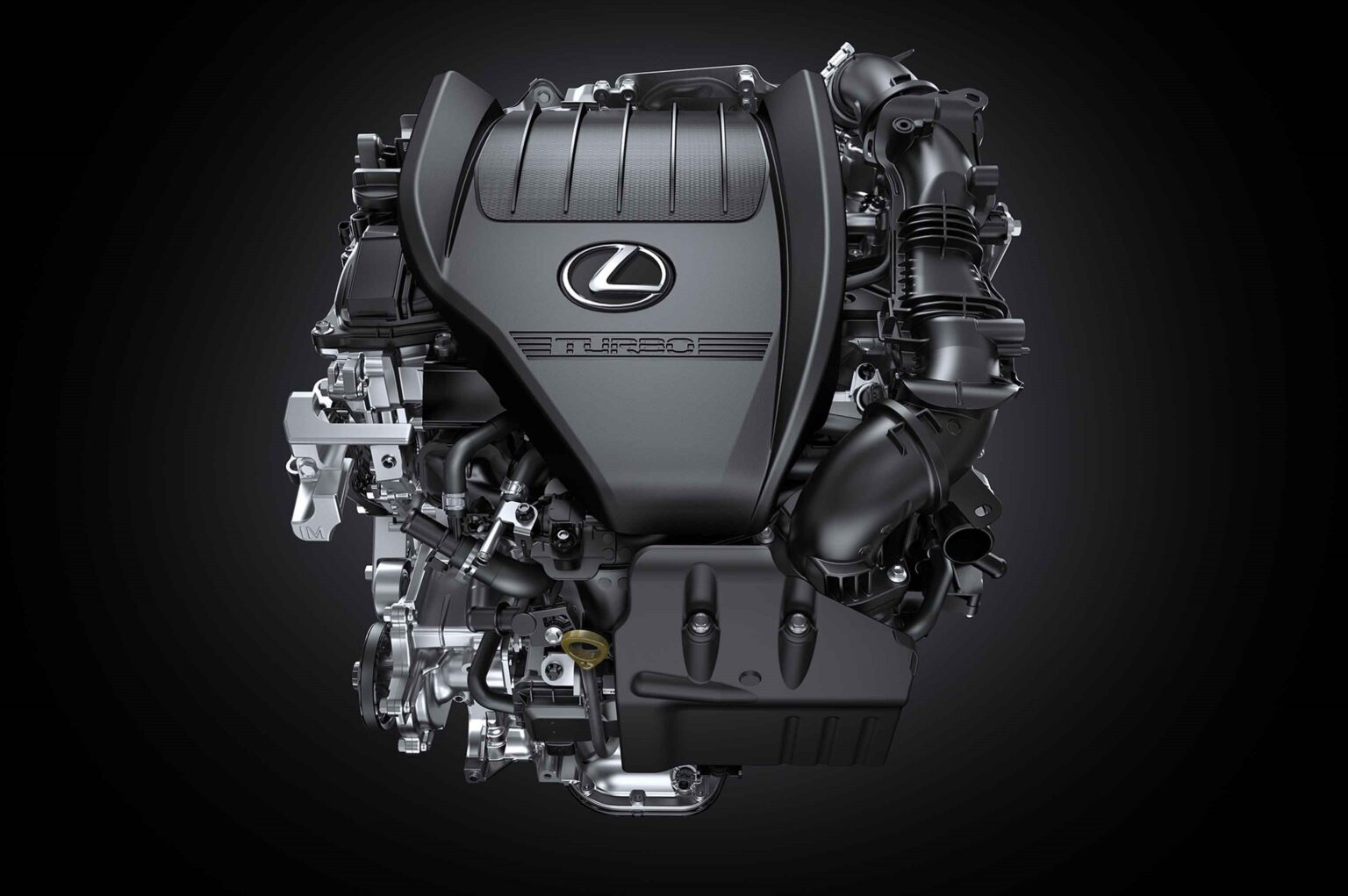
The 2023 Lexus RX 350 is powered by a 2.4-liter turbocharged inline-four engine (designated as the T24A-FTS), producing 275 horsepower and 317 lb-ft of torque. This powertrain replaced the long-standing 3.5-liter V6, utilizing a twin-scroll turbocharger and a Direct Shift 8-speed automatic transmission to provide higher low-end torque and improved fuel efficiency.
As of 2026, the 2023 Lexus RX 350 remains a pivotal model in the Lexus lineup, marking the official transition from naturally aspirated six-cylinder engines to high-output, downsized turbocharged four-cylinders. This engineering shift was not merely a response to tightening emissions regulations but a calculated move to modernize the driving dynamics of the world’s best-selling luxury crossover. By moving to the T24A-FTS engine, Lexus addressed the primary criticism of the previous generation: a lack of immediate low-end punch.
The Heart of the Fifth Generation: The T24A-FTS Engine
The T24A-FTS engine is a member of the Lexus/Toyota "Dynamic Force" engine family. While many luxury buyers were initially skeptical about moving from a 3.5L V6 to a 2.4L four-cylinder, the technical specifications tell a story of significant advancement. This engine was specifically designed for the TNGA-K platform, which underpins the 2023 RX 350, allowing for a lower center of gravity and better weight distribution than its predecessor.
High-Speed Combustion Technology
The 2.4-liter engine utilizes high-speed combustion technology, which optimizes the air-fuel mixture to burn more completely and rapidly. This is achieved through a high-tumble intake port design and a long-stroke configuration. By increasing the speed at which the flame front travels across the cylinder, Lexus engineers were able to extract more energy from every drop of fuel while minimizing heat loss. This efficiency is critical for meeting modern environmental standards while maintaining the power delivery expected in a luxury vehicle.
D-4ST Fuel Injection System
The T24A-FTS employs the D-4ST (Direct-injection 4-stroke gasoline engine Superior version with Turbo) system. This system features both direct and port injectors. At low loads, the engine can utilize port injection to ensure a clean, stable idle and reduced emissions. Under high-load situations, such as merging onto a highway, the direct injectors spray fuel at high pressure directly into the combustion chamber. This provides a cooling effect that allows for a higher compression ratio without the risk of engine knock, which is a common hurdle for turbocharged engines.
Why Lexus Retired the V6: Efficiency vs. Torque
For over two decades, the Lexus RX was synonymous with the smooth, linear power of a 3.5-liter V6. However, the 2023 redesign prioritized "torque-on-demand." While the old V6 (2GR-FKS) produced 295 horsepower, its peak torque was only 267 lb-ft, and it didn't reach that peak until 4,700 RPM.
In contrast, the 2023 RX 350’s turbocharged four-cylinder produces 317 lb-ft of torque, and more importantly, that torque is available from 1,700 to 3,600 RPM. This means that in everyday driving—pulling away from a stoplight or passing a slower vehicle—the 2023 model feels significantly more responsive and powerful than the older V6 models. The "area under the curve" is much larger in the 2.4L Turbo, providing a more effortless driving experience that aligns with the Lexus "Signature Driving Taste."
Comparison of Engine Outputs: 2022 vs. 2023
| Feature | 2022 Lexus RX 350 (V6) | 2023 Lexus RX 350 (Turbo-4) | Change |
|---|---|---|---|
| Engine Type | 3.5L Naturally Aspirated V6 | 2.4L Turbocharged I4 | Downsized/Turbocharged |
| Horsepower | 295 hp | 275 hp | -20 hp |
| Peak Torque | 267 lb-ft | 317 lb-ft | +50 lb-ft |
| Torque Peak RPM | 4,700 RPM | 1,700 – 3,600 RPM | Much Lower Entry |
| Transmission | 8-Speed Automatic | 8-Speed Direct Shift-8AT | Improved Logic |
| 0-60 MPH (AWD) | ~7.7 Seconds | ~7.2 Seconds | 0.5 Seconds Faster |
| Fuel Req. | 87 Octane (Regular) | 91 Octane (Premium) | Higher Grade Required |
Turbocharging Technology and Thermal Management
The 2023 RX 350 utilizes a twin-scroll turbocharger. Unlike a single-scroll turbo, a twin-scroll design features two separate exhaust gas inlets and two nozzles. This allows the exhaust pulses from the cylinders to be separated, preventing interference and ensuring that the turbine spins up much faster. This technology is the primary reason the 2023 RX 350 suffers from minimal "turbo lag," providing a sensation of immediate acceleration that feels closer to a large-displacement engine.
Integrated Exhaust Manifold and Cooling
To manage the intense heat generated by a turbocharger, Lexus integrated the exhaust manifold directly into the cylinder head. This manifold is water-cooled, which helps lower the temperature of the exhaust gases before they reach the turbocharger. Not only does this improve the longevity of the turbo components, but it also allows the engine to run a leaner air-fuel ratio at high speeds, further improving fuel economy during long-distance cruising.
The cooling system itself is a two-stage setup with an electric water pump. This allows the engine to warm up quickly in cold 2026 winters (reducing wear and emissions) while providing precise temperature control during heavy towing or spirited driving.
The Direct Shift-8AT Transmission
A sophisticated engine is only as good as the gearbox it is mated to. The 2023 RX 350 uses a Direct Shift 8-speed automatic transmission designed to handle the increased torque of the 2.4L engine. Lexus engineers focused on the "shift feel," ensuring that gear changes are smooth enough to be imperceptible under light throttle but crisp and decisive when the driver demands power.
The transmission features a wide range of gear ratios. A short first gear ensures strong off-the-line acceleration, while the tall eighth gear allows the engine to sit at low RPMs during highway speeds to maximize fuel efficiency. The transmission also features AI-Shift control, which uses sensors to detect if the vehicle is driving uphill or downhill and adjusts the shifting patterns accordingly to provide better engine braking or prevent hunting between gears.
All-Wheel Drive and Torque Distribution
The 2023 RX 350 was offered in both Front-Wheel Drive (FWD) and All-Wheel Drive (AWD) configurations. The AWD system is an electronically controlled setup that can vary the torque split between the front and rear axles from 100:0 (pure FWD for efficiency) to 50:50.
Unlike older mechanical systems, this electronic coupling can proactively send torque to the rear wheels based on steering angle, throttle position, and wheel-speed sensors. For example, if you accelerate hard from a standstill, the system will automatically send power to the rear wheels before any slip occurs, ensuring a stable and confident launch.
Fuel Economy and Maintenance Considerations
While the move to a four-cylinder was partly about efficiency, the 2023 RX 350 sees a modest improvement in EPA ratings rather than a revolutionary jump. The primary gain is in city driving and combined cycles. In 2026, with fuel costs remaining a significant factor for luxury owners, the RX 350's combined rating of approximately 24-25 MPG (depending on drivetrain) remains competitive for its class.
The Requirement for Premium Fuel
It is important to note that the T24A-FTS engine requires 91 octane (Premium) fuel. While the previous V6 could run on regular 87 octane, the high-compression, turbocharged nature of the 2023 engine makes premium fuel a necessity to reach the advertised performance figures and to protect the engine from pre-ignition (pinging). Using lower-grade fuel can result in reduced power and, over time, potential damage to the pistons and valves.
Long-Term Reliability
Lexus has a reputation for bulletproof reliability, and the T24A-FTS was subjected to rigorous testing before its 2023 debut. However, turbocharged engines naturally operate under higher internal pressures and temperatures than naturally aspirated ones. For owners in 2026 looking at these vehicles on the pre-owned market, adhering to the 10,000-mile (or 12-month) oil change interval is non-negotiable. Many specialists recommend "severe service" intervals of every 5,000 miles to ensure the turbocharger bearings remain properly lubricated and free of carbon buildup.
Driving Dynamics: How the New Engine Feels
One of the biggest concerns for long-time Lexus owners was the noise and vibration typically associated with four-cylinder engines. Lexus addressed this through several engineering layers:
- Twin Balance Shafts: These are used to cancel out the natural second-order vibrations of an inline-four configuration.
- Active Noise Control: The vehicle's audio system produces sound waves that counteract engine drone at specific frequencies.
- Enhanced Insulation: The 2023 model features more acoustic glass and thicker firewall insulation than the 2022 model.
The result is an engine that is remarkably quiet at cruising speeds. Under heavy acceleration, the 2.4L Turbo has a more purposeful, growling intake sound compared to the "silky" whine of the old V6. While it lacks the V6's mechanical melody, it replaces it with a sense of urgent, modern efficiency.
Frequently Asked Questions
Does the 2023 Lexus RX 350 engine have a timing belt or a timing chain?
The 2.4-liter T24A-FTS engine uses a timing chain. Unlike timing belts, which require replacement every 60,000 to 100,000 miles, a timing chain is designed to last the life of the engine. This reduces long-term maintenance costs and provides better timing precision for the Variable Valve Timing-intelligent (VVT-i) system.
Can I tow with the 2.4L turbocharged engine?
Yes, the 2023 Lexus RX 350 has a maximum towing capacity of 3,500 pounds when properly equipped. This matches the towing capacity of the previous V6 model. Because the turbocharger provides peak torque at much lower RPMs, the 2023 model actually feels more capable when pulling a trailer up grades, as the engine doesn't need to downshift as aggressively to find power.
Why does the 2023 model have less horsepower than the 2022 model?
The reduction from 295 hp to 275 hp was a strategic trade-off. Lexus prioritized torque (up from 267 to 317 lb-ft) because torque is what drivers feel during acceleration. High horsepower numbers look good on paper, but they often require high RPMs to achieve. By focusing on torque, Lexus made the RX 350 faster in real-world conditions (0-60 mph improved by half a second) despite the lower peak horsepower rating.
Is the turbocharger on the RX 350 reliable?
As of 2026, the 2.4L Turbo has proven to be a robust engine. Lexus utilized their experience from the 2.0L turbo (8AR-FTS) found in the older NX models to improve heat management and bearing design. Provided that high-quality synthetic oil is used and changed regularly, the turbocharger is designed to be a long-life component.
What is the difference between the RX 350 and the RX 350h engine?
The RX 350 (this subject) uses a 2.4L pure gasoline turbocharged engine. The RX 350h uses a 2.5L naturally aspirated engine paired with an electric hybrid system. The standard RX 350 is more powerful and has a higher towing capacity, while the RX 350h is focused on maximum fuel economy, achieving roughly 36 combined MPG.
Recommendation for 2026 Buyers
If you are evaluating a 2023 Lexus RX 350 in the current 2026 market, the engine choice represents a move toward modern performance. While traditionalists may miss the V6, the 2.4-liter Turbo offers a more responsive, torque-rich experience that makes the vehicle feel lighter and more agile.
When purchasing, prioritize vehicles with a documented service history showing regular oil changes with the correct viscosity (typically 0W-20). Also, ensure that the previous owner utilized premium fuel, as long-term use of 87 octane can lead to carbon buildup and reduced efficiency. For those who prioritize a quiet, punchy drive and don't mind the slightly higher cost of premium fuel, the 2023 RX 350's powertrain is an excellent balance of Lexus refinement and modern engineering.