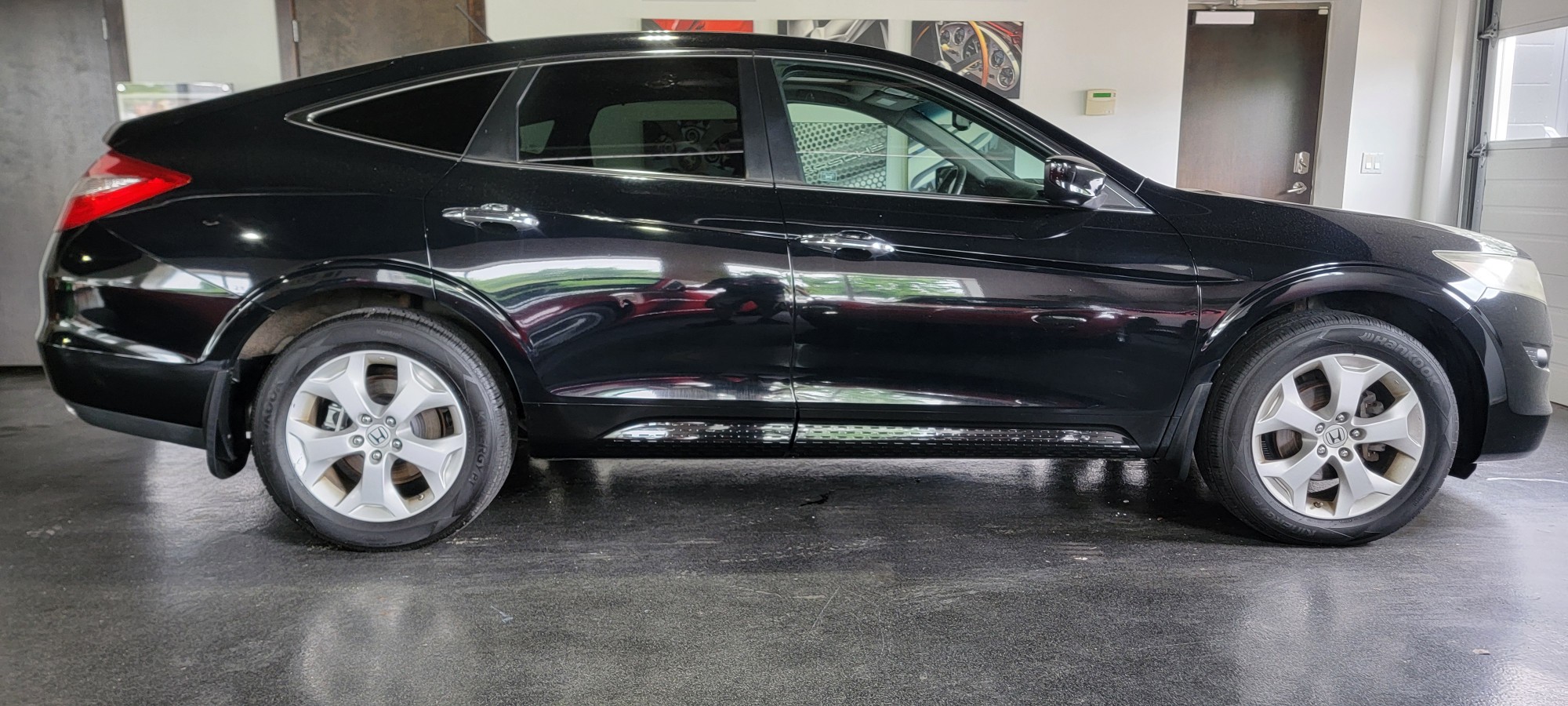
The 2012 Honda Crosstour is a unique crossover that blends the driving dynamics of the Honda Accord with the ride height and cargo versatility of a traditional SUV. For used car buyers in 2026, it remains a reliable, if unconventional, choice known for its smooth V6 engine, newly introduced inline-4 option for the 2012 model year, and exceptional cabin comfort.
The Evolution of the 2012 Honda Crosstour
To understand the 2012 Honda Crosstour, one must look at the automotive landscape of the early 2010s. When it first debuted in 2010, it was branded as the "Accord Crosstour." By 2012, Honda dropped the "Accord" prefix, attempting to establish the vehicle as a standalone model in their lineup. This year was pivotal for the nameplate because it addressed the two most common criticisms of the earlier models: price and fuel efficiency.
The 2012 model year marked the introduction of the 2.4-liter four-cylinder engine. Previously, the Crosstour was only available with a thirsty 3.5-liter V6. By adding the smaller engine, Honda lowered the entry price and improved the fleet's average fuel economy. Despite these changes, the Crosstour maintained its polarizing "fastback" silhouette—a design that remains a conversation starter even in 2026. It occupies a niche between a wagon and a crossover, competing conceptually with vehicles like the Toyota Venza and the Subaru Outback.
Technical Specifications and Powertrain Options
The 2012 Honda Crosstour offered two distinct personalities based on what was under the hood. Understanding these powertrains is essential for anyone evaluating the vehicle on the secondary market today.
The 2.4-Liter i-VTEC Inline-4
New for 2012, the 2.4-liter engine (K24) produced 192 horsepower and 162 lb-ft of torque. This engine was paired exclusively with a five-speed automatic transmission and front-wheel drive. While this powertrain is legendary for its longevity and ease of maintenance, it struggles somewhat with the Crosstour’s significant curb weight, which exceeds 3,700 pounds. In modern traffic conditions, the four-cylinder Crosstour feels adequate but far from spirited. Its primary appeal lies in its simplicity and lower operating costs.
The 3.5-Liter i-VTEC V6
The 3.5-liter V6 (J35) remained the powerhouse of the lineup, delivering 271 horsepower and 254 lb-ft of torque. This engine utilized Honda’s Variable Cylinder Management (VCM) system, which allows the engine to run on three, four, or six cylinders depending on the load to save fuel. The V6 was also the only way to get Honda’s "Real Time 4WD" system. Even by 2026 standards, this V6 is remarkably smooth, providing a level of refinement that mimics entry-level luxury vehicles from Acura. However, it requires more diligent maintenance, particularly regarding the timing belt and the VCM system components.
Interior Design and Cargo Practicality
The interior of the 2012 Crosstour is heavily derived from the eighth-generation Honda Accord, which is both a blessing and a curse.
Cabin Quality and Layout
The dashboard layout is a "button-heavy" affair, typical of Honda’s design language during this era. While it lacks the minimalist touchscreens of modern 2026 vehicles, many drivers prefer the tactile feel of physical buttons for climate and audio controls. The materials are high-quality, with soft-touch plastics and optional leather seating that tends to wear well over decades. The "Dual-Zone" climate control and the elevated seating position provide a sense of command without the "climb-in" height of a full-sized SUV.
The Hatchback Compromise
The "Crosstour" name implies a touring-ready cargo area, and it delivers—with a caveat. The fastback roofline significantly cuts into the vertical storage space. While the floor area is vast, you cannot fit tall, boxy items as easily as you could in a Honda CR-V of the same vintage.
One standout feature is the under-floor removable utility box. This plastic bin is water-resistant and includes handles, making it perfect for storing muddy gear or emergency supplies. Furthermore, the rear seats feature "One-Touch" release levers located in the cargo area, allowing them to fold nearly flat without requiring the user to walk around to the side doors.
Driving Dynamics and On-Road Behavior
One of the strongest arguments for the 2012 Crosstour is its road manners. Because it is based on the Accord chassis, it utilizes a double-wishbone front suspension and a multi-link rear setup. This configuration is far more sophisticated than the strut-based setups found on many modern crossovers.
On the highway, the Crosstour is exceptionally quiet. Honda invested heavily in Active Noise Cancellation (ANC) technology for this model, which uses the audio system's speakers to emit opposing frequencies to "cancel out" road and engine drone. The steering is hydraulic—a rarity in 2026—providing a weighted, communicative feel that electric power steering systems often struggle to replicate. With 6.7 inches of ground clearance, it can handle light snow and unpaved driveways with ease, though it is not intended for serious off-roading.
Safety Ratings and Technology
Safety was a primary focus for Honda in 2012. The Crosstour features the Advanced Compatibility Engineering (ACE) body structure, designed to deflect energy away from the cabin during a collision.
- Standard Safety Equipment: Front-seat side airbags, side curtain airbags, and active front head restraints.
- Electronic Aids: Stability control and traction control are standard.
- Visibility Tech: Higher trims (EX-L) featured a backup camera, though it was integrated into the rearview mirror or the navigation screen depending on the package.
According to the Insurance Institute for Highway Safety (IIHS), the 2012 Crosstour received the highest rating of "Good" in moderate overlap front, side, and roof strength tests. While it lacks the automated emergency braking found in 2026 vehicles, its structural integrity remains robust for a vehicle of its age.
Long-Term Reliability and Common 2012 Issues
In 2026, the 2012 Honda Crosstour is a "high-mileage" candidate. While Honda’s reputation for reliability is well-earned, there are specific areas that require inspection.
- VCM Misfires (V6 Models): The Variable Cylinder Management system on the V6 can sometimes lead to premature spark plug fouling or oil consumption. Many long-term owners use aftermarket "VCM muzzlers" to disable the cylinder deactivation, prioritizing engine longevity over a slight gain in fuel economy.
- Driveline Vibration: Some owners reported a distinct vibration during acceleration, often traced back to the inner CV joints or the driveshaft on AWD models.
- Power Steering Leaks: As a hydraulic system, the hoses and pumps can develop leaks over 15 years of operation.
- Paint and Trim: The "White Diamond Pearl" and "Crystal Black Pearl" paints from this era were sometimes prone to clear-coat failure if stored outdoors in high-UV environments.
The four-cylinder model is generally considered the "bulletproof" option, as the K24 engine uses a timing chain rather than a belt and lacks the complexities of the VCM system.
Ownership Costs and Comparison
Maintaining a 2012 Crosstour in 2026 is relatively affordable because it shares a vast majority of its mechanical components with the 2008-2012 Honda Accord. Parts are plentiful at local auto stores and salvage yards.
| Feature | 2.4L I4 (EX) | 3.5L V6 (EX-L) |
|---|---|---|
| Horsepower | 192 hp | 271 hp |
| Drivetrain | FWD Only | FWD or AWD |
| Transmission | 5-Speed Automatic | 5-Speed Automatic |
| EPA MPG (City/Hwy) | 21 / 29 | 18 / 27 (FWD) |
| Timing Component | Chain (Lifetime) | Belt (Replace every 105k miles) |
| Standard Wheels | 17-inch Alloy | 18-inch Alloy |
Data Source: Official Honda Newsroom 2012 Archive and EPA Fuel Economy Guide.
Frequently Asked Questions
Is the 2012 Honda Crosstour good in snow?
Yes, particularly the V6 AWD models. The 6.7 inches of ground clearance is roughly 1.3 inches higher than a standard Accord, which allows it to clear unplowed residential streets. However, the "Real Time 4WD" system is reactive, meaning it sends power to the rear wheels only after the front wheels begin to slip. For 2026 buyers in heavy snow belts, high-quality winter tires are a more significant factor than the AWD system itself.
Should I choose the 4-cylinder or the V6?
The choice depends on your driving habits. If you primarily commute in the city and value low maintenance costs, the 2.4L 4-cylinder is superior due to its timing chain and better fuel economy. However, if you frequently carry passengers, tow light loads, or drive in hilly terrain, the V6 is highly recommended. The 4-cylinder can feel underpowered when the vehicle is fully loaded with cargo.
What are the main differences between the 2011 and 2012 models?
The most significant difference is the introduction of the 2.4-liter engine and the renaming of the car from "Accord Crosstour" to "Crosstour." There were also minor adjustments to the feature availability across trims, making some luxury features more accessible on the lower-tier EX trim.
Does the 2012 Crosstour have Bluetooth and modern tech?
The 2012 EX-L trim includes Bluetooth HandsFreeLink for phone calls, but Bluetooth audio streaming was not standard on all configurations. Many owners in 2026 choose to install aftermarket head units with Apple CarPlay or Android Auto to bring the infotainment up to modern standards, which is a relatively straightforward process given the dashboard design.
How many miles can a 2012 Honda Crosstour last?
With proper maintenance, it is common to see these vehicles reach 200,000 to 250,000 miles. The V6 requires a timing belt service every 105,000 miles, which is a critical maintenance item. If this is neglected, a belt failure can lead to catastrophic engine damage. The 4-cylinder models are less sensitive but still require regular oil changes to protect the timing chain tensioner.
Practical Recommendation for Buyers
If you are looking for a used vehicle in 2026 that offers "Accord reliability" with extra utility, the 2012 Honda Crosstour is a hidden gem. Its unconventional looks have actually aged better than many of its contemporaries, and its build quality reflects a time when Honda was over-engineering its flagship platforms.
Next Steps: When inspecting a 2012 Crosstour, prioritize a V6 model with a documented timing belt replacement or a 4-cylinder model with a clean service history. Check the rear cargo area for water intrusion (a rare but known issue with hatch seals) and ensure the VCM system operates smoothly without excessive vibration. If you can find a well-maintained EX-L V6 AWD, you will have a vehicle that provides near-luxury comfort and all-weather capability for a fraction of the cost of a modern SUV.
Disclaimer: Automotive repairs and purchases involve financial and safety risks. Always have a used vehicle inspected by a qualified mechanic before purchase. Information provided is based on historical data and manufacturer specifications.