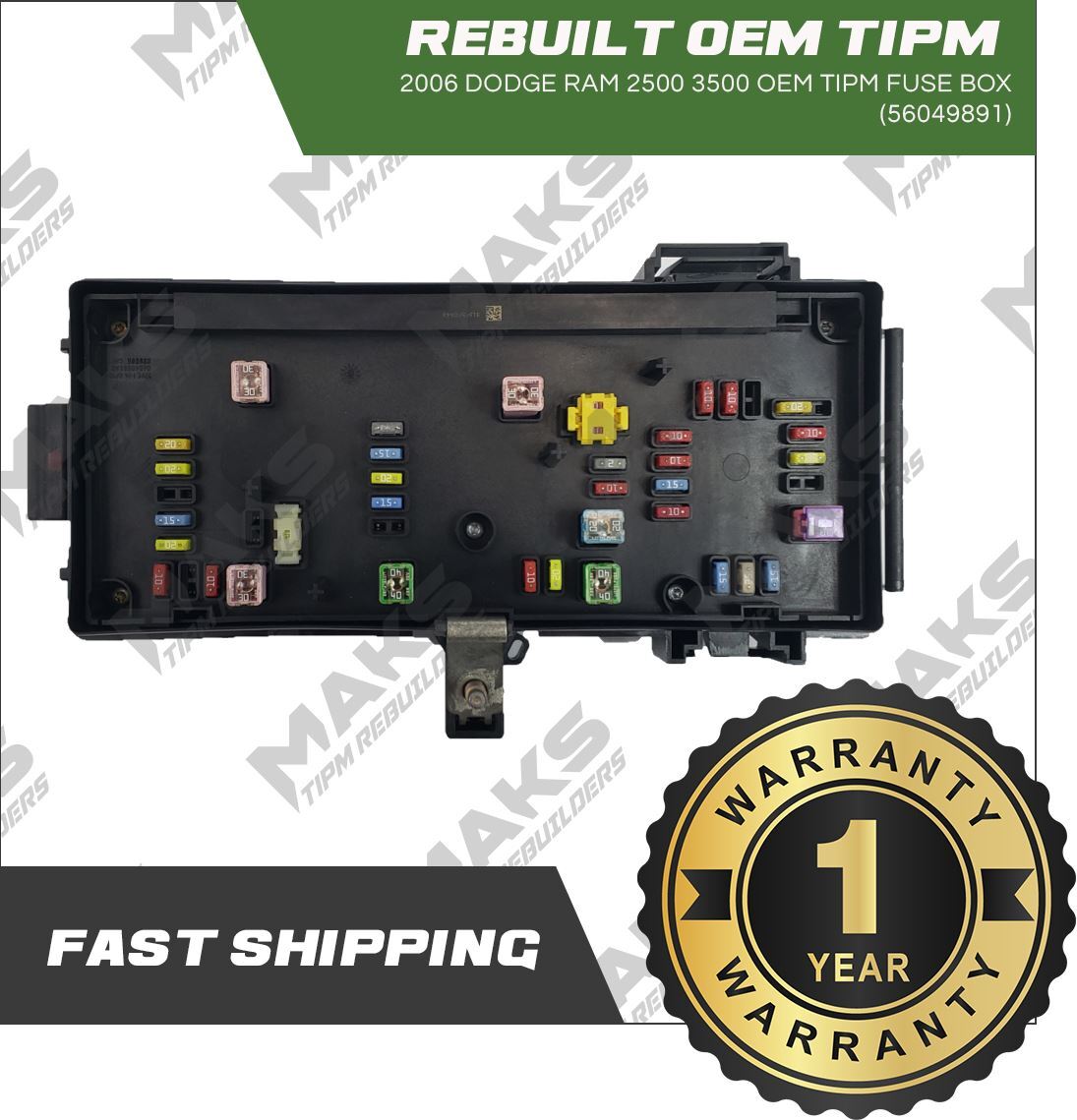
The 2006 Dodge Totally Integrated Power Module (TIPM) is the central electronic nerve center responsible for distributing power and managing communication across your vehicle's electrical system. It functions as an advanced fuse box and integrated circuit board, acting as the primary gateway for controlling lighting, fuel pumps, door locks, and numerous other essential automotive operations.
The Role of the TIPM in 2006 Dodge Vehicles
In the 2006 model year, Dodge transitioned toward highly integrated electronic architectures. The TIPM replaced the traditional, mechanical fuse block found in older vehicles. Instead of simply housing fuses and relays that facilitate direct electrical flow, the TIPM utilizes internal solid-state circuitry and microprocessors to monitor and manage electrical loads.
The module receives input signals from various sensors and switches throughout the vehicle. Based on these signals, it energizes specific circuits. This design allows for features such as "load shedding," where the system automatically cuts power to non-essential accessories if it detects a low-voltage condition to ensure the engine keeps running or to preserve battery life. Because the TIPM is deeply integrated into the Controller Area Network (CAN bus) of the vehicle, it essentially serves as a translator between your vehicle’s computer—the Powertrain Control Module (PCM)—and the various physical components.
Anatomy and Physical Configuration
Physically, the 2006 Dodge TIPM is a plastic-encased module typically mounted in the engine compartment. Inside, it contains a dense network of traces, relays, fuses, and semiconductors. Unlike a standard fuse box, where every component is replaceable, much of the circuitry inside the TIPM is soldered or permanently embedded within the unit.
The exterior features numerous plug-in connectors that interface with the vehicle's main wiring harness. These connectors are color-coded and keyed to prevent incorrect installation. Within the module, there are two distinct types of electrical protection:
- User-Accessible Fuses and Relays: These are standard automotive fuses designed to protect high-current circuits. If a fuse blows, it is often a simple fix, provided the underlying circuit has not suffered a deeper short.
- Internal Solid-State Drivers: These are the components most frequently associated with "TIPM failure." These drivers control specific functions, such as the fuel pump or headlights. Because they are integrated into the circuit board, a failure in these drivers generally cannot be repaired with a simple fuse swap.
Common Signs of a Malfunctioning TIPM
Because the TIPM controls such a wide array of vehicle functions, failure symptoms can appear erratic and unrelated. This is often described as "ghosting," where electrical components behave as if they are possessed.
- Fuel Pump Issues: A common symptom involves the vehicle failing to start because the fuel pump does not receive power, or conversely, the fuel pump runs continuously even after the ignition is turned off, leading to battery drain.
- Erratic Lighting: Headlights that flicker, won't turn on, or stay on despite the light switch being in the "off" position are frequent indicators of internal relay failure.
- Horn and Alarm Malfunctions: The horn sounding sporadically or the security system activating without cause can point toward a faulty board within the module.
- Windshield Wipers: Wipers that cycle randomly or fail to activate often trace their root cause back to the logic board within the TIPM.
- Battery Drain: If your battery consistently dies overnight despite no apparent light being left on, a shorted internal relay in the TIPM may be keeping a system energized long after the vehicle has entered its "sleep" state.
Diagnosing TIPM Issues: A Systematic Approach
Before concluding that your 2006 Dodge TIPM is defective, it is vital to perform a systematic diagnostic process. Many electrical issues are incorrectly attributed to the TIPM when they are actually caused by simple wiring faults, corroded ground straps, or dying batteries.
- Battery and Alternator Test: The TIPM is extremely sensitive to voltage fluctuations. If your battery is failing or your alternator is producing "dirty" power (AC ripple voltage), the TIPM may act up. Ensure your charging system is providing a consistent 13.5 to 14.5 volts while running.
- Scan Tool Analysis: Use an OBD-II diagnostic scanner that supports manufacturer-specific codes. Look for communication errors on the CAN bus. If the computer is reporting an "inability to communicate" with specific modules, the TIPM gateway may be the source of the blockage.
- Fuse and Relay Testing: Do not just look at the fuses; test them for continuity. Inspect the fuse box for signs of heat damage, melted plastic, or corrosion—particularly if the vehicle has been exposed to significant moisture, which can cause internal oxidation.
- Wiring Harness Inspection: Inspect the connectors leading into the TIPM. Pull them back to ensure there is no "green crust" (corrosion) on the pins. Corroded pins create high resistance, which can be misinterpreted by the module as a short or an open circuit.
Comparison of Troubleshooting Paths
| Symptom Category | Likely Culprit | Diagnostic Step |
|---|---|---|
| No-Start Condition | Fuel Pump Relay | Test for 12V at the fuel pump connector. |
| Intermittent Headlights | Internal Solid-State Driver | Check for voltage drop across the switch. |
| Parasitic Battery Drain | Stuck Internal Relay | Use an ammeter to check for draw while off. |
| Erratic Gauges/Lights | Ground/CAN Bus Fault | Inspect chassis grounds and wiring harnesses. |
Risks of Direct Replacement vs. Professional Repair
If you confirm the TIPM is faulty, you are faced with a significant decision: purchase a new unit, a salvaged unit, or have your existing unit professionally refurbished.
Purchasing New: This is the most reliable path but often the most expensive. Because the 2006 Dodge TIPM is a model-specific component, you must ensure the part number exactly matches your vehicle's trim level, engine size, and feature set (such as heated seats or remote start). A new unit often requires "flashing" or programming by a dealership to sync with your vehicle’s VIN and existing keys.
Salvaged Units: While cheaper, these units carry a significant risk. You have no way of knowing if the salvaged module has the same underlying defect or if it has been exposed to water damage. Furthermore, if the salvaged unit is not from a vehicle with an identical option list, some features may not function, or worse, the unit may be incompatible with your vehicle's engine computer.
Refurbishing Services: There are specialized electronic repair shops that open these modules and replace the internal solid-state components. This is often the preferred choice for 2006 models, as it keeps your original module programmed to your VIN, avoiding additional dealership programming costs.
Preventive Maintenance and Care
While the TIPM is an electronic component, you can prolong its life through basic preventative care. The most significant enemy of the 2006 Dodge TIPM is moisture.
- Avoid Pressure Washing the Engine Bay: Water infiltration into the module housing is a leading cause of corrosion. If you must clean the engine, use a damp cloth rather than a high-pressure hose.
- Check Cowl Drains: Ensure the water drainage areas near the base of your windshield are clear of leaves and debris. If these drains clog, water can overflow and run directly down the firewall into the engine bay, potentially soaking the TIPM.
- Maintain Battery Health: A weak battery causes the TIPM to work harder. Keeping your electrical system healthy reduces the stress on the internal circuitry of the module.
Frequently Asked Questions
Can I fix a faulty TIPM by simply replacing a fuse? Only if the issue is a simple blown fuse or a faulty relay that is user-accessible. If the problem lies within the internal circuitry, the fuse will likely be fine, and replacing it will not resolve the underlying logic failure.
Does a new TIPM require dealer programming? Yes, in most cases. Because the TIPM is part of the vehicle’s security and communication network, it must be "handshaked" with the PCM to recognize your keys and vehicle configuration.
What happens if I ignore TIPM symptoms? Aside from the obvious inconvenience of vehicle failure, an internally shorting TIPM can cause components to overheat, potentially leading to melted wiring harnesses or, in extreme cases, electrical fires within the engine bay.
Can an aftermarket alarm system cause TIPM issues? Absolutely. If an aftermarket alarm was improperly spliced into the factory wiring, it can back-feed voltage into the TIPM, confusing its microprocessors and leading to premature failure of the sensitive electronics inside.
Will a "Used" TIPM work without programming? It might allow the engine to start, but likely not. You will often find that features like power locks, cruise control, or the remote starter do not function correctly because the configuration stored in the used unit does not match the features installed on your specific vehicle.
Final Recommendation
If you suspect your 2006 Dodge TIPM is the source of your electrical gremlins, start by verifying your grounds and charging voltage. If those are perfect, consult a technician who specializes in Chrysler/Dodge electrical diagnostics. Do not rush to purchase an expensive replacement unit until you have verified the failure through a formal diagnostic scan. If replacement is necessary, prioritize a professional repair service that can refurbish your existing unit, as this preserves the essential programming required for your vehicle’s specific feature set and security keys.