Attribution modeling for smart marketing is the systematic process of assigning financial value to specific touchpoints along a customer’s conversion journey. By evaluating digital interactions—ranging from early awareness ads to final clicks—marketers determine which channels, creatives, and campaigns drive revenue, enabling precise budget optimization, improved ROI, and data-backed channel management.
Understanding Attribution Modeling in Modern Marketing
Marketing attribution connects consumer behavior with financial outcomes. In traditional advertising, measuring the direct financial impact of a billboard, radio spot, or magazine spread required broad statistical estimations. Modern digital marketing ecosystems generate granular interaction logs, enabling businesses to observe how users discover, research, and purchase products across numerous digital channels.
However, the customer journey is rarely linear. A consumer might discover a brand through a sponsored video on social media, read a review via an organic search query, click a retargeting display ad on a news publication, and ultimately convert after opening a promotional email. If a marketing team attributes 100% of the sale's value solely to the final email click, they risk underfunding the awareness and consideration channels that introduced the buyer to the brand in the first place.
Attribution modeling solves this analytical challenge by establishing objective mathematical rules or statistical algorithms to distribute revenue credit across every influential touchpoint. Smart marketing relies on accurate attribution to transition from speculative spending to predictable, data-informed capital allocation. When executed effectively, attribution modeling prevents budget waste, highlights high-performing creative assets, exposes inefficiencies in campaign structures, and aligns marketing operations directly with corporate revenue targets.
Core Attribution Model Frameworks Explained
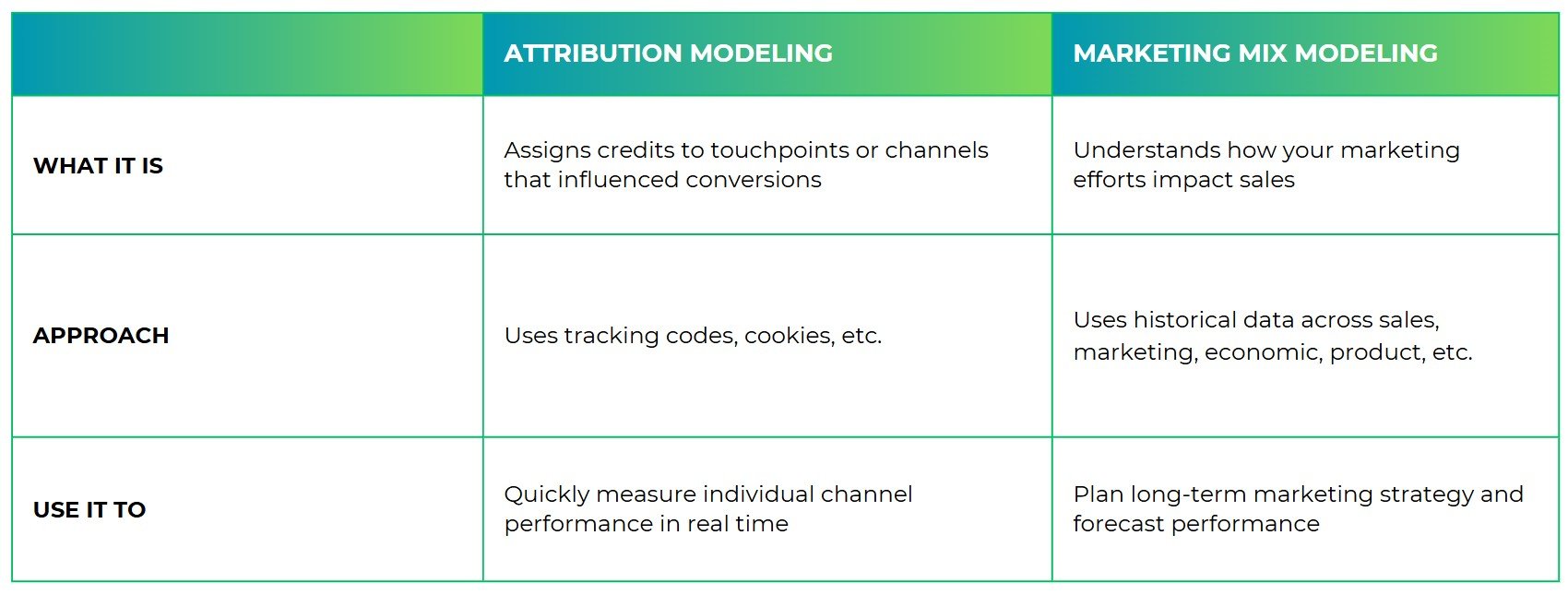
Marketing attribution models fall into three major structural categories: rule-based single-touch models, rule-based multi-touch models, and advanced algorithmic or data-driven models. Additionally, macro-level analytical frameworks like Marketing Mix Modeling (MMM) complement micro-level tracking. Understanding the operational mechanics of each model is essential for choosing the right framework for your operational complexity.
- Rule-Based Single-Touch (First/Last Click)
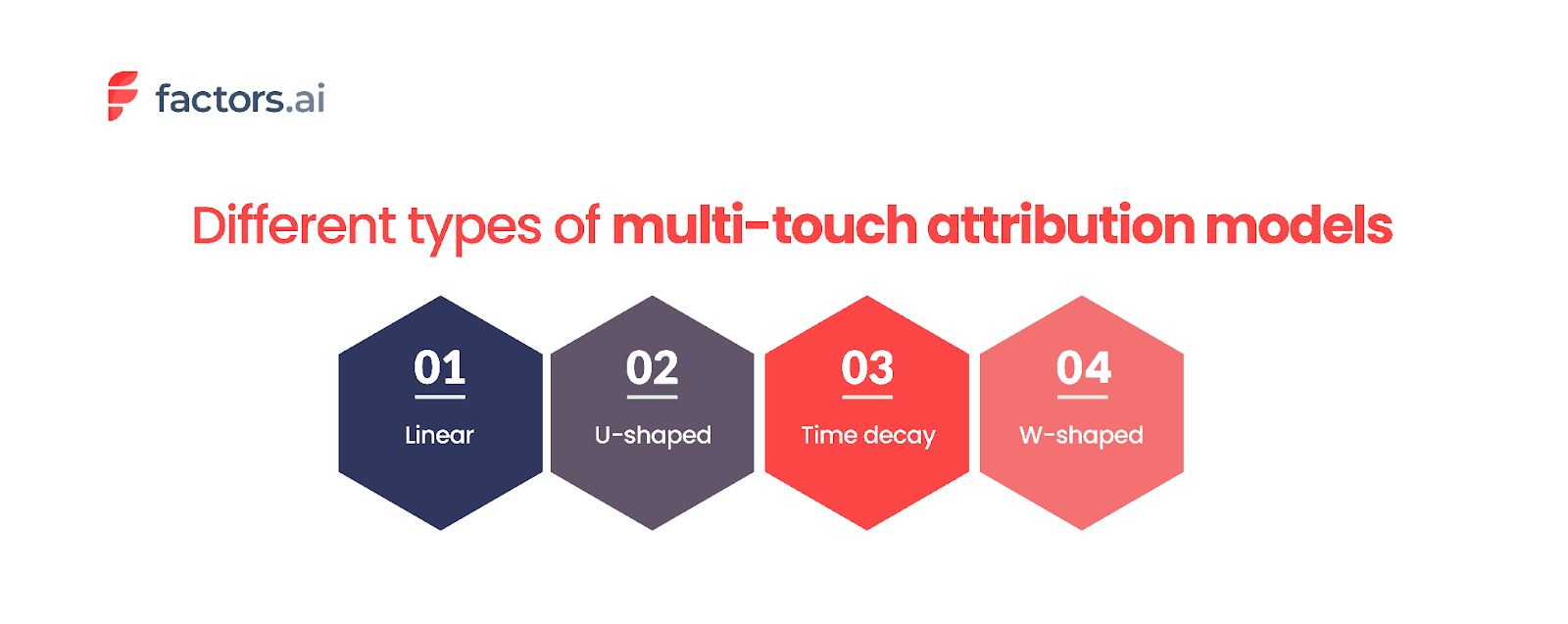
- Rule-Based Multi-Touch (Linear, Time-Decay, Position-Based)
- Algorithmic / Data-Driven (Shapley Value, Markov Chains)
- Macro-Level Triangulation (Marketing Mix Modeling + Incrementality)
Rule-Based Single-Touch Models
Single-touch models assign 100% of the conversion credit to a single point in the user journey. While mechanically simple and easy to deploy, they introduce substantial analytical bias.
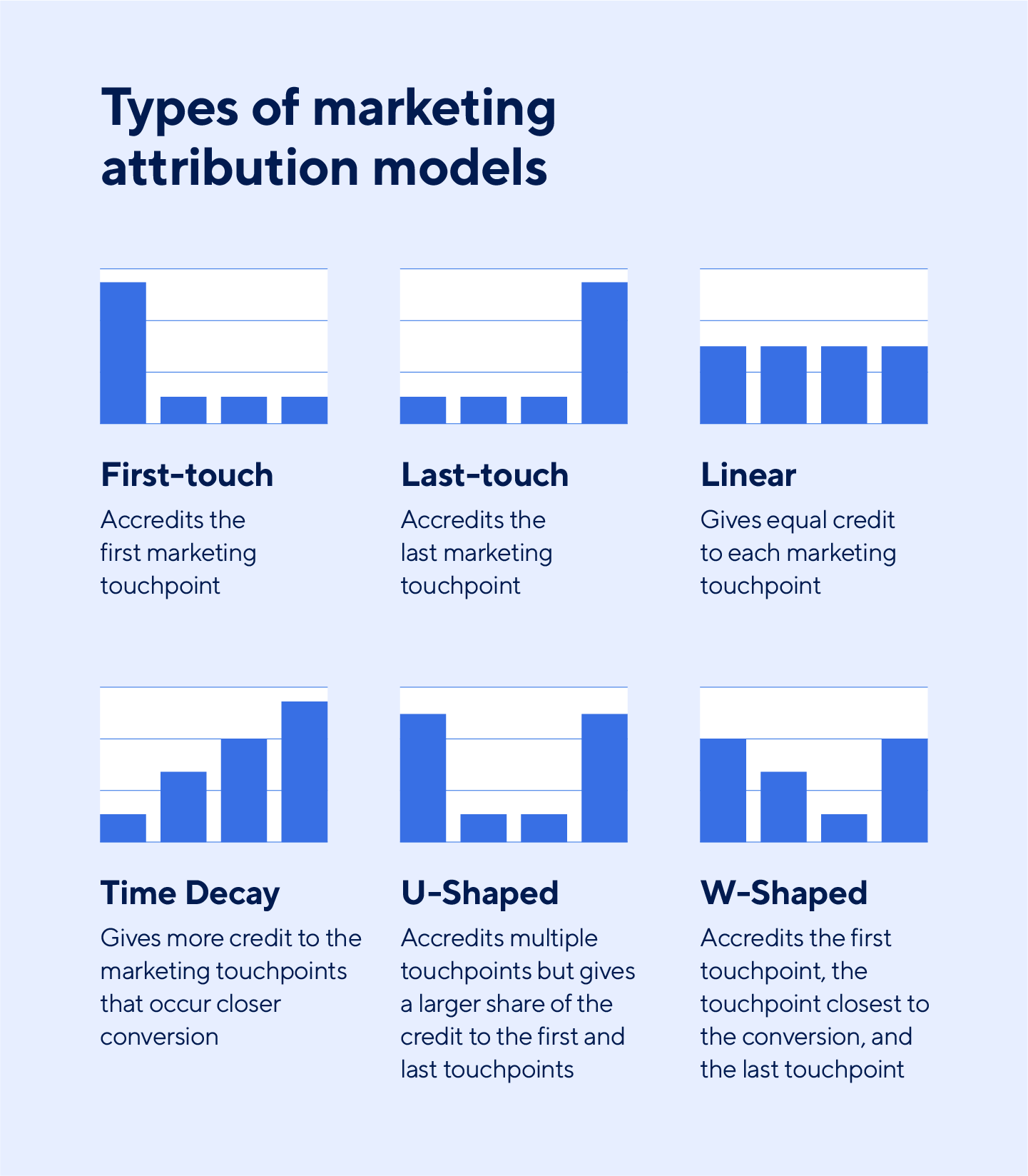
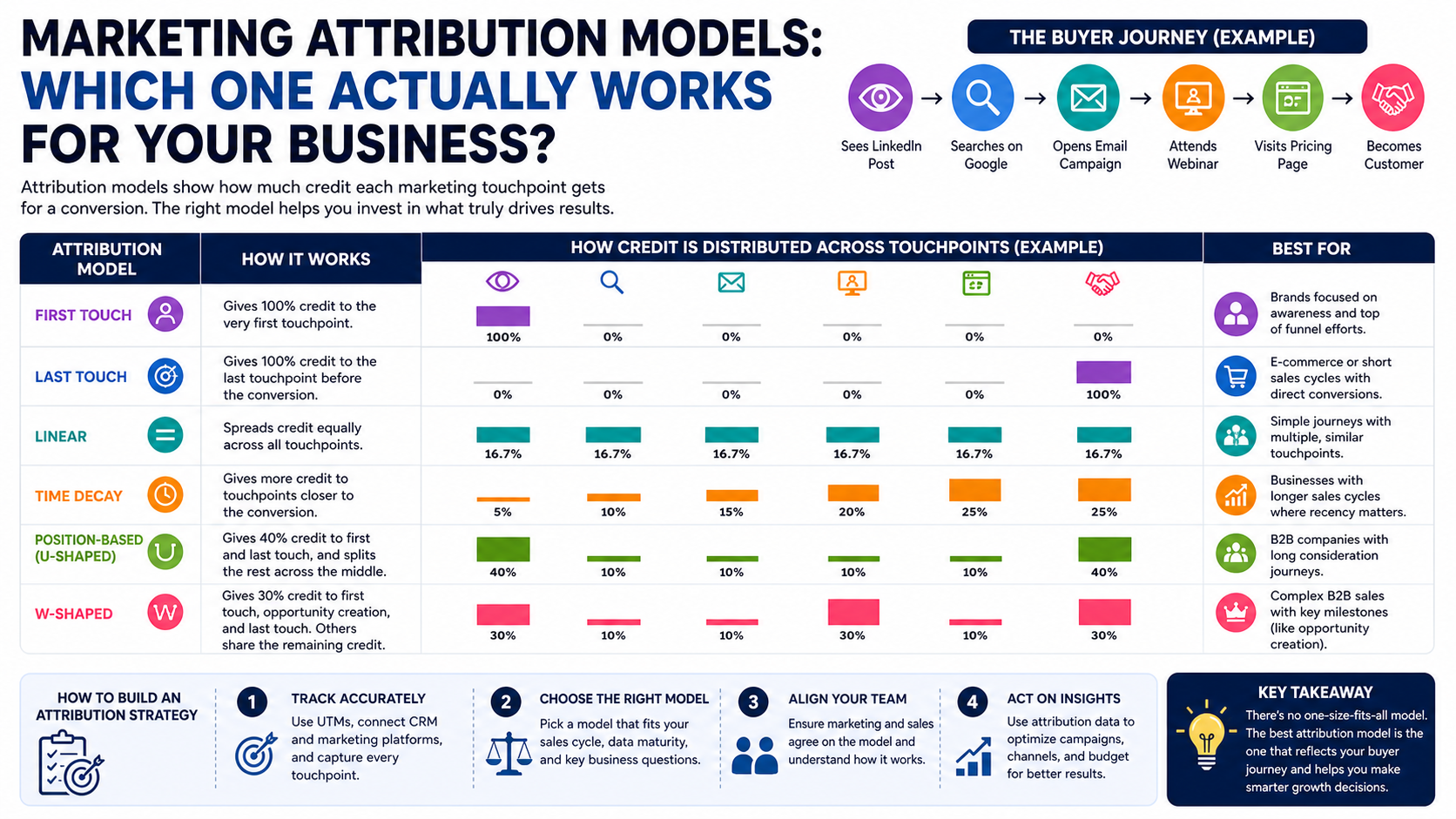
- First-Touch Attribution: Allocates total conversion credit to the initial interaction that brought a user into the sales funnel. This model prioritizes top-of-funnel (TOFU) brand awareness initiatives, such as display advertising, paid social discovery, or organic content. The primary drawback is that it completely ignores middle- and bottom-funnel touchpoints that successfully closed the sale.
- Last-Touch (Last-Click) Attribution: Assigns total conversion credit to the final interaction immediately preceding the transaction. Historically, last-touch attribution served as the default standard across platform analytics. However, it severely over-indexes on bottom-of-funnel (BOFU) channels—such as brand search campaigns, direct traffic, or retargeting emails—while starving top-of-funnel demand generation of necessary budget.
- Last Non-Direct Click Attribution: Filters out direct web traffic that occurs immediately before purchase, transferring credit to the most recent paid or organic campaign channel. This prevents direct visits from masking the actual marketing channel that prompted the customer to return.
Rule-Based Multi-Touch Models
Multi-touch attribution (MTA) spreads credit across multiple recognized touchpoints based on predefined percentage distributions. While superior to single-touch methods, these models remain static and do not adjust based on empirical data variations.
- Linear Attribution: Distributes credit equally across every touchpoint recorded in the buyer's journey. If a customer interacts with four ads before purchasing, each ad receives 25% of the credit. The major limitation of linear modeling is that it assumes every interaction carries identical persuasion weight, regardless of campaign type or messaging quality.
- Time-Decay Attribution: Employs an exponential decay algorithm that assigns greater weight to interactions occurring closer to the time of conversion. A touchpoint occurring one hour before purchase receives substantially higher credit than an ad clicked two weeks prior. This model suits sales cycles where recency strongly correlates with purchase intent, though it still undervalues initial brand introduction efforts.
- Position-Based (U-Shaped) Attribution: Allocates 40% of the conversion credit to the first touchpoint, 40% to the final touchpoint, and splits the remaining 20% evenly across all intermediate interactions. This model heavily rewards both brand discovery and conversion closure while recognizing the role of mid-funnel nurturing.
- W-Shaped Attribution: Extends the U-shaped framework for complex business-to-business (B2B) sales cycles by adding a third key milestone: lead creation. In a W-shaped model, the first touch (first visit), lead-creation touch (form submission), and primary opportunity-creation touch each receive 30% of the credit, while the remaining 10% is distributed among minor intermediate interactions.
Algorithmic and Data-Driven Models
Data-driven attribution (DDA) eliminates static rule assumptions by applying machine learning models and statistical techniques to custom user interaction datasets. DDA analyzes both converting and non-converting path behaviors to determine the true probability contribution of each channel.
- Shapley Value Regression: Originating from cooperative game theory, the Shapley value algorithm evaluates how conversion probabilities change when a specific marketing channel is included or excluded from user paths. By comparing every permutation of channel sequences across thousands of users, it calculates the marginal contribution of each touchpoint.
- Markov Chain Modeling: Represents user journeys as probabilistic state transitions within a directed graph. Nodes represent marketing touchpoints, and edges represent the transition probabilities between interactions. By calculating the "removal effect"—the fractional decrease in overall conversion probability when a specific node is removed from the network—Markov models deliver unbiased credit assignment.
Econometric Models: Marketing Mix Modeling (MMM)
Unlike user-level multi-touch attribution, Marketing Mix Modeling (MMM) operates at an aggregated, macro-economic level. Using multivariate regression analysis on historical time-series data, MMM measures the statistical relationship between aggregate spending inputs (tv, radio, paid search, social, print) and business outputs (revenue, retail volume). MMM naturally accounts for non-marketing variables such as seasonal trends, price elasticity, economic indicators, and competitor activity without relying on user tracking tags or cookies.
Comprehensive Comparison of Attribution Methodologies
Selecting an attribution methodology requires balancing data requirements, implementation cost, privacy compliance, and analytical depth. The table below compares the primary attribution frameworks across critical enterprise metrics.
| Attribution Model | Complexity | Data Requirements | Primary Strengths | Major Limitations | Optimal Use Case |
|---|---|---|---|---|---|
| First-Touch | Low | Minimal (Single session cookie / UTM) | Easy to implement; highlights user acquisition channels | Ignores intermediate nurturing and conversion closers | Lead generation & top-of-funnel discovery campaigns |
| Last-Touch | Low | Minimal (Single session cookie / UTM) | Simple setup; clear focus on final purchase drivers | Over-credits bottom-funnel channels; starves awareness budgets | Short sales cycles; transactional transactional e-commerce |
| Position-Based (U/W-Shaped) | Moderate | Multi-session user tracking logs | Balances discovery, lead creation, and conversion closure | Static rules do not reflect true incremental impact | B2B lead generation & multi-stage buying journeys |
| Data-Driven (Algorithmic) | High | Rich event-level conversion & non-conversion logs | Unbiased probabilistic weighting; adapts to user behavior | Requires high data volume; complex black-box calculations | High-volume e-commerce & mature digital ecosystems |
| Marketing Mix Modeling (MMM) | Very High | 1-3 years of aggregate spend, revenue, and external data | 100% privacy-compliant; captures offline channels & external factors | Requires specialized data science; low real-time granularity | Strategic annual budget planning & multi-channel enterprise media |
| Incrementality / Lift Testing | High | Split-testing framework / matched-market holdouts | Measures true causal impact; validates all baseline models | Requires temporary spend pauses; operationally complex | Model validation & periodic budget recalibration |
Navigating Privacy Constraints: Privacy-First Attribution Strategies
The regulatory and technical framework supporting digital analytics has fundamentally shifted. Increased enforcement of global privacy laws—such as the General Data Protection Regulation (GDPR) in the European Union and the California Consumer Privacy Act (CCPA)—alongside browser restrictions, has invalidated legacy web tracking techniques.
- Legacy Tracking Architecture
- Third-Party Cookies
- Client-Side Tracking Pixels
- Cross-Domain User Finger
- Unrestricted Web Logs
- Modern Privacy-First Architecture
- First-Party Server Analytics
- Server-to-Server APIs
- Aggregated Privacy Proofs
- MMM & Incrementality Lift
Key Privacy Disruptions
- Third-Party Cookie Deprecation & Browser Policies: Apple Safari's Intelligent Tracking Prevention (ITP) and Mozilla Firefox's Enhanced Tracking Protection (ETP) cap client-side cookie lifespans to as little as 24 hours to seven days, truncating long-term conversion paths.
- Mobile Tracking Limitations: Apple’s App Tracking Transparency (ATT) framework requires explicit opt-in consent for iOS AppTrackingTransparency framework identifiers (IDFA), restricting cross-app user tracking for non-consenting users.
- Aggregated Privacy Frameworks: Platforms increasingly report conversion metrics through privacy-preserving APIs, such as Apple's Private Click Measurement (PCM) and Google's Privacy Sandbox initiatives, which introduce data aggregation, artificial noise, and delayed reporting intervals.
Adapting to a Privacy-First Environment
To maintain reporting integrity without relying on invasive user tracking, smart marketing organizations utilize three structural adjustments:
1. Server-Side Tracking and First-Party Data Systems
Client-side tags running directly in user web browsers are increasingly blocked by ad-blockers and privacy protections. Enterprise teams manage this by deploying server-side tagging architectures, such as Server-Side Google Tag Manager or customer data platforms (CDPs). Under this design, web and app interactions pass directly from the user to a secure first-party server hosted on the brand's primary domain before being transmitted to downstream analytics tools via secure Server-to-Server (S2S) APIs.
2. First-Party Identity Resolution
Smart attribution frameworks rely heavily on authenticated user interactions. By offering clear value exchanges—such as account creation, gated research content, loyalty programs, or direct messaging sign-ups—brands capture first-party user identifiers (e.g., hashed email addresses). These identifiers allow deterministic user matching across devices within privacy compliance guidelines.
3. The Unified Measurement Framework (Triangulation)
Single analytical models no longer provide absolute accuracy. Leading organizations combine three complementary methodologies to form a "Unified Measurement Framework":
- Multi-Touch / Data-Driven Attribution (MTA/DDA): Provides granular, real-time campaign management and operational optimization using privacy-compliant first-party data.
- Marketing Mix Modeling (MMM): Establishes baseline top-level budget allocation recommendations across digital and offline channels without using individual personal identifiers.
- Incrementality Lift Testing: Acts as the ground-truth validation layer, using randomized controlled trials (RCTs) or matched-market holdout tests to measure the exact incremental sales created by specific channels.
Step-by-Step Framework for Implementing Smart Attribution
Transitioning an organization from basic last-click reporting to a resilient attribution architecture requires systematic technical configuration, process alignment, and governance.
Step 1: Define Business Objectives and Conversion Taxonomy
Begin by establishing clear conversion hierarchies within your web and app analytics. Differentiate between macro-conversions (e.g., completed e-commerce purchases, signed B2B contracts) and micro-conversions (e.g., newsletter subscriptions, product demo views, add-to-cart events). Assign explicit business metrics and expected financial values to micro-events so the attribution engine can evaluate partial-path value.
Step 2: Establish First-Party Data Tracking Infrastructure
Build a unified data architecture to capture customer touchpoints accurately.
- Deploy server-side event tracking across all digital properties.
- Configure custom domain setups to ensure analytical cookies operate in a true first-party context.
- Integrate web, mobile app, offline point-of-sale (POS), and CRM data streams into a central data warehouse (e.g., Google BigQuery, Snowflake, or Amazon Redshift).
Step 3: Standardize Data Taxonomy and UTM Parameters
Algorithmic models fail when incoming data sources are inconsistent. Implement a mandatory, organization-wide campaign tracking taxonomy using strict UTM (Urchin Tracking Module) conventions.
Enforce lower-case string formatting, eliminate spacing, and mandate standard parameter values across all internal teams and media agencies:
utm_source: Identifies the traffic publisher (e.g.,google,meta,linkedin).utm_medium: Identifies the high-level channel grouping (e.g.,cpc,paidsocial,email,organic).utm_campaign: Standardized naming format incorporating target region, campaign objective, and operational year.
Step 4: Select and Train the Right Attribution Model
Choose an initial model framework based on enterprise scale and technical capacity:
- Mid-Market Organizations: Transition from last-touch to custom Position-Based (U-Shaped) or platform-native Data-Driven Attribution models within privacy-compliant analytics platforms.
- Enterprise Organizations: Build custom statistical algorithms (e.g., Shapley value or Markov chains) inside a data warehouse using raw event logs, while simultaneously developing an open-source or proprietary Marketing Mix Model framework (such as Meta's Robyn or Google's LightweightMMM).
Step 5: Validate Models with Controlled Incrementality Testing
Never allocate capital based on unvalidated model output. Run controlled incrementality tests to compare model recommendations against real-world incremental lift. For example, execute a geo-targeted holdout test by completely pausing paid search brand ads in a representative subset of regions while keeping spend active in control regions. Compare the true net change in revenue against what your attribution model predicted.
- Target Audience Group
- Test Group (50% Region A)
- Receives Paid Search Ads
- Measure Total Lift
- Control Group (50% Region B)
- Ads Paused (Holdout)
- Measure Baseline
- Test Group (50% Region A)
Step 6: Operationalize Insights for Budget Allocation
Attribution models generate value only when they actively guide capital reallocation. Establish recurring operational review cycles (e.g., bi-weekly for tactical adjustments, quarterly for strategic channel shifts). Reallocate budget away from channels showing high platform-reported conversions but low incremental yield, shifting resources toward channels proven to create net-new demand.
Overcoming Critical Challenges and Common Pitfalls
Even sophisticated attribution strategies can suffer from structural biases and data collection flaws if common pitfalls are left unaddressed.
1. The Walled Garden Reporting Trap
Major digital advertising networks operate as closed ecosystems, often termed "walled gardens." When measuring performance using platform-native dashboards, each ad network calculates conversions using self-interested rules. For example, if a user views a display ad on Platform A, clicks a social ad on Platform B, and purchases, both platforms will claim 100% of the conversion credit.
Solution: Rely on independent, central analytics warehouses or custom multi-touch engines rather than isolated ad platform dashboards.
2. Over-Indexing on Bottom-Funnel Retargeting
Standard attribution models, particularly last-touch and time-decay, assign heavy credit to retargeting and brand search campaigns. These ads target users who already possess high purchase intent.
Solution: Apply incrementality testing specifically to retargeting campaigns. If pausing a retargeting audience results in negligible sales drops because customers would have bought anyway, reduce the baseline attribution credit assigned to those touchpoints.
3. Data Silos and Offline Disconnects
For organizations with omnichannel business models, customer journeys frequently cross online and offline boundaries. A customer may research a product on a mobile device and complete the purchase inside a physical retail store. If the point-of-sale system is disconnected from the online analytics warehouse, digital marketing channels receive zero financial credit for offline revenue generation.
Solution: Implement unified CRM loyalty programs, digital receipts matched via hashed email addresses, and geo-location foot-traffic analytics to bridge the online-to-offline gap.
Frequently Asked Questions
What is the difference between single-touch and multi-touch attribution modeling?
Single-touch attribution assigns 100% of a conversion's monetary credit to one specific customer interaction, such as the initial visit (First-Touch) or the final purchase click (Last-Touch). Multi-touch attribution distributes fractional credit across all recorded interactions along the customer's buying journey, providing a more balanced view of how awareness, consideration, and conversion tactics work together.
How does data-driven attribution (DDA) work compared to static rule-based models?
Static rule-based models (such as Linear, Time-Decay, or Position-Based) assign fixed credit percentages based on predetermined human assumptions. Data-driven attribution uses machine learning algorithms (such as Shapley Value or Markov Chain calculations) to evaluate historical conversion and non-conversion paths, automatically assigning credit based on how individual touchpoints statistically alter conversion probability.
Why is Marketing Mix Modeling (MMM) gaining popularity again alongside MTA?
Marketing Mix Modeling (MMM) relies on aggregated, macro-level econometric data rather than individual user-level tracking. As browser privacy policies, third-party cookie deprecation, and mobile tracking restrictions impair multi-touch attribution (MTA), MMM provides a completely privacy-compliant alternative for top-level budget planning across both online and traditional media.
How do privacy changes like Apple ATT and cookie deprecation impact attribution accuracy?
Privacy restrictions shorten client-side cookie lifespans, limit cross-site user tracking, and restrict mobile device identifiers. This creates broken analytics user paths, causing multi-session interactions from a single individual to appear as separate, unlinked visits. Organizations mitigate these gaps by adopting server-side tracking, first-party data capture, and unified measurement frameworks.
How frequently should marketing teams re-evaluate their attribution models?
Tactical marketing metrics derived from attribution models should be reviewed bi-weekly or monthly to guide ongoing campaign adjustments. However, the foundational statistical parameters of data-driven models and MMM frameworks should be re-calibrated quarterly or semi-annually. In addition, periodic incrementality holdout tests should be conducted twice a year to validate model assumptions.
Next Steps for Optimizing Your Marketing Attribution Stack
To build a scalable, privacy-first attribution architecture, execute the following operational steps:
- Audit Existing Analytics Coverage: Review current tracking infrastructure to identify reliance on client-side third-party cookies and unstandardized UTM parameter structures.
- Deploy First-Party Tagging: Implement server-side tagging and server-to-server API connections across core conversion endpoints to establish resilient data collection.
- Establish a Shared Campaign Taxonomy: Author and enforce an enterprise-wide tracking framework for all URL campaign tags, ensuring consistency across internal teams and external agency partners.
- Transition to Data-Driven or Hybrid Modeling: Shift from last-touch reporting toward data-driven attribution platforms or position-based frameworks aligned with your business model.
- Validate via Incrementality Testing: Plan and execute a geo-matched holdout test on your largest paid channels to benchmark model outputs against true incremental business growth.