Amanda Anisimova’s rise in professional tennis is a narrative of extraordinary early talent, profound personal resilience, and a successful return to the elite levels of the WTA Tour. After bursting onto the scene as a teenage Grand Slam semifinalist, she navigated immense personal loss and mental health challenges to redefine her career as a powerhouse in the modern game.
The Foundations of a Prodigy: Early Life and Junior Success
The trajectory of Amanda Anisimova’s career began long before she stepped onto the clay courts of Roland Garros. Born on August 31, 2001, in Freehold, New Jersey, to Russian parents Olga and Konstantin Anisimov, Amanda was immersed in a culture of discipline and athletic ambition. The family moved to Florida when she was very young to take advantage of the state’s world-class tennis infrastructure, a move that has been the catalyst for many American tennis success stories.
Under the primary tutelage of her father, Konstantin, who served as her longtime coach, Amanda developed a playing style characterized by clean ball-striking and an aggressive baseline presence. Her junior career was nothing short of spectacular. She reached the number two world ranking in the ITF Junior Circuit, a feat driven by her remarkable consistency and power. The crowning achievement of her junior years came in 2017 when she won the US Open Girls' Singles title, defeating Coco Gauff in the final. This victory signaled to the tennis world that Anisimova was not just a promising talent but a future force in the professional ranks.
The transition from juniors to the WTA Tour is often a stumbling block for many young athletes, but Anisimova’s game was structurally sound enough to bypass the typical growing pains. Her ability to take the ball early and redirect pace allowed her to compete with seasoned professionals while still in her mid-teens. By the time she was 16, she had already earned her first main-draw victory at a Premier-level tournament, setting the stage for one of the most rapid ascents in recent memory.
The 2019 Breakthrough: A Star Emerges at Roland Garros
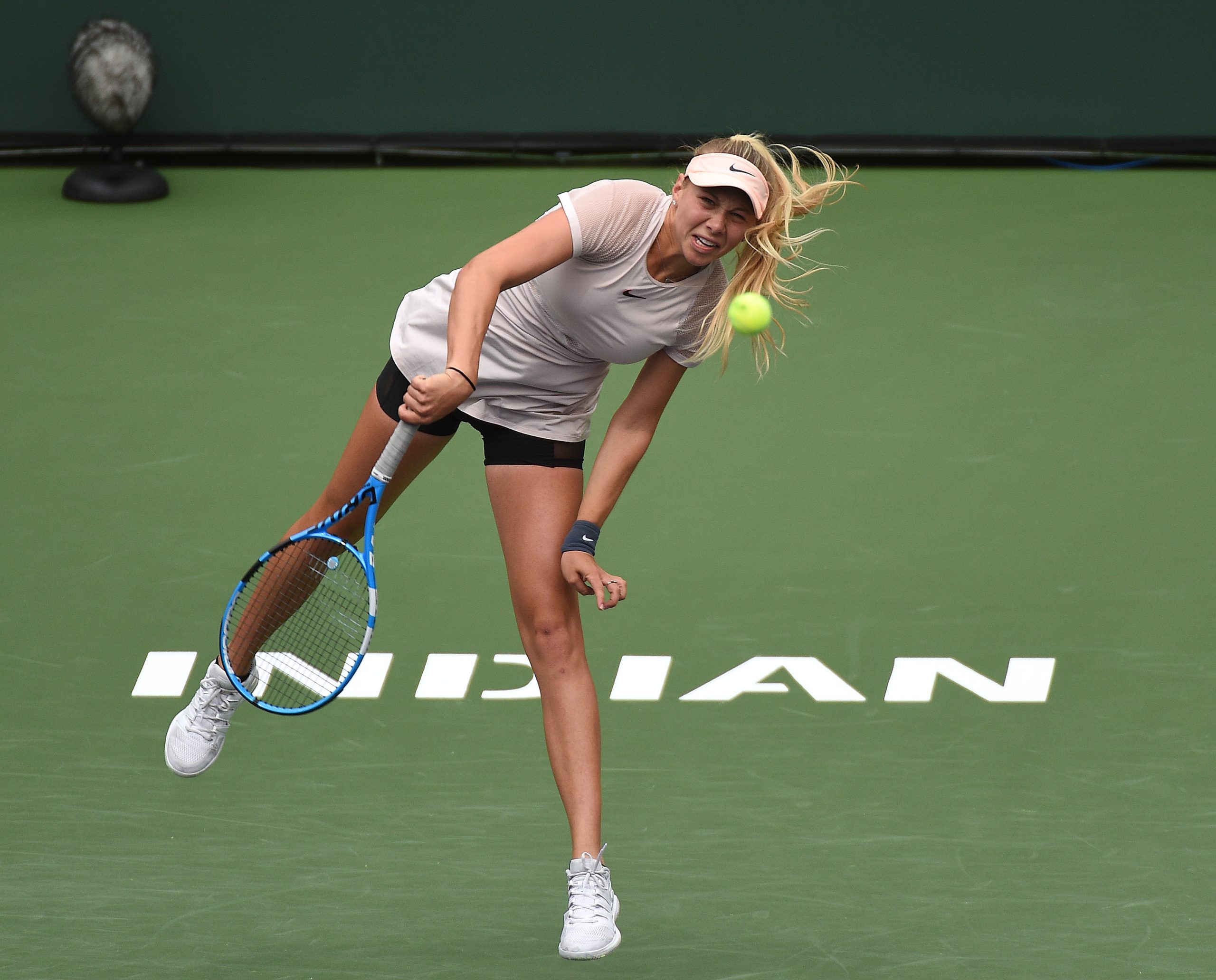
While 2018 showed glimpses of her potential—most notably a fourth-round run at Indian Wells where she defeated Petra Kvitova—it was 2019 that cemented Amanda Anisimova as a household name. In April of that year, she captured her first WTA title at the Copa Colsanitas in Bogotá, proving she could handle the physical demands of high-altitude clay-court tennis.
However, it was the 2019 French Open that served as her global introduction. At just 17 years old, Anisimova tore through the draw without dropping a set until the semifinals. Her quarterfinal match against the defending champion, Simona Halep, remains one of the most impressive displays of clinical power-hitting by a teenager in Grand Slam history. Anisimova’s 6-2, 6-4 victory over the world-renowned clay-courter showcased a level of composure and tactical brilliance that belied her age.
Although she eventually fell in the semifinals to Ashleigh Barty in a three-set battle, the message was clear: Anisimova was a future Grand Slam champion. Her ranking soared into the top 30, and she became the youngest American woman to reach a major semifinal since Venus Williams in 1997. This period marked the peak of her "initial rise," characterized by fearless play and the momentum of a player who felt she had nothing to lose.
Navigating Tragedy and Personal Setbacks
The high of the 2019 French Open was tragically cut short just months later. In August 2019, just days before the start of the US Open, Amanda’s father and coach, Konstantin Anisimova, passed away suddenly from a heart attack. The loss was devastating, both personally and professionally. Konstantin had been the architect of her game and her primary emotional support on the grueling professional tour.
In the wake of this tragedy, the "rise" of Amanda Anisimova plateaued as she rightfully prioritized her emotional well-being and navigated the grieving process. The years between late 2019 and 2021 were a period of transition. She struggled with consistency, as the absence of her father’s guidance left a void in her coaching structure. Furthermore, the COVID-19 pandemic disrupted the tour, making it difficult for a young player seeking stability to find her rhythm.
Despite these challenges, she remained a top-tier competitor, reaching the fourth round of the Australian Open and Roland Garros in subsequent years. However, the spark that had defined her 2019 run was often shadowed by the weight of expectations and personal sorrow. This phase of her career is a crucial part of her story, highlighting that professional "rise" is rarely a linear path and is often interrupted by the realities of life outside the lines.
Technical Profile: The Mechanics of Anisimova's Power
To understand why Anisimova has remained a threat on the WTA Tour through 2026, one must look at the technical aspects of her game. She is often categorized as an aggressive baseliner, but that label does not fully capture the nuance of her timing.
- The Two-Handed Backhand: This is widely considered her "signature" shot. Anisimova possesses one of the cleanest backhands on tour, capable of generating immense pace even when pushed out wide. Her ability to hit the backhand down the line with pinpoint accuracy is a primary weapon in ending rallies.
- Early Ball-Striking: Unlike many power players who require a long wind-up, Anisimova takes the ball exceptionally early. By meeting the ball at the top of its bounce, she robs her opponents of reaction time. This "flat" hitting style is particularly effective on hard courts and faster clay.
- Return of Serve: Anisimova’s height (approximately 5'11") and reach make her a formidable returner. She looks to dominate the point from the very first strike, often punishing second serves to put her opponents on the defensive immediately.
- Mental Fortitude under Pressure: While she has faced mental health hurdles, her on-court demeanor is often stoic. She has a high "clutch" factor, often playing her best tennis when facing break points or serving for sets.
By 2026, she has refined these mechanics to include better defensive movement. Earlier in her career, she could be exploited by players who moved her laterally, but her improved fitness and footwork have turned her into a more complete athlete capable of winning longer, grinding rallies.
The 2023 Hiatus: Prioritizing Mental Health
In May 2023, Amanda Anisimova made a courageous decision that would ultimately save her career. Citing burnout and concerns for her mental health, she announced an indefinite break from professional tennis. At a time when the pressure to perform and defend ranking points was at its peak, she chose to step away from the limelight to address the cumulative toll of grief and the pressures of the pro circuit.
This hiatus was a turning point. Unlike previous generations where players were expected to "play through" the pain, Anisimova followed the lead of athletes like Naomi Osaka and Ashleigh Barty, recognizing that professional longevity requires mental stability. During her time away, she focused on personal growth, interests outside of tennis, and healing.
When she returned to the tour at the start of the 2024 season, the tennis world saw a different Amanda Anisimova. She appeared rejuvenated, playing with a sense of joy and perspective that had been missing in the years following her father's death. Her run to the fourth round of the 2024 Australian Open was a statement that she had not lost her touch, but rather gained the mental clarity needed to utilize it.
The Resurgence: 2024 to 2026
The period from late 2024 through 2026 has been defined as Anisimova’s "second rise." Having shed the label of "teenage prodigy," she transitioned into a mature, veteran presence on the tour. A significant milestone in this comeback was her performance during the 2024 North American hard-court swing, particularly reaching the final of the WTA 1000 event in Toronto.
By 2025 and into the current 2026 season, Anisimova has solidified her position back in the top 20 of the WTA rankings. Her coaching partnership has stabilized, providing her with the tactical structure she lacked in the early 2020s. She has also become a vocal advocate for mental health in sports, using her platform to encourage younger players to prioritize their well-being.
As we look at her current standing in 2026, she remains one of the few players on tour who can take the racquet out of an opponent’s hand through pure offensive talent. Her "rise" is no longer just about potential; it is about the sustained excellence of a player who has survived the highs and lows of the professional grind.
Career Performance Comparison
The following table tracks the progression of Amanda Anisimova’s career across key metrics, showcasing the "peaks and valleys" of her professional journey.
| Year | Significant Achievement | Best Grand Slam Result | Year-End Ranking | Primary Focus |
|---|---|---|---|---|
| 2017 | US Open Junior Champion | N/A (Junior) | 192 | Transition to Pro |
| 2018 | Indian Wells 4th Round | US Open (1R) | 95 | Breaking into Top 100 |
| 2019 | First WTA Title (Bogotá) | French Open (SF) | 24 | Global Breakthrough |
| 2020 | Consistent 3rd Rounds | Australian Open (1R) | 30 | Navigating Personal Loss |
| 2021 | 3rd Round at majors | US Open (2R) | 78 | Rebuilding Game |
| 2022 | Second WTA Title (Melbourne) | Wimbledon (QF) | 23 | Returning to Form |
| 2023 | Mental Health Hiatus | Australian Open (1R) | 359 | Recovery & Well-being |
| 2024 | Toronto 1000 Finalist | Australian Open (4R) | Top 50 | The Comeback |
| 2025 | Multiple SF at WTA 1000s | Roland Garros (QF) | Top 20 | Consistent Elite Play |
| 2026 | Consistent Top 15 Presence | Australian Open (QF) | TBD | Title Contender |
Frequently Asked Questions
What is Amanda Anisimova's playing style?
Amanda Anisimova is an aggressive baseliner. Her game is built on taking the ball very early and using flat, powerful groundstrokes to dictate play. Her backhand down the line is widely considered one of the best in women's tennis. While her game is naturally offensive, her recent focus has been on improving her defensive movement and court coverage.
Why did Amanda Anisimova take a break from tennis in 2023?
Anisimova took an indefinite break starting in May 2023 to prioritize her mental health. She cited burnout and the emotional toll of professional competition as her primary reasons. This break allowed her to return in 2024 with a refreshed perspective and a healthier approach to the demands of the WTA Tour.
Who coached Amanda Anisimova during her rise?
For most of her early career, she was coached by her father, Konstantin Anisimov. Following his passing in 2019, she worked with several high-profile coaches, including Jaime Cortés and Hordorf. In her more recent 2024-2026 seasons, she has sought a more stable coaching team that emphasizes both tactical growth and mental conditioning.
Has Amanda Anisimova won a Grand Slam title?
As of 2026, Amanda Anisimova has not yet won a Grand Slam singles title, though she has reached the semifinals of the French Open (2019) and the quarterfinals of Wimbledon (2022). She remains a perennial contender at the majors due to her ability to defeat top-seeded players.
What is Amanda Anisimova’s height, and how does it help her game?
Amanda Anisimova is approximately 5 feet 11 inches (1.80 meters) tall. Her height provides her with significant leverage on her serve and an impressive reach from the baseline. This physical advantage allows her to flatten out her shots and dominate opponents with pace, particularly on the return of serve.
Next Actions for Fans and Analysts
To truly appreciate Amanda Anisimova’s rise in professional tennis, one should focus on her performance during the North American hard-court season. Her game is perfectly suited for the faster courts found in tournaments like Cincinnati and the US Open. Watching her matches against other heavy hitters provides a masterclass in timing and redirecting pace.
For those following her career, it is recommended to monitor her performance at the WTA 1000 levels. These tournaments often serve as the best indicators of her fitness and mental readiness for the Grand Slams. As she continues her journey through the 2026 season, her ability to maintain consistency over a full calendar year will be the final step in her transition from a gifted talent to a legendary figure in American tennis.