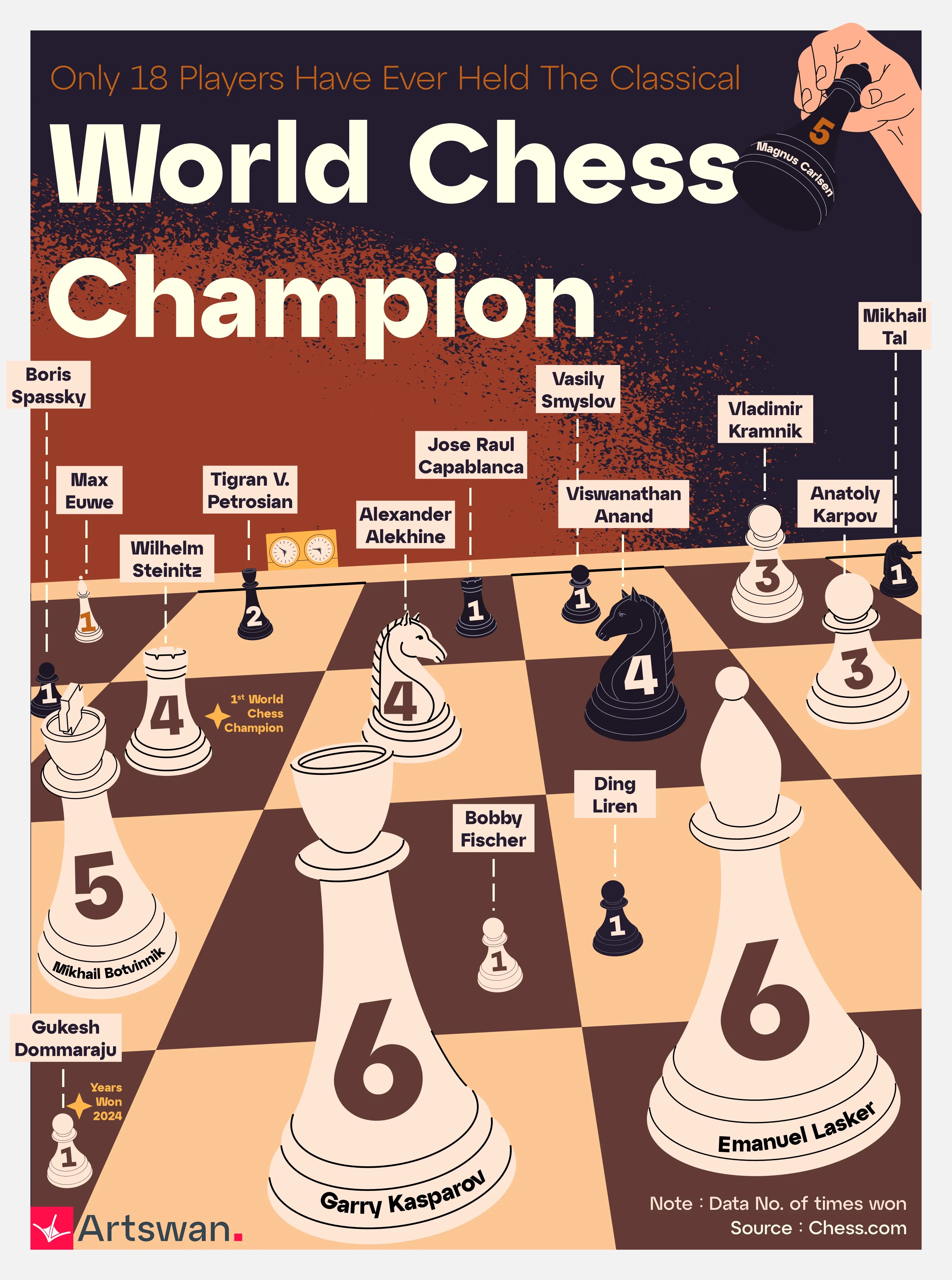
The official World Chess Championship traces an unbroken and fiercely contested lineage from Wilhelm Steinitz in 1886 to the reigning grandmasters of today. This title represents the pinnacle of intellectual competition, crowning the player who has demonstrated absolute superiority over global peers through structured, high-stakes matches.
The Evolution of the World Chess Championship
To understand the lineage of all world chess champions, one must first recognize that competitive chess existed long before an official title was codified. Informal champions, such as François-André Danican Philidor in the 18th century and later masters like Louis-La Bourdonnais and Howard Staunton, were widely recognized by their contemporaries as the strongest players of their respective eras. However, these matches lacked a formal governing framework, permanent rules, or a universally recognized championship cycle.
The modern era of world chess began in 1886 with a historic match between Wilhelm Steinitz and Johannes Zukertort. This contest is historically accepted as the first official World Chess Championship match. From that moment forward, the title transformed from an informal bragging right into a formal institution governed first by elite players, later by the Fédération Internationale des Échecs (FIDE), and occasionally subjected to dramatic schisms and reunification cycles.
The Pioneer Era: From Steinitz to Alekhine (1886–1946)
The early decades of the World Chess Championship were characterized by private arrangements between players. The reigning champion essentially held the rights to the title, choosing their challengers, securing their own funding, and setting match conditions. Despite these logistical hurdles, this period established the foundational strategic philosophies of modern chess.
Wilhelm Steinitz (1886–1894)
As the inaugural official champion, Austrian-born American master Wilhelm Steinitz revolutionized how chess was understood and played. Before Steinitz, most masters relied on brilliant, romantic tactical attacks and reckless sacrifices. Steinitz introduced positional principles—demonstrating the value of pawn structures, center control, piece coordination, and the careful defense of small advantages. He successfully defended his title against Zukertort, Mikhail Chigorin, and Isidor Gunsberg before losing the crown to a younger generation.
Emanuel Lasker (1894–1921)
Emanuel Lasker held the world championship for an astonishing 27 years, the longest reign in chess history. A brilliant mathematician and psychological player, Lasker understood that chess was played against a human opponent, not an abstract engine. He frequently played objectively inferior moves if he knew they would discomfort his opponent or create complex practical problems. He successfully defended against challengers like Steinitz, Chigorin, Frank Marshall, Siegbert Tarrasch, and David Janowski.
José Raúl Capablanca (1921–1927)
The Cuban genius José Raúl Capablanca possessed an almost supernatural intuition and legendary tactical clarity. Known as the "Chess Machine," Capablanca went undefeated in tournament play for nearly a decade. He dethroned Lasker in 1921 without losing a single game. His endgame mastery and quiet positional dominance left opponents bewildered, though his reign was brief before he fell to Alexander Alekhine.
Alexander Alekhine (1927–1935 and 1937–1946)
Alexander Alekhine, a Russian-French grandmaster, was the antithesis of Capablanca's calm clarity. Alekhine was an attacking genius who infused his games with wild, deeply calculated complexities and tactical violence. He stunned the chess world by defeating Capablanca in 1927. After losing the title to Max Euwe in 1935, Alekhine regained it in 1937 and held it until his death in 1946, making him the only champion to die while holding the title.
Max Euwe (1935–1937)
Dutch mathematician and grandmaster Max Euwe shocked the chess world by defeating Alekhine in 1935. Euwe was a meticulous strategist and one of the first champions to rely heavily on structured scientific preparation, training methods, and second-assistants. Though Alekhine reclaimed the crown two years later, Euwe’s brief reign permanently altered how players prepared for elite matches.
The FIDE Era and Soviet Dominance (1948–1993)
Following Alekhine's death in 1946, the chess world was thrown into disarray. FIDE stepped in to organize a tournament in 1948 to determine a new champion. This marked the beginning of a standardized, cyclic system involving Interzonal tournaments, Candidates matches, and a championship match. For the next four decades, Soviet grandmasters completely dominated this cycle, turning chess into a matter of national prestige.
Mikhail Botvinnik (1948–1957, 1958–1960, and 1961–1963)
Mikhail Botvinnik won the 1948 championship tournament and became the patriarch of the famous Soviet chess school. Botvinnik was a pioneer of systematic chess training, treating games with scientific rigor, deep opening preparation, and immense willpower. Though he lost the title twice—first to Vasily Smyslov and later to Mikhail Tal—he utilized FIDE's rules to invoke his right to a rematch, successfully winning the title back on both occasions.
Vasily Smyslov (1957–1958)
Vasily Smyslov was a master of harmony, positional play, and endgame precision. Known for his calm demeanor and exceptional intuition, Smyslov challenged Botvinnik multiple times before decisively winning the title in 1957. Although Botvinnik reclaimed the crown a year later, Smyslov remained a dominant force at the elite level for decades.
Mikhail Tal (1960–1961)
Known as the "Magician from Riga," Mikhail Tal brought electrifying, chaotic romance back to top-level chess. Suffering from lifelong health issues, Tal played sacrificial, attacking chess that terrified his opponents and mesmerized spectators. He defeated Botvinnik in 1960 with breathtaking combinations, though Botvinnik’s superior physical stamina and strategic adaptation allowed him to regain the title in the 1961 rematch.
Tigran Petrosian (1963–1969)
Tigran Petrosian was nicknamed the "Iron Tiger" due to his impenetrable defensive style. A master of prophylaxis—preventing opponent threats before they fully materialize—Petrosian made it nearly impossible for opponents to attack him. He defeated Botvinnik in 1963 and successfully defended his title against Boris Spassky in 1966 before Spassky defeated him in their 1969 rematch.
Boris Spassky (1969–1972)
Boris Spassky played a universal, highly flexible style capable of shifting seamlessly from sharp tactical skirmishes to profound positional grinds. He captured the championship by defeating Petrosian in 1969. His tenure as champion culminated in the legendary 1972 "Match of the Century" in Reykjavik against American challenger Bobby Fischer, a Cold War cultural watershed that brought unprecedented global attention to the game.
Bobby Fischer (1972–1975)
Robert James Fischer single-handedly broke the decades-long Soviet monopoly on the world chess championship. Exhibiting unprecedented opening preparation, psychological dominance, and relentless competitive drive, Fischer swept through the Candidates matches and defeated Spassky in 1972. However, Fischer famously forfeited his title in 1975 after FIDE refused his radical demands for match format changes. Fischer retired from competitive play entirely, becoming an enigmatic legend.
Anatoly Karpov (1975–1985)
Anatoly Karpov inherited the title by default when Fischer refused to defend it. Karpov quickly proved he was a worthy champion through relentless tournament dominance throughout the late 1970s and early 1980s. Karpov's style was characterized by boa-constrictor pressure: he would seize a tiny positional advantage and slowly squeeze his opponent to death without giving any counterplay. He successfully defended his crown multiple times against Viktor Korchnoi and launched a historic, grueling rivalry with Garry Kasparov.
Garry Kasparov (1985–2000)
Garry Kasparov is widely regarded by historians and statisticians as one of the greatest chess players in history. Possessing ferocious attacking energy, immense opening knowledge, and relentless competitive drive, Kasparov defeated Karpov in 1985. He defended his title successfully against Karpov multiple times before breaking away from FIDE in 1993 to form the Professional Chess Association (PCA), fracturing the world chess championship for over a decade.
The Schism and Reunification Era (1993–2006)
Between 1993 and 2006, the chess world suffered a damaging split. FIDE continued crowning its own champions through knockout tournaments or standard matches, while the players who broke away defended the "Classical" World Chess Championship title. This period created confusion among fans and sponsors until a formal reunification match took place.
Classical Champions (PCA / Braingames / Classical)
- Garry Kasparov (1993–2000): Continued holding the classical title after breaking from FIDE, defending against Nigel Short and Viswanathan Anand.
- Vladimir Kramnik (2000–2006): Stunned the chess world by defeating Kasparov in a 2000 match without losing a single game. Kramnik successfully defended his classical title against Peter Leko in 2004.
FIDE Champions (1993–2006)
- Anatoly Karpov (1993–1999): Won the FIDE title during the fractured era.
- Alexander Khalifman (1999–2000): Won the FIDE knockout world championship tournament.
- Viswanathan Anand (2000–2002): Won the FIDE knockout world championship.
- Ruslan Ponomariov (2002–2004): Became the youngest FIDE champion at the time.
- Rustam Kasimdzhanov (2004–2005): Won the surprise FIDE knockout event in Libya.
- Veselin Topalov (2005–2006): Won the FIDE World Chess Championship tournament in San Luis, Argentina.
In 2006, a reunification match was held between Classical Champion Vladimir Kramnik and FIDE Champion Veselin Topalov. Kramnik won the match, restoring a single, undisputed World Chess Champion.
The Modern Era: From Anand to Present (2006–Present)
The unified championship era restored clarity to the sport, introducing professional match cycles, corporate sponsorships, and eventually a shift toward rapid tiebreaks and digital streaming platforms that attracted millions of new fans globally.
Viswanathan Anand (2007–2013)
India's first chess grandmaster, Viswanathan Anand, dominated the modern era with incredible speed, deep tactical vision, and adaptability across all time controls. Anand won the unified World Chess Championship tournament in 2007, and successfully defended his title in traditional head-to-head matches against Vladimir Kramnik (2008), Veselin Topalov (2010), and Boris Gelfand (2012) before facing a new generation of digital-native players.
Magnus Carlsen (2013–2023)
Norwegian prodigy Magnus Carlsen revolutionized professional chess with his universal style, deep endgame proficiency, and psychological stamina. Carlsen defeated Anand in 2013 and successfully defended his crown against Anand (2014), Sergey Karjakin (2016), Fabiano Caruana (2018), and Ian Nepomniachtchi (2021). In 2023, Carlsen chose not to defend his title, stating a lack of motivation for the traditional classical match cycle, though he remained the world's highest-rated player.
Ding Liren (2023–2024)
Following Carlsen's abdication, Chinese grandmaster Ding Liren earned the right to play Ian Nepomniachtchi in the 2023 World Chess Championship match. In a tense, dramatic contest that went to rapid tiebreaks, Ding emerged victorious, becoming the first male chess player from China to hold the classical world championship title.
Gukesh D. (2024–Present)
Indian prodigy Gukesh D. (Dommaraju Gukesh) secured the world title in 2024 by winning the Candidates Tournament and subsequently defeating reigning champion Ding Liren. At just 18 years old, Gukesh shattered historical records to become the youngest undisputed World Chess Champion in history, marking the arrival of a new generation of players trained on advanced artificial intelligence engines.
Comparative Overview of Notable Champions
To visualize the legacy of these legendary figures, the table below highlights key metrics of some of the most influential world champions in chess history.
| Champion Name | Nationality | Reign Years | Title Type | Notable Rival / Challenger |
|---|---|---|---|---|
| Wilhelm Steinitz | Austrian / American | 1886–1894 | Undisputed | Johannes Zukertort |
| Emanuel Lasker | German | 1894–1921 | Undisputed | Siegbert Tarrasch |
| José Raúl Capablanca | Cuban | 1921–1927 | Undisputed | Alexander Alekhine |
| Alexander Alekhine | Russian / French | 1927–1935, 1937–1946 | Undisputed | Max Euwe |
| Mikhail Botvinnik | Soviet / Russian | 1948–1957, 1958–1960, 1961–1963 | FIDE / Undisputed | Vasily Smyslov, Mikhail Tal |
| Bobby Fischer | American | 1972–1975 | Undisputed | Boris Spassky |
| Garry Kasparov | Soviet / Russian | 1985–2000 | Undisputed / PCA | Anatoly Karpov |
| Viswanathan Anand | Indian | 2007–2013 | Unified | Vladimir Kramnik, Boris Gelfand |
| Magnus Carlsen | Norwegian | 2013–2023 | Undisputed | Fabiano Caruana |
| Gukesh D. | Indian | 2024–Present | Undisputed | Ding Liren |
Frequently Asked Questions
Who was the first official World Chess Champion?
Wilhelm Steinitz is recognized as the first official World Chess Champion after defeating Johannes Zukertort in a formal match in 1886. Before this match, chess champions were recognized informally by the global chess community based on tournament victories and reputation.
Who held the world chess championship for the longest time?
Emanuel Lasker holds the record for the longest unbroken reign as World Chess Champion, holding the crown for 27 years from 1894 to 1921. During this period, he successfully defended his title against the era's strongest challengers across multiple formal matches.
Why was the chess world split between 1993 and 2006?
The schism occurred in 1993 when reigning champion Garry Kasparov and challenger Nigel Short broke away from FIDE over organizational and financial disputes, forming the Professional Chess Association. This created two parallel championship lines—Classical and FIDE—until Vladimir Kramnik and Veselin Topalov unified the titles in 2006.
Who is the youngest World Chess Champion in history?
Gukesh D. became the youngest undisputed World Chess Champion in history by winning the championship title at age 18 in 2024. He surpassed previous records by combining profound tactical calculation with elite-level preparation driven by modern chess software.
Did Magnus Carlsen retire from professional chess?
No, Magnus Carlsen did not retire from professional chess. He chose not to defend his classical World Chess Championship title in 2023 because he felt uninspired by the traditional classical match format. He continues to actively compete and dominate in rapid, blitz, and elite tournament formats worldwide.
Next Steps and Further Exploration
For readers looking to deepen their understanding of chess history, studying annotated game collections from champions like Mikhail Botvinnik, Bobby Fischer, and Garry Kasparov offers invaluable strategic insight. Reviewing historical masterclasses and examining how modern engine preparation has shifted opening theory will provide a comprehensive perspective on how the game continues to evolve under each successive world champion.