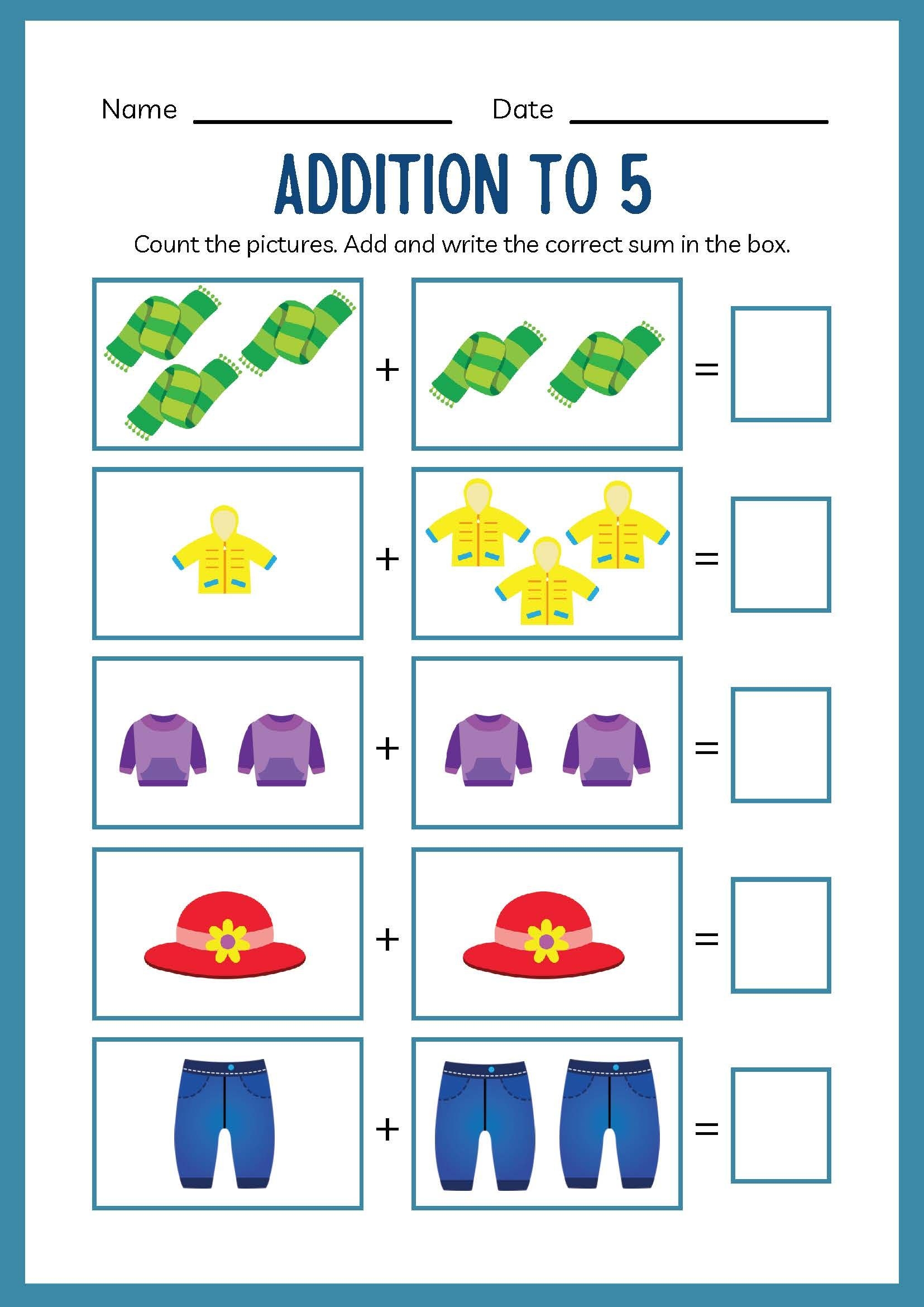
Kindergarten addition worksheets are foundational tools designed to introduce children aged 5–6 to the concept of combining sets. These resources typically focus on sums up to 10 using visual aids like pictures, ten-frames, and number lines to bridge the gap between concrete counting and abstract arithmetic symbols.
The transition from recognizing numbers to performing mathematical operations is one of the most significant milestones in early childhood education. In 2026, the landscape of early childhood pedagogy continues to emphasize a balanced approach between tactile learning and structured paper-and-pencil practice. While digital tools have their place, the physical act of completing an addition worksheet remains a critical component for developing fine motor skills and cognitive retention in young learners.
The Role of Addition Worksheets in the Kindergarten Curriculum
In the current 2026 educational framework, the kindergarten mathematics curriculum is designed around the "Concrete-Representational-Abstract" (CRA) sequence. Addition worksheets serve primarily as the "representational" phase. Before a child picks up a pencil, they should have ample experience moving physical objects—blocks, beads, or counters—to understand that addition is the process of putting groups together.
Worksheets provide the necessary structure to move toward abstract thinking. They transform physical actions into visual symbols. A well-designed worksheet does more than just ask for an answer; it guides the child's logic. For instance, a worksheet featuring three apples plus two apples helps the child see the relationship between the objects and the numerals "3" and "2." This cognitive scaffolding is essential for long-term mathematical fluency.
Developing Numerical Fluency and Subitizing
One of the key skills reinforced by kindergarten addition worksheets is subitizing—the ability to recognize the number of objects in a small group without counting them individually. When a worksheet uses dice patterns or ten-frames, it encourages children to "see" a group of five rather than counting "1, 2, 3, 4, 5." Addition worksheets that incorporate these patterns help students build "number sense," which is the underlying intuition about how numbers relate to one another.
Key Types of Kindergarten Addition Worksheets
Not all worksheets are created equal. To maintain engagement and ensure a comprehensive understanding, educators and parents should utilize several different formats. Each type targets a specific cognitive skill within the realm of early arithmetic.
1. Picture Addition Worksheets
These are the most common entry-level resources. They use recognizable icons—animals, shapes, or fruits—to represent the addends.
- The Goal: To reinforce the idea that numbers represent physical quantities.
- Best For: Introducing the concept of the plus (+) and equals (=) signs for the first time.
2. Ten-Frame Worksheets
A ten-frame is a 2x5 grid. When students use these for addition, they can see how numbers "fill up" toward ten. For example, if a child sees seven dots in a ten-frame, they can easily visualize that three more are needed to reach ten.
- The Goal: To build a strong foundation for "making ten," which is a vital skill for mental math in later grades.
- Best For: Developing spatial awareness of numbers.
3. Number Line Addition
Number lines help children understand that numbers have a specific order and distance. A worksheet might ask a child to start at 3 and take two "hops" forward to reach 5.
- The Goal: To introduce the concept of "counting on" rather than starting from one every time.
- Best For: Students who have mastered basic counting and are ready for more linear mathematical concepts.
4. Dice and Domino Addition
Using the familiar dots on dice or dominoes, these worksheets take advantage of a child's natural subitizing skills.
- The Goal: To speed up the recognition of small sums and prepare for mental math.
- Best For: Building speed and accuracy in basic sums up to 12.
Characteristics of a High-Quality Kindergarten Worksheet
When selecting or creating addition worksheets in 2026, certain technical and pedagogical standards should be met to ensure the child isn't overwhelmed. Early learners have specific physiological and cognitive needs that must be reflected in the document design.
Typography and Visual Clarity
Kindergarteners are still developing their visual tracking skills. A worksheet with too many problems crowded onto one page can cause "visual fatigue" or anxiety.
- Font Size: Use large, clear, sans-serif fonts (like Comic Sans, despite its reputation, or specialized educational fonts like Sassoon Primary).
- White Space: There should be ample room for the child to write their numbers. Small boxes lead to frustration if the child’s fine motor control isn't yet precise.
- Image Quality: Graphics must be distinct. If a child cannot tell if a blurred image is a cat or a dog, they lose focus on the math.
Progressive Difficulty
A structured learning path is essential. The first worksheets in a series should focus on "Sums to 5." Once the child demonstrates 90% accuracy, they should move to "Sums to 10." Jumping straight to sums involving double digits or sums over 10 (like 8+5) can discourage a child who hasn't yet mastered the basic combinations.
Instructions and Language
Instructions should be minimal and accompanied by a visual example. In 2026, many educators follow the "Universal Design for Learning" (UDL) guidelines, which suggest that the task should be self-explanatory through its layout. If a child needs a parent to read complex sentences to understand what to do, the worksheet may be poorly designed for the age group.
Comparing Kindergarten Addition Strategies
The following table outlines the most common strategies utilized in modern kindergarten worksheets and their specific benefits for the learner.
| Strategy | Description | Primary Benefit | Recommended Use |
|---|---|---|---|
| Counting All | Counting every object in both groups starting from one. | Establishes the core concept of addition. | First 2–4 weeks of introduction. |
| Counting On | Starting with the larger number and "counting up" the addend. | Increases efficiency; reduces cognitive load. | After the child recognizes numerals 1-10 instantly. |
| Ten-Frames | Using a 10-compartment grid to visualize numbers. | Builds "anchor to 10" mental math skills. | Daily practice for sums up to 10. |
| Number Lines | Moving forward on a horizontal line of numbers. | Visualizes the "distance" and order of numbers. | Introducing the concept of more vs. less. |
| Color by Number | Solving sums to determine which color to use in an image. | High engagement; improves fine motor skills. | Review sessions and independent work. |
The Impact of Digital Integration in 2026
While traditional printables remain the gold standard for tactile learning, the 2026 educational environment often utilizes "hybrid" worksheets. These are digital files designed for tablets that allow for stylus input.
Technological advancements have introduced "Smart Feedback" worksheets. Unlike a static PDF, these digital versions provide immediate, gentle correction. If a student writes "6" for "3+2," the system might highlight the three objects and two objects again, prompting a recount. However, experts at the National Association for the Education of Young Children (NAEYC) emphasize that screen time should be balanced with physical manipulatives to ensure sensory-motor development.
Printable vs. Digital: Which is Better?
For kindergarteners, the physical act of holding a pencil and forming the number "5" is a multi-sensory experience that aids memory. Research suggests that handwriting activates different neural pathways than typing or clicking. Therefore, while digital worksheets are convenient for travel or quick practice, physical printables are generally recommended for the primary learning phase.
Common Challenges and Troubleshooting
It is common for children to encounter "roadblocks" when first using addition worksheets. Identifying these early can prevent the development of "math anxiety."
- Reversing Numbers: It is developmentally normal for a 5-year-old to write their numbers backward (e.g., writing "3" as "ε"). On a worksheet, focus on the mathematical correctness first rather than the handwriting.
- Losing Count: If a child is "counting all" and gets lost halfway through, encourage them to mark each object with a small "X" as they count it. This is a strategy called "one-to-one correspondence marking."
- Confusion with the Zero: The concept of "0" as a value can be abstract. Worksheets that include "Adding Zero" should be introduced after the child is comfortable with 1-10 to avoid confusion.
- Reliance on Fingers: Do not discourage finger counting. It is a natural manipulative. Over time, as the child completes more worksheets, they will naturally transition to mental recall.
Step-by-Step Guide to Implementing Worksheets at Home
If you are a parent or tutor using these tools in 2026, follow this structured approach to maximize effectiveness:
- Preparation: Print worksheets that match the child’s current level. Ensure you have "counters" (pennies, cereal, or buttons) nearby to model the problems physically if the child gets stuck.
- The "I Do, We Do, You Do" Method:
- I Do: Complete the first problem while explaining your thinking out loud. "I see three birds, and two more come. I count them: 1, 2, 3, 4, 5."
- We Do: Do the second problem together. Ask the child to point to the pictures as you count.
- You Do: Let the child attempt the third problem independently.
- Keep it Short: For a kindergarten student, 10 to 15 minutes of focused worksheet time is more effective than an hour of forced labor. Stop while they are still having fun.
- Celebrate the Process: Focus on the effort and the strategy used rather than just the correct answer. Ask, "How did you know it was six?" to encourage mathematical verbalization.
Frequently Asked Questions
When should a child start using addition worksheets?
Most children are ready for basic addition worksheets once they can consistently count to 20 and recognize numerals 1 through 10. This usually occurs between the ages of 5 and 6. However, it is essential that they first understand the concept of "more" and "less" through physical play.
Are "horizontal" or "vertical" addition problems better for KG?
For beginners, horizontal problems ($2 + 2 = 4$) are often easier to read because they follow the same left-to-right flow as reading a book. Vertical problems are important for later learning (like carrying numbers), but for the kindergarten level, horizontal formats are generally preferred in introductory worksheets.
How many problems should be on a single worksheet?
For a 5-year-old, a single page should ideally contain between 5 and 10 problems. Any more can be visually overwhelming. Quality of engagement is much more important than the quantity of problems solved.
What should I do if my child hates worksheets?
If a child is resistant, pivot to "gamified" addition. Use dice, card games, or addition apps. Worksheets are a tool, not the only way to learn. You can also try "large-scale" worksheets by drawing math problems with sidewalk chalk, which incorporates gross motor movement.
Does my child need to memorize addition facts in Kindergarten?
In 2026, the focus remains on "conceptual understanding" rather than rote memorization. While some children will naturally start to remember that $2+2=4$, the goal of kindergarten is to understand why $2+2=4$. Memorization typically becomes a focus in first and second grade.
Practical Recommendation
To get the most out of addition worksheets for kindergarten, start with highly visual "Picture Addition" pages that focus on sums up to 5. Ensure the environment is distraction-free and provide the child with a variety of writing tools, such as markers or crayons, to make the process more engaging. Always keep physical counters nearby to bridge the gap between the paper and the real world. By focusing on a "success-first" model—where the child feels confident with easy problems before moving to harder ones—you will foster a positive attitude toward mathematics that can last a lifetime.