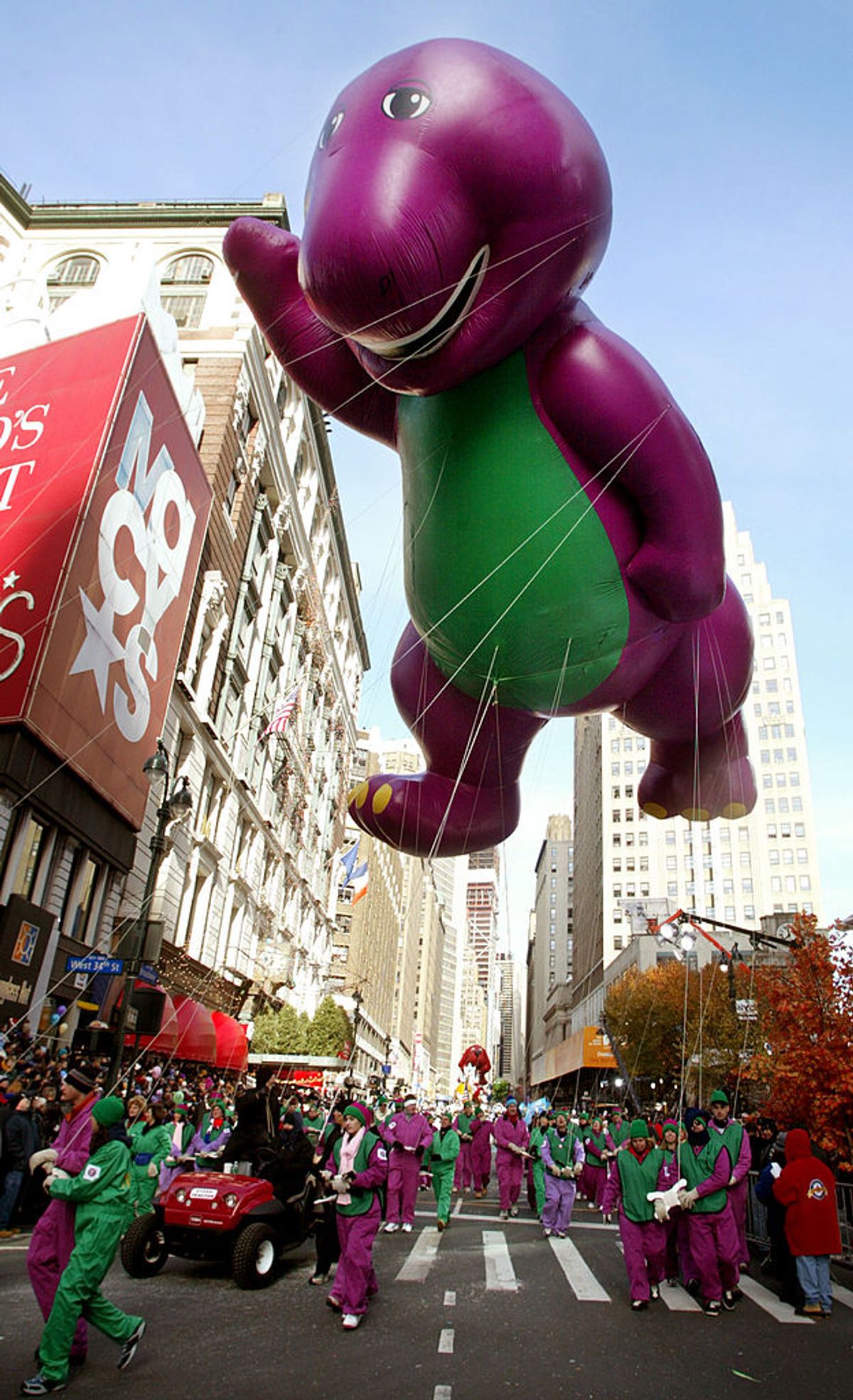
The 1997 Macy’s Thanksgiving Day Parade Barney balloon incident occurred on November 27, 1997, when dangerously high winds caused the Barney the Dinosaur balloon to careen out of control. To prevent spectator injuries, NYPD officers and parade handlers were forced to use knives to tear the balloon apart and deflate it mid-parade, resulting in the iconic character's total destruction.
The Meteorological Perfect Storm: Weather Conditions on November 27, 1997
The 71st annual Macy’s Thanksgiving Day Parade is remembered not for its festive atmosphere, but for its hazardous conditions. On that morning, New York City was buffeted by sustained winds of nearly 30 mph, with gusts reaching 43 to 50 mph. Despite these conditions, the decision was made to proceed with the giant character balloons, a choice that would later face intense scrutiny.
Balloons of this magnitude act as massive "sails." When wind speeds exceed certain thresholds, the surface area of a balloon—such as Barney, which stood several stories tall—captures the air with enough force to lift several handlers off the ground simultaneously. In 1997, the safety protocols regarding wind thresholds were significantly less stringent than they are in 2026. At the time, the decision to ground balloons was largely subjective and left to the discretion of parade officials on the ground rather than being dictated by hard meteorological data and automated sensors.
As the parade progressed down the 2.5-mile route from Central Park West to Herald Square, the wind created "canyon effects" between the skyscrapers. These localized wind tunnels amplified the gusts, making it nearly impossible for the volunteer handlers to maintain the correct angle of the tethers.
The Demise of the Barney Balloon: A Play-by-Play Account
The Barney the Dinosaur balloon, a fan favorite since its debut in 1994, became the most visible victim of the 1997 windstorms. As the Barney unit reached the vicinity of 15th Street and Broadway, the wind caught the balloon's massive purple torso, causing it to pitch violently.
Handlers struggled to keep the balloon at the standard "low-altitude" height usually reserved for windy days. However, the gusts were so erratic that the balloon began to oscillate wildly, dipping toward the crowd and then snapping back upward. The lateral force was so strong that handlers were being dragged across the pavement.
To prevent the balloon from drifting into buildings or power lines, or worse, crashing into the spectators lining the sidewalks, the New York Police Department intervened. In a scene that has since become a staple of "bizarre news" archives, officers and parade staff used utility knives and long-handled hooks to slash the balloon’s fabric. As the helium escaped, the once-cheerful dinosaur collapsed in a heap of shredded polyurethane. While no spectators were injured specifically by the Barney balloon’s destruction, the image of the character being "slaughtered" in front of thousands of children became an indelible, if somewhat grim, part of parade history.
Beyond Barney: The Cat in the Hat and Other 1997 Incidents
While the Barney incident was the most visually dramatic deflation, it was not the most dangerous event of the day. The Cat in the Hat balloon suffered a catastrophic collision at 72nd Street and Central Park West. The wind pushed the Cat into a lamppost, causing the heavy metal arm of the light fixture to snap off.
The falling debris struck 21-year-old Maria Ress, a spectator from Albany, leaving her in a coma for nearly a month and causing permanent brain damage. Three others were also injured by the falling debris. This specific tragedy shifted the narrative from one of "unfortunate weather" to one of "preventable negligence."
Other balloons also struggled throughout the route:
- The Pink Panther: This balloon had to be retired mid-route after being severely damaged by the wind and obstacles.
- Quik Bunny: Like Barney, the Nesquik mascot balloon faced handling issues and required an early deflation to ensure public safety.
- Spider-Man: The web-slinger’s balloon suffered a significant tear when it struck a tree, though it was managed more successfully than the Barney or Cat in the Hat units.
Technical Specifications of the 1997 Barney Balloon
Understanding why the Barney balloon was so susceptible to wind requires a look at its engineering. In the late 90s, Macy's balloons were constructed primarily of high-strength polyurethane, a material chosen for its ability to hold helium and its relative durability.
| Feature | Specification (Approximate) |
|---|---|
| Height | 58 Feet |
| Width | 28 Feet |
| Volume of Helium | 18,000 Cubic Feet |
| Surface Area | ~3,500 Square Feet |
| Number of Handlers | 50–70 Volunteers |
| Material | Polyurethane (multi-chambered) |
The "sail area" of the Barney balloon was immense. Because Barney was designed with a large, upright torso and wide legs, he lacked the aerodynamic profile of sleeker balloons like the Silver C-3PO or Superman. When the wind hit Barney broadside, it generated thousands of pounds of lift and lateral drag. The manual tethering system used by the handlers was simply not designed to counteract those forces once the "angle of attack" of the wind reached a critical point.
Institutional Response: The Task Force on Parade Safety
The fallout from the 1997 parade was immediate. Then-Mayor Rudolph Giuliani and Macy's officials faced intense pressure to ensure such a catastrophe never happened again. This led to the formation of the Macy’s Thanksgiving Day Parade Safety Task Force.
The task force implemented several revolutionary changes that remain the gold standard as of 2026:
- Strict Wind Limits: New regulations mandated that balloons must be grounded if sustained winds exceed 23 mph or if gusts exceed 34 mph. These numbers were determined based on the physics of the 1997 accidents.
- Height Restrictions: Modern balloons are flown at significantly lower altitudes. In 1997, balloons often hovered 50 feet or more above the ground. Today, the height is strictly regulated based on real-time anemometer readings along the route.
- Pilot Training: The role of the "Balloon Pilot" and "Captain" was professionalized. Every balloon team now undergoes rigorous training, and pilots are equipped with communication gear to receive instant weather updates.
- Lamppost Redesign: The city eventually replaced many of the ornate but fragile lampposts along the parade route with more durable, streamlined versions that are less likely to snag a balloon or shatter upon impact.
Comparative Safety Standards: Then vs. Now (2026)
Looking back from 2026, the 1997 incident serves as the "Year Zero" for modern parade safety. The technology used to monitor weather has shifted from simple ground observations to sophisticated Doppler radar and localized ultrasonic anemometers placed every few blocks along the parade route.
In 1997, the handlers were mostly employees or volunteers with minimal physical training for high-wind scenarios. In contemporary parades, while volunteers still pull the tethers, they are led by professional "Flight Operations" teams. These teams use "V-tethers"—advanced anchoring systems that provide better leverage—and sometimes utilize weighted "anchor vehicles" (such as utility trucks) to provide a physical ballast that prevents balloons from lifting off.
Furthermore, the design of the balloons has changed. Modern inflatables often use internal baffles and multi-chambered "kill-switch" vents. These vents allow handlers to rapidly deflate specific sections of a balloon without needing to resort to the "slashing" seen with Barney in 1997.
Frequently Asked Questions
Was the 1997 Barney balloon ever used again?
No. The Barney balloon involved in the 1997 incident was a total loss. Because it was slashed by knives and hooks to ensure a rapid deflation, the polyurethane fabric was too damaged to be repaired safely. A new Barney balloon was eventually commissioned for later parades, but the 1997 version was scrapped.
Did anyone die in the 1997 Macy's Thanksgiving Day Parade?
Fortunately, no one died during the 1997 parade. However, Maria Ress suffered a very serious traumatic brain injury when the Cat in the Hat balloon struck a lamppost. Her injury led to a multi-million dollar lawsuit and was the primary catalyst for the permanent safety changes seen today.
Why didn't Macy's just cancel the balloons before the parade started?
In 1997, the protocols were not as rigid as they are in 2026. There was a strong desire to "keep the show going," and the wind speeds at the start of the parade (at 77th Street) were lower than the gusts that eventually developed in the "urban canyons" further south along the route. Today, such weather would likely result in an automatic grounding of all giant balloons.
How did the police deflate the Barney balloon?
When it became clear the handlers could no longer control the balloon, NYPD officers used utility knives and long poles with blades to puncture the fabric. They targeted the main torso and the base of the limbs to release the helium as quickly as possible. This was done to prevent the balloon from potentially dragging handlers into the air or crashing into a crowd.
Has a balloon ever been slashed like that since 1997?
While balloons have been grounded or retired early due to wind since 1997, the "emergency slashing" of a balloon in front of the crowd is extremely rare. Modern "rip chords" and rapid-deflation valves have made the use of knives largely unnecessary for emergency operations.
Practical Recommendations for Parade Spectators
If you are attending a major parade like the Macy’s Thanksgiving Day Parade in 2026 or beyond, safety should be your top priority. While the 1997 incidents led to massive safety improvements, large-scale events always carry some inherent risk.
- Monitor Official Weather Alerts: If the National Weather Service issues high-wind advisories for New York City, be prepared for the possibility that balloons will be grounded or flown at very low altitudes.
- Stay Behind Barricades: Never lean over or move past the police barricades. These are positioned not just for crowd control, but to provide a "safety buffer" in case a balloon or float veers off course.
- Awareness of Surroundings: In high-wind conditions, stay aware of nearby street furniture, such as lampposts or temporary signage. As seen in the 1997 Cat in the Hat incident, the danger often comes from falling debris rather than the balloon itself.
- Follow Official Directions: If parade marshals or NYPD officers instruct a section of the crowd to move or clear a space for an emergency deflation, do so immediately and without hesitation.
The 1997 Barney balloon incident remains a landmark case study in event management and public safety. It transformed the Macy’s Thanksgiving Day Parade from a purely whimsical celebration into a highly regulated, safety-conscious operation that balances the magic of giant inflatables with the absolute necessity of protecting the millions of people who gather to see them.