Converting 19.90 euros to US dollars requires understanding live foreign exchange rates, mid-market versus retail pricing, and the specific mechanics of currency conversion fees. Because foreign exchange markets fluctuate constantly during business hours, precise conversions depend on when and how a transaction is processed. This guide explores the mechanics of converting specific currency amounts, evaluating conversion fees, and executing international transfers efficiently.
The Mechanics of Foreign Exchange Rates for Minor Amounts
When dealing with a specific figure like 19.90 euros (€19.90), understanding how currency pairs function is essential for accurate valuation. The currency pair for euros to US dollars is written as EUR/USD. The exchange rate indicates how many US dollars are required to purchase a single euro. For instance, if the EUR/USD rate is 1.08, one euro costs $1.08 USD, meaning the base conversion before fees is calculated by multiplying 19.90 by the active exchange rate.
Foreign exchange rates change dynamically from Monday through Friday while global currency markets are open. These fluctuations are driven by macroeconomic indicators, central bank monetary policies—such as interest rate adjustments by the European Central Bank (ECB) and the Federal Reserve—inflation data, geopolitical events, and market sentiment. For smaller sums like €19.90, minor fractional shifts in the exchange rate result in cents of difference, but understanding the baseline rate ensures transparency.
It is vital to distinguish between the mid-market rate and the retail rate offered to consumers. The mid-market rate—sometimes called the interbank rate—is the midpoint between the buy and sell prices of currencies in global markets. This is the benchmark rate reported by financial news platforms and tracking tools. However, retail customers rarely receive this exact rate. Banks, credit card issuers, and money transfer providers typically apply a retail markup or spread to generate revenue.
Mid-Market Rate Versus Retail Conversion Rates
When you check a currency converter online, you almost always see the mid-market rate. This rate represents the wholesale cost of moving money between institutional entities. While helpful for a baseline calculation, applying this rate directly to a personal transaction can be misleading if the service provider uses a different pricing structure.
Retail providers generally monetize currency conversion in one of two ways, or through a combination of both:
- Exchange Rate Markup: The provider adds a percentage margin to the mid-market rate. For example, if the true mid-market rate is 1.0800, a retail provider might offer you a rate of 1.0584, embedding a 2% markup directly into the conversion rate.
- Flat or Percentage Transfer Fees: The provider quotes the true mid-market rate or a close approximation, but charges a separate transaction fee (e.g., a flat €2.00 fee or a percentage of the total amount).
For small transactions such as converting 19.90 euros to dollars, flat fees can disproportionately impact the final value. If a service charges a fixed $5.00 transfer fee on a €19.90 transaction, the fee significantly outweighs the converted value of the currency. Therefore, consumers must evaluate the total cost—combining both exchange rate markups and explicit fees—rather than looking at the exchange rate in isolation.
Practical Example of Converting 19.90 Euros to US Dollars
To illustrate how these variables affect a transaction, consider a hypothetical scenario where the live mid-market rate for EUR/USD is 1.0850.
| Conversion Method / Provider Type | Applied Exchange Rate | Processing Fee | Total USD Received for €19.90 | Effective Cost / Impact |
|---|---|---|---|---|
| True Mid-Market Benchmark | 1.0850 | $0.00 | $21.59 | Theoretical maximum value |
| Traditional High-Street Bank | 1.0525 | $5.00 flat fee | $15.94 | Heavy impact from fixed fee and markup |
| Specialist Transfer Provider | 1.0820 | €0.50 equivalent | $21.03 | Low markup, transparent minor fee |
| Multi-Currency Debit Card | 1.0850 | 0% (standard tier) | $21.59 | Rates close to mid-market with minimal overhead |
As demonstrated in the comparison table, the choice of provider dictates whether the recipient or cardholder receives the full value of the conversion. Traditional banking institutions often impose high fixed costs that make small-ticket conversions financially inefficient, whereas modern multi-currency accounts or specialized fintech platforms preserve more of the underlying asset's value.
Common Methods for Converting Euros to Dollars
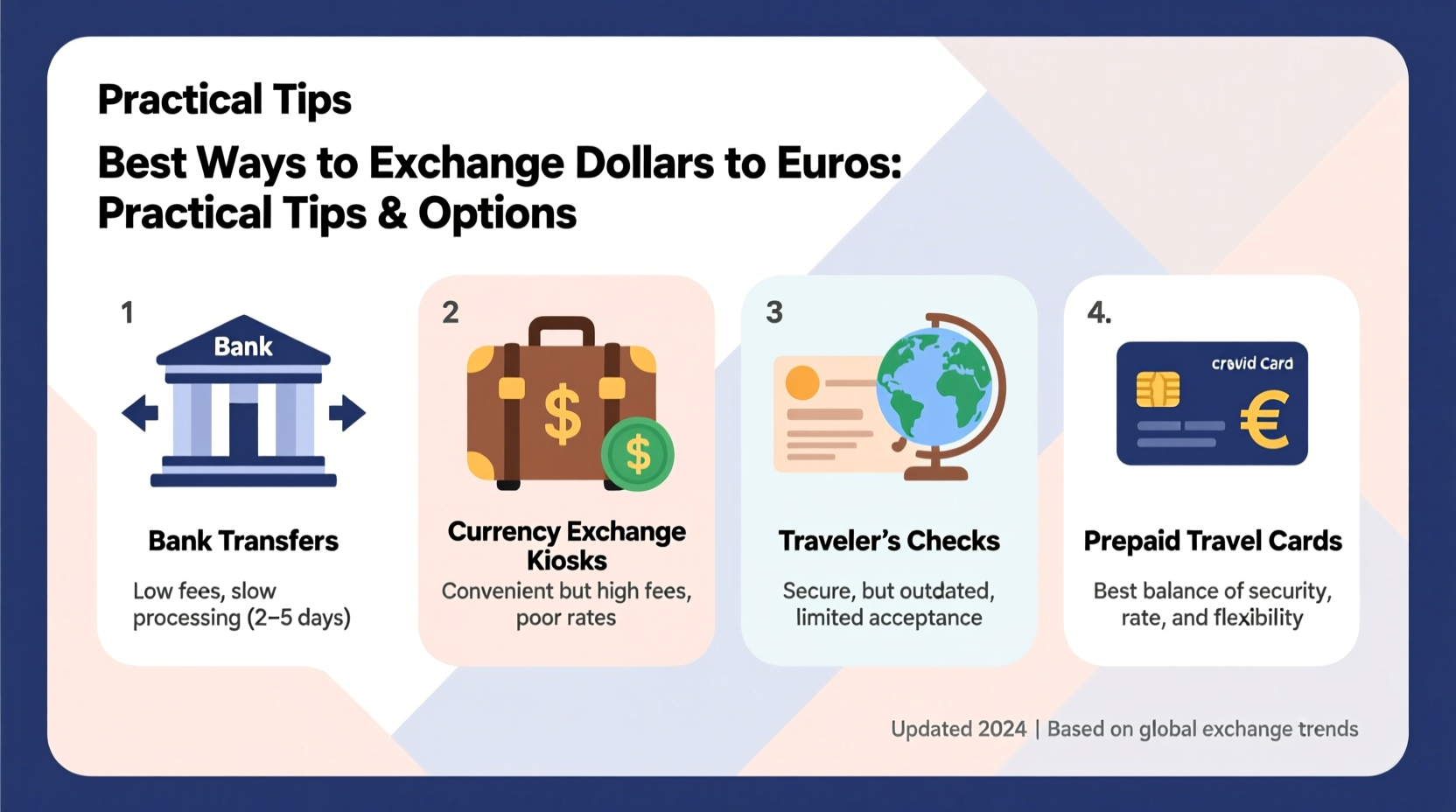
Executing a currency conversion depends on the context of the transaction, such as traveling abroad, making an online purchase from an international merchant, or sending funds to a bank account overseas. Each method carries distinct structural characteristics.
International Credit and Debit Card Purchases
When purchasing a product priced at €19.90 from an online European retailer using a US-issued credit card, the transaction goes through a payment network like Visa or Mastercard. These networks apply their own daily exchange rates, and the card issuer may add a foreign transaction fee, typically ranging from 0% to 3% of the transaction total. Some modern travel-focused credit cards waive these foreign transaction fees entirely.
Dynamic Currency Conversion (DCC)
If you encounter a point-of-sale terminal or online checkout page while traveling or shopping online that offers to charge you directly in US dollars instead of euros, you are being offered Dynamic Currency Conversion. While seeing the price in your home currency appears convenient, DCC providers typically apply unfavorable exchange rates with steep markups—often 5% to 10% above the mid-market rate. It is almost always financially advantageous to decline DCC and choose to be billed in the local currency (euros).
Specialized Money Transfer Services
For peer-to-peer transfers or funding accounts across borders, dedicated currency exchange platforms offer lower margins than traditional wire transfers. These services use batching and local bank clearing networks to minimize intermediate banking fees, allowing users to convert smaller sums with greater cost-efficiency.
Frequently Asked Questions
What is the exact value of 19.90 euros in US dollars right now?
Because foreign exchange rates fluctuate continuously during market hours, the exact value depends on the live second-by-second rate. You can calculate the baseline value by multiplying 19.90 by the current EUR/USD mid-market rate found on a reliable financial tracking platform.
Will I pay a fee when converting 19.90 euros to dollars?
Fees depend entirely on the conversion method you use. Traditional banks often charge flat wire fees or high exchange rate markups, while multi-currency digital wallets and specialized transfer providers may offer lower, more transparent rates. Always review the total landed cost before confirming a transaction.
Should I use Dynamic Currency Conversion when paying in euros?
No. Dynamic Currency Conversion (DCC) allows you to pay in your home currency, but it usually comes with inflated exchange rates and hidden markups. You will almost always get a better rate by choosing to be billed in euros and letting your card issuer handle the conversion.
Why do different currency converters show different rates?
Different platforms pull data from different liquidity providers and may quote the mid-market rate or a retail rate that already includes their profit margin. Financial news sites show the wholesale mid-market rate, whereas consumer exchange services show the retail rate available to customers.
How can I minimize costs on small foreign currency transactions?
For small amounts like €19.90, avoid traditional bank wire transfers, which carry high fixed fees. Instead, use a zero-foreign-transaction-fee credit card, a multi-currency debit card, or a reputable digital wallet designed for low-cost international spending.
Practical Next Steps for Currency Conversion
When managing transactions involving specific amounts like 19.90 euros, verify the live mid-market rate using an independent financial source to establish a fair baseline. Check whether your payment method levies foreign exchange markups or fixed transaction fees, and always opt to be charged in the local currency rather than your home currency when prompted at checkout. By avoiding high-markup retail counters and DCC terminals, you ensure that the maximum possible value of your funds is preserved.