An $sp^2$ carbon is a carbon atom that forms three sigma bonds and one pi bond, resulting in trigonal planar geometry with $120^\circ$ bond angles and hybridization involving one $s$ orbital and two $p$ orbitals.
Understanding the behavior, structure, and reactivity of $sp^2$ hybridized carbon centers is a foundational pillar of organic chemistry. When carbon forms bonds in organic molecules, its electronic configuration undergoes hybridization to maximize stability and optimize spatial orientation. While $sp^3$ carbons dictate the properties of saturated alkanes with tetrahedral geometry, $sp^2$ carbons define unsaturated systems such as alkenes, carbonyl groups, aromatic rings, and carbocations.
Mastering this concept allows chemists to predict molecular shapes, spectroscopic signatures, acidity, and reaction mechanisms. This comprehensive overview explores the foundational principles of $sp^2$ hybridization, its structural consequences, thermodynamic stability factors, and widespread presence across various classes of organic compounds.
Fundamental Concepts of Hybridization
To understand an $sp^2$ carbon, one must first look at the ground-state electron configuration of a neutral carbon atom. Carbon possesses an atomic number of 6, with an electron configuration of $1s^2 2s^2 2p^2$. In bonding, the valence electrons in the second shell ($2s$ and $2p$) participate in forming covalent bonds.
Atomic Orbitals and Promotion
In its ground state, carbon has only two unpaired electrons in its $2p$ subshell ($2p_x$ and $2p_y$), which would theoretically allow it to form only two bonds. However, carbon is tetravalent in the vast majority of stable organic compounds. To account for this, organic chemistry relies on valence bond theory and orbital hybridization.
The process begins with the promotion of one electron from the lower-energy $2s$ orbital to the vacant $2p_z$ orbital. This yields four unpaired valence electrons ($2s^1 2p_x^1 2p_y^1 2p_z^1$), satisfying the requirement for four bonds. However, these orbitals remain energetically and geometrically distinct, which would result in unequal bond lengths and strengths if they bonded directly.
Mixing $s$ and $p$ Orbitals
To achieve equivalent bonds in certain geometries, carbon mixes its atomic orbitals. For $sp^2$ hybridization, one $s$ orbital and two $p$ orbitals (typically designated as $2s$, $2p_x$, and $2p_y$) mathematically combine, or hybridize, to form three degenerate (equal energy) $sp^2$ hybrid orbitals.
One unhybridized $p$ orbital (typically the $2p_z$ orbital) remains unperturbed perpendicular to the plane of the newly formed hybrid orbitals. The resulting configuration has:
- Three $sp^2$ hybrid orbitals pointing outward.
- One pure, unhybridized $p$ orbital oriented at a $90^\circ$ angle to the plane of the hybrid orbitals.
Geometry and Spatial Orientation
The spatial arrangement of an $sp^2$ carbon is governed by Valence Shell Electron Pair Repulsion (VSEPR) theory. Because there are three regions of electron density surrounding the carbon nucleus (the three $sp^2$ hybrid orbitals), these regions maximize their separation by pointing as far away from each other as possible in three-dimensional space.
Trigonal Planar Arrangement
This maximum separation results in a trigonal planar geometry. The angle between any two of the $sp^2$ hybrid orbitals is precisely $120^\circ$, and all three orbitals lie within the exact same flat plane.
[sp2] \ C (120°) / \ [sp2] [sp2]
This flat geometry is a critical structural constraint. Unlike $sp^3$ single bonds, which allow for free rotation around the sigma bond axis, the presence of $sp^2$ carbons—particularly when locked in double-bond frameworks—restricts rotational freedom, giving rise to geometric isomerism (cis/trans or $E/Z$ stereochemistry).
The Role of the Unhybridized $p$ Orbital
Perpendicular to the trigonal planar framework sits the unhybridized $2p$ orbital. This orbital consists of two lobes, one extending directly above the plane of the carbon atoms and the other extending directly below.
When two $sp^2$ carbon atoms approach each other head-on, their respective $sp^2$ hybrid orbitals overlap end-to-end to form a strong sigma ($\sigma$) bond. Simultaneously, their parallel, unhybridized $p$ orbitals overlap side-by-side. This lateral overlap creates a pi ($\pi$) bond, completing the carbon-carbon double bond characteristic of alkenes.
Bonding Characteristics and Comparison
The unique composition of an $sp^2$ carbon—specifically its orbital character percentage—directly dictates its physical and chemical properties compared to $sp^3$ and $sp$ carbons.
S-Character and Electronegativity
An $sp^2$ hybrid orbital is composed of 33.3% $s$-character and 66.7% $p$-character (one part $s$ out of three total orbitals).
- $sp^3$ carbon: 25% $s$-character
- $sp^2$ carbon: 33.3% $s$-character
- $sp$ carbon: 50% $s$-character
Because $s$ orbitals are spherical and held closer to the positively charged nucleus than dumbbell-shaped $p$ orbitals, a higher percentage of $s$-character increases the effective electronegativity of the carbon atom. Consequently, an $sp^2$ carbon is more electronegative than an $sp^3$ carbon. This means an $sp^2$ carbon holds its valence electrons more tightly, influencing bond lengths, bond strengths, and inductive effects in adjacent functional groups.
Comparative Properties of Carbon Hybridization States
| Property | $sp^3$ Carbon (Alkanes) | $sp^2$ Carbon (Alkenes/Carbonyls) | $sp$ Carbon (Alkynes) |
|---|---|---|---|
| Geometry | Tetrahedral | Trigonal Planar | Linear |
| Bond Angle | $109.5^\circ$ | $120^\circ$ | $180^\circ$ |
| S-Character | 25% | 33.3% | 50% |
| C-H Bond Length | ~1.09 Å | ~1.08 Å | ~1.06 Å |
| C-C Single Bond Length | ~1.54 Å | ~1.50 Å (in dienes) | ~1.43 Å |
| Rotational Freedom | Free rotation | Restricted (by $\pi$ bond) | Restricted (by two $\pi$ bonds) |
Major Functional Groups Containing $sp^2$ Carbons
The $sp^2$ carbon is not restricted to simple alkenes; it is a foundational component of numerous critical organic functional groups.
1. Alkenes (Olefins)
In alkenes, a carbon-carbon double bond consists of one $\sigma$ bond and one $\pi$ bond. Each carbon involved in the double bond is $sp^2$ hybridized. The double bond forces the local molecular framework into a rigid, planar geometry, preventing rotation without breaking the $\pi$ bond.
2. Carbonyl Compounds
Carbonyl groups—found in aldehydes, ketones, carboxylic acids, esters, and amides—contain a carbon double-bonded to an oxygen atom ($C=O$). The carbonyl carbon is $sp^2$ hybridized.
- It forms three $\sigma$ bonds: one to oxygen and two to adjacent carbon or hydrogen atoms.
- The remaining unhybridized $p$ orbital on carbon overlaps with a $p$ orbital on oxygen to form a $\pi$ bond.
- Because oxygen is significantly more electronegative than carbon, it pulls electron density through the $\pi$ bond, making the $sp^2$ carbonyl carbon electrophilic (electron-deficient) and highly susceptible to nucleophilic attack.
3. Aromatic Systems (Benzene and Derivatives)
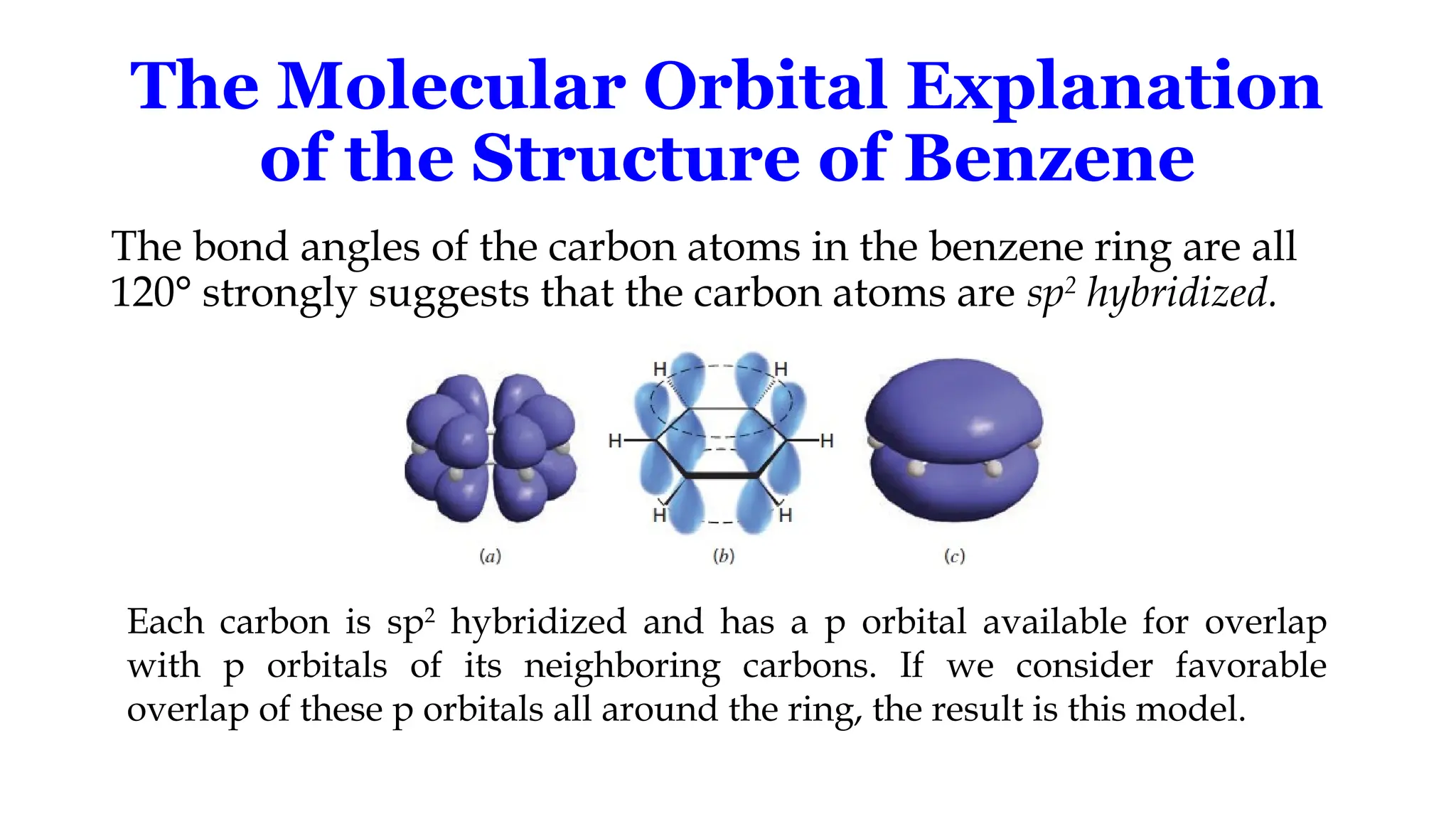
Aromatic compounds are characterized by cyclic, conjugated systems of $sp^2$ carbon atoms. In benzene ($C_6H_6$), every carbon atom is $sp^2$ hybridized and forms a planar ring with $120^\circ$ bond angles.
- Each carbon uses two $sp^2$ orbitals to bond to adjacent carbons and one to bond to a hydrogen atom.
- The remaining unhybridized $p$ orbital on each of the six carbons overlaps continuously above and below the ring plane, creating a delocalized cloud of $\pi$ electrons that provides exceptional thermodynamic stability (aromaticity).
4. Carbocations and Free Radicals
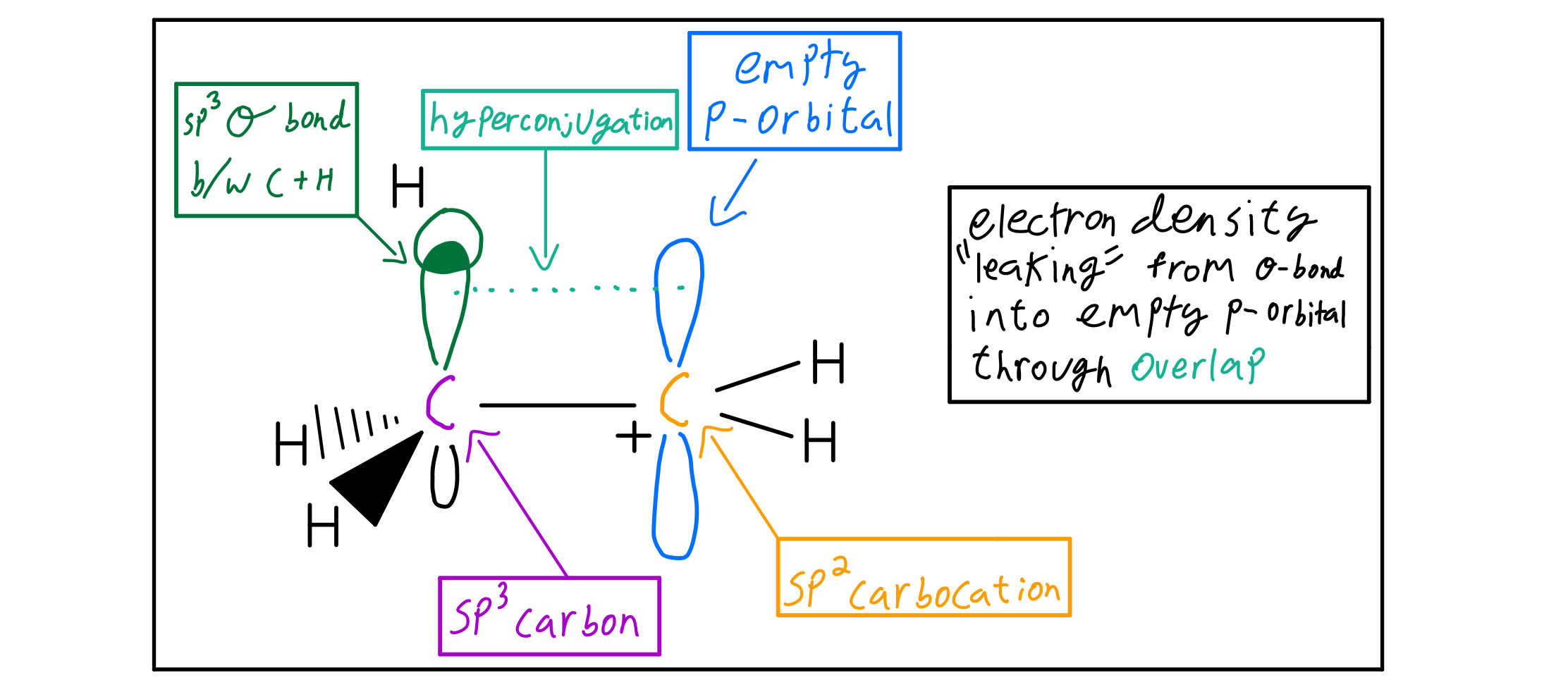
- Carbocations: A positively charged carbon atom with only six valence electrons typically adopts an $sp^2$ hybridization state. The empty, unhybridized $p$ orbital lies perpendicular to the three substituent groups, allowing neighboring electron-donating groups to stabilize the positive charge via hyperconjugation or resonance.
- Carbon Radicals: A carbon radical possesses an unpaired electron. While many simple radicals rapidly invert, they frequently exhibit partial $sp^2$ character with the single electron residing in an unhybridized $p$ orbital, leading to a planar or shallow pyramidal geometry.
Spectroscopic Identification of $sp^2$ Carbons
Analytical chemistry relies heavily on spectroscopic techniques to identify and verify the presence of $sp^2$ carbons within unknown organic structures.
Infrared (IR) Spectroscopy
The presence of $sp^2$ hybridized carbons can be inferred from characteristic stretching frequencies in an IR spectrum:
- $=C-H$ Stretch: Unlike $sp^3$ $C-H$ stretches, which appear just below $3000\text{ cm}^{-1}$ (typically $2850–2960\text{ cm}^{-1}$), $sp^2$ $C-H$ stretches appear above $3000\text{ cm}^{-1}$ (typically $3010–3100\text{ cm}^{-1}$). This shift is directly attributable to the higher $s$-character and stronger force constant of the $sp^2$ $C-H$ bond.
- $C=C$ Stretch: Alkene $C=C$ stretching vibrations typically appear as medium-to-weak absorptions around $1640–1680\text{ cm}^{-1}$.
- $C=O$ Stretch: Carbonyl $C=O$ stretches are sharp, intense bands appearing around $1680–1750\text{ cm}^{-1}$.
Nuclear Magnetic Resonance (NMR) Spectroscopy
Both $^{1}\text{H}$ and $^{13}\text{C}$ NMR spectroscopy provide definitive proof of $sp^2$ carbon environments:
- $^{13}\text{C}$ NMR: $sp^2$ carbons in alkenes and aromatic rings typically resonate in the chemical shift ($\delta$) range of $100 to $150\text{ ppm}$. Carbonyl $sp^2$ carbons are even more deshielded due to the strong electron-withdrawing effect of oxygen, appearing further downfield between $160$ and $210\text{ ppm}$.
- $^{1}\text{H}$ NMR: Protons attached directly to $sp^2$ carbons (vinylic protons) experience deshielding from the anisotropic magnetic field generated by the $\pi$ electrons, typically appearing in the $4.5$ to $6.5\text{ ppm}$ region. Aromatic protons appear further downfield between $6.5$ and $8.5\text{ ppm}$.
Common Misconceptions and Troubleshooting
When studying or applying the concepts of $sp^2$ hybridization, students and professionals often encounter specific conceptual hurdles.
1. Confusing Geometry with Hybridization State
A common error is assuming that any flat molecule must consist entirely of $sp^2$ carbons. While trigonal planar geometry is a direct hallmark of $sp^2$ centers, atoms in adjacent positions or within complex fused ring systems can experience steric strain that distorts bond angles away from the ideal $120^\circ$ without altering their fundamental hybridization.
2. Assuming Equal Reactivity Across All $sp^2$ Centers
Not all $sp^2$ carbons behave the same way chemically. An alkene $sp^2$ carbon is electron-rich and acts as a nucleophile, reacting primarily with electrophiles. Conversely, a carbonyl $sp^2$ carbon is electron-deficient and acts as an electrophile, reacting primarily with nucleophiles. Recognizing the electronic context—such as inductive and resonance effects—is vital for accurate mechanistic predictions.
Frequently Asked Questions
What is the bond angle of an $sp^2$ hybridized carbon?
An ideal $sp^2$ hybridized carbon has a bond angle of $120^\circ$. This angle arises from VSEPR theory, where three regions of electron density spread as far apart as possible within a single two-dimensional plane.
How does $sp^2$ hybridization differ from $sp^3$ hybridization?
An $sp^3$ carbon forms four single sigma bonds with tetrahedral geometry ($109.5^\circ$ angles and 25% $s$-character), allowing free rotation. An $sp^2$ carbon forms three sigma bonds and one pi bond with trigonal planar geometry ($120^\circ$ angles and 33.3% $s$-character), restricting bond rotation and introducing unsaturation.
Why are $sp^2$ C-H bonds shorter than $sp^3$ C-H bonds?
Because $sp^2$ hybrid orbitals possess 33.3% $s$-character compared to 25% in $sp^3$ orbitals, the electrons are held closer to the carbon nucleus. This tighter electrostatic attraction shortens the bond length and increases bond strength.
How can you identify an $sp^2$ carbon using IR spectroscopy?
You can identify $sp^2$ carbons by looking for $C-H$ stretching absorption bands occurring above $3000\text{ cm}^{-1}$ (typically between $3010$ and $3100\text{ cm}^{-1}$), as well as characteristic $C=C$ or $C=O$ double bond stretching signals below $1800\text{ cm}^{-1}$.
Do carbocations always have $sp^2$ hybridization?
Most simple alkyl carbocations are $sp^2$ hybridized and adopt a trigonal planar geometry with an empty, unhybridized $p$ orbital perpendicular to the plane. However, highly strained cyclic carbocations can exhibit significant geometric distortion and pyramidization.
Conclusion and Next Steps
The $sp^2$ carbon atom is a cornerstone of organic chemistry, dictating the structure, rigidity, electronic distribution, and reactivity of unsaturated functional groups. By mastering the interplay between $s$-character, trigonal planar geometry, and unhybridized $p$ orbitals, chemists can accurately predict molecular behavior across synthesis, spectroscopy, and reaction mechanisms. To build upon this foundation, examine the mechanisms of electrophilic addition to alkenes and nucleophilic addition to carbonyl compounds, observing how $sp^2$ carbon centers transition into $sp^3$ intermediates during chemical reactions.