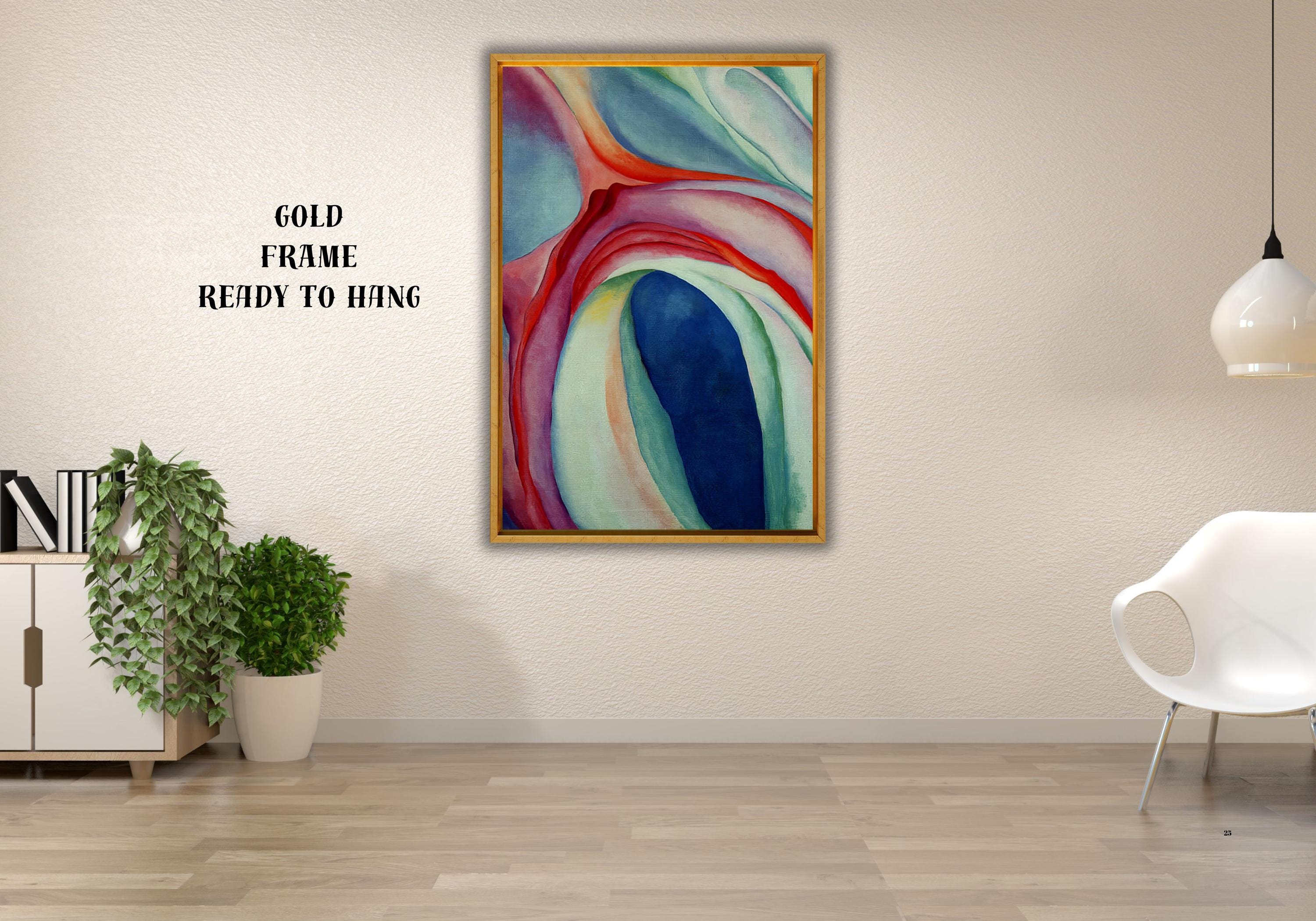
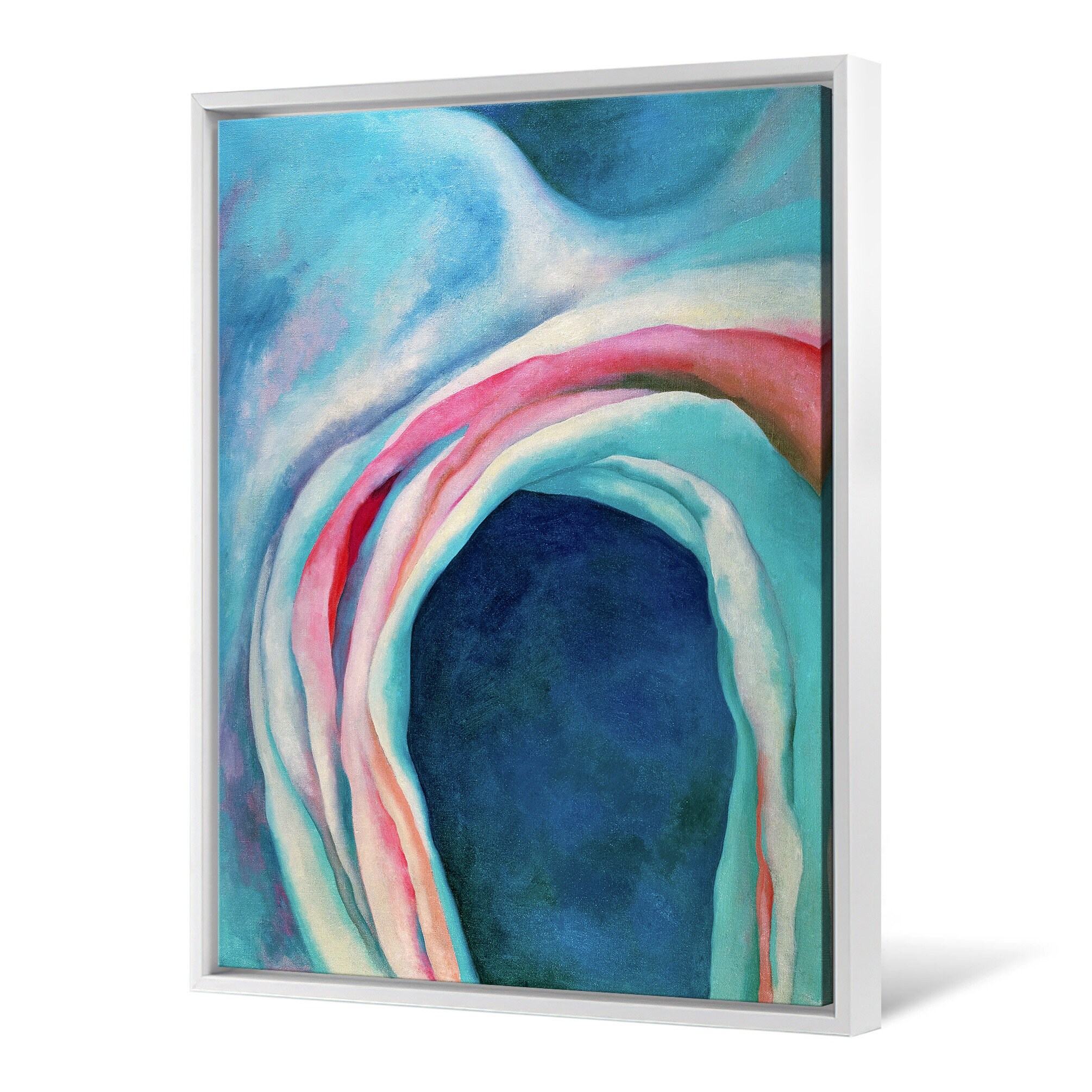
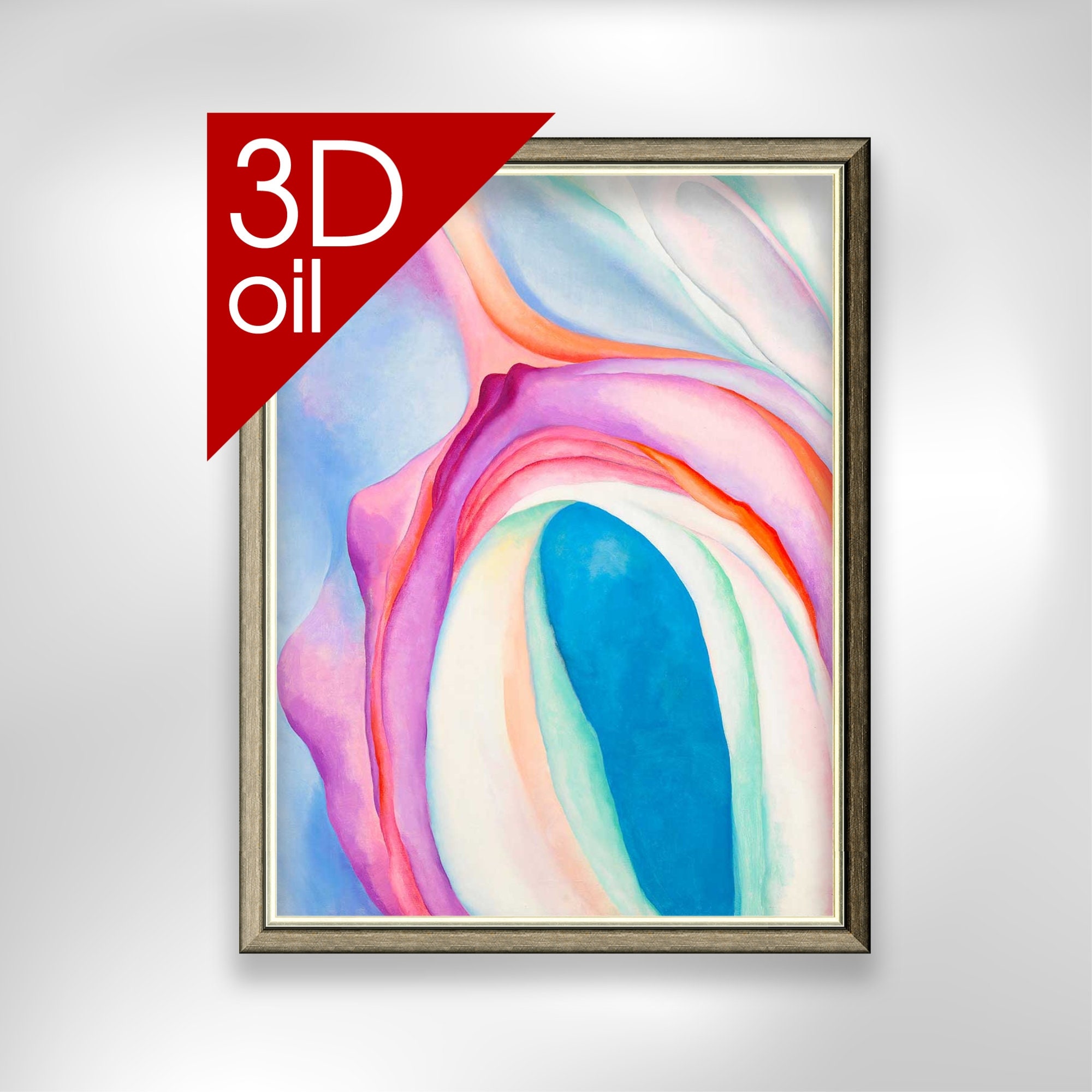
Music, Pink and Blue No. 2 is a landmark oil painting created by American artist Georgia O’Keeffe in 1918. It is a foundational work of American modernism that explores the relationship between visual color and auditory experience, currently held in the permanent collection of the Whitney Museum of American Art in New York City.
The Genesis of Music, Pink and Blue No. 2
To understand the significance of Music, Pink and Blue No. 2, one must look at the specific moment in Georgia O'Keeffe's life when it was produced. In 1918, O'Keeffe made a definitive move from Texas to New York City, a transition facilitated by the photographer and gallerist Alfred Stieglitz. This year marked her professional commitment to painting full-time and her shift from working primarily in charcoal and watercolor to mastering oil on canvas.
The painting is part of a small, experimental series where O'Keeffe sought to translate the ephemeral nature of music into a tangible, visual medium. At the time, the European avant-garde—most notably Wassily Kandinsky—was obsessed with "synesthesia," the idea that one sense could trigger another. Kandinsky’s treatise, Concerning the Spiritual in Art, argued that colors had specific "sounds" and that art should strive for the purity of music. O'Keeffe, while developing her own distinct American vernacular, was deeply influenced by these theories. She wanted to see if she could create a visual language that didn't rely on "things" (objects, people, landscapes) but instead relied on the emotional resonance of form and hue.
The "No. 2" in the title indicates it was the second major iteration of this specific exploration. While Music, Pink and Blue No. 1 (also 1918) features more jagged, energetic lines, No. 2 is characterized by smoother, more architectural arches and a sense of profound interiority. This evolution shows O'Keeffe moving toward the "organic abstraction" that would define her career for the next six decades.
Visual and Technical Analysis of the Composition
The composition of Music, Pink and Blue No. 2 is deceptive in its simplicity. It features a central, swelling void framed by undulating bands of pink, blue, and off-white. The scale of the work (approximately 35 x 29 inches) is intimate yet psychologically expansive.
The Color Palette and Luminous Technique
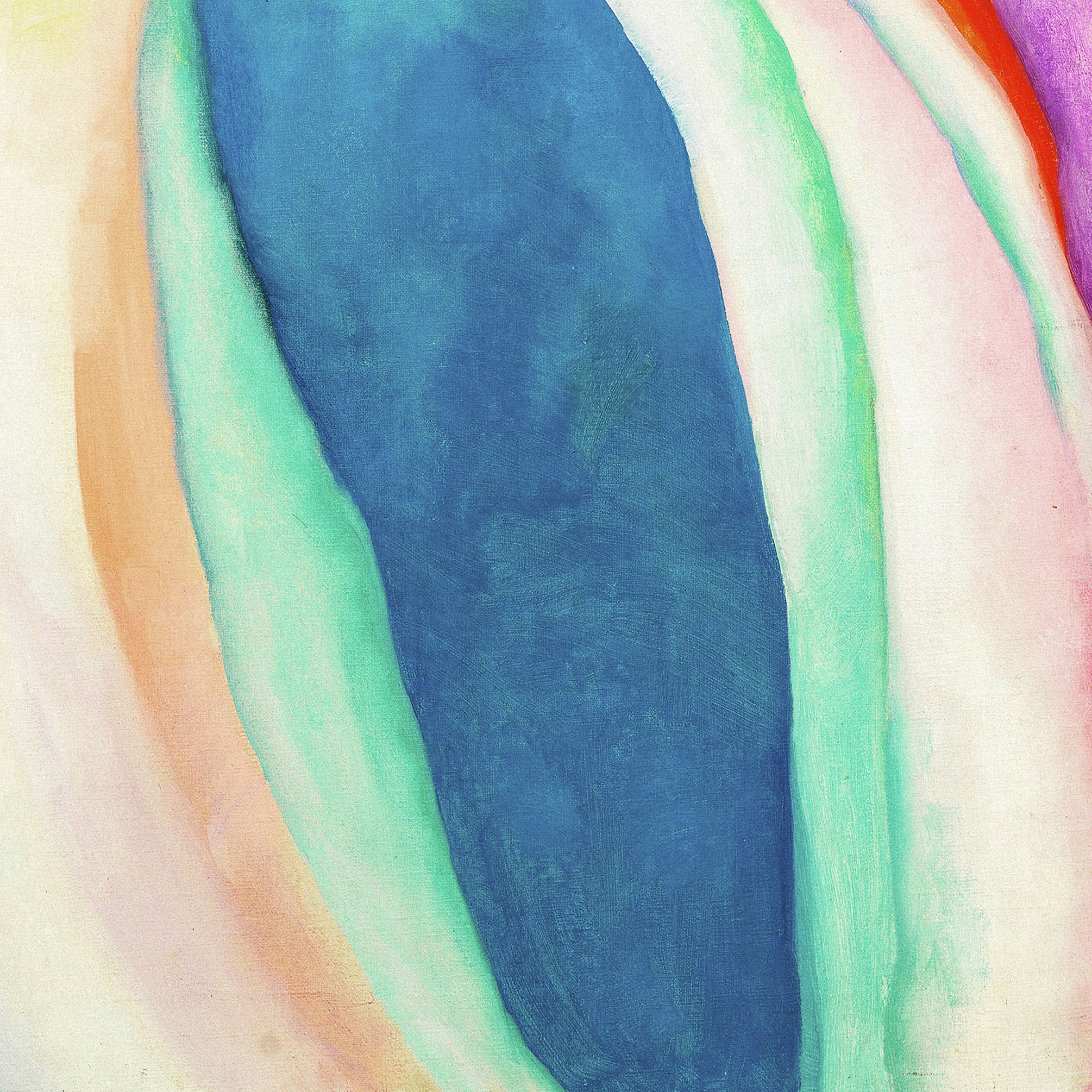
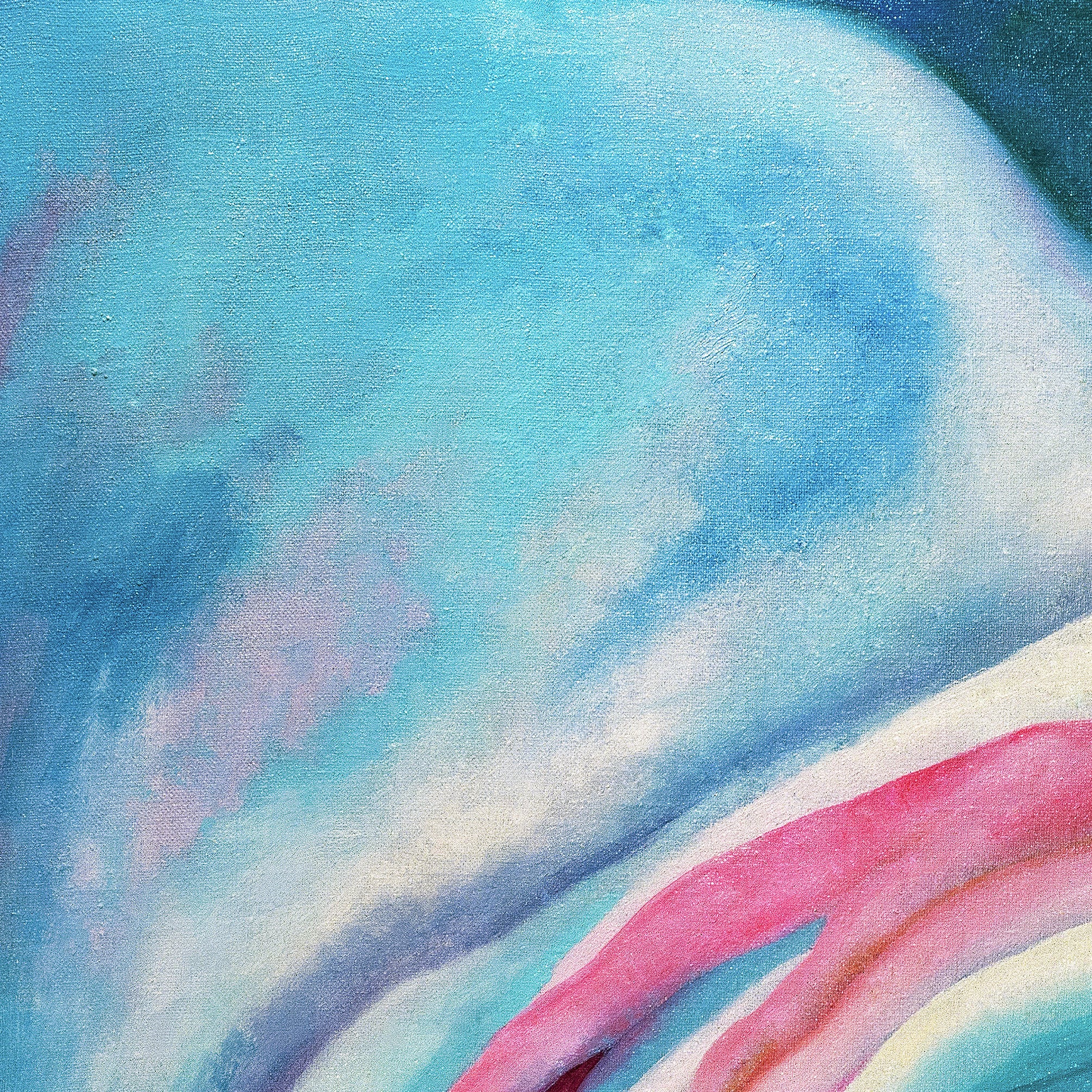
O'Keeffe’s use of color in this piece is a masterclass in tonal modulation. The "Pink" is not a single shade but a gradient ranging from pale flesh tones to deep, vibrant corals. Similarly, the "Blue" shifts from an airy cerulean to a dense, midnight navy at the edges of the central opening.
What makes the painting technically remarkable is how O'Keeffe applied the oil paint. Having spent years working with watercolors, she brought a "wash-like" sensibility to her oils. She applied the paint in thin, precise layers, blending them so seamlessly that brushstrokes are almost invisible to the naked eye. This creates a luminous effect, where the light seems to emanate from within the canvas rather than reflecting off its surface. This luminosity is essential to the "musical" quality of the work; the colors appear to vibrate or hum, mimicking the sustain of a musical chord.
Structural Abstraction
The painting utilizes a vertical orientation that draws the eye upward and then inward. The central "archway" or "portal" is the focal point. Around 1918, O'Keeffe was experimenting with the concept of "filling a space in a beautiful way," a philosophy she learned from her teacher Arthur Wesley Dow. In Music, Pink and Blue No. 2, the negative space is just as active as the positive space. The dark blue center acts as a visual "bass note," providing a deep foundation for the lighter, "treble" pinks that dance around the edges.
The Interpretive Conflict: Abstraction vs. Biology
For over a century, Music, Pink and Blue No. 2 has been at the center of one of the most famous debates in art history. When the work was first exhibited, critics—predominantly men, including Alfred Stieglitz—interpreted the painting through a Freudian lens. They saw the central opening and the soft, fleshy folds of pink as an explicit representation of female anatomy.
The Critic's Perspective
Stieglitz promoted O'Keeffe's work as the visual manifestation of "womanhood." To the critics of the 1920s, the painting was a "psychological explosion" of feminine desire. This interpretation was so pervasive that it became the standard way to view O'Keeffe's abstract work for decades. In their view, the "Music" title was a mere veil for a more biological exploration.
O'Keeffe's Rebuttal
O'Keeffe herself famously and consistently denied these sexualized interpretations. She expressed frustration that her work was being reduced to her gender. In her view, the painting was an exercise in pure abstraction. She stated that people were projecting their own "preoccupations" onto her canvases. For O'Keeffe, the shapes were inspired by the sky, the hills, and the way sound felt in her mind.
As of 2026, modern art historians generally take a more balanced view. While acknowledging that O'Keeffe’s work often resonates with organic and biological forms, they respect her intent of synesthetic abstraction. The painting is now celebrated not just as a "feminine" work, but as a sophisticated contribution to the global movement of non-objective art.
Technical Specifications and Comparative Analysis
When analyzing Music, Pink and Blue No. 2, it is helpful to compare it to its predecessor to see the artist's progression during that pivotal year.
| Feature | Music, Pink and Blue No. 1 | Music, Pink and Blue No. 2 |
|---|---|---|
| Year Produced | 1918 | 1918 |
| Medium | Oil on canvas | Oil on canvas |
| Dimensions | 35 x 29 1/8 in. | 35 x 29 7/8 in. |
| Primary Movement | Centrifugal (moving outward) | Centripetal (moving inward) |
| Key Colors | Bright pink, light blue, white | Coral, deep navy, cream |
| Current Location | Seattle Art Museum | Whitney Museum of American Art |
| Subjective Mood | Energetic, explosive | Meditative, architectural |
The comparison reveals that while both paintings share a palette and a theme, No. 2 is a more "resolved" composition. The lines in No. 2 are more deliberate, and the sense of depth is more profound. It represents O'Keeffe's growing confidence in the oil medium.
The Importance of Provenance and Conservation
The journey of Music, Pink and Blue No. 2 from O'Keeffe's studio to the Whitney Museum is a testament to its enduring value. The painting was gifted to the Whitney Museum of American Art by the artist herself, ensuring its place in the canon of American history.
Conservation Challenges
Maintaining a painting from 1918 requires significant expertise. The thin layers of oil O'Keeffe used are susceptible to "craquelure" (fine cracking) if the environment is not strictly controlled. Furthermore, the light blues and pinks she favored are sensitive to UV exposure. As of 2026, the Whitney utilizes advanced LED lighting and climate-controlled vitrines to ensure the pigments remain as vibrant as they were when O'Keeffe first applied them.
Viewing the Work in 2026
For those visiting the Whitney Museum of American Art, the painting is often displayed alongside other early American modernists like Arthur Dove and Marsden Hartley. Seeing it in person is the only way to truly appreciate the "music" within the frame. The scale of the painting allows it to occupy the viewer’s entire field of vision, creating an immersive experience that digital reproductions cannot replicate.
Practical Guidance for Students and Collectors
If you are studying this work or looking for similar aesthetic qualities in modern art, there are several key elements to focus on:
- Look for the "Edge": Notice how O'Keeffe handles the boundaries between colors. There is rarely a hard line; instead, there is a soft "feathering" that creates the illusion of movement.
- Understand the Verticality: Unlike traditional landscapes that use a horizontal "window" view, O'Keeffe uses a vertical "portrait" orientation for an abstract landscape. This forces the viewer to look "up" into the light.
- Contextualize the 1918 Era: Remember that this was painted at the end of World War I and during the height of the Spanish Flu pandemic. The serene, orderly, and beautiful nature of the work was a radical counterpoint to the chaos of the world at that time.
For collectors interested in this style, "O'Keeffe-esque" abstraction is a significant niche. While an original 1918 O'Keeffe is a multi-million dollar museum piece, the principles of organic abstraction—focusing on color gradients and natural forms—continue to influence contemporary artists in 2026.
Frequently Asked Questions
Why is the painting called "Music" if there are no instruments in it?
The title refers to the concept of synesthesia. Georgia O'Keeffe believed that music could be translated into visual forms. The shapes and colors in the painting are meant to represent the feeling and structure of a musical composition rather than a literal depiction of a musician or instrument.
Is Music, Pink and Blue No. 2 a feminist painting?
While many feminist art historians in the 1970s reclaimed this work as an icon of female-centric art, the artist herself rejected that label. She viewed it as a study in color and form. However, its importance to the history of women in art is undeniable, as it was one of the first major abstract works by a woman to gain international acclaim.
Where can I see the painting today?
The painting is part of the permanent collection of the Whitney Museum of American Art in New York City. Because it is a "star" of their collection, it is frequently on display, but it is always wise to check the museum's current exhibition schedule before visiting.
What is the difference between No. 1 and No. 2?
The primary difference is the composition's "energy." No. 1 is more open and features jagged, lightning-like forms. No. 2 (the more famous of the two) is more structured, featuring a centralized arch and smoother transitions between the colors.
Did Alfred Stieglitz influence this painting?
Yes, but perhaps not in the way he intended. Stieglitz provided the financial support and the gallery space for O'Keeffe to create this work, but his narrow, gendered interpretations of her art often frustrated her and pushed her to be even more defensive about her abstract goals.
Final Recommendation
To fully appreciate Music, Pink and Blue No. 2, one should approach it without the baggage of historical interpretations. Instead of looking for "hidden shapes" or biological metaphors, allow the eyes to follow the gradients of color and the swell of the arches. Treat the painting as a visual symphony. For those looking to dive deeper into O'Keeffe's transition into abstraction, a visit to the Georgia O'Keeffe Museum in Santa Fe, New Mexico, provides excellent context for her early New York period and the sketches that led to this masterpiece.