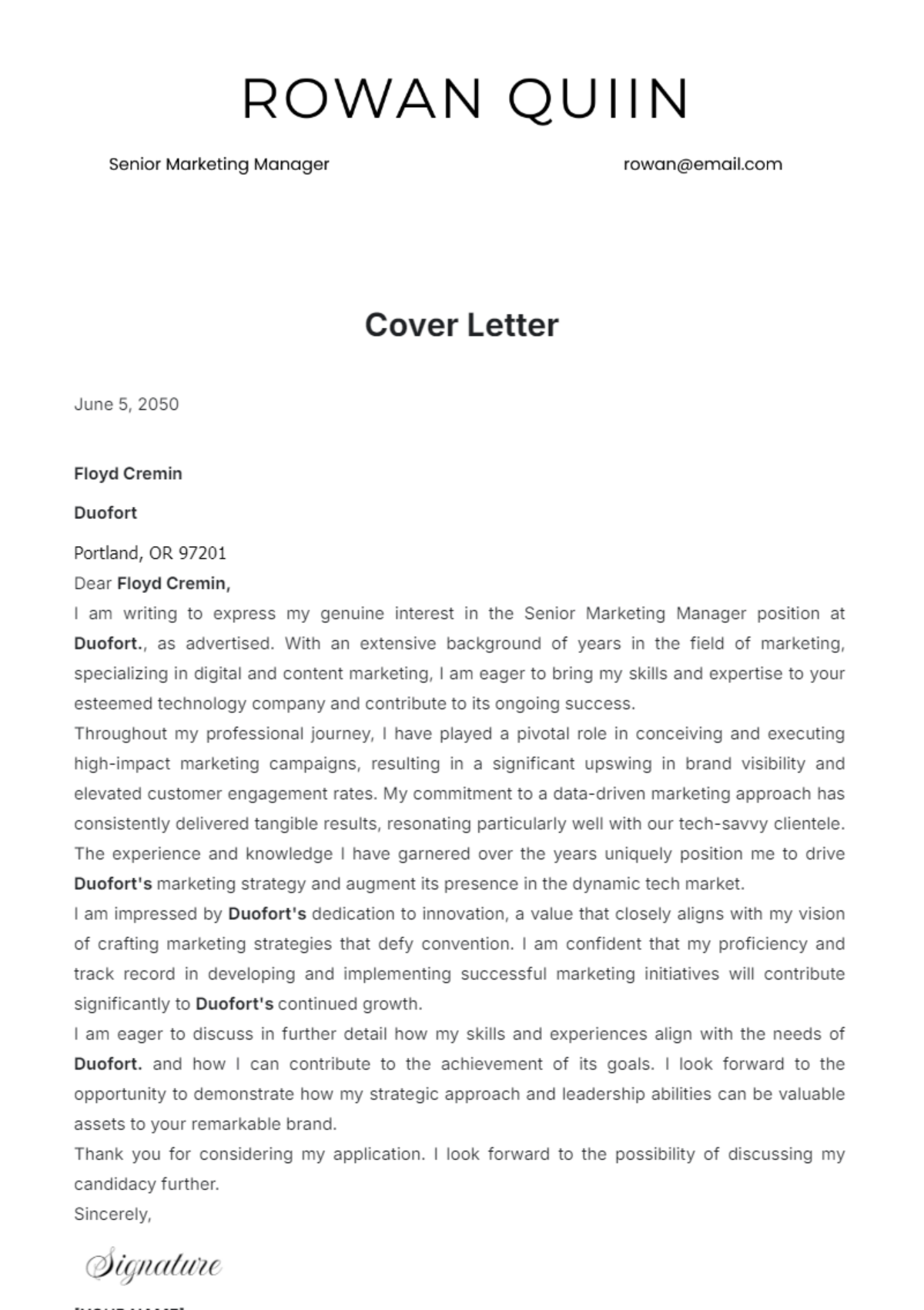
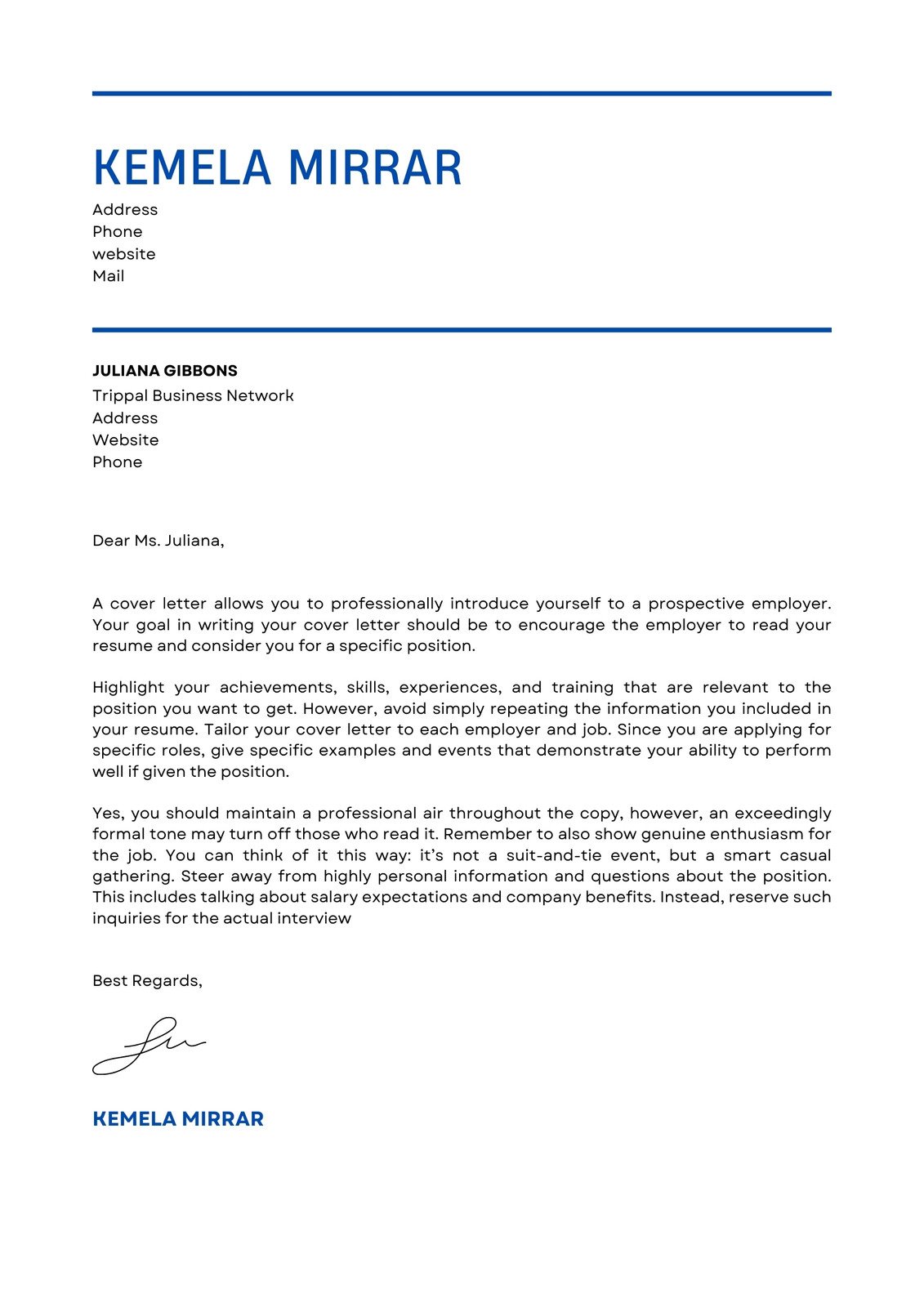
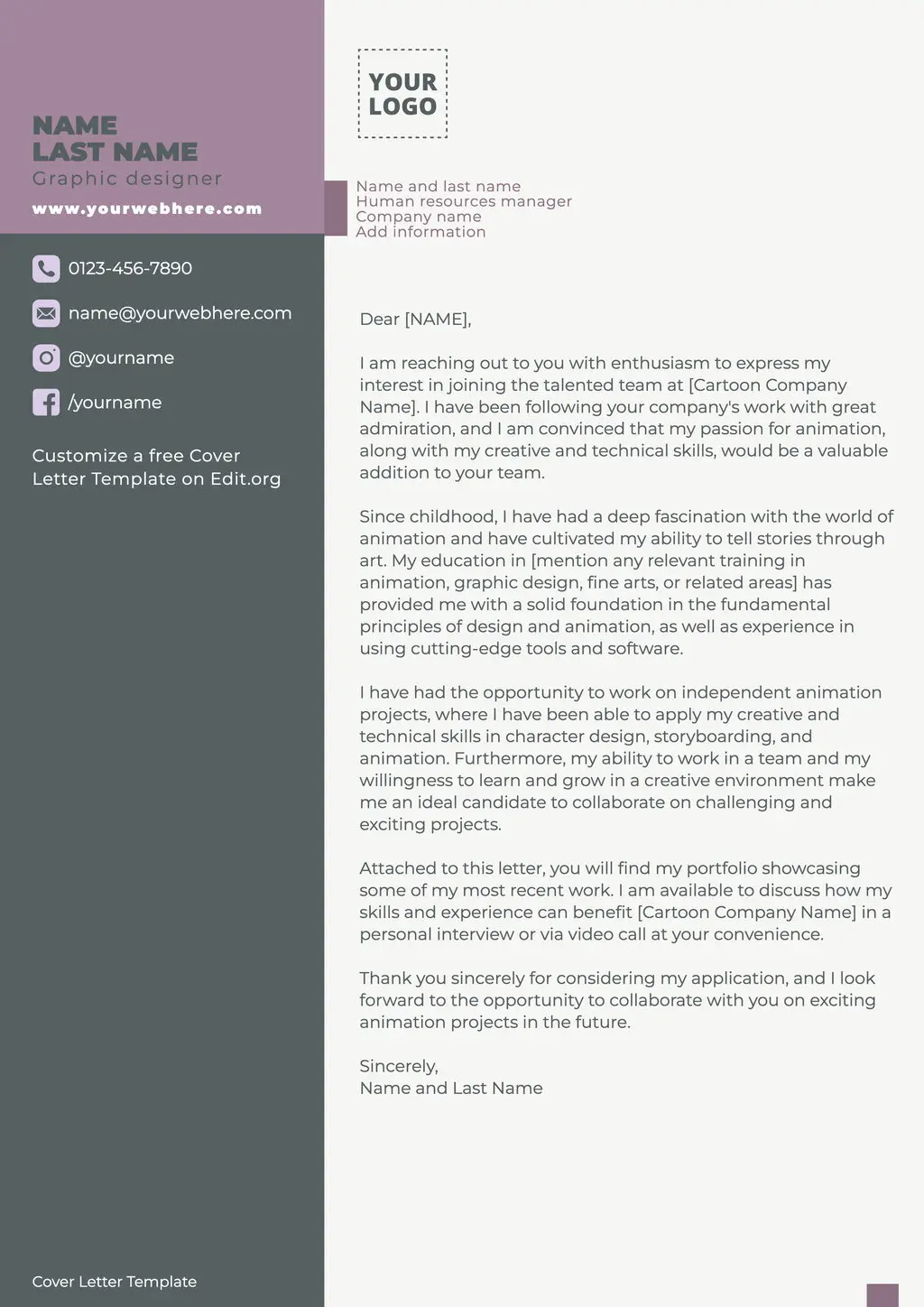
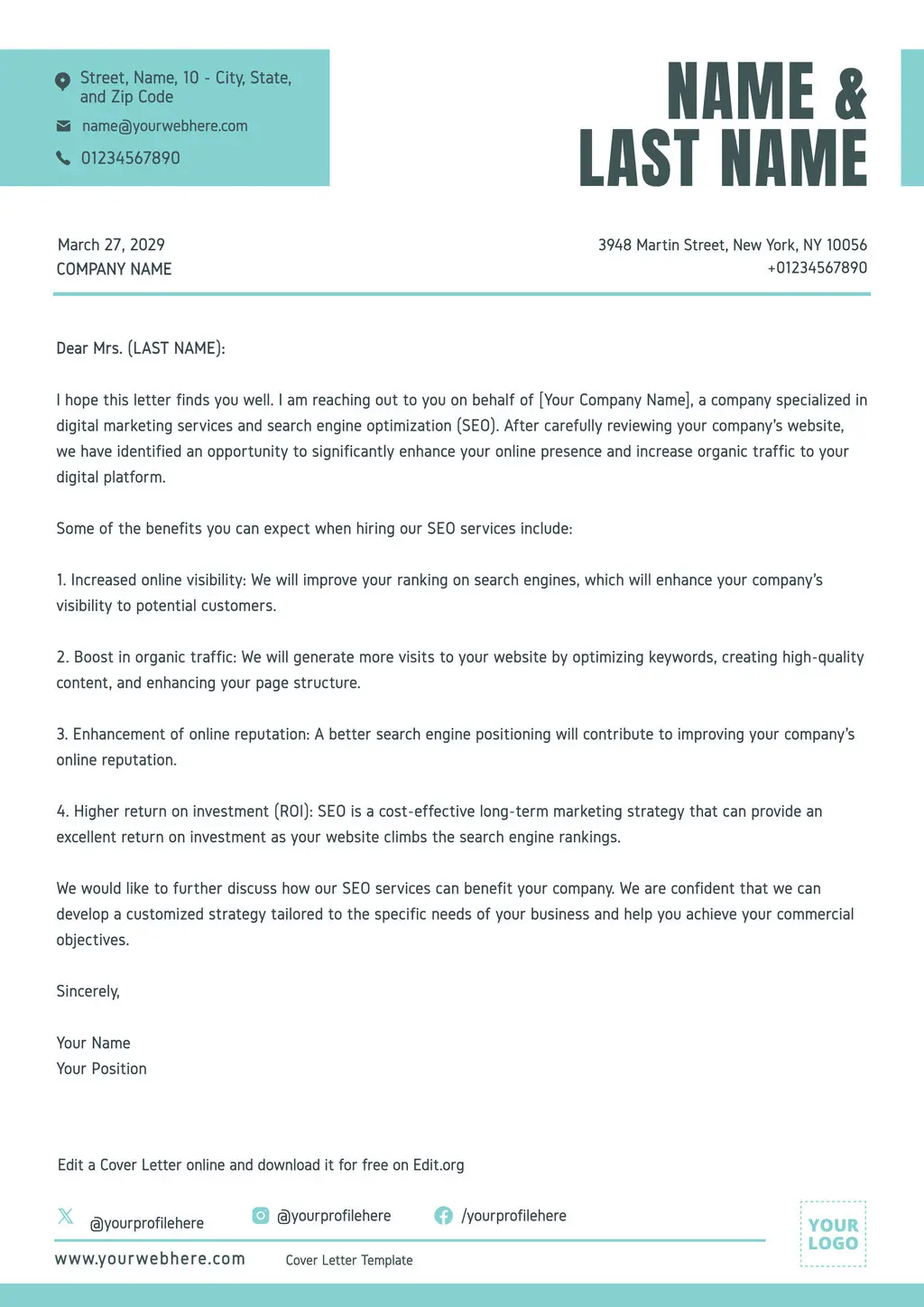
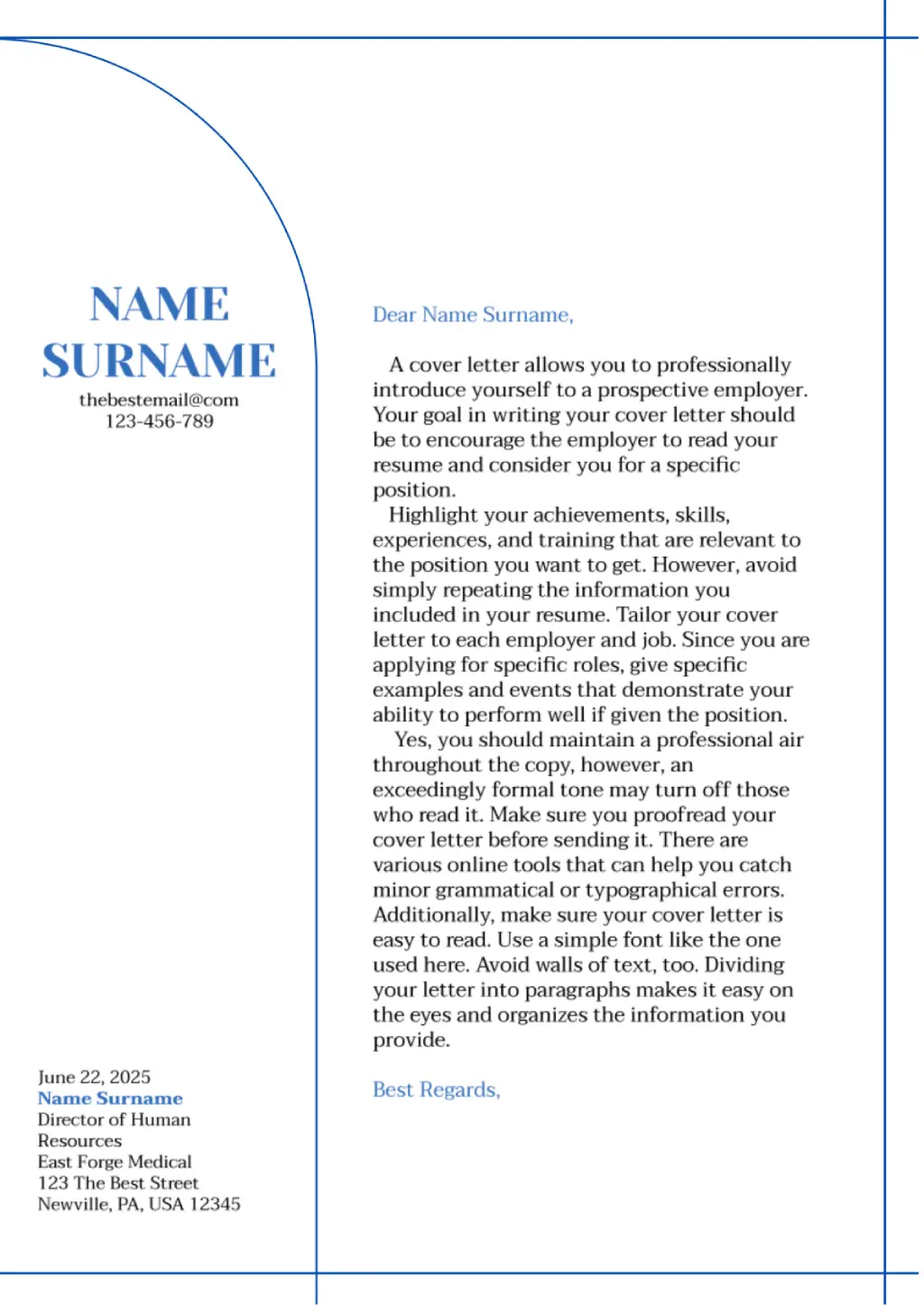
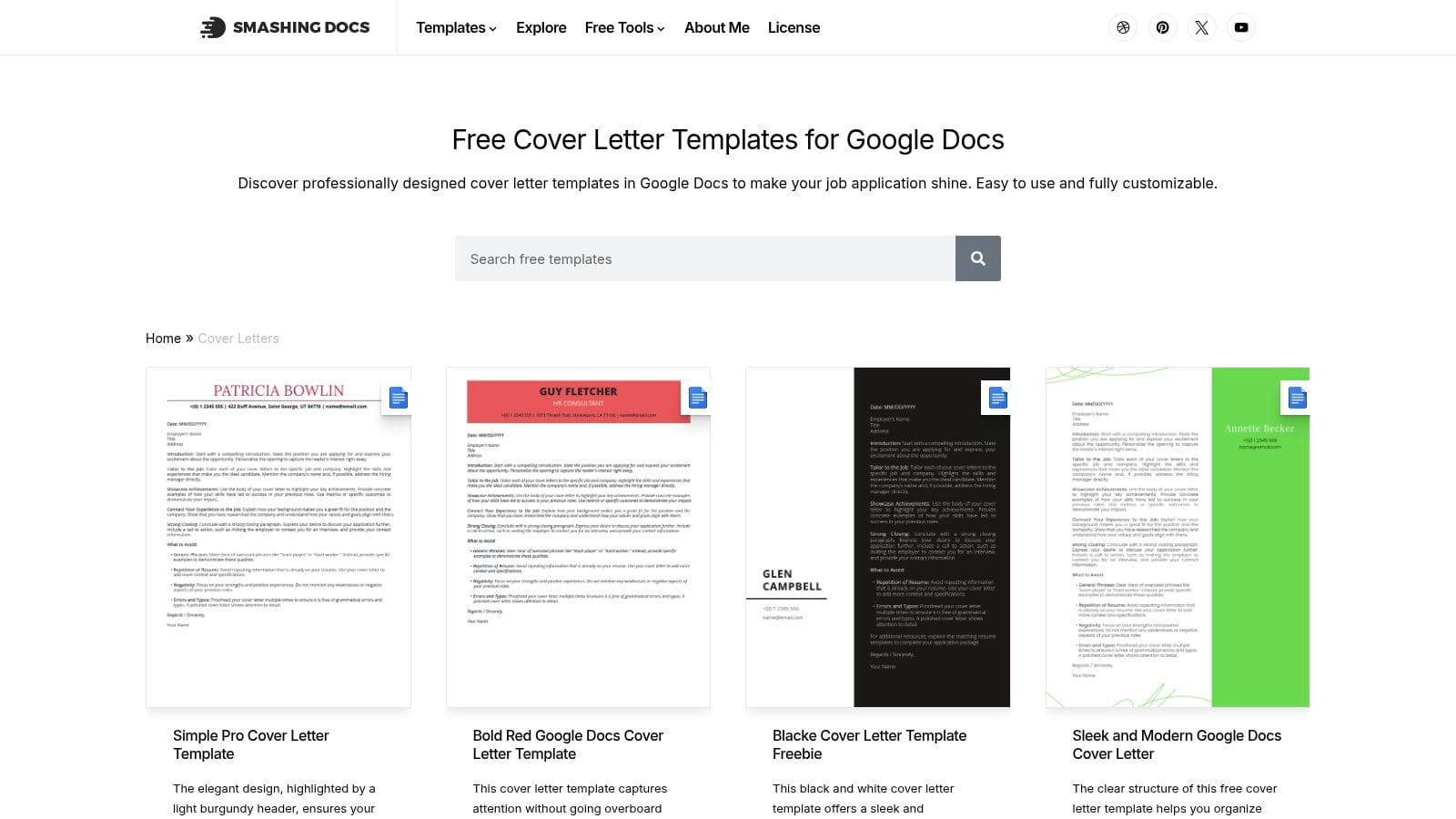
To secure an interview in 2026, you need a document that bridges the gap between your resume and the specific needs of a hiring manager. Below is a versatile, high-impact free cover letter template you can copy: [Your Name], [Contact Info], [Recipient Name], [Specific Greeting], [The Hook], [Value Proposition], [The Proof], and [The Call to Action].
This template is designed to bypass modern Applicant Tracking Systems (ATS) while appealing to the psychological triggers of human recruiters who, in 2026, value specific problem-solving capabilities over generic lists of duties.
The Master Cover Letter Template (Copy and Paste)
You can copy the text below and paste it into any word processor or email body. Replace the bracketed information with your specific details to ensure the content is tailored to the role.
[Your Full Name] [Your Phone Number] | [Your Professional Email] | [Your LinkedIn Profile URL] [Your City, State/Remote Location]
[Date]
[Hiring Manager’s Name] (Use "Hiring Manager" if the name is unavailable) [Company Name] [Company Address - Optional for Digital Submissions]
Subject: [Job Title] Application – [Your Name]
Dear [Hiring Manager Name],
As a long-time follower of [Company Name]’s work in [Industry/Niche], I was thrilled to see the opening for the [Job Title] position. With [Number] years of experience in [Your Core Skill/Specialty], I have spent my career focusing on [One Major Result You Achieve]. I am confident that my background in [Specific Skill 1] and [Specific Skill 2] makes me an ideal candidate to help your team achieve its goals for [Year/Upcoming Project].
In my current role at [Current/Previous Company], I was tasked with [Major Challenge]. By implementing [Your Solution/Strategy], I was able to [Quantifiable Result, e.g., increase revenue by 20% or reduce churn by 15%]. This experience taught me how to navigate the complexities of [Relevant Industry Trend], a skill I am eager to bring to [Company Name].
Specifically, I am drawn to this role because of [Company Name]’s recent initiative regarding [Specific Company Project or Value]. My expertise aligns perfectly with your needs in the following areas:
- [Key Requirement from Job Post]: I have [Number] years of experience doing exactly this, resulting in [Result].
- [Key Requirement from Job Post]: My proficiency in [Software/Tool/Methodology] allowed me to streamline [Process] at my previous firm.
- [Key Requirement from Job Post]: I possess a deep understanding of [Industry Concept], which I used to solve [Specific Problem].
I admire [Company Name]’s commitment to [Specific Value, e.g., sustainable innovation or customer-centricity], and I am eager to contribute to your continued success. My goal is to apply my analytical mindset and dedication to [Specific Goal] to help your team exceed its benchmarks in 2026.
I have attached my resume for your review and would welcome the opportunity to discuss how my skills can benefit [Company Name]. Thank you for your time and consideration.
Sincerely,
[Your Full Name]
Why Cover Letters Remain Essential in 2026
Despite the rise of automated recruitment and AI-driven screening, the cover letter remains a critical component of a successful job application. In 2026, the job market is characterized by an abundance of highly qualified candidates who all possess similar technical certifications. The cover letter is often the only place where you can demonstrate your "soft" skills, your cultural alignment, and your specific motivation for joining a particular organization.
A well-crafted cover letter serves as a narrative bridge. While your resume provides a historical record of what you have done, your cover letter explains what you can do for the employer in the future. It allows you to address potential gaps in your work history, explain a career pivot, or highlight a specific passion that isn't evident from a list of bullet points.
Furthermore, in an era where AI-generated content is everywhere, a personalized, human-sounding cover letter stands out. It signals to the hiring manager that you have put in the effort to research the company and that you are genuinely interested in the role, rather than simply "shotgunning" your resume to dozens of listings.
Understanding the Anatomy of a High-Impact Cover Letter
To use the template effectively, you must understand the purpose of each section. Every sentence should serve a specific function in moving the recruiter closer to the decision to invite you for an interview.
The Header and Professional Contact Information
In 2026, your contact information should be streamlined. Including a physical street address is largely considered outdated unless you are applying for a government role or a position that requires local residency for security reasons. Instead, focus on your LinkedIn profile and a professional portfolio link. Ensure your email address is modern—using an @gmail or @[yourdomain] address is preferred over older providers like Yahoo or AOL, which can subtly signal a lack of technical currency.
The Hook (Opening Paragraph)
The first paragraph must grab the reader’s attention immediately. Avoid the "I am writing to apply for..." cliché if possible. Instead, lead with a connection to the company or a major achievement. By 2026, recruiters spend less than six seconds on their initial scan of a cover letter. If you don't establish relevance in the first two sentences, you risk being overlooked.
The Value Proposition (The "Why You" Section)
This is the heart of the letter. You must translate your past experiences into future benefits for the employer. Instead of saying "I am a hard worker," say "I have a proven track record of increasing operational efficiency by 15% through the implementation of automated workflows." Use the "Star" method (Situation, Task, Action, Result) even within these paragraphs to provide concrete evidence of your capabilities.
The Proof (Bulleted Achievements)
Using bullet points in a cover letter is a modern technique that improves readability. It allows the recruiter to see exactly how you meet the top three requirements of the job description. In 2026, these should be highly specific. If the job description mentions "Project Management," your bullet point should mention the specific methodology (Agile, Scrum, Lean) and the scale of the projects you managed.
The Call to Action (Closing Paragraph)
End with confidence. Reiterate your enthusiasm and state clearly that you look forward to a conversation. Avoid passive language like "I hope to hear from you." Instead, use "I look forward to discussing how I can contribute to..." This shows leadership and initiative.
Comparing Cover Letter Styles for Different Career Paths
Not every job requires the same tone. Use the table below to determine which style of cover letter is best suited for your specific situation in 2026.
| Feature | Traditional / Corporate | Modern / Tech | Creative / Startup |
|---|---|---|---|
| Tone | Formal, authoritative, and structured. | Direct, data-driven, and efficient. | Personal, high-energy, and narrative. |
| Focus | Pedigree, years of experience, and stability. | Specific technical stacks and problem-solving. | Culture fit, mission-alignment, and "outside-the-box" thinking. |
| Formatting | Standard block paragraphs. | Mix of paragraphs and bullet points. | Flexible; may include links to media or portfolios. |
| Best For | Law, Finance, Government, Higher Education. | Software Engineering, Data Science, Product Management. | Marketing, Design, Social Media, New Ventures. |
ATS Optimization: Making Your Letter Machine-Readable
In 2026, almost all mid-to-large-sized companies use Applicant Tracking Systems to filter candidates. If your cover letter is not optimized for these systems, it may never reach a human eye.
- Use Standard Fonts: Stick to clean, sans-serif fonts like Arial, Calibri, or Helvetica. Fancy or "handwritten" fonts often fail to parse correctly in ATS software.
- Avoid Graphics and Tables: While tables are great for human readers (like the one above), they can confuse older ATS parsers. Keep the version you upload to the portal as plain text or a standard PDF.
- Keywords are Critical: Scan the job description for recurring nouns and verbs. If the posting mentions "Stakeholder Engagement" three times, ensure that exact phrase appears in your cover letter.
- File Naming Conventions: Save your file as
[FirstName]_[LastName]_Cover_Letter.pdf. This makes it easy for the recruiter to find your file in their local downloads folder.
Common Mistakes to Avoid in Your 2026 Application
Even with a great template, certain errors can sabotage your chances.
- Regurgitating Your Resume: Do not simply list your job history. The recruiter already has your resume. Use the cover letter to tell the story behind the data.
- Being Too Generic: If you could swap the company name and the letter still makes sense, it is too generic. Mention a specific project, a company value, or a recent news item about the organization.
- Focusing on Your Needs: Many candidates write about why the job would be great for them. The employer cares about why you would be great for them. Flip the narrative to focus on their pain points and your solutions.
- Typos and Grammatical Errors: In 2026, with the availability of sophisticated AI editing tools, a typo is seen as a sign of extreme negligence. Always run your final draft through a high-quality spell-checker and read it out loud to catch awkward phrasing.
Frequently Asked Questions
Should I use AI to write my cover letter?
You can use AI to generate a baseline or to brainstorm ideas, but you should never submit a purely AI-generated letter. Hiring managers in 2026 are increasingly adept at spotting the "robotic" tone of unedited AI text. Use the template provided above as your framework and add your unique voice and specific achievements to ensure it feels authentic.
How long should a cover letter be in 2026?
The ideal length is between 250 and 400 words. It should never exceed one page. Recruiters are busier than ever, and a concise letter that gets straight to the point is much more appreciated than a multi-page manifesto. Aim for three to four short paragraphs and a few bullet points.
Is it okay to use "To Whom It May Concern"?
Avoid this phrase if at all possible. It is considered cold and outdated in 2026. Use LinkedIn or the company website to find the name of the hiring manager or the department head. If you absolutely cannot find a name, "Dear [Department Name] Hiring Team" is a much better alternative.
Do I need a cover letter if the application says "optional"?
Yes. When a cover letter is optional, it is actually a test of your interest. Candidates who take the time to write a letter show more initiative and engagement than those who simply hit "submit" on their resume. In a competitive market, this extra effort can be the deciding factor.
Should I mention my salary requirements?
Unless the job posting specifically asks for salary requirements, do not mention them in your cover letter. The cover letter is about establishing value. Discussing money too early can either price you out of the role or lead to you being low-balled during the negotiation phase later in the process.
Next Steps for a Successful Application
Once you have copied and customized the template, your next action should be a "final polish" phase. Read the letter from the perspective of the hiring manager: Does this person solve my current problem? If the answer is yes, you are ready to save the document as a PDF and submit it.
Remember to follow up. If you haven't heard back within 10 to 14 days, a polite follow-up email can reiterate your interest and keep your application at the top of the pile. In the fast-paced hiring environment of 2026, persistence—when combined with a high-quality, customized cover letter—is often the key to landing the job.