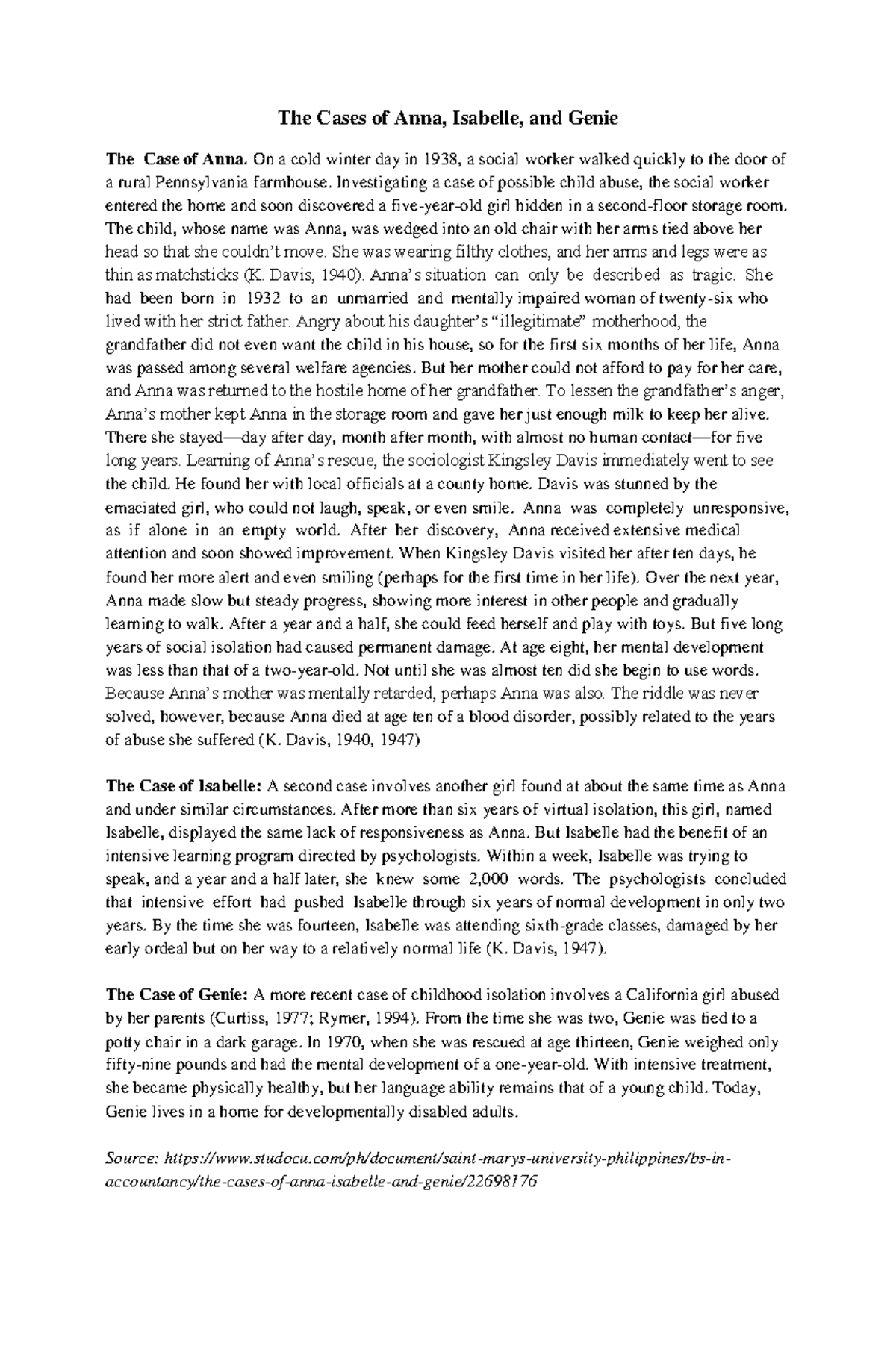
In educational psychology and sociology, the case studies of Anna and Isabelle demonstrate the profound impact of extreme social isolation on child development and human learning. Examined by sociologist Kingsley Davis in the 1940s, these contrasting cases reveal how early environmental deprivation affects speech acquisition, cognitive growth, and social development, while highlighting the transformative power of intensive, early educational intervention.
Historical Context: The Landmark Studies of Kingsley Davis
The foundational understanding of how social interaction shapes cognitive and linguistic capacity relies heavily on observational case studies of severe neglect. During the late 1930s, two young girls—known in academic literature as Anna and Isabelle—were discovered in conditions of extreme confinement and social isolation. Their discovery offered researchers unprecedented insight into human development outside of normal societal structures.
Sociologist Kingsley Davis documented both cases in landmark papers published in the American Journal of Sociology, including his 1940 study Extreme Social Isolation of a Child and his 1947 follow-up, Final Note on a Case of Extreme Isolation. Davis sought to test theories advanced by early social psychologists, such as Charles Horton Cooley and George Herbert Mead, who argued that human personality and higher cognitive functioning do not emerge spontaneously from biological maturation alone. Instead, they argued that human nature requires continuous, structured social interaction and symbolic communication to develop.
The cases of Anna and Isabelle provided a natural, albeit tragic, experiment. By analyzing the differing levels of remediation achieved by both children, educational theorists and developmental psychologists gained crucial empirical evidence regarding critical periods in child development, language acquisition, and the necessity of tailored pedagogical strategies for severe developmental delays.
Case Breakdown: Comparing Anna and Isabelle
Although Anna and Isabelle were both discovered in 1938 at approximately six years of age after spending their early childhoods hidden away from society, their environments, treatments, and developmental trajectories differed dramatically.
Anna: Environmental Deprivation and Limited Recovery
Anna was born out of wedlock in 1932. Due to familial stigma, she was moved between multiple temporary caretakers before being confined to an unused attic room in her grandfather's farmhouse. For nearly six years, Anna received only minimal physical maintenance. She was fed almost exclusively milk, left tied to a broken chair, and deprived of human companionship, speech, and sensory stimulation.
When authorities rescued Anna in February 1938 at six years and two months of age, she exhibited severe physical and developmental impairments:
- Physical Condition: She was extremely malnourished, unable to walk, stand, feed herself, or use her hands effectively. Her muscle tone was severely underdeveloped, and she was largely unresponsive to visual and auditory stimuli.
- Cognitive and Social State: She appeared completely indifferent to the people around her, showed no signs of intelligence, and could not speak or comprehend language.
- Educational Remediation: Anna was placed in a county home and later transferred to a specialized school for children with intellectual disabilities. Her educational regimen focused on basic habitual training, motor coordination, and rudimentary speech.
- Developmental Trajectory: Over four years of instruction, Anna made gradual progress. She learned to walk, feed herself with a spoon, keep her clothes clean, understand simple verbal commands, and use a limited vocabulary of basic words. However, her mental age remained that of a toddler. Anna died in 1942 at age ten from hemorrhagic jaundice.
Researchers debate whether Anna’s limited cognitive recovery stemmed primarily from the severe environmental deprivation experienced during critical early developmental windows or from an unconfirmed congenital intellectual disability present from birth.
Isabelle: Non-Verbal Attachment and Rapid Remediation
Isabelle was discovered in November 1938 at six and a half years of age, under circumstances that initially appeared similar to Anna's. Also born out of wedlock, Isabelle was hidden away in a dark room with her mother, who was deaf and unable to speak. As a result, Isabelle spent her early years isolated from normal hearing society, receiving no auditory language input or standard childhood socialization.
However, key environmental differences set Isabelle's isolation apart from Anna's:
- Socio-Emotional Connection: Unlike Anna, Isabelle shared her room with her mother. The two developed a complex system of manual gestures to communicate. Isabelle received physical affection and basic non-verbal emotional interaction, which sustained her baseline emotional attachment capacities.
- Initial Presentation: Upon her discovery, Isabelle was severely rachitic due to a lack of sunlight and proper diet, walked with a bow-legged gait, and communicated solely through croaking sounds and gestures. Her initial performance on standardized intelligence tests placed her mental age around 19 months, leading some early observers to classify her as uneducable.
- Educational Intervention: Isabelle was admitted to the Ohio State University Hospital, where a specialized team of speech specialists, psychologists, and educators designed an intensive, systematic rehabilitation program led by speech therapist Marie Mason. The educational plan utilized multi-sensory teaching techniques, combining visual imagery, kinesthetic movement, and auditory language immersion.
- Developmental Trajectory: Isabelle demonstrated an extraordinary pace of learning. After months of intensive visual and vocal training, she passed through the standard stages of linguistic development in rapid succession. Within two years of starting her educational program, Isabelle mastered complex grammatical structures, acquired a vocabulary of over 2,000 words, and scored within normal ranges on standard IQ tests. She entered public school, completed her education, and successfully integrated into adult society.
Comparative Matrix of Anna and Isabelle
The stark contrast in educational and developmental outcomes between Anna and Isabelle highlights key principles of educational psychology, early intervention, and language acquisition.
| Feature / Dimension | Case Study: Anna | Case Study: Isabelle | Pedagogical & Developmental Significance |
|---|---|---|---|
| Period of Isolation | Infancy to ~6 years old (1932–1938) | Infancy to ~6.5 years old (1932–1938) | Measures the exposure window to early sensory and social deprivation. |
| Isolation Conditions | Complete isolation in an attic; minimal physical care; zero emotional interaction. | Confined to a dark room with her deaf-mute mother; shared gesture system. | Demonstrates that basic human attachment and gesture communication preserve symbolic cognitive capacity. |
| Initial Linguistic Capacity | No speech, no gestures, minimal responsiveness to sound. | No vocal language, but highly expressive gestural communication with mother. | Distinguishes between total lack of symbolic thought and alternative symbolic communication modes. |
| Educational Remediation Strategy | Standard institutional care; basic habit and motor training. | Intensive, specialized multi-sensory speech and cognitive instruction (Marie Mason team). | Highlights the importance of individualized, targeted, and clinical educational interventions. |
| Language Acquisition Rate | Extremely slow; acquired only isolated words over 4 years. | Unprecedented speed; traversed 6 years of linguistic milestones in ~24 months. | Demonstrates cognitive plasticity and the capacity to catch up if intervention occurs within critical periods. |
| Final Cognitive Outcome | Mental age of ~2-3 years at time of death (age 10). | Normal IQ score; passed standard academic grades; reached normal adult functioning. | Illustrates the potential for full intellectual recovery when early non-verbal socialization is paired with intensive remediation. |
Theoretical and Educational Implications
The comparative analysis of Anna and Isabelle contributed foundational concepts to educational theory, child psychology, and special education pedagogy.
1. Early Socialization and Symbolic Interactionism
The studies validated theories of socialization formulated by sociologists like George Herbert Mead. Mead emphasized that the self is formed through social processes involving language and symbolic interaction. Anna's case demonstrated that without human interaction, basic human traits—such as self-awareness, symbolic thought, and emotional regulation—do not develop spontaneously.
Conversely, Isabelle's case showed that even non-verbal symbolic interaction (her gestural communication with her mother) maintained the fundamental cognitive pathways required for later language development. This finding reinforces the principle that social attachment is a mandatory prerequisite for formal learning and academic development.
2. Language Acquisition and the Critical Period Hypothesis
Isabelle’s dramatic recovery provided early empirical support for what neurobiologist Eric Lenneberg later formalized as the Critical Period Hypothesis for language acquisition. Lenneberg argued that there is a biologically determined window—extending from infancy to puberty—during which the human brain is uniquely flexible and primed to acquire language naturally.
Because Isabelle’s intensive educational intervention began at age six and a half—well before the onset of puberty—her brain retained the neuroplasticity required to process, organize, and master complex linguistic structures. Anna’s lack of progress, by contrast, raised questions about whether prolonged early sensory deprivation permanently impairs neural development, or if underlying genetic conditions constrained her recovery.
3. Cognitive Plasticity and Multi-Sensory Pedagogy
The rehabilitation of Isabelle demonstrated that intelligent design in special education can yield remarkable results. Marie Mason’s educational method for Isabelle did not rely on traditional rote learning. Instead, it used a specialized multi-sensory framework:
- Concrete to Abstract: Teaching concrete nouns using physical objects and direct sensory experiences before introducing abstract relational concepts.
- Kinesthetic Integration: Linking speech sounds to physical movements, gestural cues, and visual representations to build multi-channel neural connections.
- Immersive Social Context: Embedding language instruction inside meaningful social activities rather than isolated drills.
This structured progression established early models for modern individualized educational strategies designed for children experiencing severe developmental or sensory delays.
- Early Non-Verbal Interaction
- Sustained Symbolic Capacity
- Intensive Multi-Sensory Instruction
- Rapid Linguistic Acquisition
- Full Academic & Social Integration
Modern Applications in Special Education and Early Intervention
The lessons drawn from the cases of Anna and Isabelle continue to inform contemporary early childhood education, special education protocols, and child welfare policies.
Individualized Education Programs (IEPs) and Early Detection
Modern special education frameworks rely on early identification and tailored instruction. The dramatic contrast in Isabelle's trajectory proves that children presenting with extreme developmental delays should not be assumed to have unalterable intellectual disabilities.
Under statutes such as the Individuals with Disabilities Education Act (IDEA), educational institutions are legally mandated to evaluate children comprehensively and create an Individualized Education Program (IEP). Isabelle’s case serves as an early example of an IEP: a structured, multi-disciplinary diagnostic and instructional plan tailored to a child's baseline cognitive and emotional state.
Trauma-Informed Pedagogy
Children who experience severe early neglect or environmental deprivation suffer from complex developmental trauma. Modern trauma-informed pedagogy recognizes that learning cannot occur in an environment where a child feels unsafe or emotionally disconnected.
Educators working with severely neglected children prioritize establish relational safety before attempting academic instruction. As seen in Isabelle's case, establishing a trusting relationship between the educator and the student is a mandatory prerequisite for language acquisition and cognitive growth.
Compensatory Education for Severely Neglected Children
When children enter the school system after experiencing severe early neglect, compensatory education programs utilize techniques first modeled during Isabelle's rehabilitation:
- Systematic Phonics and Visual Association: Explicitly bridging non-verbal communication systems to formal spoken and written language.
- Sensory Integration Therapy: Providing sensory-rich environments to compensate for early environmental deprivation and help regulate the nervous system.
- Accelerated Developmental Scaffolding: Moving intentionally through fundamental developmental stages rather than forcing age-grade curriculum expectations immediately.
Methodological Considerations and Research Limitations
While the studies of Anna and Isabelle remain central to educational sociology, modern researchers approach them with appropriate methodological caveats.
Confounding Factors in Historical Case Studies
A major challenge in evaluating Anna’s case is the presence of unresolved confounding variables. Researchers could not definitively determine whether Anna was born with severe intellectual disabilities or if her developmental stagnation was caused entirely by her extreme isolation. Because detailed neurological imaging and genetic testing were unavailable in the 1930s, conclusions drawn from Anna's limited progress must remain cautious.
Ethical Boundaries and Modern Research Standards
In contemporary educational psychology, research relies on observational studies of naturally occurring interventions, clinical treatment evaluations, and non-invasive neuroimaging rather than single-case experimental isolation. Institutional Review Boards (IRBs) enforce strict ethical standards to ensure that therapeutic interventions prioritize the long-term emotional and physical well-being of vulnerable children over research data collection.
Frequently Asked Questions
What are the main differences between the cases of Anna and Isabelle in educational psychology?
The primary differences lie in their isolation conditions and developmental outcomes. Anna was isolated in near-total solitude without human interaction, while Isabelle was isolated alongside her deaf-mute mother, developing basic non-verbal gesture systems and emotional attachment. When rescued, Isabelle received intensive, specialized speech and cognitive instruction, enabling her to achieve normal intellectual and language capabilities. Anna received basic institutional care, made limited developmental progress, and died at age ten.
Why is Isabelle’s case considered crucial for theories of language acquisition?
Isabelle’s case provides real-world evidence for the Critical Period Hypothesis. Because her intensive speech and language instruction began at age six and a half—prior to puberty—she was able to acquire complete, natural language skills rapidly. Her case proved that intensive educational remediation can fully restore language development if introduced during key neuroplasticity windows.
How did Kingsley Davis contribute to educational sociology through these cases?
Kingsley Davis documented and analyzed both cases in 1940 and 1947, demonstrating that human cognitive growth, socialization, and language do not develop automatically through biological maturation alone. His work proved that social interaction and structured communication are essential environmental inputs for normal human intellectual development, shaping how educators view early childhood intervention.
What educational techniques were used to help Isabelle recover?
Isabelle’s educational program, led by speech specialist Marie Mason, utilized an intensive, multi-sensory approach. It combined visual objects, physical gestures, kinesthetic cues, and systematic phonetic instruction. The program built upon her existing non-verbal gesture communication, scaffolding step-by-step toward complex spoken syntax and literacy within a supportive environment.
What lessons do Anna and Isabelle offer for modern special education policies?
These cases highlight the necessity of early detection, multi-disciplinary diagnostic evaluations, and individualized instructional plans. They demonstrate that severe initial delays caused by environmental neglect should not automatically be judged as permanent intellectual disabilities, reinforcing the importance of early, targeted educational intervention.
Practical Guidance for Educators and Child Care Professionals
Understanding the historical lessons of Anna and Isabelle provides valuable insights for educators, special education specialists, and child development advocates working with children who have experienced severe early environmental deprivation:
- Prioritize Relational Security: Establish a secure, predictable bond with the child before introducing complex academic tasks. Cognitive processing requires emotional safety.
- Conduct Comprehensive Diagnostics: Differentiate between developmental delays resulting from environmental deprivation and underlying neurodevelopmental conditions through sustained, multi-disciplinary evaluations.
- Employ Multi-Sensory Scaffolding: Integrate visual, auditory, and kinesthetic instructional tools to activate diverse neural pathways, building upon whatever communication methods the child currently uses.
- Act Early Within Developmental Windows: Intervene as early as possible to take full advantage of neural plasticity during critical developmental periods.