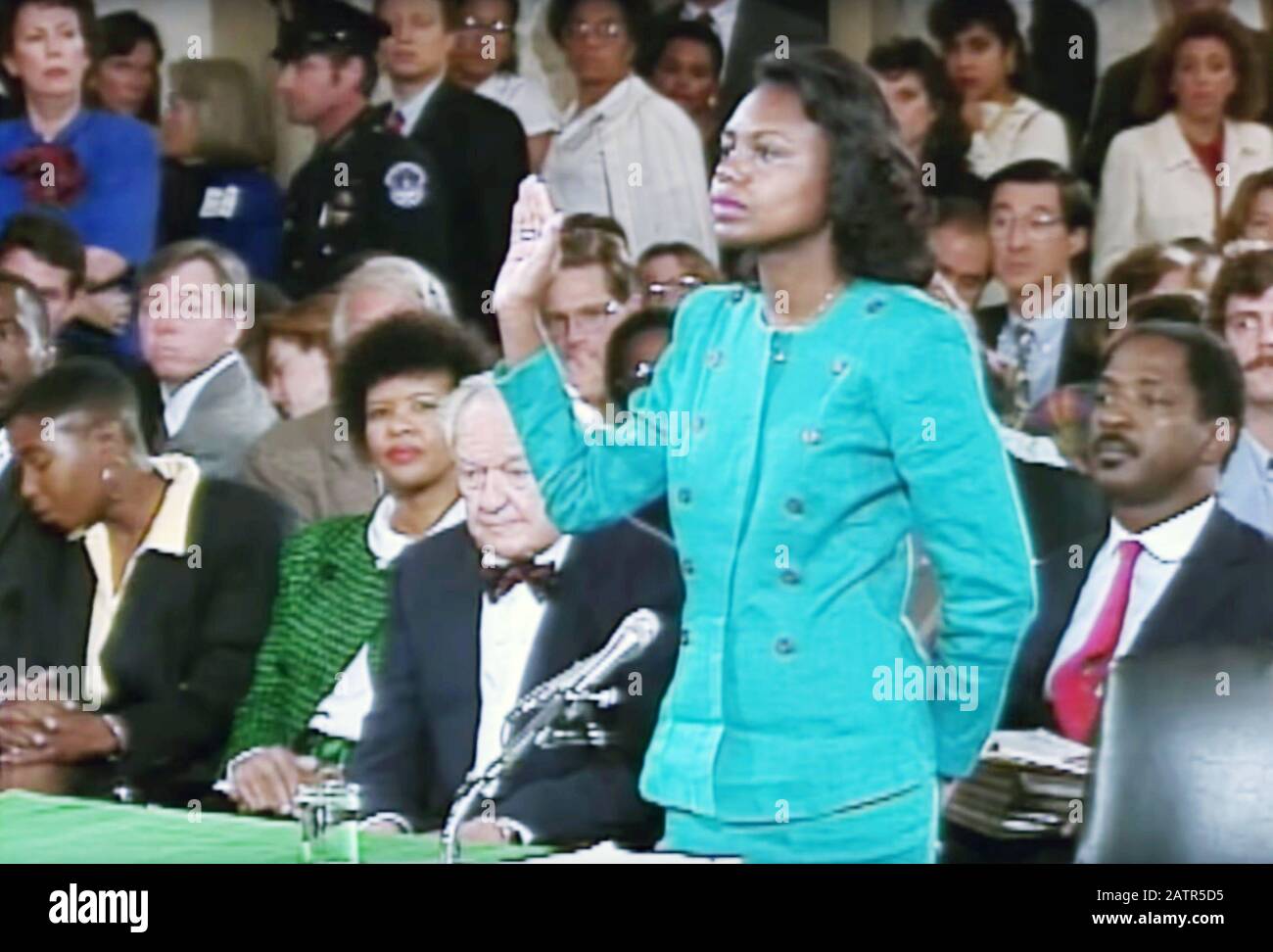
In 1991, Anita Hill, a law professor, testified before the Senate Judiciary Committee, alleging that Supreme Court nominee Clarence Thomas had sexually harassed her while he was her supervisor at the Equal Employment Opportunity Commission (EEOC) and the Department of Education. Though Thomas was eventually confirmed, the allegations fundamentally reshaped American discourse on workplace harassment, gender dynamics in politics, and the judicial confirmation process.
The Historical Context of the 1991 Confirmation
To understand the weight of the allegations brought by Anita Hill, one must first look at the political landscape of 1991. The vacancy on the Supreme Court was created by the retirement of Justice Thurgood Marshall, the first African American justice and a titan of the civil rights movement. President George H.W. Bush nominated Clarence Thomas, a conservative federal judge who had previously chaired the EEOC.
The nomination was already contentious due to Thomas's conservative judicial philosophy, which stood in stark contrast to Marshall’s liberal legacy. However, the proceedings took a dramatic turn when a confidential FBI interview with Anita Hill was leaked to the press. Hill, who had worked under Thomas at the Department of Education’s Office for Civil Rights and later at the EEOC, was called to testify publicly after initial attempts to keep her statements private failed.
As of 2026, this event remains a watershed moment in American history. It marked one of the first times sexual harassment was debated on a global stage, forcing a national conversation that had previously been relegated to private HR offices or hushed legal settlements.
The Specific Allegations of Sexual Harassment
Anita Hill’s testimony was detailed, graphic, and deeply controversial for the era. Under oath, she described a pattern of behavior that she characterized as a "hostile work environment," a legal concept that was still relatively new to the public consciousness at the time.
Hill alleged that Thomas frequently used work-related discussions to pivot toward sexual topics. Her testimony included specific claims:
- Unsolicited Comments: Hill testified that Thomas would describe sexual acts he had seen in pornographic films and discuss his own sexual prowess.
- Workplace Pressure: She claimed that Thomas repeatedly asked her out on dates despite her consistent refusals, and that he would use his position of authority to pressure her into social interactions.
- The "Coke Can" Incident: One of the most infamous details of the testimony involved Hill’s claim that Thomas had looked at a can of Coca-Cola on his desk and asked, "Who has put pubic hair on my Coke?"
- References to Pornography: Hill alleged that Thomas spoke about a character named "Long Dong Silver," a figure from adult films, during office hours.
Hill maintained that she felt she could not report the behavior at the time because of Thomas's power over her career and the lack of robust institutional protections for victims of harassment in the early 1980s.
The Senate Judiciary Committee’s Handling of the Testimony
The 1991 hearings were presided over by the Senate Judiciary Committee, which was then chaired by Senator Joe Biden. The committee’s composition—entirely male and entirely white—became a focal point of criticism. Many observers argued that the senators were ill-equipped to understand the nuances of sexual harassment or the power dynamics at play between a supervisor and a subordinate.
The Questioning of Anita Hill
Hill faced aggressive questioning from committee members. Some senators questioned her "motives," suggesting she was a tool of liberal interest groups or that she suffered from "erotomania," a delusional disorder. The skepticism directed at Hill was intense; she was asked why she had followed Thomas from the Department of Education to the EEOC if the harassment was so severe. Hill explained that, as a young attorney, she feared for her professional future and hoped the behavior would stop in a new environment.
The Defense: "High-Tech Lynching"
Clarence Thomas’s response to the allegations was a categorical and forceful denial. He did not merely refute the claims; he attacked the process itself. In a televised statement that became one of the most famous moments in Supreme Court history, Thomas characterized the hearings as a "high-tech lynching for uppity blacks who in any way deign to think for themselves."
By framing the allegations as a racialized attack rather than a grievance about workplace conduct, Thomas shifted the narrative. This defense resonated with many who felt that African American men were historically subject to false accusations, while simultaneously complicating the position of Hill, who is also Black.
Witnesses and Corroboration
One of the most enduring controversies of the 1991 hearings was the committee’s decision not to call other witnesses who might have corroborated Hill’s account. Most notably, Angela Wright, another former employee of Thomas at the EEOC, had also alleged that Thomas made inappropriate comments about her body and pressured her for dates.
Wright was subpoenaed and was present in Washington, D.C., but she was never called to testify before the cameras. Instead, her written statement was entered into the record. Other individuals, such as Rose Jourdain, were also prepared to offer supporting testimony regarding Thomas's behavior. The failure to hear from these witnesses led many to argue that the committee had prioritized a quick resolution over a thorough investigation.
Legal and Procedural Impacts
The Thomas-Hill hearings occurred at a critical juncture for labor law. At the time, Title VII of the Civil Rights Act of 1964 prohibited sex discrimination, but the legal standards for "hostile work environment" harassment were still being refined following the 1986 Supreme Court case Meritor Savings Bank v. Vinson.
Comparison of Procedural Contexts
The following table compares the 1991 hearings with the 2018 hearings of Brett Kavanaugh, illustrating how the procedural approach to allegations evolved over three decades.
| Feature | 1991 (Thomas/Hill) | 2018 (Kavanaugh/Ford) |
|---|---|---|
| Committee Chair | Joe Biden (D) | Chuck Grassley (R) |
| Primary Allegation | Workplace Sexual Harassment | Attempted Sexual Assault (High School) |
| FBI Investigation | Brief, pre-testimony check | Supplemental 1-week investigation |
| Key Defense Strategy | Racialized "High-Tech Lynching" | Partisan "Conspiracy" / Political Hit |
| Corroborating Witnesses | Subpoenaed but not called to testify | Not called to testify |
| Confirmation Vote | 52–48 (Confirmed) | 50–48 (Confirmed) |
Impact on the EEOC and Title VII
Immediately following the hearings, the number of sexual harassment claims filed with the EEOC skyrocketed. In 1991, the EEOC received approximately 6,883 harassment charges; by 1993, that number had jumped to over 11,900. Furthermore, the Civil Rights Act of 1991 was passed shortly after the hearings, which allowed victims of intentional sexual discrimination and harassment to seek compensatory and punitive damages—remedies that were previously unavailable.
The Social and Political Legacy
The long-term impact of the Anita Hill and Clarence Thomas allegations cannot be overstated. It fundamentally changed the "electability" of women in American politics and altered how corporations handle internal complaints.
The "Year of the Woman"
The image of an all-male Senate committee questioning Anita Hill served as a catalyst for female candidates. The 1992 election cycle was dubbed the "Year of the Woman" because a record number of women were elected to Congress. Figures like Patty Murray and Carol Moseley Braun (the first African American woman in the Senate) explicitly cited the Hill hearings as their motivation for running.
The MeToo Movement and 2026 Perspective
In the decades since 1991, the cultural barometer for what constitutes acceptable workplace behavior has shifted significantly. The MeToo movement, which gained global prominence in 2017, prompted a re-evaluation of the Hill-Thomas hearings. Many who had criticized Hill in 1991, including some politicians and journalists, later issued apologies or expressed regret for how she was treated.
As of 2026, the 35th anniversary of the hearings provides a lens through which to view modern judicial confirmations. The procedural precedents set in 1991—particularly regarding how the FBI handles supplemental background checks and how the Senate manages "he-said, she-said" testimony—remain a blueprint for contemporary political battles.
Current Status of the Principals (2026)
In 2026, the two central figures of the 1991 hearings remain active in their respective fields, representing the deep divide in the interpretations of their history.
- Clarence Thomas: Justice Thomas continues to serve on the Supreme Court. Having been confirmed on October 15, 1991, he is now one of the longest-serving justices in the history of the Court. His jurisprudence remains staunchly originalist, and he has often used his platform to criticize the "judicialization" of politics that he believes began with his own confirmation.
- Anita Hill: Anita Hill is a University Professor of Social Policy, Law, and Women’s, Gender and Sexuality Studies at Brandeis University. She has spent her career advocating for reform in how institutions handle gender-based violence and harassment. In recent years, she has headed the Hollywood Commission, an organization dedicated to curbing harassment in the entertainment industry.
Frequently Asked Questions
What was the final vote to confirm Clarence Thomas?
The Senate confirmed Clarence Thomas by a vote of 52 to 48 on October 15, 1991. It was one of the narrowest confirmation margins for a Supreme Court justice at that time. Eleven Democrats voted to confirm him, while two Republicans voted against him.
Did Anita Hill ever sue Clarence Thomas?
No, Anita Hill never filed a civil lawsuit against Clarence Thomas. Her allegations were brought forward as part of the Senate’s "advice and consent" constitutional role during a Supreme Court confirmation. Because the alleged incidents occurred years prior to the hearing, the statute of limitations for a civil claim under Title VII would likely have expired by 1991.
Why did Joe Biden face criticism regarding the Anita Hill hearings?
As Chairman of the Senate Judiciary Committee in 1991, Joe Biden was responsible for the conduct of the hearings. Critics have argued that he failed to protect Hill from aggressive, character-based attacks by other senators and that he should have called additional witnesses, like Angela Wright, to provide corroboration. During his 2020 presidential campaign and into his presidency, Biden expressed regret for Hill's experience, though some advocates feel the apology was insufficient.
Was Clarence Thomas ever investigated again for these claims?
While there have been occasional calls from advocacy groups and certain members of Congress to re-open investigations or consider impeachment, no formal government investigation into the 1991 sexual harassment claims has been conducted since his confirmation. The Supreme Court has no formal internal mechanism for investigating historical allegations against sitting justices that occurred prior to their appointment.
How did the allegations change HR policies in the United States?
Following the televised hearings, thousands of American companies updated their employee handbooks to include specific definitions of sexual harassment. Training programs became mandatory for managers, and "hostile work environment" became a standard term in corporate compliance. The hearings essentially moved sexual harassment from a "private grievance" to a recognized "legal liability."
Summary of the Case Significance
The allegations made by Anita Hill against Clarence Thomas were not just a legal dispute; they were a cultural flashpoint that exposed deep-seated tensions regarding race, gender, and power in America. While Thomas secured a lifetime appointment to the highest court in the land, Hill's testimony provided the spark for a legislative and social revolution that continues to influence workplace ethics and political representation in 2026.
For those researching the full history, the Senate Judiciary Committee transcripts from October 11–13, 1991, provide the most accurate account of the testimony. These documents are available through the National Archives and the U.S. Government Publishing Office.