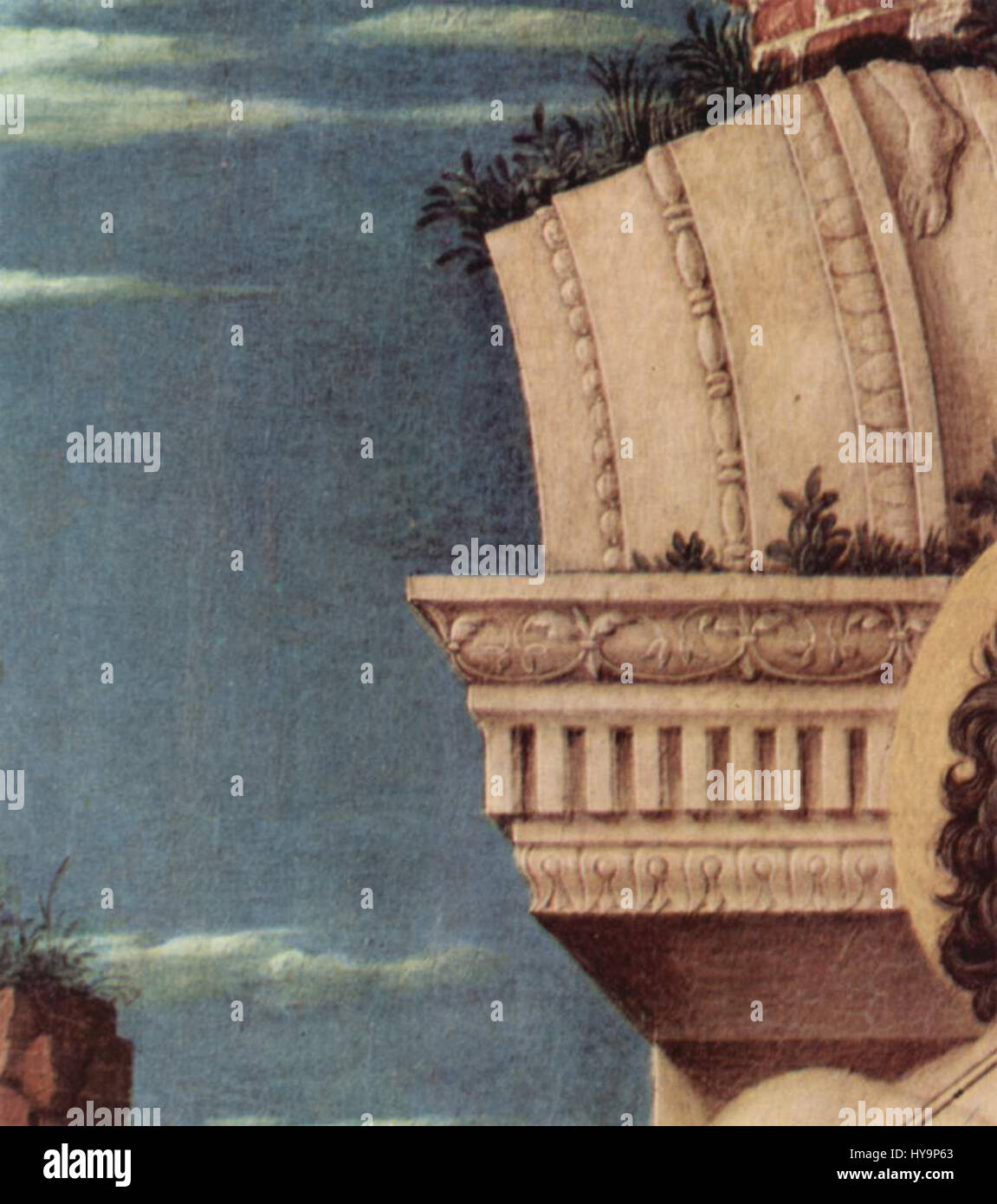
Andrea Mantegna revolutionized Renaissance art through his mastery of rigorous linear perspective, radical foreshortening, and innovative spatial illusionism, fundamentally transforming how two-dimensional surfaces could simulate three-dimensional architectural and psychological space.
Introduction to Mantegna and Fifteenth-Century Spatial Theory
The evolution of Western painting changed forever during the Quattrocento, and at the heart of this transformation stood Andrea Mantegna (1430–1506). Working primarily in Padua and Mantua, Mantegna seized upon the newly formalized mathematical laws of linear perspective—pioneered by architects like Filippo Brunelleschi and codified by humanist Leon Battista Alberti—and pushed them to their absolute technical and emotional limits. Where many of his contemporaries treated perspective as a mechanical grid to organize narrative scenes, Mantegna treated it as an expressive medium. His revolutionary use of perspective did not merely create a convincing illusion of depth; it actively manipulated the viewer's psychological state, dissolved the boundaries between architectural reality and painted fiction, and established new standards for spatial composition that influenced generations of artists, from Correggio to Rembrandt.
To understand Mantegna’s breakthroughs, one must first recognize the artistic landscape of Northern Italy during the mid-fifteenth century. Paduan painting was heavily influenced by the monumental classicism of Francesco Squarcione (Mantegna's adoptive father and master) and the archaeological precision of Florentine visitors like Donatello. Mantegna absorbed these influences, combining a sculptor's obsession with human anatomy and drapery with an uncompromising geometrical rigor. His perspective was never an afterthought or a loose backdrop; it was the foundational skeleton upon which every narrative, figure, and architectural element was constructed.
Mathematical Foundations: Linear Perspective and the Low Horizon Line
At the core of Mantegna’s spatial revolution is his meticulous application of linear perspective. Linear perspective relies on a vanishing point on the horizon line where parallel lines appear to converge, creating a mathematically consistent diminution of scale as objects recede into the distance. While artists like Masaccio and Piero della Francesca established the rules for this system in Florence, Mantegna adapted them with a distinctively dramatic flair.
One of Mantegna’s most signature technical maneuvers was his preference for an exceptionally low horizon line. By placing the vanishing point low down within the pictorial plane—or even below the bottom edge of the frame—Mantegna forced the viewer to look upward at the figures. This optical choice produced profound psychological effects:
- Monumentality: Figures depicted against a low horizon instantly assume heroic, statuesque proportions, appearing as towering colossi against the sky or architectural backdrops.
- Architectural Drama: Lowering the viewpoint accentuates the scale of surrounding classical elements, such as triumphal arches, marble pilasters, and coffered ceilings, making the setting feel vast and imposing.
- Viewer Engagement: Looking up at the scene draws the spectator into a position of humble witness, heightening the emotional gravity of sacred narratives.
In works like the St. James Led to Execution fresco cycle in the Ovetari Chapel (Eremitani Church, Padua), Mantegna’s deployment of a low viewpoint creates an aggressive, almost theatrical thrust into the picture space. The tiled pavement acts as an explicit geometric grid, guiding the viewer’s eye with mathematical certainty toward the receding orthogonals while simultaneously magnifying the physical presence of the Roman soldiers and the saint.
Radical Foreshortening: The Lamentation over the Dead Christ
Perhaps the most famous and radical demonstration of Mantegna's technical audacity is The Lamentation over the Dead Christ (c. 1480). Housed in the Pinacoteca di Brera in Milan, this painting represents one of the most daring experiments in extreme foreshortening in the history of Western art.
Foreshortening requires an artist to compress the length of an object or body as it recedes into deep space along a single line of sight. Most painters prior to Mantegna avoided applying this technique to human figures at such close quarters, fearing that severe optical distortion would make the subject look grotesque or anatomically impossible. Mantegna embraced this challenge directly.
[Traditional Lateral View] [Mantegna's Foreshortened View] Head -> Torso -> Feet [Feet] (Large scale) (Even distribution) | [Torso] (Medium scale) | [Head] (Diminished scale)
In The Lamentation, Christ's body is laid out horizontally on a marble stone, viewed strictly from the feet. If drawn with strict mathematical fidelity without adjustment, the head and upper torso would have vanished entirely from view behind the massive, towering feet in the foreground. Mantegna deliberately manipulated the perspective—enlarging the feet slightly while maintaining a believable anatomical hierarchy—to ensure the entire body remained legible while maximizing the crushing emotional impact of the tragedy.
The composition brings the viewer uncomfortably close to the corpse. The soles of Christ’s feet, marked by the stigmata, dominate the lower left quadrant of the painting, projecting outward into the viewer's personal space. From there, the eye travels rapidly up the rigid limbs to the grieving faces of the Virgin Mary, St. John, and Mary Magdalene huddled in the upper left. This compression of space strips the scene of extraneous narrative detail, focusing the observer entirely on the raw, physical reality of death.
Trompe L'oeil and Spatial Illusionism: The Camera Picta
Mantegna’s spatial experiments reached their absolute zenith in Mantua, where he served as court painter to the Gonzaga family for over forty years. In the Ducal Palace, specifically within the room known as the Camera Picta (Painted Chamber) or Camera degli Sposi (Room of the Brides), Mantegna executed a fresco cycle between 1465 and 1474 that effectively shattered the physical architecture of the room.
The Camera Picta is an early masterclass in trompe l'oeil—trick of the eye—painting. Mantegna transformed a modest, cube-shaped administrative room into an open-air pavilion overlooking the Mantuan countryside and the Gonzaga family estate.
- Painted Pilasters: Mantegna painted real architectural elements—columns, arches, and friezes—that mirrored the actual stone doorframes and fireplace of the room, seamlessly blurring the line between actual architecture and painted illusion.
- Di Sotto in Sù (From Below Upward): On the ceiling, Mantegna painted an illusory oculus (round opening) that looks straight up into an open blue sky. A balustrade rings the opening, crowded with courtiers, laughing maids (putti), a peacock, and potted plants leaning precariously over the edge.
- Unified Light Source: To sell the illusion, Mantegna meticulously aligned the painted shadows and highlights with the actual windows of the room, ensuring that the light appearing to strike the figures on the walls logically matched the natural sunlight entering the space from the outside courtyard.
This ceiling oculus is widely recognized as the historical prototype for the grand baroque ceiling frescoes of the seventeenth century, inspiring subsequent illusionistic masterpieces by artists like Correggio in Parma and Giovanni Battista Tiepolo in Venice.
Comparison of Mantegna’s Major Perspective Techniques
To appreciate the breadth of Mantegna’s spatial innovations, it is helpful to examine how his techniques manifested across different mediums, scales, and subject matters throughout his career.
| Artwork / Project | Primary Perspective Technique | Visual Effect / Purpose |
|---|---|---|
| Ovetari Chapel Frescoes (Padua, c. 1448–1457) | Low horizon line and strict orthogonals | Creates monumental, heroic figures and dramatic architectural depth in narrative scenes. |
| San Zeno Altarpiece (Verona, 1456–1459) | Continuous unified frame perspective | Integrates the painted architectural frame with the internal sacred space, uniting heaven and earth. |
| Camera Picta (Mantua, 1465–1474) | Trompe l'oeil and di sotto in sù ceiling | Dissolves solid masonry walls and ceiling to simulate an open pavilion and open sky. |
| The Lamentation over the Dead Christ (c. 1480) | Extreme foreshortening along a single axis | Maximizes emotional intensity by projecting the human body directly into the viewer's space. |
Influence on Renaissance and Baroque Art
Mantegna’s revolutionary use of perspective did not exist in an isolated vacuum; it fundamentally redirected the trajectory of European art. As a brother-in-law to Giovanni Bellini, Mantegna bridged the gap between the rigorous, linear geometry of the Paduan/Florentine schools and the atmospheric, color-driven traditions of Venetian painting. Bellini and other Venetian masters incorporated Mantegna’s architectural precision while softening the transitions with atmospheric haze (sfumato).
Furthermore, Mantegna’s prints—disseminated widely across Europe via engravings executed by him or his workshop—spread his spatial theories to Germany and the Netherlands. Albrecht Dürer, deeply influenced by Mantegna’s structural command of the human form and perspective grid systems, studied his engravings meticulously, integrating Italian geometric theory into Northern European art.
In Rome and Parma, later High Renaissance and Baroque masters adopted Mantegna's ceiling illusionism. The concept of opening up a flat plaster ceiling to reveal swirling heavens populated by foreshortened figures flying overhead is a direct descendant of the oculus in the Camera Picta. Without Mantegna’s initial geometric experimentation, the soaring, gravity-defying ceilings of the seventeenth century would lack their foundational technical blueprint.
Frequently Asked Questions
What made Andrea Mantegna’s perspective different from other Renaissance artists?
While artists like Masaccio used perspective to create realistic architectural backgrounds, Mantegna used extreme mathematical rigor combined with psychological intensity. He pushed perspective to unnatural extremes—such as low horizon lines and aggressive foreshortening—to force emotional reactions from the viewer and deliberately blur the line between painted space and physical reality.
How did Mantegna achieve the illusion in the Camera Picta?
Mantegna utilized trompe l'oeil techniques, painting architectural elements that matched the actual room's doorways and windows. He also employed di sotto in sù (from below upward) perspective on the ceiling, painting an open oculus where figures look down from a balustrade, matching the room's actual light source to cast realistic shadows.
Is The Lamentation over the Dead Christ anatomically accurate?
Not strictly. Mantegna deliberately distorted anatomical proportions—specifically enlarging the feet in the foreground and shrinking the upper body—to ensure the entire corpse remained visible along the single axis of recession. Strict optical accuracy without these adjustments would have hidden Christ's head and torso entirely behind his feet.
Where can I see Andrea Mantegna’s most famous perspective works today?
Key works can be visited in major European institutions. The Lamentation over the Dead Christ is housed in the Pinacoteca di Brera in Milan. The Camera Picta remains in situ within the Ducal Palace of Mantua. Surviving fragments of his Ovetari Chapel frescoes can be viewed at the Musei Civici agli Eremitani in Padua.
How did Mantegna influence later art movements?
His work bridged classical antiquity with Renaissance geometry, directly inspiring Albrecht Dürer in printmaking and laying the groundwork for the massive, illusionistic ceiling frescoes of the Baroque period created by artists like Correggio and Pietro da Cortona.
Conclusion and Next Actions
Andrea Mantegna’s revolutionary use of perspective transformed painting from a flat decorative craft into a dynamic, three-dimensional science of illusion and emotion. By pushing linear perspective, foreshortening, and trompe l'oeil to unprecedented extremes, he proved that geometry could convey profound human drama. To deepen your understanding of his legacy, examine high-resolution digital scans of the Brera collection to analyze the brushwork and spatial construction of The Lamentation, or plan an architectural tour of Northern Italy to experience the spatial wizardry of the Camera Picta firsthand.